UK General Election on 5th May - voting intentions?

Jaggy Bunnet said:
Vote-stealing is about the one thing I think the Tories never got caught doing.

Caught? Well I think good old Dame Shirley "I'm down to my last £300,000" Porter was caught gerrymandering, I really don’t see the difference in intent.


Jaggy Bunnet said:

Opps - I think you've made a teensy-weensy mistake there. I'm sure you did not mean to say "Labour" but "some Labour activists"? ;) After all are you really suggesting the Labour party organised the vote fraud? And there were many more reports from that whole disgusting affair that suggests other activists with other party allegiances were also up to no good. (No links to hand.)

Jaggy Bunnet said:


Highest inflation rates in decades? Must have had some extremely short decades in the old days then!

Highest in the 18 years of Tory rule was 18% in 1980. Highest under the previous Labour government was 24.2% in 1975.

You are right I allowed my rhetoric to get away with me.

Jaggy Bunnet said:


Average over the 18 years of Tory rule (79-96) was 6.5%. Average under the 5 years of the previous Labour government (74-78) was 16.4%.

I don’t have contrary figures to hand at the moment (not at my main PC) but where did you get those figures from for future reference? Plus as I pointed out earlier the Labour Party of today cannot be compared to the Labour Party of the 70s and before - the party would not be recognisable to its founders today; it underwent am ideological change during the Kinnock-Smith-Blair reform years. Whilst the term "New Labour" was used as an incredibly effective marketing tool it was also a truthful description.


Jaggy Bunnet said:


There is plenty in the Tories record, and in their plans, to attack. Making inaccurate, incorrect, easily disproved claims is not helpful.

I agree but only my inflation comment was actually wrong.


(Edited for words.)
 
Darat said:
Caught? Well I think good old Dame Shirley "I'm down to my last £300,000" Porter was caught gerrymandering, I really don’t see the difference in intent.


Those votes weren't stolen, they were bought (illegally with council funds)!

Opps - I think you've made a teensy-weensy mistake there. I'm sure you did not mean to say "Labour" but "some Labour activists"? ;) After all are you really suggesting the Labour party organised the vote fraud? And there were many more reports from that whole disgusting affair that suggests other activists with other party allegiances were also up to no good. (No links to hand.)

Not sure what your point is - you accused the Conservative party of various things including vote stealing. From the above, that was based on the actions of one person in gerrymandering. Or were you really suggesting that the Conservative party organised it? Or is such generalisation only allowed when you are doing it?

I don’t have contrary figures to hand at the moment (not at my main PC) but where did you get those figures from for future reference? Plus as I pointed out earlier the Labour Party of today cannot be compared to the Labour Party of the 70s and before - the party would not be recognisable to its founders today; it underwent am ideological change during the Kinnock-Smith-Blair reform years. Whilst the term "New Labour" was used as an incredibly effective marketing tool it was also a truthful description.

Figures are calculated on an extremely simplistic basis - adding up figures for each year and dividing by number of years. Source of figures is the research paper previously linked to:

http://www.parliament.uk/commons/lib/research/rp99/rp99-020.pdf

You made a claim about inflation that can ONLY be compared to Old Labour as New Labour did not exist at the time. Then you start whinging "but that was Old Labour" when your claim is disproved - is the record of Old Labour only admissible when it suits you?

I agree but only my inflation comment was actually wrong.

Yes, but including one obviously wrong comment allows your opponent to attack that, expose your error and therefore cast doubt on all the other claims, even if they are entirely accurate. It's not like there is a shortage of Tory scandals, mismanagement and failure to choose from.
 
Jaggy Bunnet said:


...snip..

Not sure what your point is - you accused the Conservative party of various things including vote stealing. From the above, that was based on the actions of one person in gerrymandering. Or were you really suggesting that the Conservative party organised it? Or is such generalisation only allowed when you are doing it?

..snip...


Of course generalisations (that are wrong) should be avoided by everyone myself included.

But do check the context of when I made that post. The comment you picked up on was parodying Jon In London's comment which was "...snip... to make sure that you dishonest bunch of lying, cheating scumbags never get your filthy, vote-stealing paws on anything that bears my my signature....." I played it back but changed the target from Labour to Conservative and Jon picked up on it and we discussed it.

Look at this, another example of a sweeping generalisation, I made in this thread:

"Oh labour has no problems with civil liberties, it just doesn’t think we should have any."

Is that an absolutely correct statement of Labour policy? No of course not however I would maintain it is an effective and honest way of getting over my opinion of Labour’s failings on this matter in a concise manner.

Jaggy Bunnet said:


Figures are calculated on an extremely simplistic basis - adding up figures for each year and dividing by number of years. Source of figures is the research paper previously linked to:

http://www.parliament.uk/commons/lib/research/rp99/rp99-020.pdf


Thanks - I'll note that for future reference.

Jaggy Bunnet said:

You made a claim about inflation that can ONLY be compared to Old Labour as New Labour did not exist at the time. Then you start whinging "but that was Old Labour" when your claim is disproved - is the record of Old Labour only admissible when it suits you?


Er "whinging"? I admitted my error in clear simple English: i.e.

"You are right I allowed my rhetoric to get away with me."

Where have I brought in the record of "old" Labour into this discussion? My erroneous statement was about a straight forward figure, not a comparison with previous governments.

Interestingly although I did make a mistake what I said was “…and highest inflation rates in decades…” and that statement is in fact true depending on which way you look in time, for instance it you take it to mean 60s, 70s & 80s then as you showed it is wrong however if you consider it to be the decades of the 80s, 90s and 00s it is correct. Thanks for making me see that, in future I should be more careful if I use a phrase like “in decades” to make sure I make clear the direction I mean!


Jaggy Bunnet said:


Yes, but including one obviously wrong comment allows your opponent to attack that, expose your error and therefore cast doubt on all the other claims, even if they are entirely accurate. It's not like there is a shortage of Tory scandals, mismanagement and failure to choose from.

And again I agree.
 
Darat said:
Where have I brought in the record of "old" Labour into this discussion? My erroneous statement was about a straight forward figure, not a comparison with previous governments.

Interestingly although I did make a mistake what I said was “…and highest inflation rates in decades…” and that statement is in fact true depending on which way you look in time, for instance it you take it to mean 60s, 70s & 80s then as you showed it is wrong however if you consider it to be the decades of the 80s, 90s and 00s it is correct. Thanks for making me see that, in future I should be more careful if I use a phrase like “in decades” to make sure I make clear the direction I mean!

By stating that the Tories were responsible for the highest inflation in decades - what did you think it was going to be compared to if not Old Labour's record immediately before the Tories got into power?

Inflation is the wrong ground to attack the Tories. They DID get inflation under control (look at the level when they came into power, how rapidly it reduces and how, relatively low and stable it was when they were voted out).

The Tories didn't lose the last two elections because they couldn't run the economy (after all Labour adopted their policies and spending plans for the first two years in power) but because they were seen as corrupt, untrustworthy and dishonest. To fight about their economic record is, IMO, playing into their hands.
 
Jaggy Bunnet said:
Average over the 18 years of Tory rule (79-96) was 6.5%. Average under the 5 years of the previous Labour government (74-78) was 16.4%.

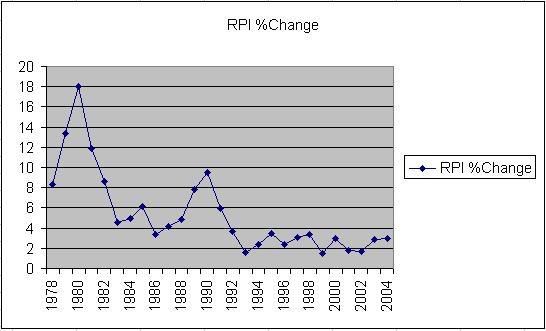
It would be useful if the linked figures brought us up to date. The claim is usually made that short-termist Tory policies brought "Boom and Bust" - that is, inflation went from very low to very high values and back repeatedly over a period of a few years. That's not well demonstrated by taking an average. Meanwhile, the Labour claim is that they keep inflation under control. We can see the swings on the given data, but because it only goes up to 1998 we can't see if it's true that it's more steady now. Unfortunately I don't have time now to look for more recent data, but I'll take a look later if nobody else comes up with it.
 
richardm said:
It would be useful if the linked figures brought us up to date. The claim is usually made that short-termist Tory policies brought "Boom and Bust" - that is, inflation went from very low to very high values and back repeatedly over a period of a few years. That's not well demonstrated by taking an average. Meanwhile, the Labour claim is that they keep inflation under control. We can see the swings on the given data, but because it only goes up to 1998 we can't see if it's true that it's more steady now. Unfortunately I don't have time now to look for more recent data, but I'll take a look later if nobody else comes up with it.

Can only find them on a spreadsheet:

http://www.statistics.gov.uk/statbase/tsdownload.asp?vlnk=7172

So to keep things simple, figures from 99-04 are:

99 1.5
00 3.0
01 1.8
02 1.7
03 2.9
04 3.0
 
Ah, thanks! So:

rpichange.jpg


We have had a long period of stability, which began around 1993, 4 years before the current government came to power in '97. So this period of stability started on the Tory watch.

You could argue that this government has managed to keep it level, whereas the Tories never managed to do so for more than a few years at a time, followed by a huge hike. Perhaps the Tories could have maintained it, but I suspect not - giving control of interest rates to the Bank of England is something they would not have done, and that is probably what has made the critical difference. (No opportunity for the Chancellor to tinker with the interest rates prior to an election to cheer people up, followed by inevitable knock-on financial horrors)
 
Matabiri said:
Or here in more detail:
http://www.moneyextra.com/glossary/gl00278.htm

Be careful of the much-quoted Consumer Prices Index (CPI), though. This was introduced in 2003 and does not include housing costs and council tax.

I think the figures in my previous post (chosen on the highly scientific basis that they were the first ones I came across on Google) were RPIX - in other words excluding housing costs.
 
Jaggy Bunnet said:
I think the figures in my previous post (chosen on the highly scientific basis that they were the first ones I came across on Google) were RPIX - in other words excluding housing costs.

This says that RPI-X includes housing costs.

"Housing:
Rent
Mortgage interest payments*
Depreciation*
Council tax & rates*
Water & other charges
Repairs & maintenance
Do-it-yourself materials
Dwelling insurance &
ground rent*

* Not included in CPI"

http://www.statistics.gov.uk/statbase/Product.asp?vlnk=868&More=n appears to have all the figures anyone could ever want.
 
asthmatic camel said:
You mean he's worthless and a lawyer?
Well, yeah, but I don't mean all lawyers are worthless. It's just that if you are, the law's a good option. Blair's a lawyer of the worst kind : still breathing.

I'm told I have "issues" with lawyers but I don't know, I thought everybody felt that way.
 
From Darat:
I am at the nearest I've ever been for not voting Labour. I believe they have gone too far to the centre/right over the last few years.
I reached that point at the 1997 general election.

I joined the Labour Party at the age of 16 and have voted Labour at every election, local, national etc., since my 18th birthday, except for the last two general elections. I remained a Labour Party activist until it became obvious that the party had abandoned all the principles that led me to join it. I left it around 1990 (I think).

I seemed to be the only person in Britain in 1997 who believed that New Labour actually meant its election promises, which were almost identical to the Tories’: privatising anything that stood still long enough (including implementing the Tories’ insane rail privatisation plan); NHS internal markets and PFI; cutting social benefits and local amenities; driving down public service workers’ pay and conditions; pointless ‘quick fixes’ in education such as increased ‘parent power’.

People were desperate to get rid of the Tories and preferred to close their eyes to the reality of Blair’s New Labour. Almost everyone I discussed with believed (or hoped) that Blair really intended to apply rather more left-wing policies than he admitted, and that the manifesto was propaganda to win the ‘moderate’ vote. Some hopes.

As spouse and I were walking to the polling station I said ‘I can’t vote for Blair’. We discussed what to do and by the time we reached the polling station had decided that the only option was to vote Green. It did seem almost surreal, as for most of my life I could never have imagined voting anything but Labour. Anyway, that’s what we did in 1997 and 2001, and we will doubtless do the same this election.
 
Lucky said:
Almost everyone I discussed with believed (or hoped) that Blair really intended to apply rather more left-wing policies than he admitted, and that the manifesto was propaganda to win the ‘moderate’ vote. Some hopes.

Wait, so a politician did what he said he was going to do and you're disappointed? I'd have been amazed :D
 
Lucky said:
by the time we reached the polling station had decided that the only option was to vote Green. It did seem almost surreal, as for most of my life I could never have imagined voting anything but Labour. Anyway, that’s what we did in 1997 and 2001, and we will doubtless do the same this election.
So how about you vote on this thread then? It would make the poll look prettier. :D

Interestingly, after all the bitching about who was "worthy" to be included, I note that when they were interviewing party leaders on the main BBC news on Tuesday night (after the announcement of the election), the people they chose to feature were Tony Blair (Lab), Michael Howard (Con), Charles Kennedy (Lib-Dem), Alex Salmond (SNP) and Elfyn Llwyd (PC). The first Question Time of the campaign, last night, had representatives from Labour, Conservative, Lib-Dem, SNP and UKIP. So far, on this poll, we have votes for Labour, Conservative, Lib-Dem, SNP and Plaid. And we might get one for the Greens if Lucky gets his act together.

So I think I rest my case regarding SNP and Plaid as being more rational inclusions in a poll than the "Respect Party" or whatever.

Intersting how well the Lib-Dems are doing on this poll. The numbers are too small to mean diddly-squat, but it will be interesting to see how this election pans out for them when the votes start coming in.

Rolfe.

PS. I note a Sinn Feinn vote has appeared. I'd be interested in hearing from that poster. Was that a serious vote from a Northern Irish voter? Was it prompted by last night's announcement?
 
Lucky said:

I seemed to be the only person in Britain in 1997 who believed that New Labour actually meant its election promises, which were almost identical to the Tories’: privatising anything that stood still long enough (including implementing the Tories’ insane rail privatisation plan); NHS internal markets and PFI; cutting social benefits and local amenities; driving down public service workers’ pay and conditions; pointless ‘quick fixes’ in education such as increased ‘parent power’.


Hardly, the only one. If I'd thought Labour were still "hard left" then I would never have voted for them in 1997!
 
As always, I'll be voting for "The party most likely to prevent the election of an SNP candidate". This time it means voting Tory. The lesser of two evils.
 

Back
Top Bottom