
I probably have had a couple of toddlers trying to, so likewiseI've had more people come to watch me take a ◊◊◊◊.

-
Security incident: ISF was recently accessed by intruders. Please change your password, and change it anywhere else you used it. Read more
You are using an out of date browser. It may not display this or other websites correctly.
You should upgrade or use an alternative browser.
You should upgrade or use an alternative browser.
Trump's Second Term
- Thread starter Orphia Nay
- Start date
And remember that Thomas was nominated by Bush Sr, because he was also looking at trashing the countryI would guess that there will remain at least a few tatters of the Constitution left, and that ex post facto laws might get into trouble. The Constitutional rule reaffirming birthright citizenship doesn't actually do much except to prevent laws from being made that abridge it. I suspect that if a new law were written to limit it, there would be an immediate constitutional challenge, and we'd be back to the court. But in any case, I think any law that limits birthright citizenship would have to apply only to babies born after the enactment of the law.
e.t.a. Assuming the Thomases of this world do not figure out another way to deem the Constitution itself unconstitutional. When the most blatantly, flagrantly corrupt Justice is in thrall to the most egregiously, floridly corrupt President, and it seems nobody has the gumption to stand up to Long Dong Silver and his posse, nothing is off the table.
mumblethrax
Species traitor

- Joined
- Apr 5, 2004
- Messages
- 5,203
I don't see any compelling reason to. If nothing else, constitutionalized birthright citizenship avoids the possibility of a permanent non-citizen underclass, which does not seem like the kind of thing the leadership of the US is currently interested in avoiding.It's a strange right, given the USA's history I can see why it came about but surely it's time the USA altered it?
Fundamentally the problem here is that people are looking for a well-grounded reason to confer the benefits and obligations of citizenship upon this baby, but not that one. That's just impossible to do, because they're ◊◊◊◊◊◊◊ babies. How is "you were ◊◊◊◊ out of this womb, rather than that one" a better way of determining citizenship than "You were ◊◊◊◊ out on this side of the border, rather than that one"? It's better to just take a pragmatic view of the matter, rather than treat citizenship as some sacred halo that can only be placed upon deserving babies. This approach works pretty well, that approach works pretty well. It's all nonsense, built on a house of cards. Do whatever.
Last edited:

The basic principle in most countries is that your parents or at least one has to be a legal citizen (rather than only a legal resident/visitor) of the country for you to be able to be a citizen. I presume the USA already uses that principle for babies born by a USA citizen but outside of the USA?
mumblethrax
Species traitor
- Joined
- Apr 5, 2004
- Messages
- 5,203
And that basic principle is no more self-justifying than the rule that is used in most of the Americas. The only strangeness you've identified in virtually unrestricted jus soli citizenship is that the idea is literally foreign to you.The basic principle in most countries is that your parents or at least one has to be a legal citizen (rather than only a legal resident/visitor) of the country for you to be able to be a citizen.
Yes, although it isn't the basic rule at play. We must grant those born here (with a handful of exceptions) citizenship. We may grant citizenship to others.I presume the USA already uses that principle for babies born by a USA citizen but outside of the USA?
Last edited:
Mojo
Mostly harmless

These days, "you can't deport me - I'm a citizen" doesn't necessarily work.Surely the point of the 'anchor baby' claim is that the parent says "You can't deport me - my baby is a citizen". Does that actually work anyway?
The Great Zaganza
Maledictorian

- Joined
- Aug 14, 2016
- Messages
- 32,971
The no.1 issue people claiming not to be racists have with immigration is lack of integration.
There is no better precondition for a successful integration than being born here.
There is no better precondition for a successful integration than being born here.
Andy_Ross
Penultimate Amazing

- Joined
- Jun 2, 2010
- Messages
- 86,320
What? and start a civil war?Criticise away! But are the left not allowed fight back?

Indeed. I don't see how she was an 'anchor baby' since her parents did not take any advantage from her US citizenship, as far as I can see, nor was that the reason she was born.Her parents were here on student visas. She has dual citizenship.
The horror, the horror.
ETA: Multiply ninjaed.
Last edited:
Andy_Ross
Penultimate Amazing
- Joined
- Jun 2, 2010
- Messages
- 86,320
Stephen Miller says the Trump administration will take “a hard look” at banning foreign pregnant women from the country
video in link
Miller: I know that some of the justices who worked on this, they think that they are so intelligent. There is no possible reading of the 14th amendment that applies to foreigners with foreign loyalties, foreign citizenship, foreign obligations, foreign everything
video in link
video in link
Miller: I know that some of the justices who worked on this, they think that they are so intelligent. There is no possible reading of the 14th amendment that applies to foreigners with foreign loyalties, foreign citizenship, foreign obligations, foreign everything
video in link
Andy_Ross
Penultimate Amazing
- Joined
- Jun 2, 2010
- Messages
- 86,320
JD Vance says his faith makes him averse to “low wage foreigners”
video in link
JD Vance says he hopes the Pope has “learned” from what he and Trump have said about immigration
video in link
video in link
JD Vance says he hopes the Pope has “learned” from what he and Trump have said about immigration
video in link
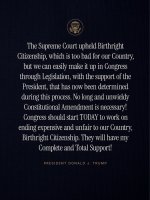
I think it is more "self-justifying". If citizenship confers rights then requiring citizenship to confer those rights to someone else is one of the rights of citizenship.And that basic principle is no more self-justifying than the rule that is used in most of the Americas. The only strangeness you've identified in virtually unrestricted jus soli citizenship is that the idea is literally foreign to you.
Yes, although it isn't the basic rule at play. We must grant those born here (with a handful of exceptions) citizenship. We may grant citizenship to others.
Andy_Ross
Penultimate Amazing
- Joined
- Jun 2, 2010
- Messages
- 86,320
JD Vance: I would love it if Democrats were willing to work with us on lowering housing prices. We could have some real bipartisan compromise.
(Trump is currently refusing to sign the bipartisan housing affordability bill)
video in link
(Trump is currently refusing to sign the bipartisan housing affordability bill)
video in link
The Great Zaganza
Maledictorian
- Joined
- Aug 14, 2016
- Messages
- 32,971
Trump is going to make this his Midterm Message

P.J. Denyer
Penultimate Amazing

Perhaps they could get more visitors if everyone who went got a commemorate presidential pardon?
The Great Zaganza
Maledictorian
- Joined
- Aug 14, 2016
- Messages
- 32,971
I would go if I got One Free Assassination Attempt.
Andy_Ross
Penultimate Amazing
- Joined
- Jun 2, 2010
- Messages
- 86,320
Not a cult
Agriculture Secretary Brooke Rollins: "In all things Donald Trump, everything as we know is better and better"
video in link
Agriculture Secretary Brooke Rollins: "In all things Donald Trump, everything as we know is better and better"
video in link
Andy_Ross
Penultimate Amazing
- Joined
- Jun 2, 2010
- Messages
- 86,320
Trump on "YMCA": "It became a 'monster' hit, again, 30 years after its original launch"
("YMCA" was released 48 years ago ... )
Donald J. Trump
@realDonald Trump
Village People singer Victor Willis is dead at 74. He was a great and happy guy who loved that I used his groups song, YMCA, at my Rallies.
It became a "monster" hit, again, 30 years after its original launch.
Many singers and groups wanted to get on board at the Rallies after all of the Rally Attendance Records were set - The crowds were, and are, enormous - But Victor and the group was there for us right from the beginning! They loved the action, and we loved them and their great and uplifting song.
We will think of Victor every time YMCA is played, like today, and all throughout this July Fourth Birthday week.
My condolences to his wonderful family and group, Victor Willis will be sorely missed, God Bless Him!!!
President DONALD J. TRUMP
("YMCA" was released 48 years ago ... )
Donald J. Trump
@realDonald Trump
Village People singer Victor Willis is dead at 74. He was a great and happy guy who loved that I used his groups song, YMCA, at my Rallies.
It became a "monster" hit, again, 30 years after its original launch.
Many singers and groups wanted to get on board at the Rallies after all of the Rally Attendance Records were set - The crowds were, and are, enormous - But Victor and the group was there for us right from the beginning! They loved the action, and we loved them and their great and uplifting song.
We will think of Victor every time YMCA is played, like today, and all throughout this July Fourth Birthday week.
My condolences to his wonderful family and group, Victor Willis will be sorely missed, God Bless Him!!!
President DONALD J. TRUMP