That seems a bit unlikely. It's not very hard to skew things by a few points here or there, but it would take more than some questionable boundary decisions and voter ID to make it "impossible to kick them out of power, regardless of what the electorate desires".
Yes, it would take more than that, it might take this:
As we look toward 2022, we anticipate the anti-democratic strategy will consist of four key pillars: (i) changing the rules to make it easier to undermine the will of the voters; (ii) changing the people who defend our democratic system by sidelining, replacing, or attacking professional election officials; (iii) promoting controversial constitutional theories about our elections to justify partisan takeovers; and (iv) eroding public confidence and trust in elections.[4] These four pillars are the foundation for election sabotage, contrary to the will of the voters.
As of December 15, 2021, there have been at least 262 bills introduced in 41 states that would interfere with election administration — and 32 of these bills have become law across 17 states.
To do that, you need a power equal to or greater than they have to stop them. What is that power, and how do you prevent it from falling into the hands of the power hungry?
That seems a bit unlikely. It's not very hard to skew things by a few points here or there, but it would take more than some questionable boundary decisions and voter ID to make it "impossible to kick them out of power, regardless of what the electorate desires".
There are plenty of examples in Red States where for all intends and purposes it is impossible for Democrats to win a 2/3rd majority, but Republicans can get it easily.
You are not very up-to-date when it comes to the GOP picking their voters.
That list is not very specific. I don't doubt that you can find examples of things I would disagree with, but I don't see anything rendering it "impossible to kick them out of power, regardless of what the electorate desires".
You want to centralise power so that it can deal with issues where local power becomes corrupt, but you aren't interested in how to stop that centralised power becoming corrupt? That just deals with the problem of centralised power by ignoring the problem.
There are plenty of examples in Red States where for all intends and purposes it is impossible for Democrats to win a 2/3rd majority, but Republicans can get it easily.
You are not very up-to-date when it comes to the GOP picking their voters.
Which red State are we talking about? Maybe I'll agree with you? We can construct artificial examples of worst case skews and so forth in any system involving districts. What is the worst example you can think of? How close are we to a State that votes 2/3 Democrat, but the State goes to the Republicans?
Which red State are we talking about? Maybe I'll agree with you? We can construct artificial examples of worst case skews and so forth in any system involving districts. What is the worst example you can think of? How close are we to a State that votes 2/3 Democrat, but the State goes to the Republicans?
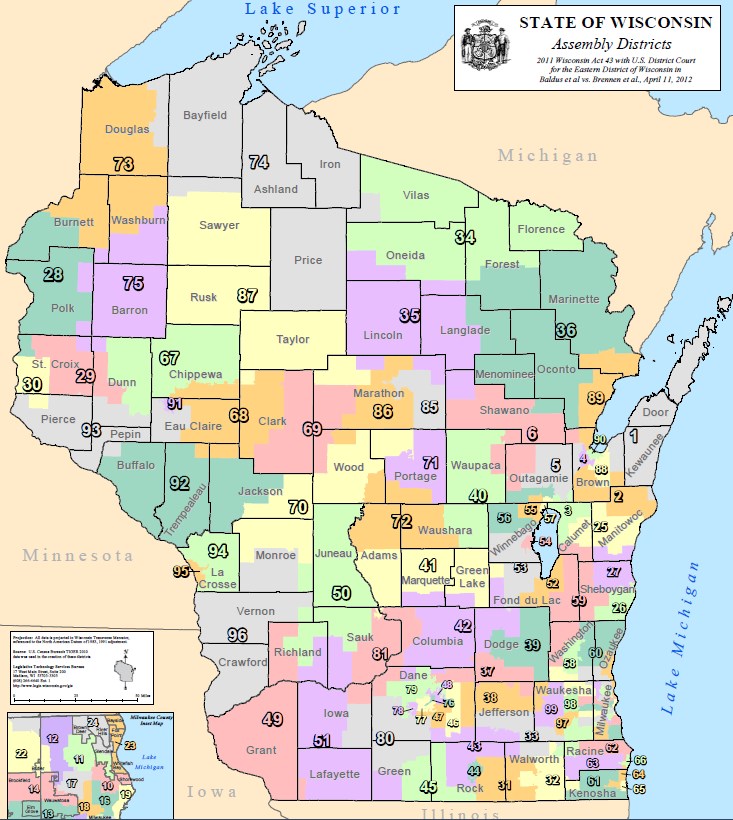
It doesn't exactly fit your requirements but how about Wisconsin where in 2018 the GOP received only 44.7% of the votes for the state legislature but won 64.6% of the seats ?
All the states where a party received a minority of the votes but got a majority of the seats have boundaries drawn by the Republicans and have returned a Republican legislature.
This particular paper looks at various types of Gerrymandering. Another case is where the proportion of seats received is out of proportion to the votes cast. In Kentucky, the GOP received 57.9% of the vote but got 89.5% of the seats.
That list is not very specific. I don't doubt that you can find examples of things I would disagree with, but I don't see anything rendering it "impossible to kick them out of power, regardless of what the electorate desires".
The party in charge gets to define the districts and will do so to retain their grip on power. There is a tipping point where, for example, the other party gets 90% of the vote that they could get enough seats to take the legislature and define the districts but realistically that's not going to happen.
Instead what you get are states where one party gets 50-55% of the votes but less than 50% of the seats time after time. This also has the effect of suppressing voter turnout for that party.
It doesn't exactly fit your requirements but how about Wisconsin where in 2018 the GOP received only 44.7% of the votes for the state legislature but won 64.6% of the seats ?
All the states where a party received a minority of the votes but got a majority of the seats have boundaries drawn by the Republicans and have returned a Republican legislature.
Ignoring talk of relative wickedness of the parties, wouldn't one expect something like that to be the case anyway given the dispersed nature of the Republican vote and the concentrated nature of the Democrat vote?
The governorship was won by the Democrats on a thin margin. A Democrat was returned to the Senate. I'm not seeing a state that is so locked up that democracy has finished there.
Redistricting has to be approved by the Governor in Wisconsin, so the districts have to be approved by a representative of the majority.
Take a look at a map of Wisconsin from 2020:
I don't see how you honestly district that to not skew Republican.
I think this is a map of the districts that go with that county map.
Maybe it could be done, but I'm not horrified that there is a significant difference between the legislature and the popular vote. Maybe you could split Milwaukee into 10 districts or something? If the point were to have the two the same, then it should be done by proportional representation.
This particular paper looks at various types of Gerrymandering. Another case is where the proportion of seats received is out of proportion to the votes cast. In Kentucky, the GOP received 57.9% of the vote but got 89.5% of the seats.
Why would you expect the proportion of seats to match the votes cast? That's not how systems with districts operate without very odd distributions of both parties.
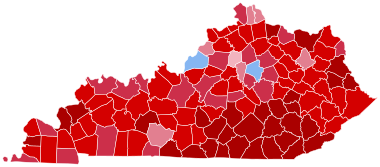
Look at Kentucky in 2020. Biden won 36% of the vote. How would you district this in order to give him something like 36% of the seats:
Do these claims of Republican gerrymandering on a mass scale really come down to the assumption that the number of districts won should look like the popular vote? The same effect happens at a national level, and it isn't because Republicans are redrawing State boundaries.
None of this looks to me like gerrymandering is normally explained:
I was expecting to see the effect produced by tortuously drawn districts with holes cut out of them. I'll also note, that the WP claims the founders intended districts to map closely to proportional representation of the states electorate. Is this true? These are the same founders that came up with the electoral college?
The party in charge gets to define the districts and will do so to retain their grip on power. There is a tipping point where, for example, the other party gets 90% of the vote that they could get enough seats to take the legislature and define the districts but realistically that's not going to happen.
I think this is a little bit of an edge case. I think the claim had been 2/3 majorities being unable to unseat the 1/3's hold on power. I haven't seen any examples of this. I am also not seeing any outrageous examples of gerrymandering. What I am seeing is a replay of the argument that the electoral college is unfair.
Instead what you get are states where one party gets 50-55% of the votes but less than 50% of the seats time after time. This also has the effect of suppressing voter turnout for that party.
Sure, but that is the nature of systems that involve districts. It's also a very much weaker claim than democracy having ended in a state, it being impossible to win, and we are all descending into tyranny unless the Federal Government steps in. Haven't there always been states where 45% of the popular vote nonetheless held the legislature of some state for an extended period of time?
Ignoring talk of relative wickedness of the parties, wouldn't one expect something like that to be the case anyway given the dispersed nature of the Republican vote and the concentrated nature of the Democrat vote?
The governorship was won by the Democrats on a thin margin. A Democrat was returned to the Senate. I'm not seeing a state that is so locked up that democracy has finished there.
Redistricting has to be approved by the Governor in Wisconsin, so the districts have to be approved by a representative of the majority.
Take a look at a map of Wisconsin from 2020:
I don't see how you honestly district that to not skew Republican. I don't doubt you could add a couple of blue districts, but there is an awful lot of red on that map.
I'm quite frankly astonished that you don't think that getting 65% of the seats with 45% of the vote isn't an unfair result.
Regarding the redness of map, land area doesn't vote, people vote.
There's a lot of red on that map because sparsely populated rural areas tend to lean Republican, densely populated urban areas tend to lean Democrat. Each of those rural areas represent significantly fewer people than the urban areas. There should be many more urban districts and many fewer rural districts and/or the districts designed so that there's a more representative mix rather than a single blue "island" surrounded by a sea of red.
If that was the intention you'd have proportional representation. You get general elections in the UK where a party wins a majority of seats far in excess of their share of the vote, and it's not unheard of to win a majority of the seats while failing to win a plurality of the vote.
This is the nature of any system involving districts that you win and lose on the basis of the vote within the district. I don't know what system you are arguing for, but it is completely different from the one in the US. Is this a discussion about gerrymandering in Republican states such that an insurmountable tyranny had been installed, or an objection to the system of districts?
Further, I thought that one of the arguments to having some system other than the popular vote decide legislative bodies was to provide some kind of counterbalancing force to the will of the majority. I don't see that one gets past that argument by saying "but it doesn't represent the will of the majority". The will of the majority decides the executive and can block the legislature. I don't see tyranny here. Possible deadlock.
There's a lot of red on that map because sparsely populated rural areas tend to lean Republican, densely populated urban areas tend to lean Democrat. Each of those rural areas represent significantly fewer people than the urban areas. There should be many more urban districts and many fewer rural districts and/or the districts designed so that there's a more representative mix rather than a single blue "island" surrounded by a sea of red.
Sure, but this is just the electoral college argument all over again. The claim was that the Republicans' were doing outrageous gerrymandered redistricting so that a tyranny was being established. Now the claim is that it's unfair that less populated areas get a disproportionate say. That's a much weaker argument.
Nothing nefarious has to go on to make the map of Kentucky favour Republicans in the legislature.
We can imagine edge cases that produce perverse results in any system. I'd have to consider what the level of the issue was and what the proposed cure was. For the moment, I like the governor having a veto on redistricting. On states where that is the case, I'm not terribly concerned.
To be honest, I think if the disproportionate influence issue got really bad, it would be a sign of things terminally falling apart. It's as bad for the people in cities to always get their way as it is for rural communities to always get theirs. I favour deadlock and compromise.
All this seems very far from the start of the discussion about Republican's using gerrymandering to turn Democrat voting states into their unassailable fiefdoms.
But what is your argument for giving rural populations many times the representation of city dwellers?
It's not The Countryside and The City voting, it's citizens in either case, supposedly deserving equal representation.
Where does one get the justification for privileging people's political influence based on their location?
It's not The Countryside and The City voting, it's citizens in either case, supposedly deserving equal representation.
Where does one get the justification for privileging people's political influence based on their location?
OK. This is a typical liberal progressive framing of the question. Everything is reduced down to ideological principles.
The reason that pure majoritarian rule is a problem is that you need to have a functioning country, or state, that isn't trying to tear itself apart. Imagine you have a 60% majority and a 40% minority who differ fundamentally in their world view and interests. One can solve that in a majoritarian way by just saying that that is too bad for the 40%. Different problems then arise from that, particularly if the two groups occupy different geographical areas. You set up a dynamic that is going to tend to drive the country or the state into splitting.
To deal with the tensions that this creates, you need to set up anti-majoritarian power centers within the state to force compromise and make the 40% feel they have some stake in the system. The alternative is the method used in the 1860s.
If there are no such forces at play, by all means, knock yourself out and let the majority get their way on everything. It seems to me as if what we see these days is nothing but these forces. Saying "yes, but we won the popular vote" doesn't solve this basic problem.
The same argument that there has been for this since the 18th Century.
OK. This is a typical liberal progressive framing of the question. Everything is reduced down to ideological principles.
The reason that pure majoritarian rule is a problem is that you need to have a functioning country, or state, that isn't trying to tear itself apart. Imagine you have a 60% majority and a 40% minority who differ fundamentally in their world view and interests. One can solve that in a majoritarian way by just saying that that is too bad for the 40%. Different problems then arise from that, particularly if the two groups occupy different geographical areas. You set up a dynamic that is going to tend to drive the country or the state into splitting.
To deal with the tensions that this creates, you need to set up anti-majoritarian power centers within the state to force compromise and make the 40% feel they have some stake in the system. The alternative is the method used in the 1860s.
If there are no such forces at play, by all means, knock yourself out and let the majority get their way on everything. It seems to me as if what we see these days is nothing but these forces. Saying "yes, but we won the popular vote" doesn't solve this basic problem.
This site uses cookies to help personalise content, tailor your experience and to keep you logged in if you register.
By continuing to use this site, you are consenting to our use of cookies.