THE WASP-18b & Space Probes Mysteries

Na, they’ll be too busy trying to overcome that resistance that everyone has been ignoring of the past 300 years, but someone without even an introductory understanding of physics guesses they found in just two weeks.

Of course,how silly of me.
 
F must be propotional to : Circle radius * speed - it's so simple math....
Too simple math, in fact. The proportion is exponential. Bjarne, now you have been told this about 17 times. Why do you keep repeating the same error?

Hans
 
Too simple math, in fact. The proportion is exponential. Bjarne, now you have been told this about 17 times. Why do you keep repeating the same error?

Hans

IIRC it was Einstein who defined insanity as "doing the same thing over and over again and expecting different results". ;)
 
The approximated energy consumption of the LHC when the particles is moving with for example 2.98E8 m/s and 2.97E8 m/s and 2E8m/s is 120 MW relative to the 180 MW.

I still do not see how you know or have calculated this.
The link also not explain how you have come that result.

Anyway lets start the attack.
If you compared to the to speed (2.99999997 m/s) and the energy consumption (220-300 MW) – it shows that if you decreases the speed about 1 % the energy consumption decreased about 50 % . – How do you explain that?


The force on an object in a circular object is never proportional to circle radius multiplied by speed ("Circle radius * speed") - it's so simple math....

And that’s in fact a problem..

F = mv^2/r
Off course, - but the problem is that the force used, is two times that force it seems to be necessary! - WHY?
It’s not enough to know how to calculate the force required, - the point is what happens?
Why is the speed only the haft of that it should have been?


g2.jpg

Consider two objects orbiting the two orbits (inner and outer) shown above, both travelling with the same speed (and weight).

Radius factor is 1 for the inner and factor 4 for the outer object.
How big force (factor) would be necessary to keep these two objects in these orbit.

I mean is it not logical that it requires 4 times larger force to keep the inner object in orbit compared to the outer, simply because the inner would accelerate inwards 4 times faster, when the force is 4 times larger..
If this is wrong, what is then the correct answer?
Try now to stick to that question.

That’s a poison question right?

Don’t deflect the discussion with personal attack and equations that in fact only confirms that when you compare these to the point above, you’ll easy see something is wrong…
Now just stick to the simple question above. This is what this is about ….

How much force does it require to keep the inner object in that orbit, compared to the force it requires to kept the outer object in orbit..? – And please explain why you conclusion is like it is.
 
Last edited:
F must be proportional to : Circle radius * speed - it's so simple math....
We already have shown you many times that you are wrong.

But why not give us another laugh :D! and show us this simple math?
Start with:
F = magnitude of the force on an object in a circular motion.
r = the radius of the circle.
s = the orbital speed (the magnitude of the velocity vector v).

and end up with:

F = k*r*s
where k is the proportionality constant between Circle radius * speed.
​
What we expect from is your usual simple-minded the assertion that F= k*r*s. Surprise us :jaw-dropp!
 
I mean is it not logical that it requires 4 times larger force to keep the inner object in orbit compared to the outer, simply because the inner would accelerate inwards 4 times faster, when the force is 4 times larger..
If this is wrong, what is then the correct answer?

Like I said, I'm no physics guy, but -

You're forgetting that gravity doesn't decrease linearly with distance, but exponentially. Thus, four times the distance, sixteen times less gravitational pull. Because 42 = 16.
 
Last edited:
We already have shown you many times that you are wrong.

But why not give us another laugh :D! and show us this simple math?
Start with:
F = magnitude of the force on an object in a circular motion.
r = the radius of the circle.
s = the orbital speed (the magnitude of the velocity vector v).

and end up with:

F = k*r*s
where k is the proportionality constant between Circle radius * speed.
​
What we expect from is your usual simple-minded the assertion that F= k*r*s. Surprise us :jaw-dropp!

Did you read post 704?

Point Repeated...
Yes you can calculted the force involved, - this is not the point.

Text repeated:
Don’t deflect the discussion with personal attack and equations that in fact only confirms that when you compare these to the point above, you’ll easy see something is wrong…
Now just stick to the simple question above. This is what this is about ….
 
You're forgetting that gravity doesn't decrease linearly with distance, but exponentially. Thus, four times the distance, sixteen times less gravitational pull. Because 42 = 16.
Bjarne would like reality to be linear, because then his cows could understand it. He really claims that it is our problem that reality is not linear!:bwall
 
I mean is it not logical that it requires 4 times larger force to keep the inner object in orbit compared to the outer, simply because the inner would accelerate inwards 4 times faster, when the force is 4 times larger..
If this is wrong, what is then the correct answer?
Try now to stick to that question.

That’s a poison question right?

No, it is a simple question with a simple answer. But you refuse to understand it. Instead, you keep clinging to your own idea.

The answer is that two things determine the centripetal force: The speed, and the turning angle. Since the turning also gets sharper, the speed only needs to be doubled, for the centripetal force to counteract the 4 times higher gravity. You have two exponential functions, and they cancel out.

This is now the 18th time it has been explained to you.


Hans
 
I still do not see how you know or have calculated this.
The link also not explain how you have come that result.

Anyway lets start the attack.
If you compared to the to speed (2.99999997 m/s) and the energy consumption (220-300 MW) – it shows that if you decreases the speed about 1 % the energy consumption decreased about 50 % . – How do you explain that?
What a pathetic attack. You do not know what you asked or what I answered so lets try again:
You asked:
Originally Posted by Bjarne
Please mention the energy consumption in % relative to the top speed (mention above - 2.99999997 m/s) or in MW relative to the 220-300 MW and the numbers of particles ,mentioned in the example above.
The answer is:
The approximated energy consumption of the LHC when the particles are moving with top speed is 120 MW relative to the 180 MW.

The number of protons in the LHC beams is about 600 trillion.

We know that you are incapable of the simplest physical calculation so what are you going to do with this?

P.S. There is no linear relationship between the power consumption of the LHC and the speed of the particles. There is a little thing called special relativity that you have forgotten.
Also much of the power is used to create magnetic fields. The power consuption of the magnets is unlikely to be linearly related to the speed of the particles.

Originally Posted by Reality Check
The force on an object in a circular object is never proportional to circle radius multiplied by speed ("Circle radius * speed") - it's so simple math....
And that’s in fact a problem..
No it is not a problem - it is a physical fact that the force on an object in a circular object is F = mv^2/r.
As any idiot can see this is not proportional to r*v.

Originally Posted by Reality Check
F = mv^2/r
Off course, - but the problem is that the force used, is two times that force it seems to be necessary! - WHY?
BECAUSE you are ignorant of the fact that this is circular motion. The force is exactly that needed to keep the body in circular motion.

F=ma where m is mass, F is the force vector and a is the acceleration vector. These are both directed into the center of the circle. So in that direction:
F=ma where F is the magnitude of the force and a is the centripetal (inward) acceleration. The acceleration is the change in velocity which is v^2/r.

It’s not enough to know how to calculate the force required, - the point is what happens?
The point is that is what happens in circular motion.

Why is the speed only the haft of that it should have been?
It is because you are really ignorant.
The speed is not half of what it should have been. It is exactly what is expected in circular motion.

Your ignorance may have deluded you into trying to apply what little you know about linear motion to circular motion.
In linear motion the force vector is in the same direction as the velocity vector and the change in speed is simply the acceleration.
Boost an object using a given force and you will get a final speed of v.
Divide the force by 4 and the speed will divide by 4.

But: In circular motion the force vector is at right angles to the velocity vector. The acceleration is not the change in the magnitude of the velocity (the speed). The acceleration is ( as always) the change in velocity vector. An object moving at a constant speed in circular motion has an centripetal (inward) acceleration of v^2/r.
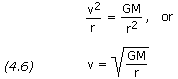
If the force is gravity then the gravitational force is GMm/r^2 and the orbital speed is
eq4-06.gif

An object in an orbit at a certain r from a body of M will have an orbital speed as above.
Change the radius by a factor of 4 and the orbital speed will change by a factor of 2.

This is now the 18th time it has been explained to you.
This is now the 19th time it has been explained to you.

 
Last edited:
Did you read post 704?

Point Repeated...
Yes you can calculted the force involved, - this is not the point.

Text repeated:
Don’t deflect the discussion with personal attack and equations that in fact only confirms that when you compare these to the point above, you’ll easy see something is wrong…
Now just stick to the simple question above. This is what this is about ….
Ignorance Repeated... in post 704.
There is no personal attack.
I am merely stating what is blinding obvious - you are totally ignorant of the simplest basics of physics. Juts about every post that you make confirms this.

The fatal flaws and basic ignorance in Bjarne's ideas in his two threads include:
  1. "Bended space is Contracted Space"
    Curved space is not contracted space
    First Asked 11 November 2009
  2. Physical quantities can be arbitrarily assigned units of measurement, e.g. an equation that returns numbers (no units) can be given units of m/s^2 or coulombs or kilograms just because Bjarne wants it to return acceleration or charge or mass.
  3. Anything Bjarne states is right even if there is experimental evidence that shows that it is wrong.
  4. Energy is not conserved in Bjarne's universe!
    First asked 26 November 2009
  5. Can Bjarne understand that the force of gravity is not constant within a solid sphere?
    First asked 26 October 2009
  6. Can Bjarne understand the physics behind orbital resonances?
    First asked 3 December 2009
    So far the answer is no :eye-poppi!
  7. Does Bjarne understand orbital mechanics?
    First asked 3 December 2009.
    So far the answer is no :eye-poppi!
  8. Can Bjarne understand that energy is not a force and cannot "equalize" a force?
    First asked 9 December 2009

    You can expend energy to create a force to equalize a force as a hovering helicopter does. But the simple facts are:
    • Forces are vectors but energy is a number.
    • The SI units of force are Newtons but the SI units of energy is Joules.
  9. Bjarne asks what a particle is!
  10. His simplistic knowledge of physis is betrayed by his delusion that since the force of gravity varies as 1/r^2 (e.g. a factor of 4 when r doubles) then the "speed factor “should” hence have been factor 4 as well" (plust other silly previous posts).
    The Basics of Space Flight: Circular Orbital Motion shows clearly that the mean orbital speed of objects should vary that the inverse of the square root of r. The fact that objects actually act like this in the real universe shocks Bjarne!
And the questions he he cannot answer (basically about units of measurement):
 
The fatal flaws and basic ignorance in Bjarne's ideas in his two threads include:
At some point you should perhaps also include Bjarne's rejection of the principle of superposition (which surely stems directly from his inability to handle complicated mathematics).
 
Last edited:
No, it is a simple question with a simple answer. But you refuse to understand it. Instead, you keep clinging to your own idea.

The answer is that two things determine the centripetal force: The speed, and the turning angle. Since the turning also gets sharper, the speed only needs to be doubled, for the centripetal force to counteract the 4 times higher gravity. You have two exponential functions, and they cancel out.

This is now the 18th time it has been explained to you.

And 18 times you have avoided answering the question:
How much force does it require to keep the inner object in that orbit, compared to the force it requires to kept the outer object in orbit (when mass and speed is the same)..?
 
And 18 times you have avoided answering the question:
How much force does it require to keep the inner object in that orbit, compared to the force it requires to kept the outer object in orbit (when mass and speed is the same)..?
The speed is not the same. The inner object is faster. The forces between the primary and the orbiting object are 4 times greater if the orbital distance is halved. One force is gravity (which follows the square rule), the other is the centripetal force, which follows the function F=m*v^2/r.

Which of this do you not understand?

Explanation # 20.


Hans
 
Last edited:
The speed is not the same. The inner object is faster. The forces between the primary and the orbiting object are 4 times greater if the orbital distance is halved. One force is gravity (which follows the square rule), the other is the centripetal force, which follows the function F=m*v^2/r.
Which of this do you not understand?
Explanation # 20.
Hans


You are NOT answering the question. Forget everything about orbit and only answer the hypothetical question below [/B]

g2.jpg

Consider two objects orbiting the two orbits (inner and outer) shown above, both travelling with the same speed and mass.

Radius factor is:

  • Factor 1 for the inner
  • Factor 4 for the outer object.

I mean is it not logical that it requires 4 times larger force to keep the inner object in orbit compared to the outer, simply because the inner would accelerate inwards 4 times faster, when the force is 4 times larger..
If this is wrong, what is then the correct answer?
Try now to stick to that question.


Don’t deflect the discussion with personal attack and equations that in fact only confirms that when you compare these to the point above, you’ll easy see something is wrong…
Now just stick to the simple question below. This is what this is about….

How much force does it require to keep the inner object in that orbit, compared to the force it requires to kept the outer object in orbit..? – And please explain why you conclusion is like it is.

That’s a poison question right?
 
Last edited:
Consider two objects orbiting the two orbits (inner and outer) shown above, both travelling with the same speed (and weight).

See that bolded, underlined part? There's your problem right there. The speeds will not be the same. No matter how much you want them to be the same, for those two objects to be in circular orbits at different distances, the speeds must be different, too.

Oh, and don't even get me started on that weight thing....
 
But not why the force / speed account is non-proportional... except if you admit that resistance is a reality...

F must be propotional to : Circle radius * speed - it's so simple math....

4 x 2 = 8 - not 16

That's a problem.
But do like everyone else in the last 300 years, -ignore it and the problem is "solved"

YES you can calculate excactly how a object is orbiting, BUT NOT WHY

That's a problem

What is the CircumferenceWP of the circle?
 
See that bolded, underlined part? There's your problem right there. The speeds will not be the same.

I K N O W that...

We are O N L Y - discussion the amount of FORCE involved if this was so.

Let say I am living at a moon in Andromeda and you on Mars, or what so ever.

This is a attempt to stepwise show that something is wrong

This is a pure F O R C E question…..
 
Last edited:
You are NOT answering the question. Forget everything about orbit and only answer the hypothetical question below [/B]

[qimg]http://www.science27.com/forum/g2.jpg[/qimg]​

Consider two objects orbiting the two orbits (inner and outer) shown above, both travelling with the same speed and mass.

Radius factor is:

  • Factor 1 for the inner
  • Factor 4 for the outer object.

I mean is it not logical that it requires 4 times larger force to keep the inner object in orbit compared to the outer, simply because the inner would accelerate inwards 4 times faster, when the force is 4 times larger..
If this is wrong, what is then the correct answer?
Try now to stick to that question.

Ignoring gravity for the moment, if we just use the centripetal force (which is required to keep the objects in circular motion):

F = mv^2/r

Hence, if m and v are constant as specified by your problem, the force is proportional to 1/r.
So at 4 times the distance, the force will be 4 times less.

That seems to be what you're trying to say, but then you make the mistake of trying to apply that to orbits.

The gravitational force cannot maintain the circular orbit at that speed on the outer track, because the force isn't proportional to 1/r, but 1/r^2. The particle/moon/whatever needs to be moving more slowly, as determined by this equation:

v^2 = (GM/r)
 
Last edited:
I K N O W that...

Then why did you state something to the contrary? If you K N O W the speeds must be different, why claim they are the same?

We are O N L Y - discussion the amount of FORCE involved if this was so.

It isn't so. It cannot be so. You already K N O W that, right?

Let say I am living at a moon in Andromeda and you on Mars, or what so ever.

This is a attempt to stepwise show that something is wrong

You can stop now. We already found something wrong at the very first step. We didn't even need cows.

This is a pure F O R C E question…..

No, it isn't. You have manufactured an impossible situation involving speed, distance, and F O R C E.
 

ISF - Join now!

Every member here is approved by hand. No bots, no spam, just people who care about evidence and honest debate.

Membership is free!

Create your free account

Back
Top Bottom