THE WASP-18b & Space Probes Mysteries

For example if you want to know the energy lost due to electric resistances and resistance against resistance.
How can you be sure you know that exactly what is what?
When the accelerator runs with full power, how can you distinguish between electric resistance (heat) lost) and resistance against motion.

Because you need to calculate the losses. This equipment runs on the absolute edge of what is technogically possible. You would know this if you had bothered to read the article.

I think no scientist at CERN etc…would dream about that it could be something wrong with ours understanding of resistance against motion, Remember resistance against motion require in a pretty low amount of energy.

I don't remember that because it only exists in your imagination. Maybe you don't think CERN scientists bother to make calculations. After all you are willing yourself to run around and measure gravity in a building with only a very sketchy idea of the mass of the building and no idea of the mass distribution in it.

However, REAL scientists and engineers don't work that way. So yes, they have calculated it all. Do you really imagine that anybody would put 3.000.000.000 Euro in the hands of a project group without very exact calculations of whether the project was possible at all?

If unexpected circumstances have been detected I do not belive hat anyone would think about if something was wrong with our understanding of physics. But rather related to the facilities.

Quite frankly, Bjarne, I don't give a damn about what you believe.

I believe if you really want an accelerator to either (beyond possible doubt) to prove or disprove if velocity also applies to constant velocity, this it self would require maybe years, of rebuilding, preparation and new software.

Now you are being silly: You have yourself claimed that the computer must be compensating for your 'kinetic resistance'. So all it takes is to read out the regulation signal.And you can rest assured that they already do that.

Time will show, - there are so many ways to finally either prove or disprove this theory. NOTHING so fare shows it’s wrong.

Everything shows it is wrong. And it is not a 'theory'. It is a stray idea in your mind. We are even charitable when we call it a hypothesis.

I know this theory is too “spacy” for many of yours. But what do you guys expect, space must be spacy.

The sad thing is that the idea is too spacy for YOU. You can't even grasp the implications of it. The rest of us can, and can see how silly it is.

We haven't even discussed the thermodynamic implications if your idea, because you obviously haven't the slightest idea what thermodynamics is.

ETA: OK I notice that RC is now taking up the thermodynamics. Good call, but I fear Bjarne doesn't even know what the term means.

Hans
 
Last edited:
Because you need to calculate the losses. This equipment runs on the absolute edge of what is technogically possible. You would know this if you had bothered to read the article.

Maybe you don't think CERN scientists bother to make calculations.
Off course they do
1.)
Why do you think there is such a big delay in CERN.
If they knew and could control every Joule, it should take few days to figure out the problems. It has taken months.

2.)
As I mentioned this is all far more completed as we believes.

3.)
Of course also experience matters, if the experience is to power up with one joule, who would worry or believe that this would be a brake down of physics.

4.)
50 Years ago we had all the calculation and equation ready for Fusions, - its “should" be just “klaks”
Today not many are optimistic anymore.
Physics is always full of surprises.

5.)
As I wrote, If CERN should guarantee that resistance again motion not applies for constant motion, this it self would require a lot of systematic experiments and analyzing.

I do not believe the facility is build for this.
One day the scientist in CERN will face the fact that the old believe could be wrong.
That day some of the old staff maybe would say,, aahhhh this is maybe because we had this and this and this strange problem. And therefore we did that and that.

But still we are talking about an insignificant small amount of energy compared to that amount the accelerator used.

In Copenhagen electricity is stolen every day. How accurate do you think staff at the power station can calculate that; 1J ? - 100J - 1000J - 10.000J ?
 
Last edited:

You appear rather confused. I was explaining why you are completely wrong. You really shouldn't be referring to that as "good point", unless you agree that you are, in fact, completely wrong.

If unexpected circumstances have been detected I do not belive hat anyone would think about if something was wrong with our understanding of physics. But rather related to the facilities.

Actually, it can often be the exact opposite. For example, a while back we had a problem where a particular component was observed to be heating up a lot more than expected. When reviewing the calculations, we found some stuff in the literature about another potential heating mechanism that may also need to be taking into account. Not completely new physics admittedly, but something that very few people had ever looked into, or even thought about, before. Of course, it turned out that that effect was insignificant in our case, and it was actually an engineering problem that was causing the extra heating.

The point being that, as usual, your beliefs are completely wrong. Perhaps you should bear in mind that while you happily imagine what you think goes on in particle accelerators, you are dealing with people who actually work in them.

1.)
Why do you think there is such a big delay in CERN.
If they knew and could control every Joule, it should take few days to figure out the problems. It has taken months.

You what? The problem you refer to that caused the year delay was nothing whatsoever to do with your nonsense. It wasn't even to do with particles at all. It was simply an electrical fault. That was figured out probably within hours. The part that took time was not figuring out the problem, it was fixing it.

2.)
As I mentioned this is all far more completed as we believes.

No, it's exactly as complicated (I'm pretty sure that's what you meant) as we believe. Because it's not a belief, it's my job. What you believe is another thing entirely that appears to have no connection whatsoever with the real world.

3.)
Of course also experience matters, if the experience is to power up with one joule, who would worry or believe that this would be a brake down of physics.

When you're dealing with subatomic particles, 1J is a hell of a lot of energy. If you have discrepancies of that magnitude, that's seriously something to worry about.

4.)
50 Years ago we had all the calculation and equation ready for Fusions

No we didn't. Not even close.

its “should" be just “klaks”
Today not many are optimistic anymore.

Assuming you were trying to say something along the lines of implying that since we had the equations we should have easily made it work, that's obviously complete bollocks. Aside from the fact that, as mentioned above, there are a lot more calculations going on even as we speak, there are also serious engineering problems involved. It's no good calculating that you need a machine that can contain a certain amount of energy if no material exists that can actually do so.

Physics is always full of surprises.

Indeed it is. The problem with your nonsense is that the things you claim would already have surprised us long ago. Since they are nowhere to be seen, we can conclude that you're simply spouting a load of nonsensical bollocks.

5.)
As I wrote, If CERN should guarantee that resistance again motion not applies for constant motion, this it self would require a lot of systematic experiments and analyzing.

No it wouldn't. Detailed measurements would certainly be required to find out exactly how and why such an effect works, but merely observing an effect is there is incredibly easy. All you need is to do something that should be affected by it and see what happens. And, as has been explained many times already, this would have affected every single particle accelerator that has ever existed. The fact that not a single one has seen any effect at all makes it pretty clear that the effect does not exist.

Edit: Incidentally, I should note that the first particle accelerators were developed in the 1920s. There have been hundreds of accelerators built over a period of more than 80 years, not a single one of which has ever noticed anything that you claim.

That day some of the old staff maybe would say,, aahhhh this is maybe because we had this and this and this strange problem.

Exactly. They would have noticed problems. But they don't. End of story.

In Copenhagen electricity is stolen every day. How accurate do you think staff at the power station can calculate that; 1J ? - 100J - 1000J - 10.000J ?

Power stations, aside from not having anything whatsoever to do with the kind of monitoring you're talking about, are not in the business of cutting edge particle physics research. I can't measure the speed of a tennis ball particularly well, that doesn't imply that the people at Wimbledon can't either.
 
Last edited:
You appear rather confused. I was explaining why you are completely wrong. You really shouldn't be referring to that as "good point", unless you agree that you are, in fact, completely wrong

You wrote:

The problem is that there are all kinds of errors in manufacturing, positioning and so on, and more importantly there are dynamic errors due to power supplies, temperature variations and so on. In the past, these were either corrected very coarsely by hand, or simply not at all. Now we have computers, we can make feedback systems to correct it much more quickly.

I read this like: there is many factors to deal with : Do we understand all these 110% correct ?

Further more:
  1. How can you distinguish between the lost of energy to e.g; heat and to kinetic resistance?`
  2. How much energy (excact amount of Joule) is an accelerator using?
  3. How much is lost to heat?
  4. How much is lost to other resistance / consumptions?
  5. How much is used to maintain resistance due to resistance of the particles,?
  6. At the time constant particle velocity is reached, how much less energy are being let in to the accelerator?
  7. How is the reduced energy consumption by constant particle velocity controlled?
  8. So soon the acceleration of the particles stops and the wanted velocity is reached, is there a clear point where you clearly can see, that exactly now the resistance against motion is reduced?
  9. What is the temperature of the particles?
  10. Is the temperature of the particle constant?
  11. How many particles are there in each bundle?
  12. Which kind (how heavy) ?
  13. What is the particle velocity when colliding ?
  14. What about the higgs, do you also expect this (very theoretical) ghost boson to cause resistance due to motion? – included the calculations ? - I mean this guy is believed to have mass right?
  15. And this higgs is believed to make it difficult for particle to move in vacuum right - what about that? - Something we know, or "only" guessing ? - (mass 120 to 220 * a protons) are these "very theoretical ghost" included all the calculations ?
 
Last edited:
When you're dealing with subatomic particles, 1J is a hell of a lot of energy. If you have discrepancies of that magnitude, that's seriously something to worry about.

But so far nothing have been done to lead the attention to the question: could resistance also apply to constant velocity, right ?
Therefore nobody have worried about that possible mistake right ?
Simply because how can you distinguish between electric resistance (heat) lost) and resistance against motion ?
Don’t tell me that you all the time will now the exact resistance due to electric resistance....

PS....

According to http://en.wikipedia.org/wiki/Large_Hadron_Collider

We can read:

Prior to being injected into the main accelerator, the particles are prepared by a series of systems that successively increase their energy. The first system is the linear particle accelerator LINAC 2 generating 50-MeV protons, which feeds the Proton Synchrotron Booster (PSB). There the protons are accelerated to 1.4 GeV and injected into the Proton Synchrotron (PS), where they are accelerated to 26 GeV. Finally the Super Proton Synchrotron (SPS) is used to further increase their energy to 450 GeV before they are at last injected (over a period of 20 minutes) into the main ring. Here the proton bunches are accumulated, accelerated (over a period of 20 minutes) to their peak 7-TeV energy, and finally circulated for 10 to 24 hours while collisions occur at the four intersection points.[26]


1.) This means (so far I understand): First when the particle top-speed is reached the particles circulated 10 to 24 hours. (with constant velocity) Right?
2.) Why so long time ?
 
Last edited:
PS....

According to http://en.wikipedia.org/wiki/Large_Hadron_Collider

We can read:

Prior to being injected into the main accelerator, the particles are prepared by a series of systems that successively increase their energy. The first system is the linear particle accelerator LINAC 2 generating 50-MeV protons, which feeds the Proton Synchrotron Booster (PSB). There the protons are accelerated to 1.4 GeV and injected into the Proton Synchrotron (PS), where they are accelerated to 26 GeV. Finally the Super Proton Synchrotron (SPS) is used to further increase their energy to 450 GeV before they are at last injected (over a period of 20 minutes) into the main ring. Here the proton bunches are accumulated, accelerated (over a period of 20 minutes) to their peak 7-TeV energy, and finally circulated for 10 to 24 hours while collisions occur at the four intersection points.[26]

1.) This means (so far I understand): First when the particle top-speed is reached the particles circulated 10 to 24 hours. (with constant velocity) Right?
2.) Why so long time ?
I actually quoted that to you before and that formed the basis for
Stored particles do not hit the walls of the accelerator
The next point is that the beams are circulated without acceleration for hours at a time. This is the accelerator acting as a storage ring. Making the beam travel in a circle is fairly basic physics. All you need are magnets and Maxwell's equations. The magnets are tuned to keep particles at a specific energy traveling in a circle.
  • Known losses (e.g. synchrotron radiation) are compensated for by RF systems.
  • Unknown losses such are your impossible "kinetic resistance" are not compensated for.
If the particles are not at that energy they escape the storage ring. They hit the walls. In the case of high energy beams as in the LHC they then proceed to destroy the system.

1.) Is not quite right. It is a constant energy as particle physicists would say or a constant speed (velocity is not speed).
2.) To collide the beams over a a period of 10 to 24 hours.
It takes a lot of money to create the beams at the LHC. That is one reson why things are so closely monitored.
Scientists want to get more than a couple of particles collliding. So they do not dump the beam after the first collisions but continue to circulate the beam until it is useless for their purposes.

And then they do not just switch the machine off and let the beams hit the walls of the ring. That would destroy the ring.
Thus the need for the Beam Dumping System.
 
Is not quite right. It is a constant energy as particle physicists would say or a constant speed (velocity is not speed).

The question was:
First when the particle top-speed is reached the particles circulated 10 to 24 hours. (with constant velocity) Right?

How can you distinguish between electric resistance (heat) lost) and resistance against motion?
Don’t tell me that you all the time will know the exact resistance due to electric resistance....( and other resistances: e.g. synchrotron radiation)
 
Last edited:
The question was:
First when the particle top-speed is reached the particles circulated 10 to 24 hours. (with constant velocity) Right?
First when the required particle speed is reached the particles are circulated 10 to 24 hours. (with constant speed)
Right

How can you distinguish between electric resistance (heat) lost) and resistance against motion?
Don’t tell me that you all the time will know the exact resistance due to electric resistance....( and other resistances: e.g. synchrotron radiation)
There are no "resistances" in the ring.

There are energy losses. The known laws of physics tell us what these energy losses are. The accelerator is designed to work with these known energy losses. They are compensated for in the RF system.

Scientists do know the exact energy losses. The energy that the RF system has to put into a stored beam is the exact energy loss due to the motion of the particles in the beam.

Then you run the accelerator and it works.

Accelerators do not have double their budgeted electricity cost
To accelerate the particles you use electricity.
Bjarne's impossible "kinetic resistance" means that twice as much electricity is used. Somebody has to pay the bill. Accountants tend to scream loudly when a budgeted item doubles.

Accelerated particles do not hit the walls of the accelerator
This is one of the very good points that Cuddles makes http://www.internationalskeptics.com/forums/showpost.php?p=5345407&postcount=473.
  • RF systems (e.g. RF cavity resonators) are used to accelerate particles and to keep them in the ring.
If there was an extra impossible "kinetic resistance" then the acceleratparticles would always hit the walls of the accelerator because the RF systems do not know about Bjarne's impossible "kinetic resistance".

Stored particles do not hit the walls of the accelerator
The next point is that the beams are circulated without acceleration for hours at a time. This is the accelerator acting as a storage ring. Making the beam travel in a circle is fairly basic physics. All you need are magnets and Maxwell's equations. The magnets are tuned to keep particles at a specific energy traveling in a circle.
If the particles are not at that energy they escape the storage ring. They hit the walls. In the case of high energy beams as in the LHC they then proceed to destroy the system.

Accelerated particles have the energy that is predicted
Yet another (less compelling) reason is that scientists are really interested in the collisions and their products. They are so interested that they measure the energy of all of the products in calorimeters.
There is a little law of physics that you should know about: energy is conserved.
Thus the energy of the products is equal to the energy of the particles that collided.
No one has claimed a Nobel Prize by noticing that energy is not conserved in the collisions, i.e. the products have half the predicted energy of the particle beams.
 
Can Bjarne win a Noble Prize

First asked 27 November 2009
Consider double pulsar systems, e.g. PSR J0737-3039.

This system is especially interesting since it provided one of the more precise of the tests of GR. If the observation is wrong then GR is wrong.

As far as I can see Bjarne's "space wind" and nonexistent "kinetic resistance" would be detected in that system and invalidate GR.

Bjarne:
Can you do the math and win a Nobel Prize?

Extracted from Pulsar Kicks and Spin Tilts in the Close Double Neutron Stars PSR J0737-3039, PSR B1534+12 and PSR B1913+16 and Wikipedia.
  • Mass of the ms pulsar = 1.34 M⊙ (solar masses)
  • Mass of the companion = 1.25 M⊙ (solar masses)
  • Current semi-major axis = 1.26 R⊙ (solar radii)
  • Current orbital eccentricity = 0.0878
  • Spin period of the ms pulsar = 23 milliseconds
  • Spin period of the companion = 2.8 seconds
  • Orbital period = 2.4 hours
You can start by calculating the "kinetic resistance". Please show all your work including the units of measurement propagating through the operations to give your final units of acceleration.

For example, using the "space wind" equation.
A = RM/Qr^2

Q= 6.52* 10^21 (no units specified)
r = 1.26 R⊙ (solar radii) = 1.26 * 6.955×10^8 m = 876,330,000 m
M = 1.34 M⊙ (solar masses) = 1.34 * 1.9891×10^30 kg = 2.665394 x 10^30 kg.

The number of second one rotation of the ms pulsar takes is 0.023 seconds. The circumference of the companions orbit is 2*pi*r. Thus the circumference is 5,506,143,780 m.
R = 5,506,143,780 m/0.023 seconds = 239,397,555,662 m/s

I get A = 127.43 kg/ms. This is not an acceleration.

Bjarne calculate something? Don't make me laugh,he will reply with another farrago of nonsense pulled out of his rear end.
 
Bjarne calculate something? Don't make me laugh,he will reply with another farrago of nonsense pulled out of his rear end.
His usual response to the calculations of others is "crap" or hand-waving statements about others not being able to do the calculations because they do not "understand" Bjarne's ideas.

He really think that you can get two different results out of an equation depending on whether you understand Bjarne or not!

Anything is possible in the Bjarneverse.
 
Bjarne
As I wrote, If CERN should guarantee that resistance again motion not applies for constant motion, this it self would require a lot of systematic experiments and analyzing.
Cuddles
No it wouldn't. Detailed measurements would certainly be required to find out exactly how and why such an effect works, but merely observing an effect is there is incredibly easy. All you need is to do something that should be affected by it and see what happens.
Bjarne
Ok
Then let’s do it.
What is the cost for that experiment?

Bjarne Wrote:
According to http://en.wikipedia.org/wiki/Large_Hadron_Collider
We can read:
Prior to being injected into the main accelerator, the particles are prepared by a series of systems that successively increase their energy. The first system is the linear particle accelerator LINAC 2 generating 50-MeV protons, which feeds the Proton Synchrotron Booster (PSB). There the protons are accelerated to 1.4 GeV and injected into the Proton Synchrotron (PS), where they are accelerated to 26 GeV. Finally the Super Proton Synchrotron (SPS) is used to further increase their energy to 450 GeV before they are at last injected (over a period of 20 minutes) into the main ring. Here the proton bunches are accumulated, accelerated (over a period of 20 minutes) to their peak 7-TeV energy, and finally circulated for 10 to 24 hours while collisions occur at the four intersection points.[26]
1.) This means (so far I understand): First when the particle top-speed is reached the particles circulated 10 to 24 hours. (with constant velocity) Right
Still no answer……..
Ok let me make a guess.
All what this is about is to reach top-speed (almost c)

and more importantly there are dynamic errors due to power supplies, temperature variations and so on
As I wrote above the particles MUST circulate with top speed.
We can not choose to let the particle circulate wit let say 1 % less speed than top-speed.
Because we are also dealing with quote: "variations in temperature, power supply" - (and who knows what more variations).
So top-speed is required.
WHY
Because top speed is top speed, even though we would let a bit more energy into the magnets (1 or 5 Joule) than required it would not be risky, because the particles can only reach top-speed.
And this is properly what is done.
In this case we are sure that the circulation will remains stable, also even through there is : Quote : “power supplies, temperature variations”

Question:
Now when more energy than required are used, (just to be sure the top-speed is maintained) how can we detect if the particles is resisting that constant speed and require about 1 Joule more than expected. ? - or not ?

If that guess all should be wrong, I guess we must let 1 Joule less energy into the accelerator EXCACTLY that n a n o s e c o n d where top-speed is reached .
BUT HOW is that possible, WHO in h... is so fast, my laptops is NOT, - and other computers (I have read) are also not, -
so I still guess there is only one possibility >>> HIM >>>

images

BUT now a new problem occurs, because what when the ghostly higgs suddenly emerge, that would change all the calculation right ? - And what about Lucky would he to discover that higgs suddenly in a split second "pops up"?

(velocity is not speed).
What is the difference?

Consider double pulsar systems, e.g. PSR J0737-3039
The error here is that each time the rotation or mass of a rotating object change, the constant change too. We were this through already for 2 to 3 weeks ago, when discussion satellites.

I get A = 127.43 kg/ms. This is not an acceleration.
You rather must understand what happens.
Space is in motion around a rotating object. (you know or should knowthat) .
The same matter/space connection responsible for that deformed space follows the rotation of the star is also able to connect to objects in that space. This will transmit KE from the rotating object to the orbiting objects. This is simple to understand, in a same way if you drag another car in very elastic robe. You know you can connect the elastic rope to you car, then you also should know you can connect with another. - In the same simple way is the space matter connection between objects.
 
Last edited:
Give it up,he's beyond redemption.
Hypnosis is not working on me.
I did try in front of 300 people.
I could not be honest and say: this is not working, and “must” play the game.
No redemption ?
Right I am completely my own.
I don’t know... maybe also brainwash don't work on me..
 
Hypnosis is not working on me.
I did try in front of 300 people.
I could not be honest and say: this is not working, and “must” play the game.
No redemption ?
Right I am completely my own.
I don’t know... maybe also brainwash don't work on me..

I'm not surprised,to be able to be brainwashed you need a brain.
 
I read this like: there is many factors to deal with : Do we understand all these 110% correct ?

No. There is no such thing as 110% understanding. That's a pretty basic maths error you've made there.

Further more:
How can you distinguish between the lost of energy to e.g; heat and to kinetic resistance?

Very easily. There is no such thing as "kinetic resistance", so all energy lost is due to something else.

How much energy (excact amount of Joule) is an accelerator using?

Which accelerator? They all use different amounts.

How much is lost to heat?

Ultimately, all of it.

How much is lost to other resistance / consumptions?

None. All losses go to heat.

How much is used to maintain resistance due to resistance of the particles,?

None. That's the whole point of this conversation.

At the time constant particle velocity is reached, how much less energy are being let in to the accelerator?

Again, which accelerator?

How is the reduced energy consumption by constant particle velocity controlled?

Fairies.

So soon the acceleration of the particles stops and the wanted velocity is reached, is there a clear point where you clearly can see, that exactly now the resistance against motion is reduced?

The resistance against motion is not reduced. There is no resistance against motion. It is your claim that there is, and we are telling you that you are wrong.

What is the temperature of the particles?

Temperature is a statistical thermodynamic concept and does not really apply to particles in an accelerator. You could work out a value, but it's not something anyone actually cares about. And again, it will depend entirely on the accelerator.

Is the temperature of the particle constant?

Yes.

How many particles are there in each bundle?
Which kind (how heavy) ?
What is the particle velocity when colliding ?

Why do you keep asking stupid questions like this? Again, these are all things that depend on the accelerator. If all accelerators were identical, we wouldn't need to have more than one of them.

What about the higgs, do you also expect this (very theoretical) ghost boson to cause resistance due to motion? – included the calculations ? - I mean this guy is believed to have mass right?

Once again, this resistance to motion nonsense is something only you believe in.

And this higgs is believed to make it difficult for particle to move in vacuum right

No, wrong.

Bjarne
Ok
Then let’s do it.
What is the cost for that experiment?

As was clearly explained in the post you just quoted, this experiment has been done every single time a particle accelerator has been turned on. There is no cost because it's something that just happens. This is no different from proposing an experiment to see if gravity makes things fall. You don't need to spend time and money on it, you just watch the millions of things that fall every day. You would only need to do experiments to find and exactly how it works. With gravity, we have done and continue to do that. With your bollocks, we haven't because there is nothing there to see and so nothing to experiment on.

Still no answer……..

Why are you lying? You just quoted someone giving you the answer.

As I wrote above the particles MUST circulate with top speed.

Actually, you wrote no such thing. Which makes it a shame that you then wrote it here, since it's completely wrong.

We can not choose to let the particle circulate wit let say 1 % less speed than top-speed.

Yes we can. We can choose to let them circulate with any speed we feel like, although the power supplies and so on will be designed to work within a particular range.

Because we are also dealing with quote: "variations in temperature, power supply" - (and who knows what more variations).
So top-speed is required.
WHY
Because top speed is top speed, even though we would let a bit more energy into the magnets (1 or 5 Joule) than required it would not be risky, because the particles can only reach top-speed.
And this is properly what is done.
In this case we are sure that the circulation will remains stable, also even through there is : Quote : “power supplies, temperature variations”

This is simply nonsensical word salad. If you wish to make a point, please try typing it in sane before translating it to English.

Question:
Now when more energy than required are used, (just to be sure the top-speed is maintained) how can we detect if the particles is resisting that constant speed and require about 1 Joule more than expected. ? - or not ?

Huh? You can detect the particles are resisting motion because more energy is required. That's the whole point.

If that guess all should be wrong, I guess we must let 1 Joule less energy into the accelerator EXCACTLY that n a n o s e c o n d where top-speed is reached .
BUT HOW is that possible, WHO in h... is so fast, my laptops is NOT, - and other computers (I have read) are also not, -
so I still guess there is only one possibility >>> HIM >>>

What the hell are you talking about? None of this has anything vaguely to do with your claim that things travelling at a constant velocity in a vacuum will magically slow down. You're just raving.

BUT now a new problem occurs, because what when the ghostly higgs suddenly emerge, that would change all the calculation right ?

No.

What is the difference?

Velocity is a vector, speed is a scalar. If you don't understand such an incredibly basic concept, you really should just stop posting and go back to school for a few years before trying to talk about this sort of stuff.
 
The error here is that each time the rotation or mass of a rotating object change, the constant change too. We were this through already for 2 to 3 weeks ago, when discussion satellites.

So then it's not a constant!

Your equation is wrong. If there's mass and angular velocity dependence in that Q factor, then there is no point at all in the calculation. If you have to calibrate the equation for every single object, it's worse than useless.
 
So then it's not a constant!

Your equation is wrong. If there's mass and angular velocity dependence in that Q factor, then there is no point at all in the calculation. If you have to calibrate the equation for every single object, it's worse than useless.

Right now I do not see it that way. It’s rather a question of understanding several other factors.

For instance:

How is the resistance due to motion inside a rotation body?
This is properly far more complicated that previously thought, because of the mass that lays “in front” of other mass, will drag space after it self, and that space will drag mass after it self.
In the same way when you truck drive behind a big truck you’ll save energy and a whole convoy will too.
The point is here the energy that possible can be transmitted also depend on how is the mutual resistance.
A rotating body can only transmit that energy it not need.
On the other hand it also get energy back to maintain its resistance against rotation, doesn’t matter how slow the circulating object(s) are.

And also its counts: how much energy can be transmitted through space, - it’s not a solid connection.

Finally and maybe most important, each reference system seems to be protected by own gravity, and dosen't seem to be effected by primary space wind.
Exsample: the Earth is not disturbed by the Sun or the galaxy’s space so long the gravity of the space wind of the Earth is stronger. So each little “universe” seems to be “unique”.

This also means when a space probe leaves the protected areas around the Earth, or other planets, suddenly stronger space wind can force it out of course. This had happen to Pioneer 10. right after leaving Neptun.

I am not saying this equation or understanding is complete, also not that it explain very much except that there are mutual energy exchange between orbiting objects and a rotating body.

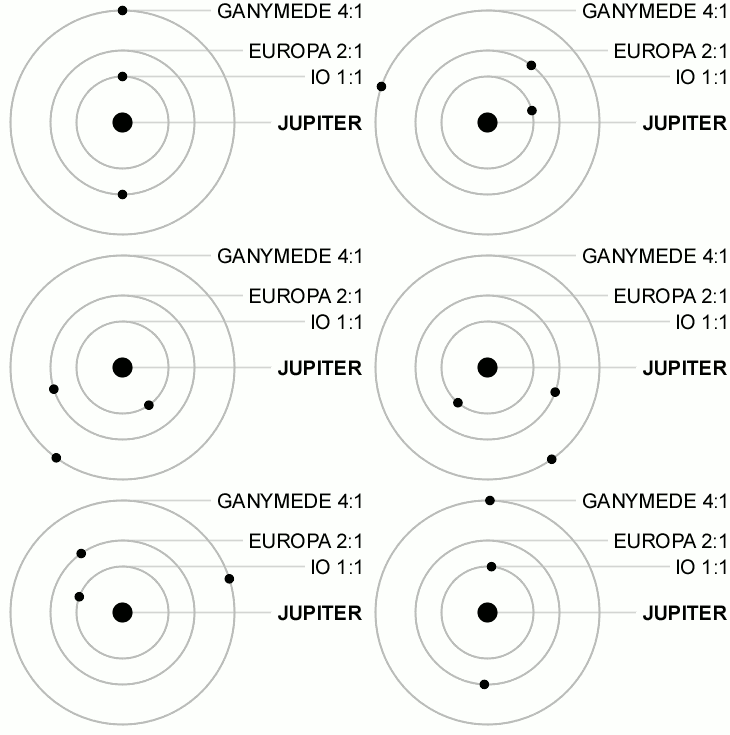
Galilean_moon_Laplace_resonance_animation.gif

We have much more to learn, and have only seen the foot of gravity mountain.
 
Last edited:

ISF - Join now!

Every member here is approved by hand. No bots, no spam, just people who care about evidence and honest debate.

Membership is free!

Create your free account

Back
Top Bottom