If you jump up from the ground on a windy day, you will be blown by the wind so that the wind will appear to "stop" in exactly the same way.It is exactly the same. If my feet leave the belt, the "wind" stops. That will not happen in the wind, so I can conclude that the belt is moving, and not the air.

You are using an out of date browser. It may not display this or other websites correctly.
You should upgrade or use an alternative browser.
Moderated The validity of classical physics - Part 2
- Thread starter Dan O.
- Start date
-
- Tags
- newtonian physics
What does it matter how long it takes to stop? It will stop. The claim is for "steady state".
The ball is only driven by the belt while the observer holds it. Do you expect that a ball thrown from a car will continue to travel as if still powered by the car?
No. I expect it will act exactly the same as if I threw the ball in a wind -- the air will push it backward.
Again, what is the difference between how you and the air interact that depends on which of the two of you are moving?
Michael C
Graduate Poster

Mac Gaunaa gave a very interesting presentation. I recommend it to everybody, "deniers" and "carteers" alike. For the "deniers": instead of making flippant comments, or just ignoring the whole thing, why not try to understand Mac's arguments? You'll see that he uses the same force/power arguments that are illustrated in Drela's diagram. You'll also see an animation showing a cart working just like the "under the ruler faster than the ruler" cart (in part 4; it's first seen the other way up, as an "up ruler" cart, in part 2). He doesn't spend too much time explaining why the treadmill in still air is equivalent to wind over the ground, probably since he expects his audience to find this pretty obvious.
Thanks, Mac, for a fascinating talk. I hope your upwind vehicle beats the speed of the wind. I've added the youtube links to your message, for easy reference:
Thanks, Mac, for a fascinating talk. I hope your upwind vehicle beats the speed of the wind. I've added the youtube links to your message, for easy reference:
Hi all,
I see that news travel fast around here, so I'm not the first to announce that my presentation of the theory for wind turbine cars and faster than the wind vehicles can now be found on youtube. Despite that I'd still like to introduce it to you:
I have now finally managed to shoot a video of a slightly updated version of the presentation I gave Sep. 24th at the 2009 Aeolus wind turbine car race in Stauning (Denmark) for the Danish Society of Engineers. The original title of the presenation was "The Aeromechanics of Wind Turbine Cars", but perhaps a better title would have been "Travelling in line with the wind using the wind" because I devote almost half of the time to talk about the DDFTTW (Directly Downwind Faster Than The Wind) vehicles, which has been rather heavily debated around here. For this reason I posted the video on Youtube for your viewing pleasure (or pain). The full presentation is close to 55 minutes, so please take your time when viewing it. Due to the constraints of youtube I split it into 6 parts.
Part 1: Introduction and a bit of history.
Part 2: A teaser & How it works #1 (Basic principles).
Part 3: How it works #2 (The main result).
Part 4: How it works #3, How fast will a WT car go and DDWFTTW theory.
Part 5: DDFFTW practical proof and attempts at easier understandable
explanations.
Part 6: Advanced topics, further reading material and closing.
And for reference, my strange last name is Gaunaa
There was quite a few spots where for some reason the things I had planned to say came out more or less reversed. However, I still think my view of how things are connected does come through, so I hope that you will enjoy the videos.
-Mac G

Just to clarify. If I were in a vacuum (or, heck, just inside the car), I would expect the ball to head straight up and straight back down compared to me, and not to slow down at all despite no longer being in contact with the car, regardless of whether the car is moving or not. A ball thrown from a stationary car in 50 mph winds will be blown backwards just like a ball thrown from a 50 mph car.
ThinAirDesigns
Graduate Poster
- Joined
- Nov 10, 2008
- Messages
- 1,058
Gentlemen ... welcome to the Humberverse.
JB
Subduction Zone
Muse

- Joined
- Dec 23, 2008
- Messages
- 999
D'rok, I cannot find it the conversation I had with humber, but he was actually sane for the greater part of it. I could repeat it if you wanted to play the part of humber. All you have to do is agree to things that seem reasonable.
D'rok
Free Barbarian on The Land

- Joined
- Dec 29, 2006
- Messages
- 6,399
D'rok, I cannot find it the conversation I had with humber, but he was actually sane for the greater part of it. I could repeat it if you wanted to play the part of humber. All you have to do is agree to things that seem reasonable.
No worries. Thanks for the effort. I'm good for now, just lurking and occasionally questioning. If I get confused down the road, can I take you up on your offer then?
Mac Gaunaa
New Blood
- Joined
- May 6, 2009
- Messages
- 10
Hey all again,
While browsing around here I stumbled on some post talking about a paper by Mark Drela that should have some relation to the DDWFTTW issue. If anybody know what that is I'd be very interested to have the title or something else that can help me get my hands on it.
Actually I got the inspiration to recast the theory I had for the wind car into what I show in the presentation and paper after one night of talking to Mark Drela at a dinner connected to a workshop we both attended here in Denmark. He is a seriously bright fella.
-Mac G
Mac Gaunaa
New Blood
- Joined
- May 6, 2009
- Messages
- 10
And thanks Michael C for the positive comments about the presentation.
-Mac G
Subduction Zone
Muse
- Joined
- Dec 23, 2008
- Messages
- 999
No worries. Thanks for the effort. I'm good for now, just lurking and occasionally questioning. If I get confused down the road, can I take you up on your offer then?
I'd be glad to at any time. Meanwhile happy lurking.
ThinAirDesigns
Graduate Poster
- Joined
- Nov 10, 2008
- Messages
- 1,058
Hey all again,
While browsing around here I stumbled on some post talking about a paper by Mark Drela that should have some relation to the DDWFTTW issue. If anybody know what that is I'd be very interested to have the title or something else that can help me get my hands on it.
Actually I got the inspiration to recast the theory I had for the wind car into what I show in the presentation and paper after one night of talking to Mark Drela at a dinner connected to a workshop we both attended here in Denmark. He is a seriously bright fella.
-Mac G
http://www.mediafire.com/download.php?xdmjm0von5q
http://www.mediafire.com/download.php?xbzbcyjy0b1
JB
humber1, Will you explain where you came up with your equations? The first looks similar to one of mine but you dropped the term for friction on cart 1. The second just includes two newly invented terms.
Knowing that humber is simply trying to derail this analysis by injecting his nonsense, I will continue using my equations.
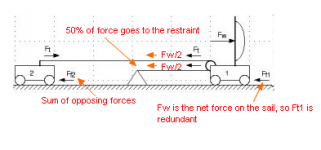
Using substitution, we get the equation:
The next step is to expand this equation by substituting the formulas that these forces come from. Those were all provided earlier if someone wants to go back and fetch them to produce the expanded equation.
- Fw = 2*Ff2 + Ff1
You have added an unnecessary term or two. The force from Cart1 is Fw. That force is derived from the drag equation, and represents the force on the cart to keep it Vc, so Ft1 is redundant. (If you would avoid the use of "sub", that would make it easier to read equations from the edit box)
Ft2 is the sum of all opposing forces,
Ft = 1/2Fw. ( half goes to the restraint)
So the net force on Cart2 is Fw/2 - Ft2. From the previous post and substituting 2V for Cart2's velocity
Fnet = 0.5*K2*(Vw-Vc)^2 - K1(2Vc)^2
Where
(1) K1 and K2 are the concatenated drag coefficients.
(2) Fw is given by your drag equation
(3) Cart2 drag is proportional to the square of its velocity (2*Vcart1)
Attachments
ThinAirDesigns
Graduate Poster
- Joined
- Nov 10, 2008
- Messages
- 1,058
Of course, we would do well to remember that it matters not that we have several very clear papers from Drela, and additionally Mac G spend an entire evening conversing with Dr. Drela on these topics in person, only Humber, who has never had a single exchange of any kind with Drela can know what Drela is truly thinking
According to Humber, Drela says his rotor in the air is a turbine, in spite of Drela himself insisting it's a prop.
JB
Last edited:
Are you claiming that the way you interact with the air (it accelerates you in the direction of the apparent "wind") will be different if you and the treadmill are moving than if the wind is moving? Can you show what this difference would be?
The wind will accelerate you in the direction of the wind. Which way does drag accelerate you? There is no motive force without being attached to the belt.
You insist that they are the same despite the obvious differences. It looks more like simple belief than anything to do with Galileo.
My position is unchanged.
Back to the original question. You are an object on that belt. What measurement can you take to determine whether the belt is moving through still air or the wind is blowing over a stationary belt?
Do you not see what you are doing? Reducing and restricting the world, until it becomes impossible to tell the difference, and then argue from that point. Just like a Creationist and every other woo-salesman ever born.
It does not matter that you "can't tell," that is Spork's misreading of both Galileo and Einstein.
In his ship, Galileo concluded that the motion of the ship did not affect the motion of objects below deck. Please show any evidence that he thought "knowing" or not made a difference. After all, he knew, even if the portholes were covered. Do you think objects would behave differently for blindfolded crewmen?
The problem for you, is that you need to live in a world of "belts in space", with no gravity or any other effects. But the belt is real, and so it the wind it is said to model, and that means I compare the belt with that, and not some sophomoric "thought experiment". Get real.
If you jump up from the ground on a windy day, you will be blown by the wind so that the wind will appear to "stop" in exactly the same way.
But you won't. If you hit a tree, that may hurt, but would be unlikely to knock some sense in to you, as you will say the tree hit you.
In the direction of the wind.The wind will accelerate you in the direction of the wind. Which way does drag accelerate you?
You're on a giant treadmill, and the air is moving 5 mph to the south. If you jump straight up, the air will accelerate you toward the south. How can you tell whether the air is slowing you down (if you and the treadmill were moving) or speeding you up (if you and the treadmill were stationary and the air was moving)? How will the experiences differ?
Similarly, when you hit the ground again, the treadmill will accelerate you toward the north to cancel whatever acceleration the air did to the south while you were in the air; this is what will happen whether the treadmill was moving or not. Again, how can you tell whether the treadmill is speeding you up (if you and the treadmill were moving) or slowing you down (if you and the treadmill were stationary and the air was moving)? How will the experiences differ?
Hey all again,
While browsing around here I stumbled on some post talking about a paper by Mark Drela that should have some relation to the DDWFTTW issue. If anybody know what that is I'd be very interested to have the title or something else that can help me get my hands on it.
Actually I got the inspiration to recast the theory I had for the wind car into what I show in the presentation and paper after one night of talking to Mark Drela at a dinner connected to a workshop we both attended here in Denmark. He is a seriously bright fella.
-Mac G
http://www.internationalskeptics.com/forums/attachment.php?attachmentid=15433&stc=1&d=1256057590
http://www.internationalskeptics.com/forums/attachment.php?attachmentid=15434&stc=1&d=1256057624
Please note that these papers are incomplete, and include arbitrarily low wheel losses, and assumes the conclusion in the derivation.
That aside, his cart is not at all like Spork's cart, but a straight froward turbine.
In the water version, the water turbine is like the wheels; a load for the propeller.
Attachments
Last edited:
D'rok
Free Barbarian on The Land
- Joined
- Dec 29, 2006
- Messages
- 6,399
Well, that's about as close to an admission as I've ever seen from humber, at least since I've been lurking.It does not matter that you "can't tell,"
Cool.