
Moderated The validity of classical physics - Part 2

(1) A man standing with his back to the wind, feels a force F driving him in the direction of the wind. He is not moving, so the net force is zero, meaning that the friction to the ground must be providing the force -F.
If he jumps, the force F will still be there, and the net force becomes F.

(2) A man standing on the belt also feels the force F. He is not moving relative to the belt, so his feet are supporting a force -F.
If he jumps, F disappears.

On the treadmill, the force is dependent upon the motion of the belt, but in the wind, is not dependent upon the ground or road. They are not equivalent.

1) The force from the wind is present as long as the air is moving relative to the man.
2) The force from the wind is present as long as the air is moving relative to the man.

They are equivalent.
 
I know exactly what you're trying to find out, but to have a true exchange you must also answer questions that I ask.

I have asked a very simple one above which will help ensure that we are using terms in the same manner. There's not much point in an exchange if we aren't using the terms in the same way.

Quid pro quo.

JB

Of course the prop is part of the cart. Now what makes the prop spin?
 
Last edited:
1) The force from the wind is present as long as the air is moving relative to the man.
The force from the wind is always on the man.

2) The force from the wind is present as long as the air is moving relative to the man.
They are equivalent.

The force on the man is not present unless he in in contact with the belt.
No matter how many similarities you offer, those differences remain.
Not equivalent. I need only one difference and there are many.

Just to make it clear, a red balloon and a red car are not the same just because they are both red.
 
Of course the prop is part of the cart.

Well then, were back where we started with you contradicting yourself. Here is your quote from just a bit ago:

I only said there no wind relative to the cart.

If the prop is part of the cart as you say above, and the prop is spinning, then there obviously IS wind relative to the cart.

Now what makes the prop spin?

If, as you say":

A: there is "no wind relative the cart"
B: "Of course the prop is part of the cart"

then why would you ask that question? The prop CAN'T be spinning AT ALL if your statements are true.


You have to make up your mind if there is or if there is not wind relative to the cart -- you can't get anywhere when you keep contradicting yourself. IF THE PROP IS SPINNING THEN THERE IS WIND RELATIVE TO THE PROP.

We can only discuss WHY things happen when we agree WHAT is happening.

So, I'll ask you again -- do you concede that when the cart is moving ddw at exactly windspeed, there is relative wind over the airfoils? You have repeatedly stated that this is not the case -- have you changed your mind?

JB
 
Last edited:
The force from the wind is always on the man.

The force on the man is not present unless he in in contact with the belt.

The force from the ground or the treadmill belt is not present when the man jumps; the force from the air however is present because he is still in contact with that air but is moving at a different speed. His motion relative to the air is the same as he jumps, therefore the force he feels from the air moving by will be exactly the same and he will experience exactly the same acceleration from that and the exact same displacement relative to the surface he was standing on. The laws of physics apply to both cases, not just the first one.

The two cases are equivalent as long as the man doesn't magically become exempt from inertia. This also true of your man jumping on an aircraft carrier, which is why your man won't be able to tell if the aircraft carrier is moving in still air or still in moving air.

You cannot ignore the laws of physics in order to justify your bizarre reasoning and statements, as you have repeatedly tried in the past and have attempted again here. Present your case without resorting to magic for a change.

To reverse one of your humberisms (the first on my list) you are suggesting a change in motion (instantly!) without sufficient force needed to achieve that change.
 
Last edited:
The force from the ground or the treadmill belt is not present when the man jumps;
So there is no force of the wind when not traveling with the belt. That is not like the wind. The observer is only part of the belt frame is he is attached to the surface.

the force from the air however is present because he is still in contact with that air but is moving at a different speed.
He will slow to a stop once his KE has expired. That leads to the obvious problem that he will be moving towards windspeed (stopped), even though he has no power. Free windspeed! That is not like the wind.

His motion relative to the air is the same as he jumps, therefore the force he feels from the air moving by will be exactly the same and he will experience exactly the same acceleration from that and the exact same displacement relative to the surface he was standing on. The laws of physics apply to both cases, not just the first one.
Objects that are not being driven directly by the belt will slow to stop once their KE is expended. That does not happen in the wind. The wind continuously drives the object.

The two cases are equivalent as long as the man doesn't magically become exempt from inertia. This also true of your man jumping on an aircraft carrier, which is why your man won't be able to tell if the aircraft carrier is moving in still air or still in moving air.
His "inertia" is the same in both cases. He has the same mass.

You cannot ignore the laws of physics in order to justify your bizarre reasoning and statements, as you have repeatedly tried in the past and have attempted again here. Present your case without resorting to magic for a change.
Yeah, sure.

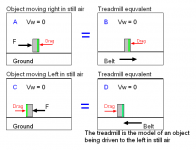
The observer attached to the belt is the equivalent of being driven by force F in still air.
in still air. The force F may be provided by an engine, but on the treadmill is is the belt. That is the only difference, and why the objects must be attached to the belt, otherwise their power is cut off. Simple.
(A) and (B) are moving to the right
(C) and (D) are moving to the left.
The treadmill is (D) but with the observer turned through 180 degrees as indicated by the green line. There is no wind, because its the belt that moves in still air. It's really a model of itself.

attachment.php
 

Attachments

  • upwind.png
    upwind.png
    14.1 KB · Views: 39
Last edited:
humber, every single point in your last post was wrong. And your attempt at making two equivalent frames of reference was wrong also. Try again. If you bring them up one point at a time I will be happy to fix them for you.
 
Last edited:
So there is no force of the wind when not traveling with the belt. That is not like the wind. The observer is only part of the belt frame is he is attached to the surface.


He will slow to a stop once his KE has expired. That leads to the obvious problem that he will be moving towards windspeed (stopped), even though he has no power. Free windspeed! That is not like the wind.


Objects that are not being driven directly by the belt will slow to stop once their KE is expended. That does not happen in the wind. The wind continuously drives the object.


His "inertia" is the same in both cases. He has the same mass.


Yeah, sure.

The observer attached to the belt is the equivalent of being driven by force F in still air.
in still air. The force F may be provided by an engine, but on the treadmill is is the belt. That is the only difference, and why the objects must be attached to the belt, otherwise their power is cut off. Simple.
(A) and (B) are moving to the right
(C) and (D) are moving to the left.
The treadmill is (D) but with the observer turned through 180 degrees as indicated by the green line. There is no wind, because its the belt that moves in still air. It's really a model of itself.

[qimg]http://www.internationalskeptics.com/forums/attachment.php?attachmentid=15414&stc=1&d=1255826719[/qimg]

No.

JB
 
Objects that are not being driven directly by the belt will slow to stop once their KE is expended. That does not happen in the wind. The wind continuously drives the object.

Sort of; the object that is in the air and not touching the ground will be driven to the same speed as the air. It doesn't matter whether the air is traveling at 5 m/s or 50 m/s or 0 m/s, once only the air is influencing the motion, the object will be driven by the air until it reaches the speed of the air.

We should take this one point at a time so I can see where you are going wrong.
 
Last edited:
humber, every single point in your last post was wrong. And your attempt at making two equivalent frames of reference was wrong also. Try again. If you bring them up one point at a time I will be happy to fix them for you.

There are no frames to talk about. The observer moving with the belt, IS moving with the belt, and that it why it behaves exactly like an observer moving with the belt. Such a machine could represent an observer in a tailwind, but not this machine.
 
Sort of; the object that is in the air and not touching the ground will be driven to the same speed as the air.
The object in the air has nothing to drive it. Why do you continue to make the same mistake?

It doesn't matter whether the air is traveling at 5 m/s or 50 m/s or 0 m/s, once only the air is influencing the motion, the object will be driven by the air until it reaches the speed of the air.
The object in the air has nothing to drive it, so it will slow against the still air of the room.


We should take this one point at a time so I can see where you are going wrong.
Yeah, sure.
Like with Maximum Power Theorem?
 
The object in the air has nothing to drive it.

Good. The only thing keeping the object in motion relative to the air is the motion that it had before the object left the ground or the belt. It is the mass of the object vs the mass of the air. The surface area presented to the air by the object times the square of the relative speed difference between the object and the air is the amount of force acting to accelerate the object and also the air (equal and opposite)

The KE of the object will be exchanged with the KE of the air in both cases. When there is no relative motion between the air and the object, no more KE can be exchanged and the object will be at rest relative to the air, whether the air is moving at 0 m/s, 5 m/s, or 50 m/s.
 
Last edited:
There are no frames to talk about. The observer moving with the belt, IS moving with the belt, and that it why it behaves exactly like an observer moving with the belt. Such a machine could represent an observer in a tailwind, but not this machine.

Your illustrations looked like you were trying to show frames of reference, they were wrong, try again.
 
And I see that mender made the same offer I did. There were so many errors it is just too much work to try to tackle them all at once. One at a time and you just might understand. Though I doubt it.
 
Good. The only thing keeping the object in motion relative to the air is the motion that it had before the object left the ground or the belt.
There is no magical connection to the belt after the object has left the belt.
The object continues to move because it has momentum, but is slowed by friction (drag) with the air. That is the same mistake as earlier.

It is the mass of the object vs the mass of the air. The surface area presented to the air by the object times the square of the relative speed difference between the object and the air is the amount of force acting to accelerate the object and also the air (equal and opposite)
The object dissipates its KE against the drag of motion. That is the same mistake again.

The KE of the object will be exchanged with the KE of the air in both cases.
The KE will be dissipated as heat, the result of friction (drag) with the air.
The same mistake again.

When there is no relative motion between the air and the object, no more KE can be exchanged and the object will be at rest relative to the air, whether the air is moving at 0 m/s, 5 m/s, or 50 m/s.
The air is not moving. The air in the room is still. Once the object's KE is dissipated, it will come to a stop relative to the air's velocity of 0m/s. That is the same state as "windspeed". The system is contradictory.
 
And I see that mender made the same offer I did. There were so many errors it is just too much work to try to tackle them all at once. One at a time and you just might understand. Though I doubt it.
Then why not start with one at a time? Saying there are just too many errors to address is a pretty weak rebuttal. Think of the children, SZ. How many might be confused by so much wrongness going unchallenged? Why not start with explaining how humber-along with Christoff and tsig-is confused about reference frames. I can never read that one too many times. :D And while you're recapping for the benefit of noobs, explain again how after reaching wind speed the wheels are turning the prop, another favorite. :eek:
 
Okay humber, I see that it is you that is still making the same mistakes. Let's try to go through these one at a time.

There is no magical connection to the belt after the object has left the belt.
The object continues to move because it has momentum, but is slowed by friction (drag) with the air. That is the same mistake as earlier.

Yes, this is your same mistake as earlier. There is no difference between the "drag" that the man jumping off of the treadmill would feel and that the man jumping up in the wind would feel. Drag = wind.

The object dissipates its KE against the drag of motion. That is the same mistake again.

Yes, I can see that you are admitting that you are making the same mistake again. The person's relative KE would dissipate in the same way that the person's relative KE to the wind would dissipate. Keep practicing and you just might get it.

The KE will be dissipated as heat, the result of friction (drag) with the air.
The same mistake again.

Yes, you are still making the same mistake again, keep admitting it and you might get it. The KE from the person jumping from the treadmill will dissipate exactly the same as the person jumping in the wind.

The air is not moving. The air in the room is still. Once the object's KE is dissipated, it will come to a stop relative to the air's velocity of 0m/s. That is the same state as "windspeed". The system is contradictory.

The system is not contradictory humber you are. As you have been told many times over KE is relative. So KE will be dissipated when an object moves through something else. So what? All I can say is keep trying and you might understand this.
 
Then why not start with one at a time? Saying there are just too many errors to address is a pretty weak rebuttal. Think of the children, SZ. How many might be confused by so much wrongness going unchallenged? Why not start with explaining how humber-along with Christoff and tsig-is confused about reference frames. I can never read that one too many times. :D And while you're recapping for the benefit of noobs, explain again how after reaching wind speed the wheels are turning the prop, another favorite. :eek:

As you see I already did. It is really not a weak excuse when someone makes so many mistakes that you cannot keep track of them. But when I looked at it in more depth it looks like he was making the same mistake over and over again.
 
Then why not start with one at a time? Saying there are just too many errors to address is a pretty weak rebuttal. Think of the children, SZ. How many might be confused by so much wrongness going unchallenged? Why not start with explaining how humber-along with Christoff and tsig-is confused about reference frames. I can never read that one too many times. :D And while you're recapping for the benefit of noobs, explain again how after reaching wind speed the wheels are turning the prop, another favorite. :eek:

There's no point. humber makes the same old wrong assertions over and over, and people correct him over and over. Once you've seen this horse go by 1217 times on the merry go round, it begins to lose its luster.

Incidentally, the wheels turn the prop from the very start. We don't have to wait for the cart to get to wind speed.

See, I explain the same things over and over too. None of us can be helped.
 

ISF - Join now!

Every member here is approved by hand. No bots, no spam, just people who care about evidence and honest debate.

Membership is free!

Create your free account

Back
Top Bottom