Moderated The validity of classical physics - Part 2

More mass, more weight, but the force of gravity stays constant. The total force that gravity exerts is m*g.

These two sentences directly contradict one another. Is the force of gravity a constant, or is it m*g?
 
I'm not explaining this again before you demonstrate you know what a reference frame does.
Oh but it does. The examples are directly analogous to what you are doing wrong.
I see. The fan is turned on, and now the plane is "flying". Does the KE you say is there, appear when the fan is turned off? Surely it would move forward a bit on that? Can the dynamic forces of the wind on the plane, be in effect if replaced by the reactive force of a rigid model mounting?

Yes it is. In fact, if we take this example a little further, we can actually make a remote controlled airplane fly in this way, if the fan is powerful enough. And the curious thing is: the plane will fly without any kinetic energy, but will noetheless expend power to enable it to fly.
Can you attach a data logger to the model to show that is the case?
How will the presumably static instruments record acceleration?

Work = force*distance. A propeller cannot do much work when it is stationary. Static thrust, but not much work. The engine of your model will do work on the air passing over it, so accelerating it, but none on the plane. Next!

In fact, it will expend exactly as much power as when it's flying through still air at a velocity equal to the negative of the fan air velocity.
I see. That tiny engine can instantly carry the plane to a velocity equal to the fan? How long does a real plane take to do that? To get to speed, the plane must work against all opposing forces and add KE to its mass. One simple experiment, involving a piece of cardboard placed between the fan and the plane, will mock your claim.

...kinetic energy is not "arbitrarily assigned". It follows, for each separate object and via strict rules, from the choice of reference frame. The reference frame defines a position reference and a zero-velocity level.
Precisely like with Volts and gravitational potential energy.
No, it follows from the work that is done on the object. If there is work in one frame, there is work in all the others. That is a direct consequence of thermodynamics, which says that work is done both at the source and load during energy transfer. That means at least two frames, and if that's true, all frames.

Sticks? I'm going to assume when you say "sticks" you mean what I called "some floating object".Let me try that...I note a few things:

1.I'm not sure bananas float, but if they do, they are in fact floating objects and therefore change nothing about the experiment.
2.Measuring the speed of a car driving at wind speed is a strange way of measuring the speed of the wind, but it will work if you can pull it off.
Why? If I travel at the speed of the wind then that is the same relative velocity. It makes not difference to the outcome of your test, but a car is nothing like the wind, and I think that huge physical difference should produce a change.

Irrelevant. The differential equations will involve the velocities. Solving the equations with the transformed velocities will give you the correct answer in the transformed frame. Transforming the answer back to the original frame will give you the correct answer in that frame.
No. To get you relative result, are assuming that at, say, 10kph the drag is X. Then you add 10 to that to get 2X. That is wrong. Your idea only works if at 10kph, the drag is zero. (The object would then be exactly at the speed of the water, and that is a naive assumption, and incorrect as well.)

First of all, why on earth do we need the two upside-down measurements?
Secondly, there is no need to do this experiment if we just do the math.
Thirdly, I don't have time to do the math now, but I can guarantee you that the forces on the hull and the sail will be identical between drawing (3) and drawing (4).
Finally, I might do the math in 2D for a cylinder cross-section halfway submerged in inviscid water later. An infinitely long, suspiciously straight and cylindrical banana, if you will.
There are many tests, a turbine power generator will give different results in each case.

You can do the cylinder, but you will need to use a method that is based on momentum, as simple drag in inaequate. Obviously, it can't be infinitely long, or you can't include the dominant end effects!
Making the water inviscid, will simply the momentum calculations.
If you do that calculation, it will show that some of the energy applied to the object from the water, is transferred from the object back to the water, and that will prevent travel at the speed of the water.

First of all, why on earth do we need the two upside-down measurements?
In the case of my drawings the water will drive the cylinder in one case, and the air in the other. You can fudge matters by insisting that the barrel moves at exactly waterspeed or wind speed, but that is not physically possible.
Using an asymmetrical device like a sail boat, and inverting it, thwarts that media-speed ploy, even if true.

I don't want to keep repeating myself. I do this solely for my own amusement, see?
Do give it a try

You seem to have ignored the runner's treadmill. You are making the same mistake there. I said that the belt had nothing to do with implied travel, but just moved the legs in a way that allowed the runner to perform the bio-mechanics of running. I think that is why they are called "exercise" machines and not tailwind simulators.

Here are two others. One is a skiing machine, and the other an elliptical running machine. I think you may have trouble with implied motion in those cases. The standard belt treadmill is just another cheaper and more robust design.


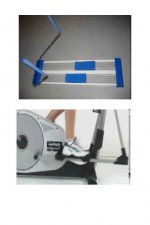
attachment.php
 

Attachments

  • pedal.jpg
    pedal.jpg
    11.8 KB · Views: 59
These two sentences directly contradict one another. Is the force of gravity a constant, or is it m*g?

That is the difference between weight and gravitational force.

If you try to accelerate something with a force of a rocket, the more mass, the greater the force needed for a given acceleration, right? But note that the force of the rocket does not depend on the mass.

Gravity is different, it pulls on the body with a (total) force that is dependent on the mass.

However, that force itself is constant, and analogous to the fixed force of the rocket's engine. That is what Einstein hoped to show in his elevator.
 
Last edited:
That is the difference between weight and gravitational force.

If you try to accelerate something with a force of a rocket, the more mass, the greater the force needed for a given acceleration, right? But note that the force of the rocket does not depend on the mass.

Gravity is different, it pulls on the body with a (total) force that is dependent on the mass.

However, that force itself is constant, and analogous to the fixed force of the rocket's engine. That is what Einstein hoped to show in his elevator.

Weight is a measurement of the force of gravity on an object.

It seems to me like you have a whole bunch of concepts all muddled together. Just so I can try to understand how you use terms, can you please define the following for me:

1. Gravity
2. Gravitational force
3. Force of gravity
4. Acceleration due to gravity
5. Gravitational constant

Thanks.
 
Weight is a measurement of the force of gravity on an object.
It seems to me like you have a whole bunch of concepts all muddled together. Just so I can try to understand how you use terms, can you please define the following for me:
1. Gravity
The attractive force between mass and the Earth.

2. Gravitational force
3. Force of gravity
Mixed in use? I mean the force between masses.

4. Acceleration due to gravity
The resultant acceleration due to that total force of gravitation on the mass

5. Gravitational constant (is constant)
It is all but constant near the mass. The gravitational force on the space station is only 3% less than at the surface. (wikki that if you like)

The usage is a problem;
http://en.wikipedia.org/wiki/Gravitation
"The terms gravitation and gravity are mostly interchangeable in everyday use, but a distinction is made in scientific circles. "Gravitation" is a general term describing the phenomenon by which bodies with mass are attracted to one another, while "gravity" refers specifically to the force exerted by the Earth on objects in its vicinity, which depends on its mass as well as other factors, such as Earth's rotation."

"Gravitation" is a force. If is is universally applicable, it should be like all the other forces, and have no dependency on mass. That would mean that under the Earth's gravity, objects would accelerate according to mass. But does not happen, because gravitation is concentrated by the mass and proportional to that mass, so all masses accelerate at the same rate.

Once that effect is understood, you see that there is a constant force behind it Earthly gravity, that is independent of mass. It is a complex topic, and posts are limited.
 
Last edited:
1. Gravity
The attractive force between mass and the Earth.

2. Gravitational force
3. Force of gravity
Mixed in use? I mean the force between masses.

4. Acceleration due to gravity
The resultant acceleration due to that total force of gravitation on the mass

5. Gravitational constant (is constant)
It is all but constant near the mass. The gravitational force on the space station is only 3% less than at the surface. (wikki that if you like)

The usage is a problem;
http://en.wikipedia.org/wiki/Gravitation
"The terms gravitation and gravity are mostly interchangeable in everyday use, but a distinction is made in scientific circles. "Gravitation" is a general term describing the phenomenon by which bodies with mass are attracted to one another, while "gravity" refers specifically to the force exerted by the Earth on objects in its vicinity, which depends on its mass as well as other factors, such as Earth's rotation."

"Gravitation" is a force. If is is universally applicable, it should be like all the other forces, and have no dependency on mass. That would mean that under the Earth's gravity, objects would accelerate according to mass. But does not happen, because gravitation is concentrated by the mass and proportional to that mass, so all masses accelerate at the same rate.

Once that effect is understood, you see that there is a constant force behind it Earthly gravity, that is independent of mass. It is a complex topic, and posts are limited.

My bad on number 2. I should have said "gravitation", not "gravitational force".

If you are defining "force of gravity" as "the [attractive] force between masses", then you are using it interchangeably with "gravitation". This would seem to an error. The force of gravity is calculable and depends on the mass of objects under gravitation.

I think you are totally out to lunch on number 5, but I don't really understand equations, so I won't try to venture an explanation of what the gravitational constant is. I will say that I think you may be assuming that it is a mathematical constant rather than a physical constant.

Gravitation is a universal force, but the force of gravity or gravitation is mass dependent.

Corrections from the usual suspects welcome.
 
Last edited:
My bad on number 2. I should have said "gravitation", not "gravitational force".

If you are defining "force of gravity" as "the [attractive] force between masses", then you are using it interchangeably with "gravitation". This would seem to an error. The force of gravity is calculable and depends on the mass of objects under gravitation.

I think you are totally out to lunch on number 5, but I don't really understand equations, so I won't try to venture an explanation of what the gravitational constant is. I will say that I think you may be assuming that it is a mathematical constant rather than a physical constant.

Gravitation is a universal force, but the force of gravity or gravitation is mass dependent.

Corrections from the usual suspects welcome.

Ok, but the whole matter is not related to the cart.

Gravitation is what produces the constant force that in known as "gravity." in the everyday sense.
There is a force per unit kilogram, and that is the Newton; that is the unit of "the force of gravity"
That is not gravitational force, because there is mass in the equation that defines the Newton.
 
I see. The fan is turned on, and now the plane is "flying". Does the KE you say is there, appear when the fan is turned off?
No, quite the opposite in fact. The KE that is there actually appears when the fan is turned on.

Can the dynamic forces of the wind on the plane, be in effect if replaced by the reactive force of a rigid model mounting?
Yes, but in that case, and this is important, you can only model flight situations in which the aircraft does not accelerate.

Work = force*distance. A propeller cannot do much work when it is stationary. Static thrust, but not much work. The engine of your model will do work on the air passing over it, so accelerating it, but none on the plane.
If the propeller accelerates air (i.e. changes the impulse of a mass of air), as you admit, and the propeller is fixed to the aircraft, as is common engineering practise, we can only conclude that the air must exert a force on the propeller and therefore on the aircraft. The propeller does work on the air, and the air doe work on the airframe. The integral of this is exactly the same amount of work it costs to propel the aircraft forward in still air.

One simple experiment, involving a piece of cardboard placed between the fan and the plane, will mock your claim.
No it will not. It will demonstrate that an aircraft experiencing a sudden very large gust of tail wind will plummet from the sky, very much like a brick.

If there is work in one frame, there is work in all the others. That is a direct consequence of thermodynamics, which says that work is done both at the source and load during energy transfer. That means at least two frames, and if that's true, all frames.
True, but kinetic energy is not work. It's quite like potential energy.

No. To get you relative result, are assuming that at, say, 10kph the drag is X. Then you add 10 to that to get 2X. That is wrong. Your idea only works if at 10kph, the drag is zero. (The object would then be exactly at the speed of the water, and that is a naive assumption, and incorrect as well.)
You seem to forget that in transforming the velocity of the water and air we also transformed the velocity of the object. The drag of an object depends on the difference between its own velocity and the velocity of the medium it's in. Since we are adding the same offset to both of these speeds, the difference between them does not change.

Back to your example: If I say in one frame, where the object moves through the water at 10 kph, and the drag is X, then under a Galilean transformation the object will move through the water at 10 kph, and the drag will be X. What has changed is the speed of the everything relative to us; nothing else.

Here are two others. One is a skiing machine, and the other an elliptical running machine. I think you may have trouble with implied motion in those cases. The standard belt treadmill is just another cheaper and more robust design.
Implied motion? I guess I would have trouble yes, depending on what you mean.

Also, whereas the treadmill is a reasonably accurate equivalent for walking on a stationary surface, there is no such equivalent for an elliptical walker. The ski machine is reasonably equivalent, but models the friction of a ski and snow by other means. It is more of a force equivalent model, rather than a complete one.
 
Definition
The newton is the unit of force derived in the SI system; it is equal to the amount of force required to accelerate a mass of one kilogram at a rate of one metre per second per second. Algebraically:
[LATEX]\rm 1~N = 1~\frac{kg\cdot m}{s^2}}.[/latex]

I bet you know of Einstein's Elevator? You know of it, but quite clearly you don't understand what it means. F=mg, F=ma (show that g is a)

You contradict yourself again. Your last line shows g as an acceleration (which is correct). But an acceleration is not the same thing as a force. You cannot simply substitute the value of an acceleration as the value of a force, because they are not the same thing. Your claim that the force of gravity is 9.81 Newtons has no basis in reality or in mathematics. This is such a basic failure on your part that you will have no hope of figuring out anything else if you can't even get the distinction between force and mass correct.
 
No, quite the opposite in fact. The KE that is there actually appears when the fan is turned on.
So we could measure this? Taking the plane in and out of the stream at a regular rate, would show an increase in the fan's power consumption, that can be shown to be related to the plane's KE? Are you serious?
Instant acceleration to the speed of the fan's air?

Yes, but in that case, and this is important, you can only model flight situations in which the aircraft does not accelerate.
Bang goes your dynamic equivalence. No acceleration, no dynamic motion.

If the propeller accelerates air (i.e. changes the impulse of a mass of air), as you admit, and the propeller is fixed to the aircraft, as is common engineering practise, we can only conclude that the air must exert a force on the propeller and therefore on the aircraft.
Force is not work. There is a reactive force that is met by whatever is holding the model in place. That is static, and so no work. No work, no KE.

The propeller does work on the air, and the air doe work on the airframe. The integral of this is exactly the same amount of work it costs to propel the aircraft forward in still air.
The engine must do work against the forces of drag and supply the planes KE as it accelerates. At a constant speed it has KE, but there is no acceleration, but the drag forces are there. Still no KE of motion for the airframe.

No it will not. It will demonstrate that an aircraft experiencing a sudden very large gust of tail wind will plummet from the sky, very much like a brick.
True, but kinetic energy is not work. It's quite like potential energy.
Potential energy only exists in fields. Fields such as gravity accelerate the mass and it gains KE.

You seem to forget that in transforming the velocity of the water and air we also transformed the velocity of the object. The drag of an object depends on the difference between its own velocity and the velocity of the medium it's in. Since we are adding the same offset to both of these speeds, the difference between them does not change.
Yes, but that is still not right. If an object can travel at 9kph in a 10kph flow, it does not mean that it will travel at 19kph in a 20kph flow, or even 18kph. Drag is non-linear, so you would need to justify that the differential is not dependent on the absolute velocity of the flow.

Back to your example: If I say in one frame, where the object moves through the water at 10 kph, and the drag is X, then under a Galilean transformation the object will move through the water at 10 kph, and the drag will be X. What has changed is the speed of the everything relative to us; nothing else.
Implied motion? I guess I would have trouble yes, depending on what you mean.
The apparent motion of the observer is added linearly to the floating object.
Pointless, but it's your example! There is no causation, between object and wind, which is why a car will yield the same result.

Also, whereas the treadmill is a reasonably accurate equivalent for walking on a stationary surface, there is no such equivalent for an elliptical walker. The ski machine is reasonably equivalent, but models the friction of a ski and snow by other means. It is more of a force equivalent model, rather than a complete one.

Friction? Not relevant.
The ski machine allows mimicry of the motion of the limbs, just like the belt version. In this case, there is no belt to give the illusion of linear motion.
There can be no "tailwind". That is absurd. If one can't have it, neither can the other.
Those two machines have handles, but the belt treadmill doesn't. The action of the belt stimulates the runner to use his balance mechanism so that he does not need the handles, so freeing the arms for a better gait.
The skiing gait will not allow for that balance, which is why skiers have stocks. ( Like walking, running is controlled falling forward.)

Otherwise the machines exploit the same principle. Suppression of motion, and the simulation of what remains. The elliptical walker is more like a dyno, yet the limbs move and work is done, but no motion.
.
 
You contradict yourself again. Your last line shows g as an acceleration (which is correct). But an acceleration is not the same thing as a force. You cannot simply substitute the value of an acceleration as the value of a force, because they are not the same thing. Your claim that the force of gravity is 9.81 Newtons has no basis in reality or in mathematics. This is such a basic failure on your part that you will have no hope of figuring out anything else if you can't even get the distinction between force and mass correct.

The Newton is a unit of force that applies to all forces and not just gravity. The SI chose the value as indicated, because they also set the value of 1kg in the same way. Funnily enough, that results in the same value of acceleration.
 
The Newton is a unit of force that applies to all forces and not just gravity.

I am well aware of that. But as you yourself have said, the force of gravity depends upon mass. The quantity 9.81 Newtons is not a mass-dependent force, it is a constant force.

The SI chose the value as indicated, because they also set the value of 1kg in the same way. Funnily enough, that results in the same value of acceleration.

Let me make this more explicit for you, since you obviously STILL can't figure it out. What is the force of gravity on a 2 kg object? What is the force of gravity on a 10 kg object? You will find that in neither case is the answer 9.81 Newtons.
 
I doubt anyone other than humber is confused, but just in case and to amplify what H'eth and Zig are saying, the force of gravity is not "constant", and it's not 9.81N.

Near the surface of the earth, the gravitational force on an object with mass M is approximately F=M*g, where g=9.81m/s^2. Since 1N=1kg*m/s^2, the gravitational force on an object that weighs 1kg is 9.81N. But the gravity force on an object that weights 1g is .00981N, and on an object that weighs a metric ton it's 9,810N. So the force is obviously not 9.81N in general, nor is it "constant" with regard to mass (it's also not exactly constant if you take an object and move it around, although it's close so long as you stay near the earth's surface).

Since the mass that determines the gravitational force - the "M" in those equations" - is the same M that appears in Newton's law F=M*a, all freely falling objects near the earth's surface fall at the same rate (a=g). That's an example of a deep principle called the "equivalence principle".

As for the gravitational constant, usually denoted G, that is indeed a universal constant (as far as anyone knows). It's a factor that appears in the formula governing the the gravitational attraction between two masses. For example one can derive that g=9.81m/s^2 near the earth's surface from G, the mass of the earth, and its radius.

(Oh, and flight simulators cannot possibly simulate the inertial forces experienced by pilots flying planes.)
 
Last edited:
It's baaaaack....

:D Heh heh. I knew you'd be thrilled sol. In fact I was going to PM you about it but then thought, why spoil your elation seeing it back when you next logged in. Betcha can't resist making a few comments. :p You know you will eventually.

Thanks for the clarification and for fulfilling the prophecy sol. It has already been posted at TR. http://talkrational.org/showthread.php?p=638599#post638599

Here was humber's reply:

but the density falls.

Nope.

The dynamic pressure falls, as does the volume.

The density remains the same in a non-compressible fluid, but actually increases in any compressible medium.

Uh uh. The density remains the same, but speed increases? Where does that extra energy come from?

density = mass/volume
pressure = force/area
really dense = Captain

The Newton is an SI unit.
The kilogram is an SI unit
Guess how they are related?
DOH !

Your serve sol. Think of the children! :boggled: :)
 
Yes, you chased poor humber away, unfortunately for everyone he never stays away for long:rolleyes: He is still trying to use the same line of logic on TR that did not work here. Now he is plumbing the depths of hydrodynamics. I think he is going to need a plumber:D
 
So we could measure this? Taking the plane in and out of the stream at a regular rate, would show an increase in the fan's power consumption, that can be shown to be related to the plane's KE? Are you serious?
Yes, I'm serious. You can measure airspeeds in the wake, you can measure forces on the aircraft, you name it. (Well, not you yourself apparently)

Bang goes your dynamic equivalence. No acceleration, no dynamic motion.
Except that the air is in dynamic motion.

Force is not work. There is a reactive force that is met by whatever is holding the model in place. That is static, and so no work. No work, no KE.
Except that work is being done on the air.

The engine must do work against the forces of drag and supply the planes KE as it accelerates. At a constant speed it has KE, but there is no acceleration, but the drag forces are there. Still no KE of motion for the airframe.
Except that the air has changing kinetic energy.

Potential energy only exists in fields. Fields such as gravity accelerate the mass and it gains KE.
Doesn't matter. It's all a matter of reference frame. Once you choose one, you know which is which, and what goes where.

Yes, but that is still not right. If an object can travel at 9kph in a 10kph flow, it does not mean that it will travel at 19kph in a 20kph flow,...
Actually, it will do exactly that. However, if you say it like that, you make it seem like the flow and the object have changed, which is emphatically not the case. It is exclusively our point of view that has changed.

or even 18kph. Drag is non-linear, so you would need to justify that the differential is not dependent on the absolute velocity of the flow.
Cough...dependent on the what?

Repeat after me: The absolute velocity of the flow is not a thing that exists in this particular universe.

The apparent motion of the observer is added linearly to the floating object.
Pointless, but it's your example!
Almost there, humber. It's not pointless, it's just that simple. It tells you that there is no difference in dynamics between walking on a road in Britain and a road that's upside down and traveling a few thousand km/h the other way in New Zealand.

There is no causation, between object and wind, which is why a car will yield the same result.
Actually it's because in your banana experiment, the car and the wind have the same velocity by definition. That pretty much gives it away.

Friction? Not relevant.
The ski machine allows mimicry of the motion of the limbs, just like the belt version. In this case, there is no belt to give the illusion of linear motion.
There can be no "tailwind". That is absurd. If one can't have it, neither can the other.
Those two machines have handles, but the belt treadmill doesn't. The action of the belt stimulates the runner to use his balance mechanism so that he does not need the handles, so freeing the arms for a better gait.
The skiing gait will not allow for that balance, which is why skiers have stocks. ( Like walking, running is controlled falling forward.)

Otherwise the machines exploit the same principle. Suppression of motion, and the simulation of what remains. The elliptical walker is more like a dyno, yet the limbs move and work is done, but no motion.
No motion? Yes motion, you center-of-gravity-centric point-mass-approximationist absolute-velocitist silly person, you!
Limbs move, wheels, pulleys, levers, air, sweat, muscle. There is so much moving there, it's almost not funny anymore. The only thing not moving relative to the ground, effectively, is the center of mass of the whole thing. Work is done. Heat ensues.
 
I doubt anyone other than humber is confused, but just in case and to amplify what H'eth and Zig are saying, the force of gravity is not "constant", and it's not 9.81N.
It is close enough to constant, and the 9.81 is a result of making both the mass and force units by the same method. That's why it is the same numerical value as acceleration. The 9.81 fills the need for historical compatibility. It it were 1.0, then you would have no point at all.

Near the surface of the earth, the gravitational force on an object with mass M is approximately F=M*g, where g=9.81m/s^2.
That is its "weight" though that force is actually the reaction from the ground. Otherwise, freefall could not be called "weightless".

Since 1N=1kg*m/s^2, the gravitational force on an object that weighs 1kg is 9.81N.
Yes....one Newton.

But the gravity force on an object that weights 1g is .00981N, and on an object that weighs a metric ton it's 9,810N. So the force is obviously not 9.81N in general, nor is it "constant" with regard to mass (it's also not exactly constant if you take an object and move it around, although it's close so long as you stay near the earth's surface).
I see, you have given 3 examples where you have multiplied 3 masses by a constant, but it's not a constant?
It is well known that gravity changes around the globe. Some scales have a number of constants that can be selected according to location.

Since the mass that determines the gravitational force - the "M" in those equations" - is the same M that appears in Newton's law F=M*a, all freely falling objects near the earth's surface fall at the same rate (a=g). That's an example of a deep principle called the "equivalence principle".
F=ma, but F is not dependent on the mass it is accelerating, whereas the force of local gravity is. Force of gravity is directly proportional to mass, acceleration is inversely proportional to mass, and that is why acceleration is constant on this planet.

As for the gravitational constant, usually denoted G, that is indeed a universal constant (as far as anyone knows). It's a factor that appears in the formula governing the the gravitational attraction between two masses. For example one can derive that g=9.81m/s^2 near the earth's surface from G, the mass of the earth, and its radius.
No relation to 'g' then. It's random, I suppose?

(Oh, and flight simulators cannot possibly simulate the inertial forces experienced by pilots flying planes.)
Really? How fast do you think a massive plane like a Jumbo can move before falling out of its design envelope? No point in hoping you can train pilots to handle that. The simple simulators don't even try. All they need to do is fool a commercial pilot into thinking that he is flying.

It's purely a matter of economics. A trainer is needed anyway, so that flight experienced pilot can tell the student of the differences that are not simulated. Why add to the expense of the machine to satisfy a rare event?

The point of the flight simulator was to show that all such machines are indeed compromises, and at least in part a consequence of suppressing actual motion; that is not implied as you seem to think (remember the treadmill in a van), but must be engineered into the simulator.
On the other hand, fighter simulators are the real thing and they do have real cockpit motion and use a number of techniques to do that. A fighter pilot costs about $20 million to train.
 
I am well aware of that. But as you yourself have said, the force of gravity depends upon mass. The quantity 9.81 Newtons is not a mass-dependent force, it is a constant force.
A Newton is just a unit. It is the force required to accelerate a mass of 1kg to 1m/s. It's a unit...

Let me make this more explicit for you, since you obviously STILL can't figure it out. What is the force of gravity on a 2 kg object? What is the force of gravity on a 10 kg object? You will find that in neither case is the answer 9.81 Newtons.
No, of course not. A Newton is a unit, based on 1kg, so for 2kg its twice as much, but the Newton is used to measure all forces in the SI system.

There was a time when the only reference for force was local gravity, so the unit is based on that, which is why the unit itself involves mass.
 
A Newton is just a unit. It is the force required to accelerate a mass of 1kg to 1m/s. It's a unit...

Yes, it's a unit, but (surprise, surprise) you've got your definition of that unit wrong. 1 Newton is the force required to accelerate 1 kg at 1 m/s2. Note that this is an acceleration, not a velocity. Whether a force makes a mass reach any particular velocity depends upon how long that force is applied. A 1 kg mass can reach 1 m/s velocity with much less force than 1 N, and you can also apply a much larger force and never reach that velocity, with the right time intervals.

And you have conspicuously failed to answer my question: what is the force of gravity on a 2 kg mass? On a 10 kg mass?
 
Yes, I'm serious. You can measure airspeeds in the wake, you can measure forces on the aircraft, you name it. (Well, not you yourself apparently)
That is not correct, but I asked you if you were serious about the fan having the KE. And that it came and when with the air flow.
Do answer the question.
Except that the air is in dynamic motion.
Newton says the plane will react in opposition to those forces. Restraining the model with a fixed and unlimited reactive force (the mount) will not produce the same result. You also said that the system could not produce accelerations, so do make up your mind.
Do you really think that a ball suspended by a thread in the wind will behave the same, when on a rigid mount in a windtunnel?

Except that work is being done on the air.
Yes, except real engines also do work on the plane. Your model would waste energy on the air.
Except that the air has changing kinetic energy.
A real object in motion with the air is in a state of dynamic equilibrium that sees it absorbing and releasing KE. Both the air and the object do that.

Doesn't matter. It's all a matter of reference frame. Once you choose one, you know which is which, and what goes where.
Baby talk. Do you take any notice of what is said to you? What about the problem of chasing the source dissipation? Not of interest?

Actually, it will do exactly that. However, if you say it like that, you make it seem like the flow and the object have changed, which is emphatically not the case. It is exclusively our point of view that has changed.
Human perception does not change reality.

Cough...dependent on the what?
Repeat after me: The absolute velocity of the flow is not a thing that exists in this particular universe.
A sophomoric mantra of no consequence. Absolute flow does exist in this case, because you determined what it was, and it's hypothetical.!

Despite what many may say, you can chose a reference in a cold, relative world. Do you use any calibrated instruments perhaps? Set them to zero without consulting Buddha?
You would first force a value, and then make a faux appeal to "everything is relative". The type of relative motion you refer to has been long understood, and is in no way dependent on their being an absolute reference or not. Einstein excluded that sort of naive relativism, to arrive at a physical world free of observer influence. That is a cornerstone of his idea. So your point is?

ETA: Galilean Relativity does not rely on their being an absolute reference. Einstein's world is not physically dependent upon the observer, and you say there is no absolute reference.
Why then do you raise that as a (cough) objection? If there were an absolute reference, and I asserted that the ground was that reference, I may be wrong, but given that there is no absolute reference, it cannot possibly be of harm if I do. Can you explain your objection?

None of that allows to to add a fixed velocity to a moving object and assume that the drag will be the same. It is meaningless. Add +10, make the observer move at +10, so that you can then subtract it to prove the original premise. Brilliant.

Almost there, humber. It's not pointless, it's just that simple. It tells you that there is no difference in dynamics between walking on a road in Britain and a road that's upside down and traveling a few thousand km/h the other way in New Zealand.
I have done both, and you? You are not doing nearly well enough to be condescending. You left 50% of the last post but one behind on the cutting floor. And you still will not address my (3) and (4).

Actually it's because in your banana experiment, the car and the wind have the same velocity by definition. That pretty much gives it away.
Yes by "definition". I could cover the river in plexiglass and it would make no difference. A completely contrived reference, so that you can talk about frames of reference. Try again.

No motion? Yes motion, you center-of-gravity-centric point-mass-approximationist absolute-velocitist silly person, you!
Limbs move, wheels, pulleys, levers, air, sweat, muscle. There is so much moving there, it's almost not funny anymore.
All of which I told you. That is quite shameful considering your profession.
You were quit adamant that the runner was just like the real thing and with a tailwind.

The only thing not moving relative to the ground, effectively, is the center of mass of the whole thing. Work is done. Heat ensues.
That is right. What happened to the tailwind?
Where is the implied motion, that you insisted NASA would tell me was there?
 
Last edited:

ISF - Join now!

Every member here is approved by hand. No bots, no spam, just people who care about evidence and honest debate.

Membership is free!

Create your free account

Back
Top Bottom