Moderated The validity of classical physics - Part 2

I'm still nowhere near to catching up on the thread, and it looks like it might have found a new home elsewhere. I see that at least another page has been devoted to going slowly through the balloon/relative-motion argument again while I was on my holidays (at one point I noticed a bird flying past me...backwards!...but that was just "apparent motion":rolleyes:).

I don't know whether it's considered relevant or permissible for me to say this, but I do feel very disappointed to find that the thread is still being moderated post-by-post, and possibly posts are being lost in the process (or this may be coincidental), and I am increasingly feeling that the moderation process here makes things rather difficult. Perhaps it was useful to put the thread on moderation for a little while - I think it gave us all the reminder of the need to moderate ourselves - but it could have been returned by now, since we have behaved ourselves rather well. Besides, I also feel that it would be more useful to use a combination of more direct challenges by mods to specific individuals for their (our - I'm not innocent) infractions, with warnings and further action being taken if necessary, and an occasional encouragement to all of us not just to behave ourselves, but to use the report button to moderate each other. Ideally, this is what we should be doing when someone offends us, not retalliate, but click on the report button.

Anyway, back on topic,

This is false. Not only is there something that mandates that, it is a fundamental principle of physics. The laws of physics depend only on relative motion, those laws mandate a unique evolution given an initial state, and identical initial states for relative motion therefore lead to identical end states.
Once again, sol, you put something that underpins the arguments succinctly, extending my knowledge and understanding. Thanks.

No. Not false at all!
Oh dear...

What “laws of physics” mandates that the two balloons end up in identical end states? What law of physics prevents the balloon being towed from running into a thorn bush? What law of physics prevents the stationary balloon from being shot full of holes by a kid with a BB gun? All you need to do to see these alternate end states is to expand your reference frame to include more information such as the presence of the thorn bush or the kid with the BB gun. Reference frames were not devised to put blinders on us, so we cannot see everything that is happening which can effect the outcome of motion or an event. That is a common misinterpretation of what frames of reference are all about. A balloon drifting with the wind is clearly accelerating up towards the wind velocity, and its end state will be one of dynamic equilibrium with the wind at some velocity which is less than wind velocity. The balloon which was being towed and is now released will be decelerating to reach a static equilibrium with the still air and it will also be still. These are different end states which an observer who is in the reference frame of the balloon would be unable to predict, but an observer, who has a vantage point which allows him to see that one balloon is towed, while the other is not, can easily predict. Why place your observer in the limited reference frame of the balloon if you do not need to? When in doubt, expand your reference frame, if you can. But never narrow your frame to exclude relevant information; that is self limiting and a big mistake!
Rubbish. The laws of physics from your original frame of reference or any other would also have to include thorn bushes and BB guns, and still the results would be identical! You can't just choose to expand your horizons to include more information because you've chosen a different frame, but disallow that information in the other frame, just so that you can come up with different final conditions!

No, the initial conditions do not mandate the outcome. You are suggesting absolute determinism.
Oh dear, oh dear, oh dear. And the alternative is what, that some mind or other can decide how things are going to turn out? Physics - certainly classical physics - is utterly deterministic. If this is how deep the disagreement goes, we can stop here. If you think that there is a human or superhuman will involved in making things happen differently following initial conditions, then you're on the wrong section of the forum. If you're arguing for some chaotic fluctuations, then these are (a) not relevant to classical physics and (b) not relevant to the situation at all because of the scale - chaotic influences are all cancelled out, which is why when you put your car keys in the little drawer by the front door, they don't appear later in your pocket without someone moving them. (In fact a and b are pretty much the same reason.) Once again, if we had a balloon the size of a few atoms, we could not predict its motion in any specific case, but we could give a description of the range of possible motions, given the relevant conditions in proper detail. Thus we can say that a balloon in still air becomes "still", although we know that at some level it is vibrating in all sorts of chaotic fashions. Similarly we can say that it reaches windspeed (exactly the same thing unless, as has been pointed out, you appeal to a ground motion to differentiate "real wind" - oh if only you had just defined that when I asked...) despite tiny irregularities moment to moment.

(Once more copying and pasting somewhere in case this disappears, and looking forward to it appearing here sometime...)
 
You made it anonymous to protect the innocent, or so you can criticize his logic with impunity? He needs to go on a clear thinking course?

"The balloon is then free to be transported at a velocity which is almost akin to that of the wind, as the friction and resistance experienced by the object is minimised by its shape."

It is 2. It can't be closer to windspeed, because that is absolute. Any deviation, and it's 2.
It's not looking good for balloons. Another post, a simulation, shot the other foot.
So he says that it's nearer to 1 than 2, then you interpret his words as supporting 2. That's why I said he needs to think more clearly. So do you. You are now saying that this shoots our argument in the foot, when it clearly says 1 is closer to the truth. You have a different concept of critical thinking, obviously.

The second part of his answer is completely wrong, and I might get round to arguing with him about it later. The Met Office shouldn't be answering such questions with ambiguous nonsense about balloons travelling "at windspeed as near as makes no odds" (my original definition of 1), and "very close to it due to their low friction". Not when they make such a fuss on their website about their educational role.
 
I accept that they can travel at less than the windspeed if:

A. They are self propelled by and on board energy source.

B. Restrained or held back against the wind by another medium (such as the earth).

If you believe that they will always reach a speed that is less than the wind without "external help" then you could certainly build a blimp that deployed turbines that would exploit this difference to generate power that could be used to drive the blimp even slower still which would create more of a difference and thus more power and thus more of a difference and so on and so on until the blimp is traveling upwind. So where would the upper limit of this blimp's velocity be with respect to the wind?
No! I won't have that, Hairball! The turbine you use to generate power depends on the residual "pushing wind", as you observe, but if you use this to increase the speed of the balloon (overcoming aetherial drag) you reduce that residual pushing wind. If it could reach windspeed, you would then have to be generating power from no wind. That must be why this has never been done. You see, you're trying to get extra power from the steady state, the balance between the pushing wind and aetherial drag. They are already in balance, and presumably any turbine you try to deploy would have its own aetherial-drag coefficient and require a bit extra windpush. I like how we have to actually coin new expressions for humber/Christoph's physics. Kind of makes it more "interesting". ;)

That's when they're not coining their own. I love this new "apparent velocity" (or was it "apparent motion", I can't remember) of humber's, and how it was applied to the backwards motion of a bird flying forwards through a strong headwind.

Another interesting discovery from my recent contemplations of this phenomenon is that humber is not such a Groundian as I thought, perhaps. If a bird is flying with an airspeed of 5 km/h, say, in a wind blowing at 20 km/h, I can observe it moving past me (on the ground, mind you, I've dumped my balloon because I can't trust it anymore, and standing perfectly still just to be on the safe side) backwards - i.e. tail-first relative to its motion over the ground - at a staggering 15 km/s.

This, I think humber said, is just "apparent" motion, however (which fits with me being an observer, of course), but note: I am stationary wrt the ground, so "apparent velocity" can be ground-relative velocity (which I thought were real velocities!).

In such a wind (real, of course), a real bird could actually fly backwards from one real town to another 15 km apart (real distance), yet do it using only "apparent motion". Wild.
 
How would you know?
Only Spork et al, think that motion is impossible without reference to another object. Because objects move relative to each other, does not mean that relative motion causes that motion. Yours is not not an error of physics, but of basic logic.

Strawman -- no one has claimed that 'motion is the cause of motion'.

Of course I could simply ask you to produce a single example that meets your original statement (an object moving without the existence of a validating reference to another object), but we all know how it works when you are asked to give examples of your statements -- not much point to the request.

JB
 
An object in motion in fluid, will not reach the speed of the fluid, because of the local, and purely physical effects of drag and energy transfer. That's all.

But according to you, this is only true if the fluid is moving with respect to the surface of the earth. You are assuming some unknown, magical, non-local effect.

On the contrary. The drag is local, so the object moves slower within that fluid, or w.r.t that fluid (air). It is a simple matter of fact that the wind moves over the ground, so whatever is moving in the wind, also moves w.r.t the ground. That fact is of little practical consequence, until that object hits something fixed to the ground, or drives a vehicle with wheels in contact with the ground.
If the effect was local, then it must pertain in still air, so a balloon would move slower than still air. I suppose from your perspective that is fine - it means less than nothing, without becoming negative, so also zero? So therefore a ballloon in still air is still. You don't mean to imply that it will maintain a flow of air over it to keep overcoming something like it's inertia. It's all still. In "real wind", however, the air is really moving, so the push of the tailwind is required constantly to keep the balloon moving. Velocity, motion, you consider to be "absolute", in contradiction of classical physics.

So which describes correctly the condition of the air over the ground moving at the right speed to keep pace with the rotation of the Earth? Is it still air, in which we can expect a balloon to float motionless in it, or is it wind, in which case it must constantly propel the balloon? At the equator, it has to move at over 1000 mph, as I've said several times now. Is that "apparent motion"? What is its absolute velocity?
 
Upon discussing your question with a colleague in IT operations who was formerly a Radiosonde (weather balloon) observer, I can confirm that the first of your theories is closest to the truth. The balloons we launch are filled with a gas and air composite which, it is intended, will keep the balloon at a fairly constant height. The balloon is then free to be transported at a velocity which is almost akin to that of the wind, as the friction and resistance experienced by the object is minimised by its shape.

I wonder what he's thinking. Friction between the balloon and the air? A balloon does not have a streamlined shape: it offers considerable resistance to the air. And whether the balloon is streamlined or not, the friction between it and the air is precisely what will ensure that it reaches the same speed as the air.

What he is thinking is that the balloon will not precisely match the wind speed since wind speeds are always changing and the change in velocity of the balloon will lag behind the change in velocity of the wind.

Of course he also pointed out the use of the tether which means that the instrument package will typically be moving faster than the wind that it is measuring relative to the groundian observer :)
 
Strawman -- no one has claimed that 'motion is the cause of motion'.

Of course I could simply ask you to produce a single example that meets your original statement (an object moving without the existence of a validating reference to another object), but we all know how it works when you are asked to give examples of your statements -- not much point to the request.

JB

Then you can't possibly understand the reply from the Met Office, let alone the question. Perhaps Spork can help you out. His analysis shows that a cart can run on negative power.
 
What he is thinking is that the balloon will not precisely match the wind speed since wind speeds are always changing and the change in velocity of the balloon will lag behind the change in velocity of the wind.

Well, that may be what he's thinking when he says: "The balloon is then free to be transported at a velocity which is almost akin to that of the wind", but what does he mean by "as the friction and resistance experienced by the object is minimised by its shape"? What object has its friction minimised with respect to what other object, or medium?
 
I wonder what he's thinking. Friction between the balloon and the air? A balloon does not have a streamlined shape: it offers considerable resistance to the air. And whether the balloon is streamlined or not, the friction between it and the air is precisely what will ensure that it reaches the same speed as the air.
Absolutely so.

You say he may be thinking of "aetherial drag", but it is clear that in Newton's model of absolute space, the aether has no drag: if it did, Newton's first law wouldn't hold.
I quite agree. My use of "aetherial drag" was to give a name to the mystery force humber and Christoph propose, due to which some proportion of a "real wind" has to be maintained. I've also called it the Humber Aerodynamic Impedance after his very "astute" electrical metaphor. I forgot to wink.

What he is thinking is that the balloon will not precisely match the wind speed since wind speeds are always changing and the change in velocity of the balloon will lag behind the change in velocity of the wind.
I don't think so, for the reason Michael gives below. He cites the friction as a problem for maintaining windspeed, I think, and I think it suggests a subtle and insidious pre-Renaissance thinking. If we dug more, I think we'd find more people who think this way (at least at first). It's a lesser example of the DDWFTTW question, where people who might later work out that it's not impossible have an immediate gut reaction and think it must be impossible. The general dealing with my question, giving irrelevant information about weather balloons and failing to see its obvious status as purely a physics problem also suggests that this person, and the IT colleague with whom he discussed it, haven't ever had to wonder about it, amazingly. Either that, or the IT-ex-Radiosonde bloke might know his stuff, but it all got mixed up in the composition of the reply, since the guy writing it didn't understand it very well. The more I think about this the more unbelievable it seems. It's a bit like spork's discovery of how dim many physics professors and engineers are when faced with something like the cart, but really, how the heck can the Met Office not know the answer and give it unambiguously, without, just like humber, insulting Newton and Galileo?

I did email to remind them when I hadn't got an answer after 10 days or so, and I fear my reply might have come from a less technical department in a rush after that. I'm going to write back soon.

Of course he also pointed out the use of the tether which means that the instrument package will typically be moving faster than the wind that it is measuring relative to the groundian observer :)
Now, should that be a wink smiley, rather than a smile smiley?

Well, that may be what he's thinking when he says: "The balloon is then free to be transported at a velocity which is almost akin to that of the wind", but what does he mean by "as the friction and resistance experienced by the object is minimised by its shape"? What object has its friction minimised with respect to what other object, or medium?
I think your interpretation is right, Michael.

There is another possible cause of confusion here, which I also came across at a wikipedia page on hot-air ballooning. There it said that competition balloons have low aerodynamic drag, and I queried this, thinking that the drag is a good thing for speed, so you don't want streamlined competition balloons. I also put this in the context of my understanding that balloons quickly attain windspeed, in case I was wrong and humber might be right. The answer was simple and I kicked myself. They are designed with low drag so that they can ascend and descend rapidly, to get into the stream of air they need to be in. In the vertical direction they're not cruising, like they are horizontally, but forcing their way through relatively still air (in its vertical component). My view of a balloon travelling at windspeed wasn't "corrected", nor contradicted by anything else at wikipedia of course.

It is just possible that in their discussion of weather balloons, the vertical streamlining might have contaminated things for my meteorologist friends.
 
Well, that may be what he's thinking when he says: "The balloon is then free to be transported at a velocity which is almost akin to that of the wind", but what does he mean by "as the friction and resistance experienced by the object is minimised by its shape"? What object has its friction minimised with respect to what other object, or medium?

A balloon's shape does not "minimize" the friction and resistance so he is technically incorrect there (or were all those air ship designers just trying for a pleasing cigar shape and not thinking about trying to push the ship through the air as efficiently as possible). For a given volume, a long narrow shape has lower resistance (pressure drag) but increases the friction (viscus drag) whereas a flatter shape (sail) has low viscus drag but much higher pressure drag . Somewhere in the middle is the minimum drag shape that is pointy on the ends and fat in the middle.

The phrasing of the answer makes it easy to incorrectly interpret that minimizing drag makes the balloon travel closer to the instantaneous wind speed instead of the opposite.
 
There is another possible cause of confusion here, which I also came across at a wikipedia page on hot-air ballooning. There it said that competition balloons have low aerodynamic drag, and I queried this, thinking that the drag is a good thing for speed, so you don't want streamlined competition balloons. I also put this in the context of my understanding that balloons quickly attain windspeed, in case I was wrong and humber might be right. The answer was simple and I kicked myself. They are designed with low drag so that they can ascend and descend rapidly, to get into the stream of air they need to be in. In the vertical direction they're not cruising, like they are horizontally, but forcing their way through relatively still air (in its vertical component). My view of a balloon travelling at windspeed wasn't "corrected", nor contradicted by anything else at wikipedia of course.

Where did you find the reference that says competition balloons have low air drag? I looked at the Wikipedia page on Hot Air Ballooning, but couldn't anything about it there. It doesn't seem to correspond to reality: if a competition balloon needed to be low drag in the vertical direction it should be shaped something like a rocket, or an upturned airship. In fact, they are as near spherical as other balloons.

The difficulty in competition ballooning is not to be able to get up and down quickly, it's to be able to control the altitude with precision. When you turn the burner on for a certain number of seconds, this gives you lift which continues well after you have stopped the burner: an experienced pilot will know how long the burst of the burner should be to rise a certain amount. Competition ballooning is not about speed: pilots are not judged on their time, but on their accuracy in hitting the target (more details here).

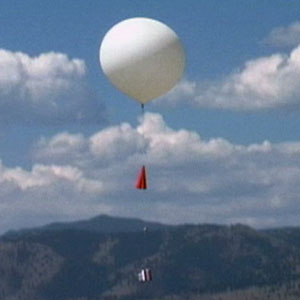
Weather balloons are usually pretty near to spherical:

1661249acf961e2c05.jpg


So the Met Office guy's remark "as the friction and resistance experienced by the object is minimised by its shape" remains perplexing.
 
It's here Michael (sorry, it's "Hot air balloons" and there is some discussion about the numerous pages) - the short paragraph on Shape. If you go to the discussion page there you'll find my query (Peter Bogra; what a silly name I chose, and why they scare you into not using your own name beats the hell out of me -I think I'll ask if I can change it) and the reply. There is generally an awful lot of criticism of that page, much of the maths being completely wrong, or it was. That was my first wikipedia moment, and all the editing stuff is still rather confusing.

I'd be interested to know more about all that. I'll follow the link you provided, thanks.

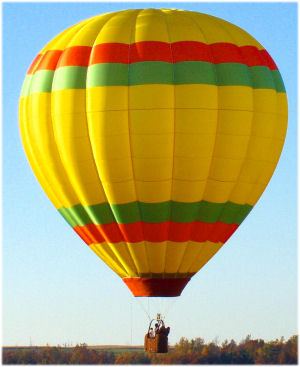
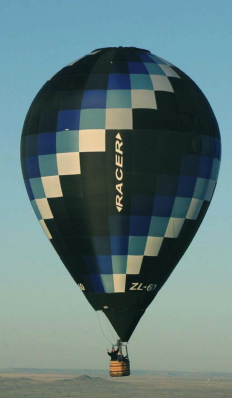
Thanks John. I followed the link that was cited in the note to the remark about racing balloons and was taken to "What’s the Skinny on Racing Balloons?", which explains that modern "racers" do indeed have less drag in the vertical direction than traditional hot air balloons. This enables them to ascend and descend faster, using less fuel. I've learnt something.

Here you can see the difference:

1661249ae4547a92e5.jpg
1661249ae4547b4ab1.png


Of course that doesn't explain the remark from the Met Office guy.
 
The 'problem' with the answer from the Met Office guy is the equivalent of a average bus driver having been asked to explain the finer points of the internal combustion engine.

JB
 
I am curious about the speed difference between the bee
http://en.wikipedia.org/wiki/File:Canberra_Baloon_Fiesta_2006.jpg
and the turtle
http://en.wikipedia.org/wiki/File:Bup.jpg

I saw a tv program once about sewing a balloon that looked like a monster.

When I read the response from the met office I started to think about all completely wrong theories about why airplanes fly and physics about airplanes. I believe you are very likely to hear about one of those if you ask a pilot about why an airplane fly.
 
Thanks John. I followed the link that was cited in the note to the remark about racing balloons and was taken to "What’s the Skinny on Racing Balloons?", which explains that modern "racers" do indeed have less drag in the vertical direction than traditional hot air balloons. This enables them to ascend and descend faster, using less fuel. I've learnt something.

Here you can see the difference:

1661249ae4547a92e5.jpg
1661249ae4547b4ab1.png


Of course that doesn't explain the remark from the Met Office guy.
You're welcome. You've taught me a lot. I have to admit I forgot to follow that skinny link once it was fixed and just took the guy at his word. I think it's a little to do with that, and quite a lot to do with having the go-faster logo "<RACER>" vertically on the balloon. ;) I also remember reading something about venting the hot air with some lateral velocity rather than with the usual circular vent at the top of yer average passenger balloon, but I can't remember where now.

I'm glad we sorted that out. I agree it doesn't explain the met office remark. Bus drivers today! I know what you mean, JB, and I'm certain that explains the original reply's ambiguity. The second reply was actually from someone else and said on behalf of expert, but I still thought "no real drag" was silly, as well as starting "As far as I'm concerned", which just suggested that although he was fairly sure of his opinion, he didn't want to bother to see if there was an official position on it in the met office. I would have thought that someone in the organisation deals with the actual aero, or they're just er, flying blind. It's like if I asked the bus driver about the internal combustion engine, and his organisation says it is very interested in educating the public, I expect him to go and ask the guy that fixes them when they conk out. In fact, it's a bit like I asked the bus company if their buses use petrol, and can tell me its fuel budget, and I get the answer that they've seen somebody put something in the little hole in the side, and that's probably petrol. I ask again and get someone from the garage: "In my opinion, it's about £500 a day, but I can't get anyone in accounts right now".
 

ISF - Join now!

Every member here is approved by hand. No bots, no spam, just people who care about evidence and honest debate.

Membership is free!

Create your free account

Back
Top Bottom