Moderated The validity of classical physics - Part 2

Humber, when you finally understand relative velocities, we'll talk.

No Mender, you want to turn defeat to victory. I told you your measurements were wrong a long time ago, and told you why the spring balance would corrupt the measurement. Also with Ynot's table. I predicted its behavior saying the results would be invalid, but a few posts ago, you tried to persuade me otherwise.
This has nothing to do with the very, very, very simple idea of relative velocities, but of mechanical engineering and measurement

If you are so sure, then all you need do is run the cart as normal, and pull from the rear (as you would expect when measure thrust), and then see what happens. Because the measurements are taken from the front, a difficult position to justify, I expect that you already know the result of the other test.
 
Short answer:

A free-floating balloon in a constant wind, moving at a constant horizontal velocity different from that of the wind, would be violating Newton's laws of motion: in this situation the horizontal forces on the balloon would be unbalanced, since there would be a net horizontal drag force resulting from the relative motion of air and balloon. According to Newton's laws, an object will only travel at a constant velocity if the forces on it are balanced, i.e. the net force on the object is zero. If there is a net force in any direction, it will cause an acceleration in this direction.

Longer answer:

When a lighter-than air balloon is released into the wind, there are three forces acting upon it:

1. Gravity
2. Buoyancy
3. Drag

Gravity and buoyancy are both vertical forces. The weight of the balloon acts downwards, while buoyancy (upwards) is provided by the weight of the volume of air displaced by the balloon (see Archimedes' principle). As long as the balloon is less dense than the air, there will be a net force upwards, causing the balloon to accelerate upwards until the upward and downward forces are in equilibrium.

The only force that can act horizontally on the balloon is drag. This drag, by virtue of Newton's second law, will keep accelerating the balloon horizontally until the horizontal forces on the balloon are in equilibrium, meaning that the net horizontal force on the balloon is zero. This only happens when there is zero drag, meaning that the relative velocity between balloon and air is also zero.

A balloon going at a constant speed at 95%, or 99%, or whatever of wind speed would be an impossibility. If, for instance, the wind is blowing at 20 km/h and the balloon is going at 19 km/h, the speed of the balloon relative to the air is 1 km/h. Any difference of speed between air and balloon produces drag. The balloon could only keep going at a constant velocity if there were zero forces acting on it (Newton's first law). There is no force that acts in the opposite direction to the drag produced by the air, so constant velocity of the balloon is impossible as long as there is a difference between its velocity and that of the air.

No. Already covered. Simple regurgitation
 
The readings must be taken with the cart in situ, as used. If you want to measure the pulling power of a tractor, you do so from the rear. Same here.
There are countless problems with the treadmill, and you, or anybody can find someway of describing or turning this and that, to make ends meet. The treadmill does not work. The cart CANNOT climb the belt. It is theoretically unsound.

The measurements were taken while the cart was on the treadmill in the same configuration that I will be testing it outside. The scale was behind the cart as you suggest.

The treadmill works and the cart CLIMBS the belt. Your theory is unsound and needs re-evaluation. Your understanding of the physics involved is flawed. We'll talk once you have that corrected.
Edited by Tricky: 
Off topic comments removed
 
Are you talking about the "no turbulence" qualification? I would also add that there must be no earthquake while the plane is on the ground. Neither of those are relevant to the point. With respect to the plane, the physics of sitting on a plane is the same regardless of its speed with respect to the earth.
Drive downwind at 10kph in a 10kph wind. Hold a balloon out of the window.
I don't think it will behave the same once the shielding environment of the car is removed.

Now imagine a neutrally buoyant balloon in a plane going a steady 550 mph. It will move at air speed, 550 mph. That is, it will appear still from inside the plane. Why do you think that is different from a balloon in a steady 550 mph wind with no plane around it? The air around the balloon is doing the exact same thing with respect to the earth and the balloon in both cases. What magical effect does the plane have on the balloon? Why does this magical effect completely and exactly counteract the magical effect that the earth has on the balloon when there is no plane?

No it is not, Modified! What you are describing is a balloon in still air. It is inside a container driven at 550mph.
In a room (as inside the aircraft), the air pressure is essentially equal upon the entire surface of the balloon, so there is no net force in either direction, therefore the balloon does not move w.r.t the floor.
The plane however, is subject to the drag and forces of motion through the air, as they are essential for motion through the air. The balloon, like its passengers (or at least 1st class passengers), is not subject to the cold force of the wind. Should the balloon go it alone, it will be subject to those forces.

If you put a small private plane in the cargo hold of a Hercules, and then fly the Hercules at 550mph, would you say that the private plane was "just like it is flying at 550mph" Turn the plane's engine or not?

In your first example, all the power and forces of flight, are met by the aircraft. Perhaps the inside of a tennis ball experiences no drag as it travels across court, but not the surface that is actually in contact with the air.
 
Can someone else weigh in on this? Am I wrong?

(Treadmill belt moving 10kph to the left. Stationary observer next to treadmill).

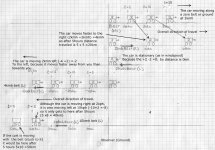
Try this D'rok. The car moves 2kmh as indicated by the speedometer. That speed is relative to the belt; to the surface of the belt itself.
The belt itself moves, so naturally, the car goes with it. The ground observer sees the belt at 10kph left. The car is moving 2km right with respect to the surface of the belt, but not as fast as the belt itself is moving left, so it moves away from you to the left at 8kph.
There is no gain for the car. It still moves at 2kph.
 

Attachments

  • carbelt.jpg
    carbelt.jpg
    128.8 KB · Views: 6
I can't see anything wrong with your logic. The mistake that Humber keeps making is to mix values from different frames of reference: it's fine to choose any one particular frame of reference to analyse a system, but not to mix together values observed from two different frames.

This is not so. There are only many objects moving in one frame. The point of measurement, that of analysis, may be from any of those moving objects.
The insistence that ground cannot be one because it is perhaps not seen to be moving, is invalid.
Any observer from any object can see and correctly measure the relative velocity of any other, moving or not, ground or not, therefore, a ground observer can see the belt and the car, and correctly calculate their velocities.
For the treadmill this is "inconvenient" as it is breaks the supporting rule of "relative motion between no more than two things". The ground is common to all objects, so you see them all, in correct relationship.
The treadmill is a model of a belt built into the ground.
 
The measurements were taken while the cart was on the treadmill in the same configuration that I will be testing it outside. The scale was behind the cart as you suggest.

The treadmill works and the cart CLIMBS the belt. Your theory is unsound and needs re-evaluation. Your understanding of the physics involved is flawed. We'll talk once you have that corrected.
Edited by Tricky: 
Off topic comments removed

In that case, you are still providing a return, but the force is not high enough.
The wheels will loose traction, and produce a near constant force. That is nothing like the force needed to actually make driven progress up the belt. At "windspeed" it is sliding on top of the belt, skimming it while doing nothing.

That is the friction force it need to stay in place, and not of the ability to climb the belt. The wheels have a fixed ratio to the propeller, and that is an inescapable fact. They must spin, or be at exactly the speed dictated by the belt.
In the first case, the propeller receives even less power than available from the belt due to the slipping wheels, but yet when at the speed dictated by the belt, it must already be at "windspeed"- an artificial state where belt motion "cancels out" wheel motion.
The cart cannot actually travel between those two states, nor can the wheels spin faster than the belt, unless there is power that does not come from the belt. It cannot pull itself up by its own shoelaces, so it cannot climb the belt.
You are measuring no more than the force that "just happens to be there", due to friction. That is the static force. To find the force that is available to accelerate the cart, you need to measure the difference between that static force, and when the car is in motion. The fork tests show that this is low. It takes a long time to recover from being pushed with the fork.

I would also insist that all measurements be taken with the treadmill level, so that the effects of gravity can be reduced. Surely, that can only be of advantage to the cart?
 
No. Already covered. Simple regurgitation

humber, you asked for a demonstration. I took the trouble to make it as clear as possible. Since you make no attempt to present a coherent argument to support your point, there is no point in my continuing.
 
No. Already covered. Simple regurgitation

Perhaps I should better reply.

Newton says that force is met by an equal and opposite force. When a free body is accelerated in "space", it is the reaction of the mass to acceleration.
It is perhaps the force required to push that object through space-time.

On the Earth, objects experience the same, but also those of drag and other opposing forces.
There is always drag, up or down stream. It is easy to see why. If you put a buoyant object is a bath of still water, and move it, the required force will be the same if moves to the left or to the right.
Small motion to the right requires the same force as a small motion to the left. That is, equal incremental forces.
If the water flows a little, then what difference would that make? You would say the object "can't tell" if it is moving w.r.t the ground, for example.
Moving with or against the flow, requires incremental motion with respect to the water, and so the "drag" is the same up or down stream. Only the direction of the average force is different, and that affect the outcome, but nothing else. Equivalence says so.

Another canard is that things move according to F=ma. Quite true, but when an object is in fluid, it loses energy to friction, and the fluid around it slows. As far as the driving force is concerned, is rather like having a continuous flow of additional mass to accelerate, as the fluid looses (or takes away) that energy.
To move in a constant flow, means that continuous force is required to meet that incremental (acceleration) load.
 
No you are not.

Humber has repeatedly refused to accept the parameters of the stated problem: 'cart moving 2kph to the right relative to the observer', and has instead continually substituted his own '2kph relative to the belt' parameter.

No matter how many times he has been corrected, he continues to make this substitution with no working explanation. I wouldn't expect this to change.

JB

Last but not least.

I do not change observers, because there are none to change. The car, belt, and the observer are all in the same frame. For convenience, rational people call that ground, and you seem to agree.

I understand the 'parameters'. I am supposed to accept that motion w.r.t the belt is "on top" of the speed of the belt.
That is quite true, but is only "faster" when the car's speed w.r.t. the belt's surface, is greater than which the belt itself moves back the other way.
To make your case for 12kph rightw.r.t. the ground observer, for a car on a left-going belt of 10kph, the car must travel at 22kph to the right w.r.t to the belt's surface. (22 right - 10 left = 12 right.)

It must be so. If the belt moves to the left at 10kph, then "no motion" for the car as ground observer see it, must mean that the car moves at 10kph
to the right w.r.t the belt's surface. (10 right - 10 left = 0) "windspeed"

To get to 12kph to the right, means 10 right (reaching stationary) plus 12 more to the right, to make 22kph right w.r.t the belt's surface. You do often refer to the belt as a "surface with boundary conditions"?
That's a penalty for starting from the rear, so that the "wind" can be said to be there.

On the other hand the car is said top be moving at 2kph to the right w.r.t the belt's surface. That is 10kph to the left (the actual speed of the belt itself), plus 2kph to the right, makes 8kph to the left w.r.t the ground observer. (10 left - 2right = 8 left)

If you say that this contradicts 400 years of science and current text books, I reply that I could take a number of recognised textbooks, and demonstrate perpetual motion to be possible.
It is the way that the information is used, and what is left out, that makes that possible.
 
Short answer:

A free-floating balloon in a constant wind, moving at a constant horizontal velocity different from that of the wind, would be violating Newton's laws of motion: in this situation the horizontal forces on the balloon would be unbalanced, since there would be a net horizontal drag force resulting from the relative motion of air and balloon. According to Newton's laws, an object will only travel at a constant velocity if the forces on it are balanced, i.e. the net force on the object is zero. If there is a net force in any direction, it will cause an acceleration in this direction.

Longer answer:

When a lighter-than air balloon is released into the wind, there are three forces acting upon it:

1. Gravity
2. Buoyancy
3. Drag

Gravity and buoyancy are both vertical forces. The weight of the balloon acts downwards, while buoyancy (upwards) is provided by the weight of the volume of air displaced by the balloon (see Archimedes' principle). As long as the balloon is less dense than the air, there will be a net force upwards, causing the balloon to accelerate upwards until the upward and downward forces are in equilibrium.

The only force that can act horizontally on the balloon is drag. This drag, by virtue of Newton's second law, will keep accelerating the balloon horizontally until the horizontal forces on the balloon are in equilibrium, meaning that the net horizontal force on the balloon is zero. This only happens when there is zero drag, meaning that the relative velocity between balloon and air is also zero.

A balloon going at a constant speed at 95%, or 99%, or whatever of wind speed would be an impossibility. If, for instance, the wind is blowing at 20 km/h and the balloon is going at 19 km/h, the speed of the balloon relative to the air is 1 km/h. Any difference of speed between air and balloon produces drag. The balloon could only keep going at a constant velocity if there were zero forces acting on it (Newton's first law). There is no force that acts in the opposite direction to the drag produced by the air, so constant velocity of the balloon is impossible as long as there is a difference between its velocity and that of the air.


Don’t you see that you have answered your own question? You say the vertical forces are cancelled out, the gravity and the buoyancy, so that the balloon is free-floating. It is free-floating in the air, meaning that the surface tension of the air is always in contact with it. The fact that the vertical forces mutually cancel each other does not mean they are not acting! The Normal force and the gravitational force cancel each other for the paper weight sitting on my desk, but when I try to slide it horizontally, there is still friction. The surface tension of the air is always acting, similar to friction; even while the balloon is travelling in the wind, and it must be overcome by some force of the wind to keep it moving. The required force may be very small, perhaps as little as 1 % of the wind, but it must be there! Again, I believe it would be impossible to measure this with a wind sensor mounted on the balloon. Like most instruments, at greater sensitivity (lower wind speeds) the accuracy gets worse. The very best wind sensors are only accurate to within 3 % of actual wind velocity, and that accuracy drops off as wind velocity decreases. You cannot accurately measure a 1 mph wind! For practical reasons, we accept balloon velocity as being the same as wind velocity, simply because there is no way to measure the difference, even though the difference must exist! If you have ever tried calculating the mathematics of surface tension, either in air or in water, you will find it is neither simple nor exact. While this may be of interest for the physics and mathematics, it is silly to argue about something which cannot be proven. Whatever happened with the Meteorological Office? I will accept their decision, just to stop this nonsensical argument!
 
To make your case for 12kph rightw.r.t. the ground observer, for a car on a left-going belt of 10kph, the car must travel at 22kph to the right w.r.t to the belt's surface. (22 right - 10 left = 12 right.)

Yes! Which means the speedometer of the car reads 22kph.

It must be so. If the belt moves to the left at 10kph, then "no motion" for the car as ground observer see it, must mean that the car moves at 10kph
to the right w.r.t the belt's surface. (10 right - 10 left = 0) "windspeed"

Yes! Which means the speedometer of the car reads 10kph.

To get to 12kph to the right, means 10 right (reaching stationary) plus 12 more to the right, to make 22kph right w.r.t the belt's surface.

As above...Yes! Which means the speedometer of the car reads 22kph.

And therefore, using humber's words: "To get to 2kph to the right, means 10 right (reaching stationary) plus 2 more to the right, to make 12kph right w.r.t the belt's surface."

Which means the speedometer of the car reads 12kph.

Progress? Has it really been a simple language/communication barrier all along?
 
Don’t you see that you have answered your own question? You say the vertical forces are cancelled out, the gravity and the buoyancy, so that the balloon is free-floating. It is free-floating in the air, meaning that the surface tension of the air is always in contact with it.
Firstly, I don't really think "surface tension" of the air in contact with a balloon is any more relevant than "solar pressure".

The fact that the vertical forces mutually cancel each other does not mean they are not acting! The Normal force and the gravitational force cancel each other for the paper weight sitting on my desk, but when I try to slide it horizontally, there is still friction. The surface tension of the air is always acting, similar to friction; even while the balloon is travelling in the wind, and it must be overcome by some force of the wind to keep it moving.
Your paperweight moving across the desk is analogous to the balloon moving with respect to the air. Just as when you let go, it stops (attaining the exact same speed as the desk), so the balloon is subject to drag only when it moves w.r.t. the air. As I've said several times, that drag is an unbalanced force, which accelerates the balloon directly against its motion, which clearly reduces the relative velocity. That drag force reduces to zero only when the relative velocity is zero. Then there is no net drag force, and all remains in constant motion. Certainly, you can think of there being different forces all round the balloon, all cancelling out, just as the normal and weight forces cancel for the paperweight. The result is the same. F = 0, therefore a = 0.

The required force may be very small, perhaps as little as 1 % of the wind, but it must be there!
As Michael explained, if the balloon were going 1% slower than the wind, it would have an unbalanced force increasing its velocity to nearer 100%. If it were moving 99.999999% of the speed of the wind, it would have a force accelerating it, smaller, but still positive, still in the direction of motion.

It is true, of course, that in a perfect mathematical model, the graph of velocity against time of a balloon released from stationary in a constant wind would increase forever, approaching the velocity of the wind, but never quite getting there. That is the only sense in which your argument is valid. It is a point that has been made before, and has repeatedly been put in context that this inverse exponential increase (or whatever it is called) is utterly negligible except in the mathematical model. It would be quite a different argument from that of humber, and how I interpret your view, where there is always a resistance of "opposing drag" to overcome. An acid test is this: in the mathematical model, if you pulled a balloon to just over windspeed, it would slow down towards windspeed in a similar way, plotting again as a curve never reaching windspeed (i.e. never getting as low as windspeed). You and humber seem to suggest it would soon slow to below windspeed.

Again, I believe it would be impossible to measure this with a wind sensor mounted on the balloon. Like most instruments, at greater sensitivity (lower wind speeds) the accuracy gets worse. The very best wind sensors are only accurate to within 3 % of actual wind velocity, and that accuracy drops off as wind velocity decreases. You cannot accurately measure a 1 mph wind!
That is almost certainly untrue. Perhaps most anemometers for weather readings might find such small windspeeds difficult to get accurately. If so, it will be because of their having to deal with a wide range. If you hold a small piece of long, light tissue paper hanging loosly and move your hand through the still air, I 'guesstimate' that you could detect windspeeds well below 1 mph, perhaps down to 0.1 mph. Do you think more sensitive anemometers could not be designed and built with modern technology and materials?

It is almost inconcievable that balloonists would not have noticed a constant breeze, even very light, from the rearward direction. It would be interesting to know if anyone has mounted a sensitive anemometer on a balloon (since they regularly carry all sorts of instruments), for instance to measure the variations, the gusts. I am confident that these will come from all directions equally.

For practical reasons, we accept balloon velocity as being the same as wind velocity, simply because there is no way to measure the difference, even though the difference must exist! If you have ever tried calculating the mathematics of surface tension, either in air or in water, you will find it is neither simple nor exact.
Again, I don't think that surface tension is the issue. Drag does have components of viscous drag and friction drag, and it's not a very simple subject (particularly at higher speeds) - there's even electrostatic drag - but it ALL comes down to zero ONLY when there is no relative movement, and it all opposes relative movement.

While this may be of interest for the physics and mathematics, it is silly to argue about something which cannot be proven.
How many things might we consider beyond our ability to prove unless we discuss them. Then, someone often goes and tests the theory, finds the means to do it. Your insistence that it cannot be proven, in the face of well-respected mathematical proof, seems a little willful.

Whatever happened with the Meteorological Office? I will accept their decision, just to stop this nonsensical argument!
I'm still waiting. I will post their reply as soon as I hear back from them. I'll also post anything else I find that's relevant to this, other than endless quotes from commercial ballooning sites (which I could) saying things like "There is no wind in the gondola, so don't overdress. We float with the wind..." or endless articles that take it for granted (which I could), such as the tracking of balloons to determine windspeed, performed routinely, where no adjustments are made for "opposing drag" or "aerodynamic impedance". They discovered the jet stream with balloons, and the balloons are tracked, and that's the figure they say the wind goes at. Why? Because there is no maths or reasoning to suggest any other possibility except in very sharply accelerating situations (rapid rising or falling usually, into different air streams). As Michael says, to do otherwise would require overturning Newton's laws of motion.

 
Yes! Which means the speedometer of the car reads 22kph.
Yes! Which means the speedometer of the car reads 10kph.
Yes. Of course. So the car is actually moving at 22kph along the belt.(you would need an engine to do that)
For 12kph right ?
If you took the car off the belt, and ran it on the ground, it would only need to get to 12kph for the same result. ( You need an engine in both cases).
Remember that in JB's example, the speedometer reads 2kph, otherwise, there is no dispute.

As above...Yes! Which means the speedometer of the car reads 22kph.

And therefore, using humber's words: "To get to 2kph to the right, means 10 right (reaching stationary) plus 2 more to the right, to make 12kph right w.r.t the belt's surface."

What does the belt do, other than to make it more difficult?

Which means the speedometer of the car reads 12kph.
Progress? Has it really been a simple language/communication barrier all along?
Could be a communication problem, but I don't see how it make a difference to put it on the belt. Where are the moving observers? It looks to me that what you see is what you get.
 
@Christoph - in addition to my last post, there is the other argument against the slower-than-windspeed theory: all motion is relative. What we call a 5 mph wind above your house is assumed to be 5 mph relative to the ground. A 100 mph wind in the jet stream, similarly, is assumed to be 100 mph relative to the ground.

In order to make the slower-than-windspeed claim, you have to be a "Groundian", believing that there is something special about the ground, not just as a frame of reference for calculations, but as an origin for measuring windspeed in some physically significant way. This is also contrary to Newtonian and every other kind of mechanics since well before the Renaissance. In physical terms, if we imagine that the jet stream is in the same direction as that breeze above your house, we could equally validly call the latter a 95 mph wind, taking the jet stream as our frame of reference. The 95 mph breeze is now also going in the opposite direction from what it was before. I don't think a balloon would have much of an idea what to do if you let go of one out the window. :) This is another way of gaining insight into the aeroplane analogy. For a little party balloon, there is no "ground", and it doesn't matter whether it's in a plane cabin or your house. The only wind that has any physical effect on it is that of its relative motion with the air. It doesn't matter that your house is orbiting the centre of the earth at hundreds of miles an hour, does it? On a still day at the Equator, the air is moving at over a thousand miles an hour, and that's only from the frame of reference of the centre of the earth (I won't take it any further, because you could argue that there's no air in space, so our massive velocities through space don't cause "opposing drag"). Why doesn't a balloon released at the equator get dragged back to something like 950 mph, whizzing away at 50 mph towards the western horizon on that still day?

This, incidentally, is also the reason for so much of the arguments about maths with the cart. It's tempting to miss off your reference frame for velocities when you think everyone understands them, but every velocity only has meaning if you say what it's in relation to. Things like "10 m/s to the left with the belt, i.e. stationary..." are very easy to misunderstand. "With" is a particularly confusing word, because it can mean "in the direction of", or "at the same speed as". So if a belt is going at 10 m/s (relative to something!), and we say that a cart is going at 1 m/s with the belt, does that mean 1 m/s relative to the other origin already mentioned in the direction of the belt relative to the other origin already mentioned, or 1 m/s relative to the belt, in the direction of the belt's motion relative to the other origin? It all gets very ambiguous unless every motion is given its correct frame. And the above shows that when we are considering more than one vector and comparing them, English syntax is not good for discriminating between alternative meanings.
 
Newton says that force is met by an equal and opposite force. When a free body is accelerated in "space", it is the reaction of the mass to acceleration.
It is perhaps the force required to push that object through space-time.

On the Earth, objects experience the same, but also those of drag and other opposing forces.
There is always drag, up or down stream. It is easy to see why. If you put a buoyant object is a bath of still water, and move it, the required force will be the same if moves to the left or to the right.
Small motion to the right requires the same force as a small motion to the left. That is, equal incremental forces.
If the water flows a little, then what difference would that make? You would say the object "can't tell" if it is moving w.r.t the ground, for example.
Moving with or against the flow, requires incremental motion with respect to the water, and so the "drag" is the same up or down stream.

Here's where you go wrong. Moving faster or slower than the flow requires incremental motion with respect to the water, so in both these cases there is a drag force. Moving with the flow requires no incremental motion with respect to the water: in this case the water exerts no drag force on the object.

Another canard is that things move according to F=ma. Quite true, but when an object is in fluid, it loses energy to friction, and the fluid around it slows. As far as the driving force is concerned, is rather like having a continuous flow of additional mass to accelerate, as the fluid looses (or takes away) that energy.
To move in a constant flow, means that continuous force is required to meet that incremental (acceleration) load.

There is no load if the object is moving at exactly the same speed as the fluid! Only in this situation is there no load, and therefore no acceleration. F = ma always holds.
 
Don’t you see that you have answered your own question? You say the vertical forces are cancelled out, the gravity and the buoyancy, so that the balloon is free-floating. It is free-floating in the air, meaning that the surface tension of the air is always in contact with it. The fact that the vertical forces mutually cancel each other does not mean they are not acting! The Normal force and the gravitational force cancel each other for the paper weight sitting on my desk, but when I try to slide it horizontally, there is still friction. The surface tension of the air is always acting, similar to friction; even while the balloon is travelling in the wind, and it must be overcome by some force of the wind to keep it moving.

Friction against what? The only thing that is in contact with the balloon is the air, so the only thing that can offer a frictional force against the motion of the balloon is the air. If the balloon moves relative to the air, there will indeed be a frictional force, commonly know as "drag" between air and balloon. This drag will accelerate (or decelerate) the balloon until there is no more movement between balloon and air, just as when you give your paperweight a push on the desk and let go, the frictional force between paperweight and desk will quickly slow down the velocity of the paperweight to that of the desk. It doesn't matter if the desk is stationary in your room or standing on the deck of an ocean liner moving through the water with a constant velocity of 20 km/h: as long as the desk isn't accelerating, the paperweight will quickly reach the same velocity as the desk and stay there. Similarly, it doesn't matter if there is no wind at all, if the wind is measured at 15 km/h relative to the ground or if the wind is measured to be 5 km/h relative to that same ocean liner, the balloon will quickly reach the velocity of the air and stay there. Any difference between the velocity of the balloon and that of the air, however small, would require an extra horizontal force to combat the drag, or "friction" between balloon and air.

The required force may be very small, perhaps as little as 1 % of the wind, but it must be there! Again, I believe it would be impossible to measure this with a wind sensor mounted on the balloon. Like most instruments, at greater sensitivity (lower wind speeds) the accuracy gets worse. The very best wind sensors are only accurate to within 3 % of actual wind velocity, and that accuracy drops off as wind velocity decreases. You cannot accurately measure a 1 mph wind! For practical reasons, we accept balloon velocity as being the same as wind velocity, simply because there is no way to measure the difference, even though the difference must exist!

The difference cannot continually exist. That is the essential point here. If there is a difference between the speed of the balloon and the speed of the air, there must be a force to counteract the drag of the air. Where does this force come from? It cannot be the upward and downward forces of buoyancy and weight, since these two forces have no horizontal component.

If you have ever tried calculating the mathematics of surface tension, either in air or in water, you will find it is neither simple nor exact. While this may be of interest for the physics and mathematics, it is silly to argue about something which cannot be proven. Whatever happened with the Meteorological Office? I will accept their decision, just to stop this nonsensical argument!

1. This can be proven, without any reference to surface tension.
2. I find it interesting. If you don't find it interesting, forget it, but don't keep claiming you understand it. If you do find it interesting, make an effort to understand the physics.
 
Firstly, I don't really think "surface tension" of the air in contact with a balloon is any more relevant than "solar pressure".


That is almost certainly untrue. Perhaps most anemometers for weather readings might find such small windspeeds difficult to get accurately. If so, it will be because of their having to deal with a wide range. If you hold a small piece of long, light tissue paper hanging loosly and move your hand through the still air, I 'guesstimate' that you could detect windspeeds well below 1 mph, perhaps down to 0.1 mph. Do you think more sensitive anemometers could not be designed and built with modern technology and materials?

It is almost inconcievable that balloonists would not have noticed a constant breeze, even very light, from the rearward direction. It would be interesting to know if anyone has mounted a sensitive anemometer on a balloon (since they regularly carry all sorts of instruments), for instance to measure the variations, the gusts. I am confident that these will come from all directions equally.

Again, I don't think that surface tension is the issue. Drag does have components of viscous drag and friction drag, and it's not a very simple subject (particularly at higher speeds) - there's even electrostatic drag - but it ALL comes down to zero ONLY when there is no relative movement, and it all opposes relative movement.

How many things might we consider beyond our ability to prove unless we discuss them. Then, someone often goes and tests the theory, finds the means to do it. Your insistence that it cannot be proven, in the face of well-respected mathematical proof, seems a little willful.


What “well respected mathematical proof”? Please post it and end the discussion. I don’t need to reference the ground any more than you do when you say the balloon and the wind are travelling at the same speed. To get the relative velocities you only need to measure the difference between the balloon and the wind, but this will not be easy to do! Let’s suppose that the balloon requires as little as one Newton per square meter to keep it in motion. That is one Pascal of pressure! Do you think you can feel one Pascal of pressure on your face from the wind? I highly doubt it. Try pressing a pencil point against a piece of paper with just enough pressure so as to NOT make any mark, and that will be about one Pascal! As I said earlier, we accept balloon velocity as wind velocity as being for all practical purposes equivalent, and it is probably not practical to measure the difference. Surface tension is all important to this discussion, if you have ever studied fluid dynamics. I am no expert on the subject either, but I have encountered it just enough to know it is extremely complicated and defies a direct mathematical solution. This is not a simple matter at all; certainly it is not as simple as determining relative velocities! Your argument about relative velocities has absolutely nothing to do with the reason why a balloon must be travelling at a velocity just under wind velocity, and this in NO way whatsoever is a violation of Newton’s Laws of Motion. In fact, if the balloon were to be travelling at wind speed, with NO force applied, while over-coming the surface tension of the air, THAT would be a violation of Newton’s Laws!
 
Christoph said:
In fact, if the balloon were to be travelling at wind speed, with NO force applied, while over-coming the surface tension of the air, THAT would be a violation of Newton’s Laws!

This is such an important result. An object moving with the same speed as the air "feels a force due to the surface tension of the air".

So all object in the air feels this "force". For example a balloon on a still air "feels" a force due surface tension. I didn't even know air had any surface tension.

I also thought about an easy experiment to show this. Put a balloon in an empty room with no air movements and measure the speed of the balloon due to the balance of the surface tension and drag.
 
Here's an experimental anemometer (abstract only, it costs to get the full article) with a quoted range of 0.2 - 4.5 ft/s.
I make that 0.06 - 1.4 m/s
or about 0.14 - 3.1 mph

It is described as having a "small vane", so I guess it might be possible to improve on. This does look like a difficult area of anemometry, Christoph, the low-speed end. Hot wire anemometers also get something like that accurate, or maybe not quite.

They (M R Head et al) have developed the above mechanical-electronic one to self-balance.

The idea of there being a constant wind passing a balloon seems to be one of the first mistakes in aviation theory. Francesco Lana de Terzi published his aeronautical machine in 1670, and, while there are many references on the web pointing out the flaw in his method of gaining lift - evacuating copper spheres of their air, which would be crushed instead by the pressure outside - few bother to mention the unnecessary sail he added.

In What Makes Airplanes Fly?: History, Science, and Applications of Aerodynamics, Peter P. Wegener does bother to comment, "A sail was (mistakenly) added to keep the contraption on course." (p9 on the preview).
 

ISF - Join now!

Every member here is approved by hand. No bots, no spam, just people who care about evidence and honest debate.

Membership is free!

Create your free account

Back
Top Bottom