Oohh look a pointer to real data posted by humber.
Well, you didn't for the automotive book, so I though I should. I wanted to give you a fighting chance.
But....teh...he...perhaps there is a secret message. As we all know, I found yours. However, I don't need to do that.
But we've seen this one before, it concludes ..
But that was for a boat on water. He goes on to say...
Thus proving you are wrong.
When are you going to pay up on that bet humber? You owe JREF a $100 donation and they could really use it now to help improve the server.
You saw it, yes, but you did not understanding, or read it. Rather
late, don't you think?
You didn't think it would be
that easy did you?
Equivalence
Drela completely contradicts your notions of equivalence.
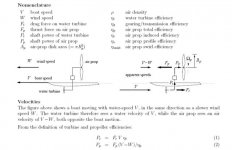
The diagram shows his model.
(1) He changes only the direction of the vectors. They are effectively refereed to the vehicle speed.
(2) He does not change the media, or the sources of power.
(3) He considers only the differential velocities of wind and water, but not the vehicle-to-water -o air. There is only that one difference of wind and water as a power source.
(4) His derivation of drag and force are as I posted, with force and drag related to the square of the difference in velocities.
Forces
The net force is the difference of drag and drive forces as my skater and balloon. The drag is again the sum of the aerodynamic and wheels forces. He refers to the balance of these forces at windspeed as "hover" mode.
See the provided equations. (see text and eq 20)
As I said, he has given quite wide berth to his calculations, so it will be necessary to see if these are practical; particularly the value of swirl at windspeed. That has yet to be shown to be so.
You face a dilemma.
(1) His derivation bears no resemblance to yours, or relevance to the treadmill. He does not support the treadmill's use of equivalence.
(2) If he is right, then DDWFTW travel is simply a matter of straightforward engineering, as I much earlier claimed, and totally independent of your ideas of relative motion and equivalence. He makes those
redundant.
(3) If he is wrong, DDWFTW is then not possible, but the sub-windspeed calculations stand, denying your argument concerning balloons, as does the meteorological book.
(4) Drela does not break any physical laws, or require additional sources of energy. He does not mention relative motion other than in the simple derivation. A matter of mathematical convenience. That is the correct use of equivalence.
I think you lose either way, so please pay the promised $100 to JREF.