Wait a minute. YOU pointed out that the 1981 stimulus was larger than the one we recently passed. Now you're bitching about how much it ran up the debt? You don't get to have it both ways.
BobTheDonkey said:
Actually, in this case, he kinda does. See, the two stimuli being discussed happened via different routes. So, in comparison, the '81 stimulus not only was more expensive at the onset (dollar for dollar, adjusted for inflation), the Government's means of paying off it's debt was decreased by the same amount that was spent. Thus, ballooning the deficit. The stimulus as signed by Obama was a one time spending effort that did not cut Government revenue. So, the ability of the Government to pay off it's debt was not diminished in the same manner that the stimulus of '81 did.
Actually, the latest stimulus had about two hundred billion in tax cuts too (somewhere around there). But either through decreased taxes or increased spending, the governement is going to have less money. There is nothing permanent about either one: spending can be cut off and tax cuts can be reversed.
If anything, I would argue that govt. spending is the harder one to control. Once that money flows out to specific congressional districts, it can be hard as hell to cut off. This is esp. true if a new entitlement program is created. There is no way, for example, that the Medicare Prescription Act will ever be repealed.
But you need to look at the context of the two stimulus acts: national debt level and entitlement spending:
In 1980, total national debt hadn't even hit the trillion mark. It was about 1/3 of GDP. It was possible to pass the tax cuts in 1981 and still not be too concerned about debt levels. Contrast that with Sept. 2008 (right before TARP). Debt-to-GDP had climbed to just under ten trillion (around 70% of GDP). Your margin for error is a lot less with a debt load like that. Nor are these record deficits we've seen expected to be a "one time thing". Trillion-dollar deficits will be the norm for many years. CBO projects Obama's budgets will bring debt-to-GDP up to 90% by 2020. Krugman hand-waves this away from his Ivory Tower, but European countries are already dealing with the effects of such high debt loads. The PIIGS are still in trouble and Germany and Britain just passed (or are going to pass) radically reduced budgets. We'll see how they do in the coming years.
In 1980, Medicare was bringing in a hefty surplus, and would for decades to come. S.S. was in trouble, but was "fixed" in 1983 and also made solvent for decades. That is not the case now. In 2008, for the first time, Medicare had to cash in some of it's IOU's. That will only get worse and there's not even a hint of a fix in the works. S.S. is also in trouble again, but Medicare/Medicaid is the real killer.
So in the context of everything, the stimulus of 81 was far less riskier than the recent stimulus.
Wait, aren't the Bush tax cuts set to expire? Anyway, we know what happened shortly after the 81 stimulus: record economic growth. I don't see that happening anytime soon. We're not even adding enough jobs to keep up with the growth of the labor force.
BobTheDonkey said:
Right, because more money was in the system. Same as what you see when the Gov't pays for outside contractors. So, in this case, not only is the stimulus increasing monetary flow (which was the real danger, btw - the lack of monetary flow due to Banks puckering up), it's producing long-term physical gains in the way of rebuilt/new infrastructure. It's, essentially, a win-win. The Gov't gets to choose how the money is spent - something tax cuts don't allow the Gov't as much direct say in - while the money is still making it's way to the public sector. And if the tax cuts expire, wouldn't that mean an increase in the Gov't's ability to repay the debt?
It's hard to spend nearly a trillion and not produce some gains. But measured by the goals of the people pushing the stimulus, it has failed. Unemployment was supposed to stay below 8%. That was what, a year ago? It will likely be above 8% for yet another year. Who knows how many jobs the stimulus has "saved", but we know that a net two million have been
lost since the stimulus was passed. That also was not supposed to happen.
As to the bolded part, do you think Govt. is a more efficient allocator of resources? I live in California and can tell you that once govt. spending really starts to get going, it creates its own weird inertia. Entrenched interest groups (which my union is a part of) want to make sure that spending doesn't get cut. So it doesn't get cut and now we have obscenely high tax rates and budget battles every year. With all this "allocation" of money by the state, you would think things would be demonstrably better than they were, say, ten years ago. They're not.
I thought you were concerened about debt. Or is debt only a problem when it's a result of tax cuts?

BobTheDonkey said:
Debt is always a problem. It's a larger problem when you increase debt and decrease revenue at the same time. It's like taking a new job with lower pay while at the same time buying a more expensive house. Just not the wisest financial move. This is opposed to maintaining a relatively similar revenue stream (yes, I know, revenue will be decreased as there is less taxable income - however, 33% of what's available is still higher revenue than 30% of what's available, etc) and purchasing a more expensive house. Increases debt - but the ability to pay off that debt is not as negatively affected.
Which is exactly what we did with the latest stimulus. The tax cuts that were passed cost about $200 billion (
http://projects.nytimes.com/44th_president/stimulus). A lot of it was also aid to states. Infrastructure spending was only about $100 billion out of the $750 billion.



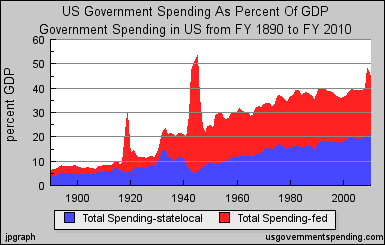


 utlays.png[/qimg]