• Quick note - the problem with Youtube videos not embedding on the forum appears to have been fixed, thanks to ZiprHead. If you do still see problems let me know.

Cont: The sinking of MS Estonia: Case Reopened Part VI

Status
Not open for further replies.
Actually, the Stockholm Archipelago does. We have clear directions, starting from the entrances to the Archipelago and showing the route into the harbors.

Okay, that's true. I stand corrected. Archipelagos in general cannot have a direction of buoyage, but a particular archipelago connected to a port (e.g., Stockholm) can. That's by virtue of its being a port, not by virtue of its being an archipelago.

Having said that, the image of Viking Sally that Vixen previously posted is definitely not at sea but inside the Archipelago. Most probably close to a port.
* * *
Given how the ship is moving, I'd say that the photographer is probably standing on land in the port.

Probably, but it doesn't matter where the photographer is. The ship is moving at a wakeless speed consistent with visor-up operations in port.
 
As I pointed out, the Finnish words for 'switched on' is completely different from the word 'tuned', as in English. Anyone would know that 'tuning' a radio, for example, is quite different from 'switching it on'.


The Finnish authorities said the buoys were found untuned and switched off.

You have zero idea about how these function, as displayed over and over again in this thread. If you say that they are tunable in the field, you should be a able to cite the owner's manual where they describe how to tune it. You can't, because they can't be tunes in the field.

Also, I provided you a translation that translated it as unarmed (actually, I did so twice), so maybe your command of the language is not nearly as good as you believe.
 
A coincidence is something that is paranormal.


No it isn't, it's just two things coinciding without an actual causal connection. If there's a connection, even a "paranormal" one, it isn't a coincidence.

Coincidences are often claimed to be evidence of the paranormal, but they aren't. They're just coincidences.
 
Having said that, the image of Viking Sally that Vixen previously posted is definitely not at sea but inside the Archipelago.

I feel obliged to point out that I've been misreading several of these posts. They've been consistent and clear in identifying "the" archipelago, meaning the Stockholm Archipelago. Instead I've been taking it as "an" archipelago—any old archipelago. So let me apologize for consistently mistaking what you all are trying to say. It matters in terms of how to interpret buoys in photographs and therefore where the photos are taken and therefore what the expectations should be for the bow visor position. We still have no evidence for the claim that it's "not unusual" to sail in open seas with the visor raised, but that doesn't mean I'm reading correctly the references to the Stockholm Archipelago.
 
I feel obliged to point out that I've been misreading several of these posts. They've been consistent and clear in identifying "the" archipelago, meaning the Stockholm Archipelago. Instead I've been taking it as "an" archipelago—any old archipelago. So let me apologize for consistently mistaking what you all are trying to say. It matters in terms of how to interpret buoys in photographs and therefore where the photos are taken and therefore what the expectations should be for the bow visor position. We still have no evidence for the claim that it's "not unusual" to sail in open seas with the visor raised, but that doesn't mean I'm reading correctly the references to the Stockholm Archipelago.
This might be me messing it up also. Living in the area, and navigating the archipelagos for many years, it's so easy to assume that everybody else is just as familiar with them...

When it comes to Estonia - there was really only one Archipelago involved (or supposed to be involved) - the Stockholm one. Tallin is just a port on quite an open coast. It's only when the route was planned to get to Söderarm that there was a change from mostly open sea navigation to Archipelago navigation.

However, when it comes to the Viking Sally Age, she use to among other routes to sail Stockholm-Mariehamn->Åbo (Turku) or Kapellskär->Mariehamn->Nådendal.

These routes have the Stockholm Achipelago in one end. A short hop over the Åland sea to Mariehamn. After that navigating quite complex routes through first the Åland archipelago and the Åbo Archipelago. (They are connected)

The Åland/Åbo Archipelagos are collectively called the "Archipelago sea" for example in weather reports.
 
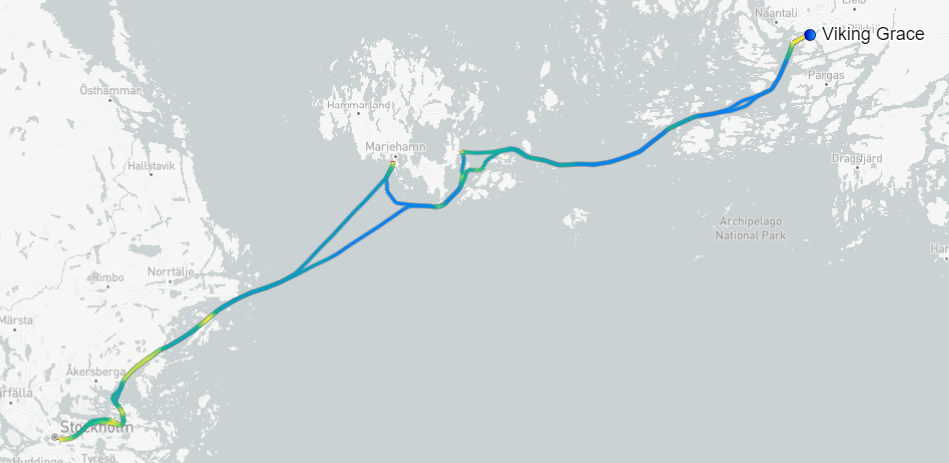
This is the Stockholm-Åbo (Turku) route as it looks right now.

This is from the AIS track for Viking Grace that is one of the ferrys that do the daily roundtrip.

 
If you had followed the thread, you would be aware I and a co-author were researching the early years of WWII from a nordic perspective, that is 1941-1942 mainly, and those were where I took photocopies (which were quite expensive, especially for A3, as TIMES was a large broadsheet which didn't even fit A3). If you knew your history you would also know Stalingrad was towards WWII end and was - hello?!!! - Germany versus Russia, so would have zero to do with British troops. Mojo mischievously decided to conflate the Brits with Stalingrad because they were in the same sentence.

So I hope that is now clear.
I have been following the thread. Have you?

That doesn't answer my question. Did you claim that the Times had reporters in the German front lines, yes or no?

It is official that the temperature was 10.5ºC in the water that night.

You can cook potatoes in a variety of ways, including boiling, baking, roasting or making chips.

Oh I'm sorry, I thought we were posting random facts again. Your post doesn't deal with the point of the post it's replying to.
 
Last edited:
This might be me messing it up also. Living in the area, and navigating the archipelagos for many years, it's so easy to assume that everybody else is just as familiar with them...

That's a reasonable expectation. All the ports I've sailed to and from routinely are also open-coast ports, or sparsely insular harbors such as San Francisco Bay. Conversely the only archipelagos I've sailed through true archipelagos such as those off Belize. This is why we have harbor pilots; there's local knowledge that must be respected by all parties.
 
Harbour Marks are expected everywhere, they aren't the same as a channel marker as found in an estuary or broad river.

But, in restricted and busy waters, shipping is often constrained in to traffic lanes which have marker buoys.

What a skipper does is refer to local pilotage guides to identify what is what and what each buoy actually means, the basic markings can have different meanings depending on local conditions and regulations.

I certainly wouldn't be sailing there without a good printed pilot.
 
Last edited:
That's a reasonable expectation. All the ports I've sailed to and from routinely are also open-coast ports, or sparsely insular harbors such as San Francisco Bay. Conversely the only archipelagos I've sailed through true archipelagos such as those off Belize. This is why we have harbor pilots; there's local knowledge that must be respected by all parties.

We have pilots in in the Stockholm area also, that would board the ships outside of Söderarm or Sandhamn, and stay on all the way into the port.

However, for the ferries that run the regular route, the captains onboard have actually been trained and have the certificates to be allowed to sail the routes without having to use an external pilot.
 
It's not completed. It won't be completed until well into 2024.

Any classified information will remain classified. I am hoping the government will come clean.

They issued a preliminary report. Most accident review boards do this as they complete most of the work, and have compiled the evidence so they can present the basic findings to the press/media while they put the finishing touches on the final report. They tell you what they found, what they've ruled out, and what the evidence indicates as the cause of the accident in the preliminary report. The details of the investigation, the methodology, the various scientific tests performed, and other detailed information will be presented in the final report.

Yes, some of that work is ongoing. But most of it is administrative in nature to cover all the angles. They're not hiding anything. We're coming up on 30 years since the sinking, everyone in power in 1994 is either retired or dead. And in 2023 the new breed of technical folks working this case are the type to leak information they feel is being suppressed.
 
I don't think it would be that easy for a captain to deliberately sink a ship. There have been reports from survivors of how they thought Captain Andresson seemed to be in a strange mood that night and of how he was seen being confronted with a group of men arguing. But the Estonian crew were modelled on Swedish crews, in which the Captain works as a team of three or four. IOW were he to have been suicidal (and taking 1,000 people with him...?) there are the other two/three mates, well-qualified in their navigation exams and experience, standing in his way. The JAIC Report does not deal with what happened to the captain, which I would have thought crucial. In the Herald of Free Enterprise accident, the Casa Concordia or the Bow Belle on the Thames, much attention was given to the role of the Captain and his crew - they were even arrested and charged - yet the crew here are treated as helpful eye witnesses, one of them whom the JAIC relies heavily on turns out to have been a drug smuggler. Nine years jail. In Finland that is a massive sentence. Most prisoners get a very light sentence even for murder.

I think you just underlined my point.:rolleyes:
 
But, in restricted and busy waters, shipping is often constrained in to traffic lanes which have marker buoys.
When it comes to the fairways into/out of Stockholm, they are all considered a narrow channel/fairways. There just isn't any room for them to do anything else than following the fairway.

There are a couple of designated spots when inbound and outbound vessels can meet, and that is coordinated via VTS Stockholm that keep track of them.
 
This is from the AIS track for Viking Grace that is one of the ferrys that do the daily roundtrip.

Definitely some stretches along that route where you don't want the visor raised. When I lived in Italy I routinely did the ro-ro trip between Sicily and the mainland, both in cars an on trains. Most times the sea conditions were fairly calm, but they did get very bad on occasion. Even on such a short trip in calm seas, they never sailed with the visors raised from beginning to end. At all the times the visor was raised the ships were doing probably less than 3 kn.
 
MV Estonia had sailed in a far worse storm some five weeks earlier.

And got lucky. It was also the only time she had sailed in such weather. So what can we imply from this? Maybe there was latent structural damage to the bow visor that went unnoticed, or ignored for five weeks?

The list of vessels which sunk after their profiles had changed (ei: being sold to companies that operate in waters the ship was never designed to navigate) is long. The number of wrecks caused by captains with the most experience is longer.

The Titan had successfully surveyed the Titanic five times before its accident. Doesn't mean the design was sound.
 
However, for the ferries that run the regular route, the captains onboard have actually been trained and have the certificates to be allowed to sail the routes without having to use an external pilot.

Which is the way it should be. I just mean that just because you've sailed a lot in one place doesn't make you familiar with another place. Familiarity with local waters (whatever your reason for being in them) has value.
 
I don't think it would be that easy for a captain to deliberately sink a ship. There have been reports from survivors of how they thought Captain Andresson seemed to be in a strange mood that night and of how he was seen being confronted with a group of men arguing. But the Estonian crew were modelled on Swedish crews, in which the Captain works as a team of three or four. IOW were he to have been suicidal (and taking 1,000 people with him...?) there are the other two/three mates, well-qualified in their navigation exams and experience, standing in his way. The JAIC Report does not deal with what happened to the captain, which I would have thought crucial. In the Herald of Free Enterprise accident, the Casa Concordia or the Bow Belle on the Thames, much attention was given to the role of the Captain and his crew - they were even arrested and charged - yet the crew here are treated as helpful eye witnesses, one of them whom the JAIC relies heavily on turns out to have been a drug smuggler. Nine years jail. In Finland that is a massive sentence. Most prisoners get a very light sentence even for murder.

Bolding mine.

A little googling says that the only possible sentence for a murder conviction in Finland, is life imprisonment. All life sentences are automatically reviewed by an appellate court, but only after a minimum of 12 years.

https://en.wikipedia.org/wiki/Murder_in_Finnish_law#:~:text=For%20an%20adult%20of%20sound,authority%20to%20grant%20a%20pardon.

For an adult of sound mind, the only possible punishment for murder is life imprisonment. A conditional release may be granted after 12 years of imprisonment, subject to approval in the Helsinki Court of Appeals.[2] The President of Finland also has the authority to grant a pardon.[3]
 
Definitely some stretches along that route where you don't want the visor raised. When I lived in Italy I routinely did the ro-ro trip between Sicily and the mainland, both in cars an on trains. Most times the sea conditions were fairly calm, but they did get very bad on occasion. Even on such a short trip in calm seas, they never sailed with the visors raised from beginning to end. At all the times the visor was raised the ships were doing probably less than 3 kn.

I fully agree with that. I've never seen the visor raised outside of close port manouvering. Usually just so that they raise the visor before getting to close to the quay where it wouldn't be able to be opened.

And many ships today have a different design when it comes to bow ports, that are not raised but instead open sideways. From what I understand, that means that wave pressure actually force the ports closed, rather than the other way around.
 
Last edited:
Survival time for around 10° C is around 60 minutes before exhaustion or unconsciousness and 1–3 hours expected survival time.

Variables like water temperature, sea state, BMI, water movement, and movement of the person in the water make estimates difficult. It's unlikely that a simple number can accurately predict survival time.

Most figures you see are based on an estimate of the amount of time it will take for a person to become hypothermic in calm water. Those estimates greatly understate the danger because they don't consider sea state and make no distinction between water that's flat calm vs rough water with breaking waves, and they also don't consider the relationship between wave splash, inhaling water, and drowning.
In cold water, wearing a standard lifejacket, most people are likely to drown before they become hypothermic and they underestimate the speed with which manual dexterity can be lost.

Unless you're wearing thermal protection like an immersion drysuit or wetsuit, cold water immersion is immediately life-threatening and most people will experience high intensity cold shock, including a complete loss of dexterity and breathing control, at water temperatures between 10° an 16° C.

It's handy to have your refresher course notes in the drawer.

 
Status
Not open for further replies.

Back
Top Bottom