femr,
Tom,
I do not appreciate you using your posts to me as some form of venting opportunity.
If you must vent, separate it from your dialogue with me.
This is not "venting". It's stating one of the most fundamental principles of Measurements and Analysis 101.
I've posted
THIS for you before. Please watch it. Pay close attention. It'll only take about 10 seconds.
The KEY comment:
MIT physics professor said:
"There is an uncertainty in every single measurement. Unless you know the uncertainty, you know absolutely NOTHING about your measurement."
When I was an engineering student, if we turned in our lab results without an error analysis, it was not accepted. If we didn't get it done, we got a failing grade. Even if we did all the analysis exactly right.
In a previous post, you replied to my comment:
tfk said:
[You & I have disagreed about] ... Especially the recognition & quantification of data errors and their huge effect on the interpretation of data.
femr said:
I probably don't use formal methods, but it's all done as well as possible with nothing hidden or deliberately distorted.
You seem to be suggesting that you think an error analysis is a statement of a researcher's mistakes or dishonesty. Nothing could be further from the truth.
It is an acknowledgment of the
inescapable fact that there is an inherent error in every single measurement that anybody, anywhere takes. And a formal analysis of how much those errors will impact any calculated conclusion.
This is an absolutely crucial component of any measurement analysis.
The LACK of an understanding and clear statement of the sources & magnitudes of one's measurement errors is an incompetence.
The LACK of an acknowledgment of those error is a dishonesty.
What I can tell you is this: the single biggest lesson of error analysis is a shocked: "I cannot BELIEVE that, after taking all those measurements so carefully, we've got to acknowledge THIS BIG an error." But that was precisely the message that our instructors were trying to get us to appreciate.
Are you talking about "what this video says about the continuum vs. discrete process of collapse"?
If that's your topic, the drop of the penthouse says to an experienced structural engineer the same thing that the collapse of the previous (east) penthouse said, and that the subsequent collapse of the north wall confirmed: "the building is in the
process of collapsing".
And a careful analysis - like your "east corner" graph confirms that.
And there is absolutely nothing that can be seen in this gif to deny that.
The resulting position determined is therefore clearly sub-pixel when translated back into the units of the original tiny source.
There are a half-dozen or more features of your tiny, circling pixel that are not available to you in the WTC videos.
That's not to say that Syntheyes cannot do significant image enhancement. That is to say that the results of that enhancement is not going to be anywhere near as effective as your example.
It is a side effect of aliasing that small movements of the object cause slight variation in inter-pixel intensity, saturation and colour.
And a principle source of aliasing in video images is leakage in the stop bands of image processing filters. Did you get that? "Filters". As in "things that ALTER the exact rendition of your measured quantity." Filters that have altered your video before you ever got your hands on it.
Not hugely. Subtilely.
UNTIL you get down to the individual pixel level.
... The graph shows accurate (not perfect) sub-pixel location data for the position of the small blob.
I could go into more detail, but hope that clarifies.
No, actually it does not.
I didn't ask what type of sub-pixel techniques your program CAN use. I asked which specific ones you DID use.
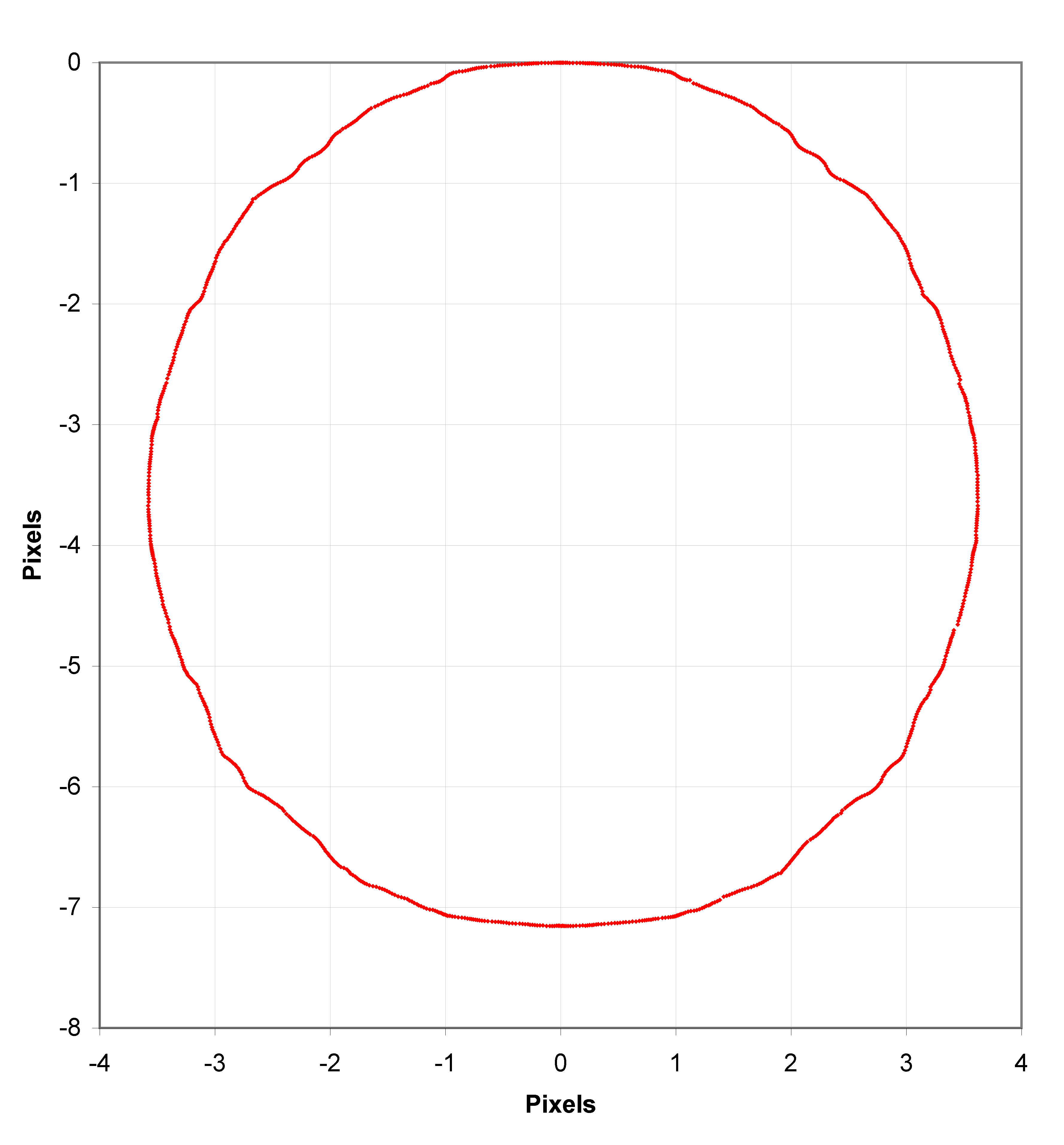
ETA: Another test using exactly the same small blob rescale, but extended such that it takes 1000 frames to perform the circular movement...
Utterly irrelevant to WTC video. You don't have repetitive, oscillating motion that you can sample multiple times. You don't have 1000 frames of motion to analyze.
For this example, I'll quite confidently state that the 3rd decimal place is required, as accuracy under 0.01 pixels is clear.
Any talk about 1/100 of a pixel in any discussion of available WTC videos is fantasy.
Can be quantified, by graphing the difference between *perfect* and the trace location, but not sure how much it matters.
Stop talking about quantifying it. Stop demeaning the valuable act of quantifying your error. Do it.
But do it right. Not like you have been half-assedly doing it. (See next paragraph.)
Now, obviously this level of accuracy does not directly apply to the video traces,
That's right. It doesn't apply.
(As an aside: You probably shouldn't have brought it up, then. It makes it look like you are indulging in "baffling with the bs".)
This whole method that you use to guess your accuracy - creating perfect graphic images, with 100% contrast, with perfectly defined edges, moving in perfectly geometric, repeating motions, at any number of frame acquisitions, at any spatial resolution, applying perfectly symmetrical blurs & then using filters & processing to reconstruct your original shape & motion - is self-deluding.
Your artificially created reference video ignores the 20 - 100 sources of unpredictable, asymmetric, non-constant in space & time distortions that occur before the image gets to disk.
as they contain all manner of other noise and distortion sources. For previous descent traces I've estimated +/-0.2 pixels taking account of noise.
My guess, based on measurements that I've made in the past: If you performed a real error analysis, and you used re-interlaced video, you'd find that during the collapse (the time of interest, of course), you've got uncertainties of about ± 2 to ±3 pixels before image enhancements & ±1 to ±2 pixels after image enhancements.
If you use single frames, then your uncertainties will be about twice as large.
Now, I could be wrong about that. Yeah, it's happened before.
Do you know what it would take to convince me that I'm wrong? And to get me to immediately change my mind?
Funny thing. It'd take a competent error analysis.
Tom