• Quick note - the problem with Youtube videos not embedding on the forum appears to have been fixed, thanks to ZiprHead. If you do still see problems let me know.

The PG Film - Bob Heironimus and Patty - Part III


Have you ever discussed the methods you used to make that map?

I'm just curious because, as an archaeologist, I've had a fair amount of training and experience mapping areas (sites), and I know it's not easy to do without a fair amount of experience. I'm not necessarily doubting the accuracy of your map, but I have seen how easy it is to screw up little things and end up with a map that looks very little like what someone else would produce, so I'm curious about how it was made, since you freely admit you and the other people who produced it are amateurs.

Also, can you discuss how you determined the age of the plants you were examined at the site? Some species on the northwest coast grow surprisingly fast, and most people I've known have a hard time accurately guessing the ages of things like trees. For example, I've seen people mistake 40 year old Douglas firs for old growth a number of times because they grow ridiculously fast.

It seems like you lose your patience kind of easily here, but if you expect us to take your point of view as authoritative, some methodology discussion would help.
 
Originally Posted by Roger Knights

It proves that the film wasn't shipped by air from Arcata, but was mailed instead. (And, as I mentioned a few days ago, no air shipment from Arcata then occurred either, because Peter Byrne checked all the flight records and interviewed pilots from there.)

Let me make sure this is your idea of proof of something being mailed:

" Someone threw a piece of paper in the trash, and when asked what it was, said it was a receipt. "

I have to respect your brass, Roger, if nothing else..

Patterson was the one who shipped the film and owned the piece of paper, not a possibly unconnected “someone.” Your misrepresentation is pretty brassy.

I concede that if Jensen had obtained the receipt, that would be “proof.” So his testimony, not being as strong, should be called something less. How about “best evidence”?

Patterson said the film had been shipped by “registered mail,” not a term one would use for a private shipment by a small plane.

And the context strengthens the evidence. Patterson spoke in an unguarded moment to a friend (Dennis Jensen) who had no reason to lie (to embarrass Patterson).

Moreover, Patterson took a risk by mentioning and tossing out the receipt for the shipment. Jensen might have said, “Let me take a look at that; it’s a historic memento” or “I’d like to keep that as a souvenir.” If Patterson had refused, he’d have looked like a liar—and Jensen might have exposed him as such after Patterson’s death, which he must have suspected might be soon.
 
Have you ever discussed the methods you used to make that map? ... if you expect us to take your point of view as authoritative, some methodology discussion would help.

In my comment 3379 on page 85 I provided links to places where he discussed his methods. First, though, I include the comment I was responding to, for context:

https://www.blogger.com/profile/07852437322070677310

That's your film site expert?

Is he an expert on the PGF film site because he visited the site 48 years after the film was shot?

Roger Knights said:
Streufert wasn't just a site visitor. He is rather, an expert in the details of the site, having studied it itself and what others had written of it and the photos they'd taken of it for years in conjunction with several other knowledgeable Bigfooters, including members of his site rediscovery team. The links below should give you an indication of the depth of his involvement. These include detailed maps of the site, based on his team's site surveys. The sidebar contains links to additional threads of his on the topic.

http://bigfootbooksblog.blogspot.com/2011/11/patterson-gimlin-film-site-rediscovered.html

http://bigfootbooksblog.blogspot.com/2012/01/pgf-bigfoot-film-site-mathematically.html

It seems like you [Bigfoot Bookman aka Steven Streufert] lose your patience kind of easily here ....

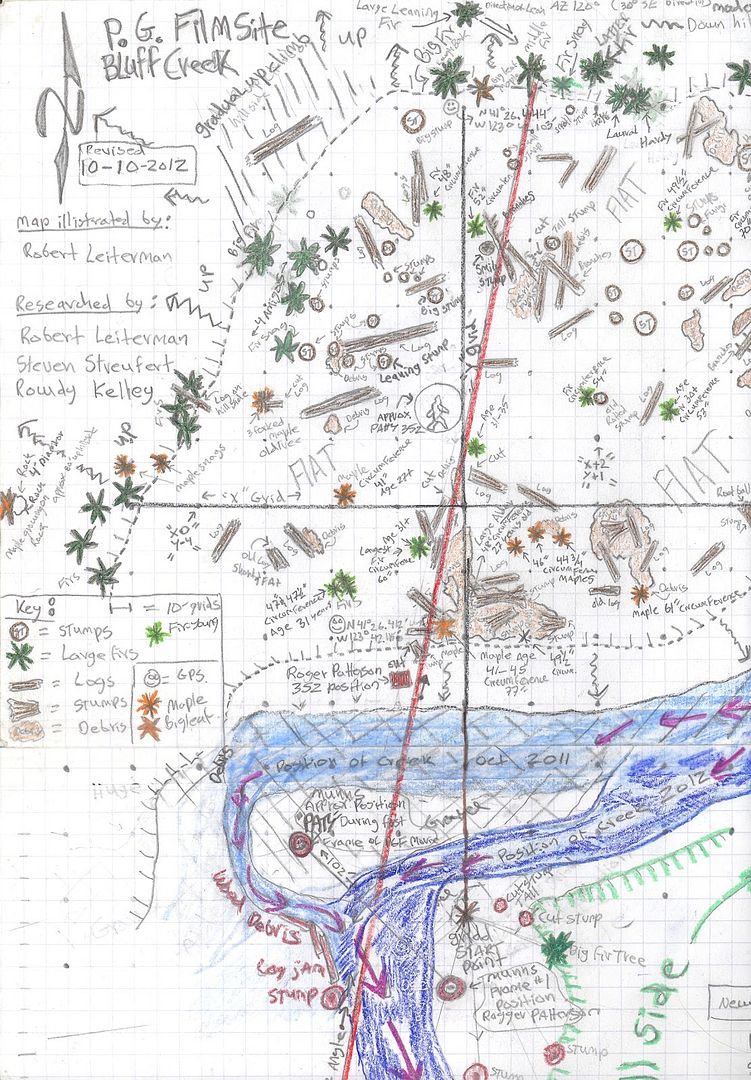
I think LTC's snark above, and the dismissive comments after I posted Streufert's maps in comment 3388, got under Streufert's skin. Here they are (from Part II, page 85):
LTC in 3390: "Yes, because we've never discussed Streufert or seen those maps before..."

Parcher in 3392: "These maps look like a view into a manic mind. I have no idea how to relate anything because it doesn't look like what we see in the PGF. It is drastically different."

Resume in 3393: "Looks like someone got a new box of Crayolas. Is this magneted to your fridge Roger?"

Gilbert Syndrome in 3396: (It's invisible to me, but it's probably similar to the ones above.)
page 86:
Dmaker in 3417: "I want to see more pencil crayon drawings littered with misspelled words. It makes me feel all sciency."

LTC8K6 in 3420: "I'm still not sure how a map made of the site 40+ years later tells us anything at all about the PGF or BH. Even if it were the best map ever made of the site, I'm still struggling to find it even useful regarding the veracity of the PGF incident. IIRC, we've seen other maps of the site made by people who visited it much earlier, and they differed quite a bit. Not sure what a third different map does for the subject."
There were no favorable comments.
 
Last edited:
In my comment 3379 on page 85 I provided links to places where he discussed his methods.

Thanks for the links, but I don't see much about the methodology I asked about in there. Steven talks a lot about how the site was found and about how to match it with previous images, but spends little to no time on the actual mapping process. This is important because of his continued insistence that everything was done in an amateurish way; in order for people to tell if the map is accurate, it's useful to tell what methods they used to make the map. For example, compass and tape measuring, pace measuring, or some other form of measuring scale and determining distance and direction.

The main reason I'm asking is to give Steven (and I guess you as well, since you're relying on the authority of that map) a chance to explain his work. He seemed to be getting frustrated because people weren't taking it seriously, but that's a somewhat reasonable position to take if we can't trust the accuracy of the map. Again, I'm not saying it's wrong. I'm saying you guys will be in a better position to argue for authority about this subject if we can trust the evidence you're using. Criticizing methodology is a pretty standard part of scientific discourse.
 
After the filming, Green left a message at Dahinden’s hotel in SF to contact Hodgson. After contacting Hodgson, Dahinden traveled to Willow Creek, where he met Jim McClarin, who was already there. (He may have been a resident then.) Patterson, on his way home, called Hodgson from Orleans and told him of events. Dahinden and McClarin then headed to Yakima to see the film the next day. (From Chris Murphy’s Bigfoot Film Journal, pp.35–36.)

Dahinden later said he regretted leaving Willow Creek and failing to examine the site while it was fresh. I suppose he could have gone back, but I guess he didn’t have enough money for that.

What is this constant rehashing of info supposed to do exactly?

Does it get more valuable the more it's printed?
 
...4. Dennis Jensen, Patterson’s assistant after 1967, said that one day when he was in Patterson’s house and Patterson was cleaning out his desk and files, Patterson tossed a piece of paper into a wastebasket, saying that it was the registered mail receipt from when he shipped the film from Bluff Creek...


When did Jensen say this? I gotta say, the anecdote sounds rather odd and specific.


Let me make sure this is your idea of proof of something being mailed:

" Someone threw a piece of paper in the trash, and when asked what it was, said it was a receipt. "...


By the sounds of it, Jensen didn't actually ask. It seems more like Patterson holding up a piece of paper and saying- "This is me, Roger Patterson holding the all important mailing receipt. Now I'm throwing the all important mailing receipt in the bin. Did you see that Mr. Jensen?"

It's a little weird. But, whatever. It's possible it happened, I guess, but, it sounds.... kinda made up.
 
Last edited:
It wasn't done "in an amateurish way." I said we are amateurs, in the sense that we are not professional surveyors. Surely you can see the difference that your choice of rhetoric makes?

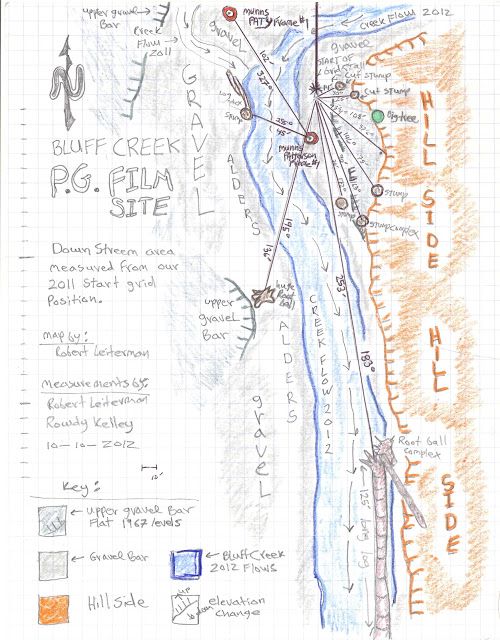
Once we were reasonably assured in our own minds that we had indeed found matches for the original trees, stumps, and old log piles from the flood, we determined to map the whole site using a grid map. We chose the point that Gimlin had identified as the approximate spot where they had first seen the subject, and with a compass we drew a line directly north. Along the way we marked ten foot segments. From the center we drew the line east and west, planting flags at each grid corner. Then we covered the entire site on foot, drawing in everything we found that was obviously old, removing from our mapping any trees and objects that were obviously too young to have been there in 1967 or 1971/2. We checked the entire mapping which was on graph paper, and then Robert drew the final first version map you see above. We compared it with the aerial photo from Dahinden and found so many matches it was clearly beyond coincidence (second photo above). Fortuitously, we met an independent geologist, and he did the trigonometry to compare the two images, correcting for viewing angles. The match was perfect with a very small margin of error. The next year we brought Munns up there. He confirmed it was the site using his own methods, and did analyses based on the film itself and the early site photos. There is no doubt that it's the site, and our map is accurate within mere inches, though not quite good enough for exact photogrammetry (according to Munns). We found in fact that our measurements were better than those done by Green and Dahinden, back in the day.

BFBM
 
Last edited:
Mins has no clue about photogrammetry, he demonstrated that in this forum.
His comment that an accurate ground map could not be used to analyse frames of the film using photogrammetry only reinforces his demonstrated ignorance of the subject.
His continued avoidance of using the process that would disprove his lens focal length assertions are just too obvious.
 
Wow...that's clarifying stuff to support the crayon drawing, graph paper, a geologist and trigonometry. Bill Munns opinion really adds to the "skeptical" viewpoint, didn't he want to dangle beneath a helicopter in a porch swing to take aerial photos of the site?

 
Last edited:
Bringing these forward. I found another error. FIAT = FLAT. There are no cars here.


Map #1
SS%20Site-only%202nd_zps7hxkl4vw.jpg


Map #2
SS--BC%20Film%20Site%20Map_zpsshrvzeaf.jpg
 
Last edited:
In my comment 3379 on page 85 I provided links to places where he discussed his methods. First, though, I include the comment I was responding to, for context:


Let it be known that Roger couldn't even see my comment, but included it in a list of "snarky comments" anyway.

A man old enough to be my grandpa, lol. :rolleyes:


I think LTC's snark above, and the dismissive comments after I posted Streufert's maps in comment 3388, got under Streufert's skin. Here they are (from Part II, page 85):

There were no favorable comments.

Let it be known that Roger couldn't even see my comment, but included it in a list of "snarky comments" anyway.

A man old enough to be my grandpa, lol. :rolleyes:

In all seriousness, what do you expect to get when you post such a bloody ludicrously scribbled map a la Crayola? Sort yourself out.
 
Perhaps you've been believing something that isn't true?

Oh, touche! lol.

In all seriousness, I never saw you conducting yourself in a sceptical manner when you were on Never Finding Bigfoot. Being a self-professed sceptic, is there any reason why you didn't feel the need to lay the Smack Down on Bobes and the gang?
 
Last edited:
In the past I watched a video of a Gimlin lecture with follow-up questions and answers. One person asked, "How far away from the creek was Patty when you first saw her?" His answer was, "About 18 inches." She was only a foot and a half from the water, according to Gimlin.

So given that information we can look at these maps and sort of see how far Patty walked away from the water before Patterson got his first frame of her on film. Maybe a rough calculation could be done for elapsed time of her walking away based on previously done calculations of her "walking speed". But then I seem to recall one or both of the guys saying that she stood and looked at them for a period of time before walking away.

But then there also remains the question of this creek in the fall of 1967. Is its position the same as in these maps? Is its shape the same? Is its width the same? Did the iconic giant log jam of the first few frames become moved? P&G said that that log jam concealed Patty as they approached her on horseback. So, from their perspective, she is "behind" the log jam and also 18" from the water.

Of course these cowboy Bigfooters could have made all of that up as part of a big hoax story.

ETA: I did write about the Gimlin lecture with the 18" comment here but I can't remember exactly when. I probably also linked to the video lecture.
 
Last edited:
If she's 18" from the water then she's either on the creek embankment or she's about to clamber up the embankment to get to the sand flat. Either way, there are going to be some really interesting tracks of hers climbing that soft bank next to the creek. We heard nothing of that from anyone there.
 
And they drew the map on a sheet of graph paper instead of starting with an actual contour map of the area ... why?
 

Back
Top Bottom