The One Covid-19 Science and Medicine Thread

Status
Not open for further replies.
I have an interesting scenario. My son has been offered a job in the UK, available now. Assuming he can get there (I can’t see a possible way now) would be get to bypass quarantine as a) he has already had the virus and has fully recovered and b) Australia has almost eradicated the virus? I guess he would.

If his job is as senior advisor to Boris Johnson, then yes, he can happily bypass the quarantine.
 
I never bothered checking the low countries, but it's a fact that some of the very low impact countries have high fish consumption.

I can only speak for my family, and it's not checked as a routine matter. I have annual blood tests and my 10 yo son does as well. Interestingly, they check his vitamin B levels, but haven't ever looked at D.

Now that's bloody interesting, because I was looking hard a few weeks ago - when people pooh-poohed the idea, but there's a whole heap of research available now.

Some highlights:

link

And Science Daily to finish off:

I'm going to go and post all that in the territory thread.
Given vitamin D deficiency is a problem when one doesn't get enough sunlight on the skin, we should see a higher fatality rate in NY compared to Southern California. Is that happening?

Looking at the citations:
From Science Direct: "severe deficiency are twice as likely"

A severe deficiency in vitamin D is a serious problem regardless.

Where did they get this data:
By analyzing publicly available patient data from around the globe, Backman and his team discovered a strong correlation between vitamin D levels and cytokine storm -- a hyperinflammatory condition caused by an overactive immune system -- as well as a correlation between vitamin D deficiency and mortality.
It sounds great, look at all those countries. How many patients had the data available? I want to see the data.

It's not that vitamin D isn't a very important vitamin. I'm just leary of these magical discoveries.
 
Last edited:
Given vitamin D deficiency is a problem when one doesn't get enough sunlight on the skin, we should see a higher fatality rate in NY compared to Southern California. Is that happening?

Err... kinda? Not quite, though. While vitamin D doesn't occur naturally in most base food stuffs, a lot of foods that one can buy at a supermarket have some added apparently. That'll generally throw off a lot of sunlight-based calculations.

Personally, I likely get a bit of an excess because of the amount of milk I drink and a daily supplementary multivitamin, not counting any of the rest. Not that I expect that the excess does much more than get flushed down the toilet.
 
Last edited:
Here's the actual study:

The Role of Vitamin D in Suppressing Cytokine Storm in COVID-19 Patients and Associated Mortality
Reported medical characteristics of 793 COVID-19 patients were used to evaluate the intensity of cytokine storm in severe COVID-19 using C-reactive protein (CRP) levels. Medical data reported from a national study of 3,848 participants in 2007- 2008 was used to investigate the association between Vit D status and CRP.

Findings:
Age-specific CFR in Italy, Spain, and France (70 yo ≤ age < 80 yo) was substantially
higher (>1.9 times) than other countries (Germany, South Korea, China); for the elderly
(age ≥70 yo), Italy and Spain present the highest CFR (>1.7 times that of other countries).
The age-specific ratio of confirmed cases in Italy, Spain, and France has also been
substantially higher than in other countries. A more severe deficiency of Vit D (mean 25-
hydroxyvitamin D (25OHD) concentration <0.25 ng/L) is reported in Italy and Spain

compared to other countries. Our analysis of the reported clinical data (25OHD, CRP)
from multiple studies suggests that elimination of severe Vit D deficiency reduces the risk
of high CRP levels (odds ratio of 2) which may be used as a surrogate marker of cytokine
storm which was estimated to a potential reduction in severe COVID-19 cases of up to
15%.

Are they using general information to draw specific conclusions?

I need time to read the rest.
 
Err... kinda? Not quite, though. While vitamin D doesn't occur naturally in most base food stuffs, a lot of foods that one can buy at a supermarket have some added apparently. That'll generally throw off a lot of sunlight-based calculations.

Personally, I likely get a bit of an excess because of the amount of milk I drink and a daily supplementary multivitamin, not counting any of the rest. Not that I expect that the excess does much more than get flushed down the toilet.

So to what degree do you think this throws off the general statement there is less vitamin D deficiency in sunnier climates? And don't they eat/drink roughly the same amount of vitamin D in foods in the populated latitudes? Or take supplements in those latitudes?

It was a general statement about an observation that might lead to an hypothesis.
 
Last edited:
A mathematical curiosity.
world population growth is 220,000 a day so with deaths at 346,000 from Covid that is just a day and a half.
A remarkably disruptive virus.
 
Where did they get this data:It sounds great, look at all those countries. How many patients had the data available? I want to see the data.

It's not that vitamin D isn't a very important vitamin. I'm just leary of these magical discoveries.

I know that my country has a national health database that can be accessed by researchers (including journalists). I think that's at least somewhat common in OECD countries which have a NHS. It gives researchers an opportunity to find statisitical connections between drugs/symptoms/diseases etc without leaving their desks. I understand that it requires caution/skill to avoid data-mining bias.
 
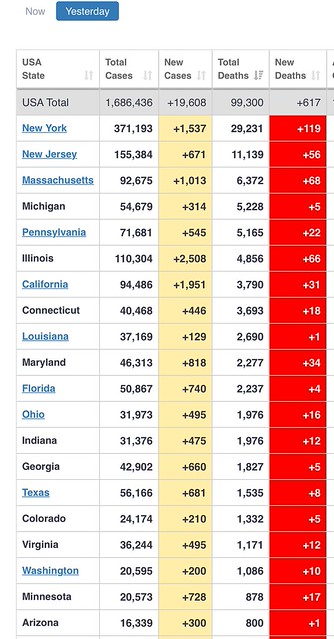
A month ago I posted this;

As an aside, I’ve marked May 24 on my calendar. Currently Florida and Georgia are #10 and #11 respectively in total deaths. I’m really curious as to how they’ll be ranked a month from now with Georgia opening things up a bit yesterday and Florida trending that way. Georgia is of particular interest, since we have a second home there. If I think of it I’ll check Georgia and Florida standings every Friday and post the results here. Lots of variables to be sure, but it may give some insight as to whether they opened up prematurely or not.

Well, the results of my little “experiment” are in. At the end of one month, Florida dropped one spot to 11th, and Georgia dropped three spots to 14th.

49932701717_591ab3cd53_z.jpg


So, not what I predicted if Florida and Georgia opened “too soon”.

Thoughts...

1) Maybe a month was not long enough. We’ll see. I’ll still be looking for effects going forward, but I don’t want to be accused of goalpost moving.

2) Maybe Total Deaths wasn’t the best metric, but it was the one I chose.

3) We have to trust the statistics coming out of Georgia and Florida are accurate. There’s been some accusations of shenanigans, especially in FL, but World-o-Meter was my compilation of choice.

4) There’s a chance that the heat and humidity in the South is helping keep the spread of the virus down.

5) And, finally, there’s a chance that Kemp and Desantis were not being as reckless as some thought. And that’s a good thing, as even Joe Scarborough had to admit:

49900651803_3601990ca7_z.jpg


Back when this one month “study” started, US deaths were about 52,000. Helps put things in perspective as we hit the 100,000 mark tomorrow.
 
I know that my country has a national health database that can be accessed by researchers (including journalists). I think that's at least somewhat common in OECD countries which have a NHS. It gives researchers an opportunity to find statisitical connections between drugs/symptoms/diseases etc without leaving their desks. I understand that it requires caution/skill to avoid data-mining bias.
Does it include all the lab data from all the COVID 19 patients and did they all have vitamin D levels? And now that I think about it, wouldn't anyone with a vitamin D deficiency have had that corrected right away when it was detected?

I didn't mean there wasn't data, I meant was there specific data on vitamin D levels on thousands of patients?

Turns out we don't have to guess though since I linked to the original study. And at first glance, they drew a lot of conclusions from indirect evidence.
 
Last edited:
Does it include all the lab data from all the COVID 19 patients and did they all have vitamin D levels? And now that I think about it, wouldn't anyone with a vitamin D deficiency have had that corrected right away when it was detected?

One of those pieces contained a note that massive doses of D to solve the deficiency didn't work, which is why NHS is recommending everyone dose daily. I imagine it must take time for the immune system to gear up with the vitamin D, so it adds up to me.
 
So to what degree do you think this throws off the general statement there is less vitamin D deficiency in sunnier climates? And don't they eat/drink roughly the same amount of vitamin D in foods in the populated latitudes? Or take supplements in those latitudes?

It was a general statement about an observation that might lead to an hypothesis.

Hard to say, to answer your first question directly. The point was more directed at the highlighted, as it was, though. Vitamin D deficiency frequently does not take place when people do not get enough sunlight, in short, given that that's not the only route to get a sufficient quantity. That doesn't change that places where more people spend more time outside in the sun are probably more likely to have less in the way of people deficient in Vitamin D, just that it throws a much harder to account for variable into the equation.
 
Last edited:
Got my free Covid-19 test this morning. Results in a couple days. I was there 30 minutes early and the line was quite long already. I snuck in the exit and asked about expedited testing. (I wasn't going to be able to stand that long in a line.) Good idea, as they told me just to drive around the back of the building for special Handicapped access. Got right in (one car ahead). Took about 10 minutes overall.
I do find it eerily ironic that they are doing pandemic testing at the Minneapolis Armory, when that was the location where they set up triage hospital beds in the movie Contagion.
 
Does it include all the lab data from all the COVID 19 patients and did they all have vitamin D levels? And now that I think about it, wouldn't anyone with a vitamin D deficiency have had that corrected right away when it was detected?

I didn't mean there wasn't data, I meant was there specific data on vitamin D levels on thousands of patients?

Turns out we don't have to guess though since I linked to the original study. And at first glance, they drew a lot of conclusions from indirect evidence.

It's updated continuously. I visit my GP, blood test is taken, blood pressure measured, urine test if I remembered to bring a sample, and into the database it goes. The prescription medicines I use can be found there as well, along with other medical history such as accidents. It would be the same with all tests and measurements of Covid patients along with their medical history. They don't necessarily do every possible test, though. So levels of Vitamin D may not be known for a number of patients. However, you could do a search on all patients where vitamin D is mentioned.

(What researchers can't get out of the database is any particular individual's identity, at least without authorization)
 
Hard to say, to answer your first question directly. The point was more directed at the highlighted, as it was, though. Vitamin D deficiency frequently does not take place when people do not get enough sunlight, in short, given that that's not the only route to get a sufficient quantity. That doesn't change that places where more people spend more time outside in the sun are probably more likely to have less in the way of people deficient in Vitamin D, just that it throws a much harder to account for variable into the equation.

There could be several confounding variables. We've mentioned Japan before, so I found this study from 2019 showing low levels of Vitamin D in Japanese women:

https://www.ncbi.nlm.nih.gov/pmc/articles/PMC6398852/

However, Japan has a good NHS and people visit their GPs regularly at little or no cost. I'm betting that the above study was discussed in Japanese medical journals, so perhaps their GPs started looking for it and began recommending supplements to their patients? It seems plausinbe to me.
 
One of those pieces contained a note that massive doses of D to solve the deficiency didn't work, which is why NHS is recommending everyone dose daily. I imagine it must take time for the immune system to gear up with the vitamin D, so it adds up to me.

I'm thinking of D did something great good for immune systems it would have been defined decade or two ago.

Do you think D does something particular to C19?
 
I'm thinking of D did something great good for immune systems it would have been defined decade or two ago.

Do you think D does something particular to C19?
There is some evidence that it is useful for prevention/treatment of upper respiratory tract infections. The efficacy is not clear cut, but this is why there is interest in it re:COVID-19
 
I'm thinking of D did something great good for immune systems it would have been defined decade or two ago.

To some extent, it has. An abstract, though, might be an okay thing to poke at to start with that.

It is now clear that vitamin D has important roles in addition to its classic effects on calcium and bone homeostasis. As the vitamin D receptor is expressed on immune cells (B cells, T cells and antigen presenting cells) and these immunologic cells are all are capable of synthesizing the active vitamin D metabolite, vitamin D has the capability of acting in an autocrine manner in a local immunologic milieu. Vitamin D can modulate the innate and adaptive immune responses. Deficiency in vitamin D is associated with increased autoimmunity as well as an increased susceptibility to infection. As immune cells in autoimmune diseases are responsive to the ameliorative effects of vitamin D, the beneficial effects of supplementing vitamin D deficient individuals with autoimmune disease may extend beyond the effects on bone and calcium homeostasis.

Going further, of course, it's not so much that more is great so much as that too little is bad.
 
Last edited:
I'm thinking of D did something great good for immune systems it would have been defined decade or two ago.

From one decade ago:

Vitamin D can modulate the innate and adaptive immune responses. Deficiency in vitamin D is associated with increased autoimmunity as well as an increased susceptibility to infection.

https://www.ncbi.nlm.nih.gov/pmc/articles/PMC3166406/.

Do you think D does something particular to C19?

I don't think it does anything to Covid, but given the fact that 80% or more people who catch Covid hardly notice it, it might just be that it's not that bad a disease, unless your immune response is lower due to D deficiency.
 
To some extent, it has. An abstract, though, might be an okay thing to poke at to start with that.


Going further, of course, it's not so much that more is great so much as that too little is bad.

Yes, it's one of those things where you should just have enough of it. Having too little weakens your immune system. Which is probably a bad idea if you get infected with any virus, really.
 
Status
Not open for further replies.

ISF - Join now!

Every member here is approved by hand. No bots, no spam, just people who care about evidence and honest debate.

Membership is free!

Create your free account

Back
Top Bottom