
You are using an out of date browser. It may not display this or other websites correctly.
You should upgrade or use an alternative browser.
You should upgrade or use an alternative browser.
Bikewer
Penultimate Amazing

Only slightly OT, and in regards to Daviddayjordan's post... Back when I was studying art more seriously, one of the painting magazines ran an article on the much-revered "golden section".
The fellow writing the article had you divide up your canvas according to these principals, marking off junctures and such. You were supposed to put "items of interest" at these junctures, to make a pleasing composition.
Unfortunately, when the author got done marking, measuring, and juncturing, there was hardly a square inch of canvas that did not have a place for these points of interest.
Utter bunkum, IMO.
Thank you all for the thoughtful replies. Solus, did you perhaps mean that by its very definition, beauty is subjective?
ACK! I can't edit the post to fix it.

I definitely know what objective and subjective mean. Typo!
Beauty is definitely subjective in my opinion.

qayak
Penultimate Amazing

- Joined
- Jul 31, 2006
- Messages
- 13,844
I would say that it's clear to me that beauty is subjective... it is a property of a perception that pleases someone.
However, it's also clear that there are patterns to what people perceive as subjectively beautiful--patterns enough to study, but not to be taken as universal rules.
I agree. No universal rules but definitely general rules regarding beauty.
It could very well be that the reason humans are not completely objective on things like this is that it would limit our success as a species. If Angelina Jolie was the only woman men found beautiful, we would be relying on Angeline, and the few like her, to keep up the population.
I don't care how attractive Angelina is, after a couple of billion guys have been with her
 , I'm really not interested anymore!

andyandy
anthropomorphic ape

- Joined
- Apr 30, 2006
- Messages
- 8,377
I'd be interested in what people in China, for example think of this face.
the "western face" is considered very attractive in japan - especially (god knows why) a small face (kao chisaii!) and a "tall" (high bridged) nose (hana takaii!)
I think there is a genetic-basis for our perception of beauty, which is then reinforced/perpetuated through societial influences. We find attractive those of the opposite sex (i'm not sure where homosexual attraction fits into this) who can provide a good genetic bank for our offspring.
we have built in mechanisms which mean that we don't find people too similiar in appearance to our siblings of opposite sex attractive - to prevent inbreeding,
we find women during the peak of monthy fertility more attractive than at other times of the month,
we find symetrical faces more attractive
there are tribes in which fat women are considered more attractive than those of a skinny nature
if a male individual has blue eyes, he will find a lady with blue eyes more attractive - because the recessive gene will mean he can be more certain that any offspring is his own
social example,
In victorian times pale skin was considered beautiful - as a tan would mean one worked outside - a very lower class activity. With the advent of the package holidays, a tan was a symbol of wealth.
etc etc.
this is all a bit short of any details....but should be easily google-able

so, the "objective" element of beauty is provided by genetics - although this itself may itself be of a subjective nature distinct to the individual's specific requirements. This "objectivity" is then reinforced/perpetuated/altered through societal pressures....
Last edited:
Well...there are composite faces from many areas. That one happens to be Greek (the average of 16 faces--the names were listed in the original paper). I posted it because it is uncannily close to one of our forumites. Another face, averaged from a US magazine's "top 16 most beautiful women in the world" is this:[qimg]http://kai.dyndns.org/images/greek_beauty.jpg[/qimg]
I'd be interested in what people in China, for example think of this face.

I don't know how many faces, nor of whom, but for Chinese, Korean, and Japanese (in order):
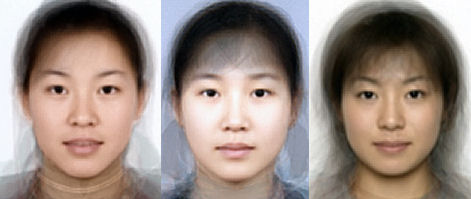
All from here.
andyandy
anthropomorphic ape
- Joined
- Apr 30, 2006
- Messages
- 8,377
ok.....here's a bit fore flesh to my last post
http://www.sciencedaily.com/releases/2006/10/061023193617.htmBlue Eyes -- A Clue To Paternity
The laws of genetics state that eye color is inherited as follows:
If both parents have blue eyes, the children will have blue eyes.
If both parents have brown eyes, a quarter of the children will have blue eyes, and three quarters will have brown eyes.
The brown eye form of the eye color gene (or allele) is dominant, whereas the blue eye allele is recessive.
It then follows that if a child born to two blue-eyed parents does not have blue eyes, then the blue-eyed father is not the biological father. It is therefore reasonable to expect that a man would be more attracted towards a woman displaying a trait that increases his paternal confidence, and the likelihood that he could uncover his partner’s sexual infidelity.
Eighty-eight male and female students were asked to rate facial attractiveness of models on a computer. The pictures were close-ups of young adult faces, unfamiliar to the participants. The eye color of each model was manipulated, so that for each model’s face two versions were shown, one with the natural eye color (blue/brown) and another with the other color (brown/blue). The participants’ own eye color was noted.
Both blue-eyed and brown-eyed women showed no difference in their preferences for male models of either eye color. Similarly, brown-eyed men showed no preference for either blue-eyed or brown-eyed female models. However, blue-eyed men rated blue-eyed female models as more attractive than brown-eyed models.
In a second study, a group of 443 young adults of both sexes and different eye colors were asked to report the eye color of their romantic partners. Blue-eyed men were the group with the largest proportion of partners of the same eye color.
According to Bruno Laeng and colleagues, “It is remarkable that blue-eyed men showed such a clear preference for women with the same eye color, given that the present experiment did not request participants to choose prospective sexual mates, but only to provide their aesthetic or attractiveness responses…based on face close-up photographs.” Blue-eyed men may have unconsciously learned to value a physical trait that can facilitate recognition of own kin.
andyandy
anthropomorphic ape
- Joined
- Apr 30, 2006
- Messages
- 8,377
http://www.psichi.org/pubs/articles/article_548.asp
This is a great paper - re evolutionary pressures on "attractiveness"
This is a great paper - re evolutionary pressures on "attractiveness"
WHR [waist to hip ratio], Reproductive Function, and Health Status
There is strong evidence indicating that WHR is an accurate somatic indicator of reproductive endocrinological status and long-term health risk (see Table 1).
As evidenced from the findings summarized in Table 1, WHR reliably links practically all the conditions that affect women's reproductive status and fertility (for reference, see Singh, 1993a, 2002). It seems that an elevated level of circulating estrogen lowers WHR, whereas an elevated level of circulating testosterone increases WHR. Women with high WHR have more irregular menstrual cycles, fewer ovulatory cycles, and lower pregnancy rates in artificial insemination and in vitro fertilization embryo transfers than women with lower WHRs, independent of body weight. One of the significant problems affecting the reproductive success of ancestral population males would have been to assess whether a potential mate was nubile nullipara (have not given any birth), as such women have higher fecundity than those who have given birth or are lactating; multiparity (number of children given birth to) directly increases the size of WHR. More critically, WHR size can be used to roughly estimate whether a woman is in the early stages of pregnancy induced by another male; investing resources in a child fathered by another male does not enhance a male's reproductive success. The size of WHR increases even in the early stages of pregnancy. Etc etc.
snip snip
In summary, WHR size provides reliable information about the reproductive age, fertility, and health status of a woman at a glance. If fertility and good health are significant determinants of female attractiveness, one should be able to affect female attractiveness judgments systematically by manipulating WHR size alone.
snippy snippy
The evidence summarized in this paper demolishes the myth that beauty is ever-changing, skin-deep, and superficial. The attractiveness judgment based on figures defined by WHR is a robust phenomenon evident in various cultures. I have presented data to establish that the allure of the hourglass figure is "programmed" in the human mind, because it provides important biological information about a woman's youthfulness, health status, and fertility.
It should be stressed that the notion of what constitutes female attractiveness is wired in the human mind does not imply that judgment of attractiveness is rigid and impervious to environmental conditions. There are huge differences among various human societies due to ecological conditions. Therefore, one of the variables that may shape the nature of preferences is the population-typical ranges of body weight and WHR distribution. As pointed out by Symons (1979), psychological mechanisms could instantiate a rule to prefer WHR somewhat lower than the local female average. As there are population specific variations in the size of the WHR, it could be that female attractiveness is defined on the basis of being somewhat lower than the local female average rather than some absolute size of WHR (Sugiyama, 2004). For example, in societies where the local average of WHR of female population is say 0.80, men in the society may judge women with 0.75 WHR attractive, whereas in societies with the average of 0.73, men may judge women with 0.75 as unattractive.
Last edited:
The critiques on aesthetics I've read were mostly unconcerned with faces as a way of judging beauty, and I think it's because they were trying to figure out art and why so many cultures have it rather than.... oh, I don't know... whether their neighbor was an ugly old hag or not 
I'm a fan of the essay in the preface to Gautier's "Mademoiselle de Maupin" but I can't find the full text online... It was a response mostly to Kant, who said that beauty could only be judged by morality, because we had to be unconcerned with whether or not the object being judged existed.
As soon as something has utility, he says, we are predisposed towards it. Pleasure derived from an object is alright, but desire is not. As soon as you want to attain something, it can no longer be judged objectively.
He mentions castles and flowers as examples.
I'll keep an eye out for the essays, since I don't have anything to add beyond what they did on the subject, but I am a greater fan of Gautier's perspective, which was part of the whole "art for art's sake" movement.
I think the reason the debate came up in the first place (I could be wrong here, but many of the critics mention it) had to do with whether or not art should contain things that are immoral (like nudity). Therefore it had to be decided whether the human body could be represented because, despite its foot being in immorality, it was beautiful, or if there was no real reason for representing such a thing at all.
When I worked in an art museum, for example, there were a great number of paintings depicting nude people that looked... well, weird. And it was because during the time when people were really getting all over the art/beauty/morality argument, those moral critics got hold of the paintings and painted on clothes.
Conservationists later tried to remove the clothes. It ends with the paintings looking like they are both naked and clothed simultaneously.
Anyway, I could be wrong, just thought I'd toss that in...
Here's a link to the whole aesthetics movement, summarized...
http://www.glbtq.com/literature/aestheticism.html
Ichneumonwasp
Unregistered
- Joined
- Feb 2, 2006
- Messages
- 6,240
Mercutio said:That one happens to be Greek (the average of 16 faces--the names were listed in the original paper). I posted it because it is uncannily close to one of our forumites.
Um, like, um, [shuffles feet], um, like, um, like which one?
I was merely interested in a purely scientific, speculative, philosophical way.
Really.
Um, yeah.
Z
Variable Constant

The funny thing is, to my eye, that composite face is dull, lifeless, featureless. The eyebrows are interesting, but the rest of the face is unrelentingly bland. And almost no Native American attributes!
Nope, not beautiful. Pretty enough, but pretty isn't beautiful.
Nope, not beautiful. Pretty enough, but pretty isn't beautiful.
andyandy
anthropomorphic ape
- Joined
- Apr 30, 2006
- Messages
- 8,377
The funny thing is, to my eye, that composite face is dull, lifeless, featureless. The eyebrows are interesting, but the rest of the face is unrelentingly bland. And almost no Native American attributes!
Nope, not beautiful. Pretty enough, but pretty isn't beautiful.
well....if you don't want her.....
andyandy
anthropomorphic ape
- Joined
- Apr 30, 2006
- Messages
- 8,377
good old Japan
http://www.japantoday.com/jp/kuchikomi/408Shukan Gendai (May 6-13) quotes an old saying which neatly sums up the point it's trying to make: "It takes three days to get tired of a 'bijin' (beautiful woman), and three days to get used to a 'busu' (homely woman)."
In other words, bijin are overrated, and as to busu – why, give them a chance, men; the rewards are as rich as they are (perhaps) unexpected.
It's a message whose time has come – so much so that Shukan Gendai sees a "busu boom" in the not very distant offing. Win one while you can, it advises its male readers. Before long the competition will be intense. You'll call, but she won't be home.
It all started with a bestseller called "Busu no Kabe" (The Wall of the Busu) by cosmetic surgeon Katsuya Takasu. Takasu describes "an interesting experiment." On your computer, patch together a composite face using 10 bijin faces; the result, he says, will be an average face. Then do the same with 10 busu faces – you'll end up with a beauty.
snip snip
"There is a connection," he explains, "between inner quality and outer appearance. Sexy men and beautiful women tend not to be very interesting people. Why? Because good-looking men and women are (otherwise) average. A lover wants his or her partner to be 'interesting.' Look at history. It's full of promiscuous men who flitted from woman to woman, only to settle down with a busu in the end. Napoleon did. So did Louis XIV."
"Sexually," adds writer Nobuhiro Motohashi, "bijin will often disappoint you. They're too busy playing the bijin role. But busu – they're the greatest; so eager to please – maybe because once they've caught a man they don't want to let him go. Whereas bijin – well, sexually," he sums up, "bijin are basically busu."
Are bijin's days as queens of the sexual carnival numbered? Are busu on the verge of a quiet coup d'etat? They may well be. Even the professional womanizers, Shukan Gendai finds, are starting to shift their allegiance.
“In my private life," confesses a "charisma host" who entertains women clients at a club in Tokyo's Kabukicho, "I find bijin hard to take. I mean, I'm trying too hard, she's trying too hard... It's all rather exhausting. You get to a point where you see the attraction of a busu you can just relax and be at ease with."
Then there's a certain movie director with more than 5,000 "adult videos" to his directing credit. "I deal with bijin all the time in the course of my work," he says. "And the fact is, if a woman is a bijin, the chances are pretty good she's lacking something in terms of character."
So there it is, a potentially seismic shift. Busu will bask in new glory, while bijin are left lonely and neglected at home, lamenting the sad fate that cast them in beautiful molds only to mock them!
Kopji
Philosopher

- Joined
- Apr 21, 2003
- Messages
- 8,004
To the OP, I see 'beauty' and 'morality' as being the same kind of idea. We judge things by them as if they were objective, but they are subjective.
Some ideas seem to be useful (confer a survival benefit?) if thought of as objective; for me that is the more difficult paradox to resolve. How do we learn to live together when ideas that are subjective, help us survive as a 'human tribe' when thought of as objective?
Some ideas seem to be useful (confer a survival benefit?) if thought of as objective; for me that is the more difficult paradox to resolve. How do we learn to live together when ideas that are subjective, help us survive as a 'human tribe' when thought of as objective?

qayak
Penultimate Amazing
- Joined
- Jul 31, 2006
- Messages
- 13,844
Some ideas seem to be useful (confer a survival benefit?) if thought of as objective; for me that is the more difficult paradox to resolve. How do we learn to live together when ideas that are subjective, help us survive as a 'human tribe' when thought of as objective?
Our system of morality works pretty well. The one problem seems to be that it is based on our beginnings of living in small groups and tribes. In today's world this doesn't work. Back then, morals were for dealing with your immediate neighbours. It was okay to be immoral when dealing with the people outside your own "in" group. Ancient texts bear this out, the bible included.
All that is needed though, is to get people to see the entire world as being the "in" group. Great strides have been made in accomplishing this but there is still a long way to go. This extension of morality seems to be the first thing to go when wars break out as witnessed throughout history. Two groups will live side by side for years with few problems and then start killing each other based on the fact that they are from different ethnic backgrounds.
Hopefully, in the future, through education and diversification these divisions will become smaller and smaller.

Z
Variable Constant
beauty: subjective or objective
Beauty is subjective
Paul
Well, that's YOUR opinion...

I agree. No, I do not think that we can speak properly of "objective beauty" or of "objective right and wrong". I think we fool ourselves into thinking that things like these are "objective" when they are really only agreed upon inter-subjectively by a large number of people. I think your example demonstrates very well that what we call "objective" is simply inter-subjective. It's the age old problem of people surrounding themselves with like-minded folks and then thinking that simply because we all agree then we must have found truth.
We do, however, need to contrast this with the fact that there are objective truths. We know one for certain -- thinking happens. That is objectively true. So there is no room for someone to jump in and try the simplistic "relativist fallacy" argument of "Oh, so you say there is no objective truth, well is that statement objectively true or not?".
I think this is a very interesting point to make.
I would reserve the characterization of "objective" for things that appear, to the best of our collective knowledge, to operate independently of the subject doing the thinking. So something like "beauty" or "morality" is out because it necessarily refers to something that ultimately lies with the opinion of the thinker.
Something like "the moon is made of cheese" operates independently of the thinkers because it refers to things that can be observed by all, assuming common definitions of words (if "cheese" means "various types of rock" then the meaning obviously changes... but wait, what do I mean by "rock" and "various types"... cosmic!). It doesn't require agreement, as far as we can tell, to be true. I suppose you could say that this means everything eventually rests on the inter-subjective definitions of various words and concepts... but that seems to be getting a little weasely (a highly subjective opinion, obviously).
"Beauty" appears to be based on certain things that can be quantified (measuring ratios, etc.), but I'd argue that the concept ultimately depends on what the individual considers beautiful. I think your term "inter-subjective" is a perfect way of describing it. There is some common agreement, but it can't be pinned down to a single, specific, opinion-independent quantification.