
You are using an out of date browser. It may not display this or other websites correctly.
You should upgrade or use an alternative browser.
You should upgrade or use an alternative browser.
The Heiwa Challenge
- Thread starter Heiwa
- Start date
- Status
- Not open for further replies.

Tony Szamboti
Illuminator
- Joined
- Jun 2, 2007
- Messages
- 4,976
For debris to overtake the main collapse indicates that there was some apparent deceleration as the collapse of the floors progressed... Since gravity essentially won that battle I'm not sure why it's strange that as the collapse progressed with a net gain in speed. Especially considering that with how the collapse propagated the core wasn't largely responsible for allowing the collapse to continue after it had already begun in the impact regions.
When kinetic energy is transferred it requires a loss of velocity by the object transferring the energy. The falling upper block could not destroy the columns below, which were designed to take multiples of it's load, and gain speed at the same time.
There was no deceleration of the upper block of WTC 1. Go measure it's fall yourself.
The only way the upper block could gain speed was for the strength of the columns below to be degraded to where they could not support it's static load.

There was deceleration. The video does not have the time and space resolution to see the deceleration. But the momentum transfer model matches the time of fall for the WTC. You forgot to use some engineering skills like sampling theory to see your ideas are delusions.When kinetic energy is transferred it requires a loss of velocity by the object transferring the energy. The falling upper block could not destroy the columns below, which were designed to take multiples of it's load, and gain speed at the same time.
There was no deceleration of the upper block of WTC 1. Go measure it's fall yourself.
The only way the upper block could gain speed was for the strength of the columns below to be degraded to where they could not support it's static load.
If there were no deceleration the WTC would have fallen in 9 seconds. We have times greater than 12.08 seconds. This means there were decelerations. Do you need some refresher courses on sampling theory and basic physics?
Do you need for me to explain pixels and frame per second again for observing the collapse? This is funny to see how poorly you are performing as an engineer. You can change your name but you are still the realcddeal with zero evidence to support your realcddeal.
Last edited:
phunk
Illuminator

- Joined
- Aug 10, 2007
- Messages
- 4,127
When kinetic energy is transferred it requires a loss of velocity by the object transferring the energy. The falling upper block could not destroy the columns below, which were designed to take multiples of it's load, and gain speed at the same time.
There was no deceleration of the upper block of WTC 1. Go measure it's fall yourself.
The only way the upper block could gain speed was for the strength of the columns below to be degraded to where they could not support it's static load.
You didn't pass high school physics, did you? There is no need to lose velocity, only has to lose acceleration.
Newtons Bit
Penultimate Amazing

- Joined
- Apr 12, 2007
- Messages
- 10,049
You didn't pass high school physics, did you? There is no need to lose velocity, only has to lose acceleration.
It does actually need to lose velocity to apply a force GREATER than it's own m*a. Which is, I believe, his entire point.
However, this assumes that the upper block is actually causing the damage below and not the rubble layer.
Grizzly Bear
このマスクに&#
- Joined
- May 30, 2008
- Messages
- 7,963
When kinetic energy is transferred it requires a loss of velocity by the object transferring the energy. The falling upper block could not destroy the columns below, which were designed to take multiples of it's load, and gain speed at the same time.
There was no deceleration of the upper block of WTC 1. Go measure it's fall yourself.
The columns never needed to be destroyed in the first place in order to fail, and few of the columns in the debris pile ever were destroyed. The majority of failure points were the bolts and welds that contributed to the structures' stability, and that's readily apparent at initiation, progression, and aftermath. There's nothing unexpected there. The deceleration you're looking for is in the average acceleration of the overall collapse; where the collapse front proceeded downward to the ground slower than the debris that fell independent of the rest of the building. The reason why there's no substantial visible "jolt" is because the individual floors were overwhelmed immediately upon impact and the net acceleration wasn't substantially reduced in the process.
Or as you're aware apply a dynamic load which changes based on the distance of travel and the acceleration of the mass and exceed the strength of the underlying connections that hold them together. Add insult to injury by applying those loads axially. That's generally the reason why the collapse was able to progress... This stuff has been discussed to death, though admittedly by people with better qualifications than me.The only way the upper block could gain speed was for the strength of the columns below to be degraded to where they could not support it's static load.
Last edited:
phunk
Illuminator
- Joined
- Aug 10, 2007
- Messages
- 4,127
It does actually need to lose velocity to apply a force GREATER than it's own m*a. Which is, I believe, his entire point.
However, this assumes that the upper block is actually causing the damage below and not the rubble layer.
This is true, but it also assumes that greater than m*a is necessary to cause collapse. It is not needed if the columns are offset and not colliding head-on with the columns below. If the load falls between the columns, or on the floors, or anywhere other than square on top of the lower columns, there's no chance of collapse arrest even if the load is gently lowered down.
It does actually need to lose velocity to apply a force GREATER than it's own m*a. Which is, I believe, his entire point.
However, this assumes that the upper block is actually causing the damage below and not the rubble layer.
Rubble layer causing damage? Well, in The Heiwa Challenge any means to break elements and connections in A are permitted as long as initial energy applied is by dropping part C on part A using gravity.
This energy application will evidently disturb the static equilibrium of A and C and, apart of deforming and, maybe, breaking elements/connections at interface C/A (or maybe somewhere else? - interface A/ground?) may produce rubble = free, broken elements, B! OK, fair enough! And now these broken elements B produce a one-way crush down of A ... with C pushing from behind?
Can you give an example of any such composite structure and what kind of broken, fully disconnected elements of it can destroy the complete structure from top down?

I went to the NIST site right after posting to come back and site which chapter it is in and it appears that the NIST server with the WTC reports on it is down for maintenance this weekend. I don't remember the exact chapter(s) and I don't have the reports downloaded right now.
If you have the reports downloaded then you should be able to find it quickly. Part of it would be under design and construction and the photos, showing the reinforcement, would be where the floor assembly fire testing is described.
I have the report saved via PDF, I'll try to do a search on it.
ETA: Well, I was mistaken. I only have NCSTAR 1-2 saved. It's not in that one, though.
Last edited:
Rubble layer causing damage? Well, in The Heiwa Challenge any means to break elements and connections in A are permitted as long as initial energy applied is by dropping part C on part A using gravity.
This energy application will evidently disturb the static equilibrium of A and C and, apart of deforming and, maybe, breaking elements/connections at interface C/A (or maybe somewhere else? - interface A/ground?) may produce rubble = free, broken elements, B! OK, fair enough! And now these broken elements B produce a one-way crush down of A ... with C pushing from behind?
Can you give an example of any such composite structure and what kind of broken, fully disconnected elements of it can destroy the complete structure from top down?
one question:
How much of the broken elements were transformed into clouds and then pressed out from the crushing zone? When I see the immense clouds during the collapse, I would estimate, that 90 % of the material was thrown / pressed out during the top-down demolition (this is for me the most probably scenario).
It is clear, that the broken elements did mainly not stay in the crushing zone or?
332nd
Penultimate Amazing

- Joined
- Sep 27, 2006
- Messages
- 11,278
http://www.engr.psu.edu/ae/WTC/wtc-photo.jpg Huge photo (slow loading,zoomable)
(F11 may toggle fullscreen on/off on yur computer)
You have no idea how big those cranes are do you?
BigAl
Philosopher

- Joined
- Jun 9, 2007
- Messages
- 5,397
one question:
How much of the broken elements were transformed into clouds and then pressed out from the crushing zone? When I see the immense clouds during the collapse, I would estimate, that 90 % of the material was thrown / pressed out during the top-down demolition (this is for me the most probably scenario).
It is clear, that the broken elements did mainly not stay in the crushing zone or?
I dunno what "in the crushing zone " means.
The debris for WTC1 and 2 was spread over the 24 acre plaza.
Newtons Bit
Penultimate Amazing
- Joined
- Apr 12, 2007
- Messages
- 10,049
Rubble layer causing damage? Well, in The Heiwa Challenge any means to break elements and connections in A are permitted as long as initial energy applied is by dropping part C on part A using gravity.
This energy application will evidently disturb the static equilibrium of A and C and, apart of deforming and, maybe, breaking elements/connections at interface C/A (or maybe somewhere else? - interface A/ground?) may produce rubble = free, broken elements, B! OK, fair enough! And now these broken elements B produce a one-way crush down of A ... with C pushing from behind?
Can you give an example of any such composite structure and what kind of broken, fully disconnected elements of it can destroy the complete structure from top down?
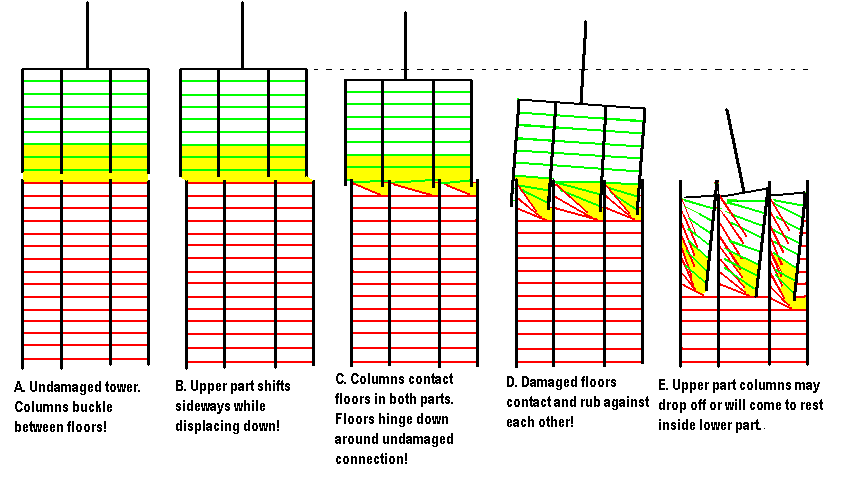
You see this Heiwa? It's not real. Part C&D&E never happens. The columns never get tied up in the trusses because the trusses rotate and snap (like all steel thicker than wire). All the concrete and office contents fall to the bottom and overload each successive floor. The columns, which were once supported in the out-of-plane direction by the floor are now unstable and collapse under their own self-weight.
The "upper block" as it were, doesn't actually cause the lower block to collapse. The rubble from the upper block and lower block together does.
.one question:
How much of the broken elements were transformed into clouds and then pressed out from the crushing zone? When I see the immense clouds during the collapse, I would estimate, that 90 % of the material was thrown / pressed out during the top-down demolition (this is for me the most probably scenario).
It is clear, that the broken elements did mainly not stay in the crushing zone or?
bio,
You need to distinguish between:
"... opaque dust & debris laden air ..."
and
"... mass ...".
If the portion of the debris that you are considering does not immediately descend as in a gravity fall, but hangs in the air, that IMMEDIATELY tells you that this component is low density and small. Ergo, it does not have much total mass.
And, to the precision of all but the MOST rigorous of calculations, is negligible.
The estimates that I've seen say that the amount of total mass that is thrown out of the footprint of the buildings is around 1/4th to 1/3rd. No where near 90%.
tom
The "upper block" as it were, doesn't actually cause the lower block to collapse. The rubble from the upper block and lower block together does.
Amazing what rubble can do! But this is The Heiwa Challenge thread and any structure is permitted where part C one-way crushes part A as per post #1. If rubble of parts A and C assist ... pls, feel free to demonstrate it.
But rubble from part C? According Bazant, Seffen, Mackey & Co (NIST?) part C is supposed to be intact ... and drive the whole one-way crush down destruction. You do not seriously believe that broken off elements of a structure can break intact elements of same structure?
one question:
How much of the broken elements were transformed into clouds and then pressed out from the crushing zone? When I see the immense clouds during the collapse, I would estimate, that 90 % of the material was thrown / pressed out during the top-down demolition (this is for me the most probably scenario).
It is clear, that the broken elements did mainly not stay in the crushing zone or?
According Bazant & Co only air and smoke are ejected outside the foot print. Broken elements of part A are supposed to compress into a rubble layer part B that in turn one-way crushes down intact structure of part A. I know it sounds ridiculous but it is part of the OCT.
Part C starting the whole thing is supposed to be crushed up at the end of the drama. These OCTists really invent fairy tales and you are not supposed to ask any questions for obvious reasons.
Newtons Bit
Penultimate Amazing
- Joined
- Apr 12, 2007
- Messages
- 10,049
Amazing what rubble can do! But this is The Heiwa Challenge thread and any structure is permitted where part C one-way crushes part A as per post #1. If rubble of parts A and C assist ... pls, feel free to demonstrate it.
But rubble from part C? According Bazant, Seffen, Mackey & Co (NIST?) part C is supposed to be intact ... and drive the whole one-way crush down destruction. You do not seriously believe that broken off elements of a structure can break intact elements of same structure?
1. I seriously think you have no idea what you're talking about. Ever wonder why it's "Heiwa's" Axiom and not <insert old long since dead european dude>'s theorem?
2. I seriously think that rubble has mass and that due to gravity this rubble has weight. The floors can only support approximately their own self-weight and an additional 100psf. Which means that one floor can support, at most, rubble created from three floors above. Once a floor gets overloaded by three floors above, it collapses as well.
3. Whether or not Bazant, Seffen, Mackey, Gordon Ross, Heiwa, and/or Newtons.Bit have provided an incorrect model for collapse has nothing to do with how it actually collapsed. We all base theoretical models on assumptions, which may or may not be accurate or based on real physics (like your assumptions)
Hewia,
Regarding Newton's post above:
If you were the foreman on the job, and you were familiar with the VERTICAL assembly of the columns (4 x Ø1" bolts in the adjoining plates), how many 3 story tall assemblies would you allow your crew to stack with ONLY those 4 bolts holding the stack from falling over?
How many would you expect to stand, unsupported except by those 4 bolts) on a breezy day (say wind gusts to 15 knots)?
How many would you expect to stand with wind gusts of 500 knots (as some estimates have suggested from the expulsion of 4 million cubic feet per second of debris laden air, and an avalanche of solid debris?
And yet, for some reason, your drawing shows vertical, unsupported columns reaching upwards & downwards 15 stories... Thru debris ...
Curious.
Regarding Newton's post above:
http://heiwaco.tripod.com/WTC1slicea.GIF
You see this Heiwa? It's not real. Part C&D&E never happens. The columns never get tied up in the trusses because the trusses rotate and snap (like all steel thicker than wire). All the concrete and office contents fall to the bottom and overload each successive floor. The columns, which were once supported in the out-of-plane direction by the floor are now unstable and collapse under their own self-weight.
The "upper block" as it were, doesn't actually cause the lower block to collapse. The rubble from the upper block and lower block together does.
If you were the foreman on the job, and you were familiar with the VERTICAL assembly of the columns (4 x Ø1" bolts in the adjoining plates), how many 3 story tall assemblies would you allow your crew to stack with ONLY those 4 bolts holding the stack from falling over?
How many would you expect to stand, unsupported except by those 4 bolts) on a breezy day (say wind gusts to 15 knots)?
How many would you expect to stand with wind gusts of 500 knots (as some estimates have suggested from the expulsion of 4 million cubic feet per second of debris laden air, and an avalanche of solid debris?
And yet, for some reason, your drawing shows vertical, unsupported columns reaching upwards & downwards 15 stories... Thru debris ...
Curious.
Your idea of dropping 10 percent of a building on itself from 2 miles make your ideas insane and stupid.According Bazant & Co only air and smoke are ejected outside the foot print. Broken elements of part A are supposed to compress into a rubble layer part B that in turn one-way crushes down intact structure of part A. I know it sounds ridiculous but it is part of the OCT.
Part C starting the whole thing is supposed to be crushed up at the end of the drama. These OCTists really invent fairy tales and you are not supposed to ask any questions for obvious reasons.
After you lost your challenge twice on 911 your posts are entertaining as delusions and parody on engineering. Explain your pizza box theory again please. How does the pizza box delusion fit with your challenge and nonsensical axiom? If you had practical knowledge of models, would that help you see your challenge is a failure?
Last edited:
According Bazant & Co only air and smoke are ejected outside the foot print. Broken elements of part A are supposed to compress into a rubble layer part B that in turn one-way crushes down intact structure of part A. I know it sounds ridiculous but it is part of the OCT.
Part C starting the whole thing is supposed to be crushed up at the end of the drama. These OCTists really invent fairy tales and you are not supposed to ask any questions for obvious reasons.
By "OCTists" you are referring to ALL the serious physicists and engineers in the world. You keep trying to trick people who know vastly more and who think far more clearly than you do that there are three parts of the collapsing structure. You have achieved nothing apart from establishing that you are an incompetent.
In reality, there were the collapsing floors, including the impact floors and the floors above them, and the floors they crushed. As the collapse progressed, it added mass and momentum. All the smoke you've blown, all the absurd mangling of basic physics you've indulged in, and all the ideological posturing you put on display can't change the facts. NIST's thousand consultants, the FEMA group, the Purdue and Berkeley teams, the independent academics who have written papers you can't understand, and the highly-qualified engineers on this forum, all of them are right and you are WRONG.
Last edited:
- Status
- Not open for further replies.