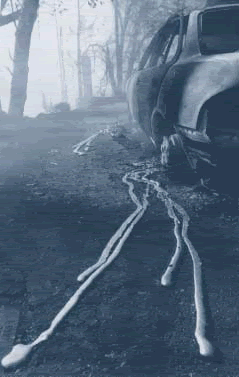
The Great Thermate Debate

Yeah, as I've told you previously a few months back in this very thread.

Ah, yes:
I read the paper you linked, and found nothing in it to rightly substantiate your claim that the damage to the steel recovered by FEMA was not inflicted by thermate.
That was a nice handwave back then. So, in sum, you read but didn't comprehend the WPI studies. Here are two posts that summarize the reasons why those studies rule out thermite/thermate:
More posts and threads:
... and there are more, but these are the ones I can recall off the top of my head and dig up though the search function.

Bottom line: The microstructure of the sulfidation corroded steel establishes what the temperature boundaries were for those structures to have been formed; temperatures beyond that would have destroyed the very microstructures that were studied. Furthermore, the reaction kinetics of thermite/thermate are far too fast to have created those microstructures; Erin Sullivan from WPI hypothesized that the rate of sulfidation would've been on the order of hours to days, and therm*te reacts in seconds. Sunstealer echoes this in the first link above. Simply understanding that the microstructures establishes an range of possible temperatures outside of which those microstructures would not exist is enough to rule out therm*te as a cause for them.
 
My Dads hobby is Model Engineering. He builds working model steam locomotives. He has a workshop with all the usual engineering machine tools; lathe, milling machine, surface grinder (good source of microspheres by the way)
he also has a furnace. It can melt 4lb of iron or brass etc. In form it is like a big round steel drum lined with fireclay. It has a big fireclay lid with a hole for the exhaust blast and a burner connected to a gas supply and a big blower goes into the side. When the lid is taken off to remove the crucible and the iron is poured into a pattern you can feel the heat 20 feet away. As soon as the blast is taken off the furnace it cools even in the insulated fireclay, you have 30 seconds max to pour. Any molten steel wouldn't have remained so for day, to think it would shows no knowledge of iron founding or steel making. What do the truthers thinkthose huge steelworks are for?
 
My Dads hobby is Model Engineering. He builds working model steam locomotives. He has a workshop with all the usual engineering machine tools; lathe, milling machine, surface grinder (good source of microspheres by the way)
he also has a furnace. It can melt 4lb of iron or brass etc. In form it is like a big round steel drum lined with fireclay. It has a big fireclay lid with a hole for the exhaust blast and a burner connected to a gas supply and a big blower goes into the side. When the lid is taken off to remove the crucible and the iron is poured into a pattern you can feel the heat 20 feet away. As soon as the blast is taken off the furnace it cools even in the insulated fireclay, you have 30 seconds max to pour. Any molten steel wouldn't have remained so for day, to think it would shows no knowledge of iron founding or steel making. What do the truthers thinkthose huge steelworks are for?

Excellent illustration of the concept of scale, one that Truthers never get.

Your dad's foundry works at small-scale but cools very quickly, as you have said.

A subterranean WTC 'foundry' that could keep steel molten for weeks would mean you wouldn't get within 100yds of the heart of it, let alone just lever off lumps of concrete and see molten steel at close quarters.

Is this a river of molten metal, or metal that merely looks molten? -

meltedwheels-1.gif
 
Last edited:
Rather, perhaps if you had earned one you might not have completely failed to comprehend my point about the color of the light emitted from the molten material making it easy to approximate it's temperate as being hot enough to contain molten steel or otherwise.

Err, you can't determine the temperature of a molten material from light emitted unless you know what the material is.
 
Rather, perhaps if you had earned one you might not have completely failed to comprehend my point about the color of the light emitted from the molten material making it easy to approximate it's temperate as being hot enough to contain molten steel or otherwise.

First, "Being hot enough to contain molten steel" doesn't mean it contains molten steel. My tea is typically hot enough to contain molten butter, yet it usually doesn't.
Second, Robertson is no metallurgist, and you can't prove that he is competent to assess the colout and temperature of something that glows.
Third, you can't prove that Robertson actually used any valid method to deterrmine the colour of whatever he saw "running like a little river". What colour was that stuff? What temperature did it have? Robertson may very well be unaware that molten steel would glow white hot.

However, you're obviously no metallurgist by any stretch, as if you were you'd know that the zinc you suggested would boil off before even getting to the point of emitting light,

INCORRECT, and I think a candidate "Masochistic Lie", as anyone can look up that Zinc has a boiling point of 1180 K, at which temperature it would glow orange-red - you linked to the Wiki-Page on Black body radiation. Materials start glowing faintly at even lower temps - something like 850 K.

and copper vaporizes just shortly beyond that point, well before it can reach the color of light emission comparable to that of molten steel.

INCORRECT, and possibly another Masochistic Lie. Copper melts at 1357.77 K (1084.62 °C, 1984.32 °F), well below the melting point of steel, and boils at 2835 K (2562 °C, 4643 °F), well above that point.

Also, you're wrong in suggesting glass has a lower melting point than steel, as it's actually around the same to much higher depending on the particular constitution of the glass.

Exactly, depends on the particular constitution.
Which is another reason why Robertson cannot possibly identify some glowing material by sight alone.


Thanks for illustrating several of the reasons I gave why Robertson's or any other mere eye-witness' report of "molten steel" does not prove by a long shot that there was indeed molten steel.
 
Oystein's post reminds me of something: When discussing temperatures and colors, Sunstealer reminds us of which variable is the most important to know:
No I can professionally assure you that it is indeed you that has it wrong. You have to assume that the material is steel. A colour chart tells you absolutely nothing unless you know the colour chart is for a material that matches the material you are looking at.

You have already been shown other colour charts and other materials that conform to those colours.

Metallurgists do not work like that. We can only ascertain a temperature of a metal if a) we know what metal we are looking at b) we have the materials corresponding colour chart or c) good experience of working with a metal and thereby estimating temperature by eye like a blacksmith or d) a thermocouple/direct measurement.
My point in bringing this up is that people who make temperature-color arguments in relation to 9/11 tend to be presuming that the material they're looking at is steel to begin with. As Sunstealer points out, you need to know it's steel in order to make sure you've concluded the temperature correctly, yet conspiracy peddlers presume steel to arrive at a temperature, then cite the temperature to justify the presence of molten steel. That's practically a circular argument, and it don't work that way, folks. You don't make the argument that x+y=z when both y and z are unknown; you can't solve for z with just knowing x and nothing more.

This also segues into another point we all made long ago: Eyeballing temps by colors is fraught with potential error. Look at the chart on this page:
http://www.sizes.com/materls/colors_of_heated_metals.htm

... and note that it compares different temperatures for steel with the same color. That page itself describes the problem well:
Before infrared pyrometers became available, blacksmiths and other metalworkers judged the temperature of heated steel and iron by its color. Unfortunately, it isn’t possible to do so very accurately1, especially at temperatures above 1200 °C...

... The variation demonstrates how unreliable this method is even in the hands of careful observers.
And that's when you already know you're looking at steel and are being careful with your observations. Contrast that to any and every truther attempt to pull in color-temperature arguments in this forum: They're citing off-the-cuff observations (or worse yet, photographs with unknown white balances, exposure curves, etc.) and trying to make claims from those.

Color-temperture arguments to justify the notion of molten steel at Ground Zero end up being nothing more than attempts to put a pseudoscientific face on facile, questionable analyses. Again, when you go back to the verifiable, you'll note a marked absence of evidence for molten steel, not the least of which are the utter lack of reports for having to remove large, resolidified pools of iron. There could be good observations made through the notion of analyzing colors of materials observed in person and seen in photos and videos. The problem is, the conspiracy peddlers have yet to make any good ones.
 
Steel may have a melting point as low as 1370ºC.

I've melted my share of steel in my days. Commonly, people often use "melt/melting" a bit colloquially so that it can represent the state of or period when, in this case, steel becomes licorice and loose up until turning into a liquid completely. The difference in temperatures, at pure average, between the former and the latter states are as you also know quite substantial.

Here's an anecdotal reflection of a mistake I've made while smithing or prepairing for smithing (not once, but at least half a dozen times); I accidentally left steel bars at the furnace end, by the gap or mouth where the heat and flames (ideally there shouldn't be much of those) shoot out, at 1100ºC only to return from the much too long coffee-break to see that the bars exterior scales if you will had started shedding and even small droplets of slag formed underneath the gap. Granted, it wasn't the best of alloys but it certainly was steel and it didn't take the general 1300-1400ºC to have it partially 'melt'.

The bar wasn't liquified, true, but it had begun to transform into that state. And it's not like it's stable one degree minus one way, and liquified plus one degree the other way.

Of course, when sharing my own experience with truthers I tend to get hit with sexy comebacks' like "that's just obfuscation" and "pure NWO sophistry". :boggled:
 
Color-temperture arguments to justify the notion of molten steel at Ground Zero end up being nothing more than attempts to put a pseudoscientific face on facile, questionable analyses.

Well it's also impossible for almost all people alive today to deliver a verdict of the metal's composition simply by watching its colour or when it's liquid or after it has solidified.
The problem is that people tend to use the word "metal" and "steel" a bit interchangebly, especially truthers. The claim that there were signs of molten metals in the piles or such at GZ is a no brainer. I wouldn't expect anything less from such a fire, followed by continous fires in a chemically mixed pot that were the piles.

If someone saw a pool of molten steel, how could they differentiate it from a molten metallic ponds that might've included or primarily been aluminum, copper zinc, iron, tin, glass mixtures? They couldn't possibly do that.
Furthermore, if temperatures were high enough to melt steel, it would've been more than high enough to melt other metals and compounds, thus potentially contaminating any such "pool", and again making it impossible to differentiate the metallic nature thereof.
 
Just to add, I was recently told by a truther that glass wouldn't make a difference since it can't glow bright or yellowish when molten either way. :eek:

Now that's a stundie.

Molten-glass-ladeled-from-12-pot-furnace-500x332.jpg

1234946500.jpg
 
Furthermore, if temperatures were high enough to melt steel, it would've been more than high enough to melt other metals and compounds, thus potentially contaminating any such "pool", and again making it impossible to differentiate the metallic nature thereof.

Yeah, this has been pointed out to them in the past. It seems convenient for them to forget that the entire freakin' facade of the towers was aluminum, not to mention God knows how many metals in the furniture, electric wiring, plumbing, lighting, etc. inside the offices. Furthermore, they really work to forget the fact that several thousand pounds of aircraft-grade aluminum - a metal with a far lower melting point than steel - was introduced to each tower at several hundred miles per hour :(.

Just about any sighting of molten metal cited by conspiracy peddlers can almost certainly be due to other metals with lesser melting points having melted in the fires. And mixing together.

Just to add, I was recently told by a truther that glass wouldn't make a difference since it can't glow bright or yellowish when molten either way. :eek:

Now that's a stundie.


Yep. Similar pictures have been posted before, to no effect. But this entire issue with color has led to some serious hilarity. We have witnessed people try to claim that this picture:
17074469213b61793d.jpg


... was proof positive of molten steel. It's almost sad to link them to the video where a damn fire truck drives right through that "molten steel":
Google Video This video is not hosted by the ISF, the ISF can not be held responsible for the suitability or legality of this material. By clicking the link below you agree to view content from an external website.
I AGREE

(What kills me is that the moron who posted that on Google Video still tries to make the steel claim... despite a truck going right through it :rolleyes:).

Anyway, yeah: This whole issue of colors may be utilized painfully incorrectly by truthers... but it sure does give everyone else a good laugh!
 
Just to add, I was recently told by a truther that glass wouldn't make a difference since it can't glow bright or yellowish when molten either way. :eek:

Now that's a stundie.

Molten-glass-ladeled-from-12-pot-furnace-500x332.jpg


Why is that guy wearing protective equipment? A big vat of soft glass can't be hot, like a river of steel flowing right by you, no need for protective equipment.
 
What kills me is that the moron who posted that on Google Video still tries to make the steel claim... despite a truck going right through it

Oh I remember that vid! I do recall the truck's necessarily supernatural'esque tires, had it been the material proposed by truthers. It's very much on a kindergarten-level, thinking'wise, as if they were making a pig's breakfast of playing the game; 'why bother finding answers when you can just ask already answered questions'?
 
Why is that guy wearing protective equipment? A big vat of soft glass can't be hot, like a river of steel flowing right by you, no need for protective equipment.

It's odd isn't it? Where are the tequilas and molten-steel furniture by the beach?
 
Glass has always been a leading contender in my bok, although there is the possibility, given were it came from, that it was lead.

I have never seen a fire of that size in which some glass did not melt. I have seen glass melt in ordinary house fires. That there were no melted glass at all would be a sign that maybe Judy Woo-woo was right about the space-case discombobulator ray gun.

It's one of thoise things that everybody would see but not bother recording because it is nothing unusual.
 
Not all of it did, an example os such can be seen in this exibit from the New York City Police Museum's 9/11 Remembered exibit:

[qimg]http://img823.imageshack.us/img823/5862/meltedconcrete.th.jpg[/qimg]

Note the placard towards the bottom left, which reads:


So yeah, there was obviously molten concrete too.

Well, there are two things that I should point out to you.

A lot of concrete was broken up in WTC 6 where these weapons were recovered. And then it was heated in a fire, which probably caused some chemical changes, and then it was doused with water to slake it, causing it to reset and, at the same time, incorporate a lot of iron oxide so that it formed concretions around the steel weapons. If you look very closely at those concretions, you will note that the mixture is very heterogenous, including small bits of stone and some apparently unaltered concrete. The weapons appear not to have changed shape to any extent, but they are no longer smooth, because they are massively corroded by the heat and water with a drasticly alkaline pH. All manner of minerals are formed in this way. A fire hot enough to melt concrete would also be hot enough to melt the steel into an entirely unrecognizeable mass of metal.

I know that concrete can melt, because I have on occassion melted small amounts of it myself. And it did involve thermite. It only took a lump the size of an 8-ounce styrofoam coffee cup, set on a concrete surface.

It melted an area about three inches across and about half an inch deep.

But I can tell you right now that they concrete you see in those pictures was not melted in that same manner because it is opaque. Melted concrete, or brick, or clay becomes vitrified, i.e., turns to a translucent glass.

Some, basicly, the curator who made up those placards was more likely a historian, or a cop. Definitely not an engineer or a chemist and most decidedly not a fire investigator.

Because the dust has iron micro-spheres in it, which are formed by molten steel being splattered and/or vaporised.

True to a limited extent but, as has been pointed out here on numerous occasions, a lot of concrete, especially where light weight is a crucial concern, contains fly ash from the burning of coal. Coal, because it often contains various iron compounds, along with whatever other minerals, like clay and fine sand got included into the mulm at the bottom of whatever primordial swamp formed it, will produce a great many microscopic iron spherules when it is burned.

So does welding structural steel that has been painted with a resinous coating that is colored with iron oxide.

So, basicly, you have precisely squat here for evidence.
 
Last edited:
Of course the name of this thread aside, there really is no "Great Thermate Debate".
Silly, the OP made a typo. This thread is about the great thermate debacle. It was supposed to tell the story of how the great thermate debate was rigged with explosives and mentally dustified; how debating whether or not thermate was every present at the WTC is like dividing by zero.
 
I have seen glass melt in ordinary house fires.

I can personally attest that glass beer bottles, chucked into an ordinary wood-fueled bonfire, will soften to such an extent that when they are dug out of the ashes the next day they have flattened out and bear the clear imprints of the coals they were lying on.
 
My Dads hobby is Model Engineering. He builds working model steam locomotives. He has a workshop with all the usual engineering machine tools; lathe, milling machine, surface grinder (good source of microspheres by the way)
he also has a furnace. It can melt 4lb of iron or brass etc. In form it is like a big round steel drum lined with fireclay. It has a big fireclay lid with a hole for the exhaust blast and a burner connected to a gas supply and a big blower goes into the side. When the lid is taken off to remove the crucible and the iron is poured into a pattern you can feel the heat 20 feet away. As soon as the blast is taken off the furnace it cools even in the insulated fireclay, you have 30 seconds max to pour. Any molten steel wouldn't have remained so for day, to think it would shows no knowledge of iron founding or steel making. What do the truthers thinkthose huge steelworks are for?

NWO crematoriums in disguise?
 

Back
Top Bottom