The Global Obesity Epidemic

Yeah, because it does make sense. Not JUST 'D', not JUST calcium, nor JUST the probiotics of the cheese, but that there is a synergistic effect of all three.

Matrix is the word I've been looking for. Few diseases are monogenic. Those are "RARE' diseases. The rest of our health problems are caused by a Matrix of genes. Just like our recent thread about how there is NOT one "gay gene". Then toss in a co-matrix of environmental factors.

See why I "Eagerly await our AI Overlords" ?

Cool link to the Promethease report anyway.

"is there a better name if the inter-relation of data?"

Probably not, "metabolomics" but that's a nice subject I looked into last year with some similarities.

I'm liking a cybersecurity wiz's mention I saw this week on Twitter of the "entanglement" of data, environment, biology, psychology, politics, and so much else.

Again, not what you were thinking of, but wanted to say something about this interconnectedness.

Seems to be a Baader Meinhof Phenomenon I've got going, or science/the zeitgeist does.

If this was Twitter or IG I'd tag #SDGs #CircularEconomy #SystemsChange to round things off. :D
 
"An interactive bubble chart showing the entanglement of genotype and phenotype, with footnotes" ?

Add in environmental factors and you can see why I eagerly await AI.
 
(is there a better name if the inter-relation of data? Matrix is the word I couldn't remember, but there may be a name for that particular type of graph)


I think that you will find these two articles interesting:

“The effects of dairy foods such as yogurt and cheese on body composition, diabetes and CVD risks can be attributed to the food matrix with the interaction of nutrients including protein, calcium, SCFA (short chain fatty acids) from fermentation, and perhaps peptides and phospholipids.The effects are different to what would be expected solely on the basis of the nutritional content. Cheese is a good example, despite its saturated fat and salt content, the majority of studies report that cheese consumption does not increase the risk of CVD and may, in fact, be beneficial. A diet including yogurt and cheese, in reasonable quantities, should be recommended for everyone to prevent and manage type 2 diabetes and cardiovascular disease. The low-fat version of these dairy foods might by helpful for non-diabetic overweight and obese individuals, whereas emerging evidence suggests the full-fat versions are optimal for people who already have type 2 diabetes.”
« Beyond nutrients: health effects of the dairy matrix » (European Society for Clinical Nutrition and Metabolism, Sep. 6, 2018)


Notice that it seems to be not just a question of the combination of nutritional elements but also of the size and shape of molecules:

“Yogurt and cheese do not exert the detrimental effects on blood lipids and blood pressure as previously predicted by its sodium and saturated fat content. Dairy, in particular full-fat, exerts beneficial effects on LDL-cholesterol, blood pressure and postprandial triglycerides,” he added. Observational studies also support that full-fat yogurt and cheese may protect from cardiovascular disease, type 2 diabetes, as well as osteopaenia and osteoporotic fractures, he told the audience.
These effects are due to the relatively recently-discovered phenomenon of the ‘food matrix’, and its impacts are particularly stark when it comes to dairy products. Yet this is counterintuitive at best, and unbelievable at worst, as it flies in the face of all dietary advice produced since the middle of the last century. The thinking behind the food matrix is that the nutritional value of a food is not limited to the sum of its nutrients, but varies according to the structure of the food, the nutrients, the matrix and interactions with other components in the food.(…)
The reality, said Prof Astrup, is that it’s more complex than simply looking at blood-saturated fats.
“For example, the impact on LDL-C particle size, HDL-C and functionality, and other mediators for the atherosclerotic process should be taken into account. Some food components, for example, have an impact on how the saturated fat affects cholesterol in the blood.”
Observational studies also support that full-fat yogurt and cheese may protect from cardiovascular disease, type 2 diabetes, as well as osteopaenia and osteoporotic fractures, he told the audience
(…)
Even the term ‘saturated fat’ is merely a catch-all, added Prof Astrup.
“If you think about saturated fat, it is essentially many different saturated fatty acids — short-chain, medium-chain, and long-chain — everyone working in biochemistry agrees that they have completely different effects on the body,” he continued.
“For example, if you take saturated fat in dark chocolate, you have stearic acid. It is also a saturated fat, but it doesn’t have the same effect as if you take palmitic acid found in meat and other products. There are so many different biological effects.”
Navigating the ‘food matrix’ (Medical Independent, July 2, 2019)
 
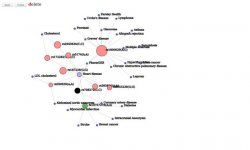
Okay, I took a screen shot. This graph is frm the Lily Mendel sample, 'diseases', heart diseases. 55 gene snps, those are rs numbers. (my own kit hoas 62) You can see that the big pink rs1800629 is connected to all sorts of grief.
 

Attachments

  • Screenshot_2019-11-22 Screenshot.jpg
    Screenshot_2019-11-22 Screenshot.jpg
    18.8 KB · Views: 9
Last edited:
"An interactive bubble chart showing the entanglement of genotype and phenotype, with footnotes" ?

Add in environmental factors and you can see why I eagerly await AI.

:thumbsup: Nice.

Yes, the "entanglement" is lovely. Bit hard to see the connecting lines in the screenshot. But I really agree it's fascinating.


Here's another example - an interactive "diagram".

I think this music search site is very, very cool and I'd love to see it done with genetics, disease, environment etc.

http://www.liveplasma.com/
 
Last edited:
I'll try not to let this thought turn into a derail...

Speaking of AI, there's this new from today:

We Teach A.I. Systems Everything, Including Our Biases

"BERT, (new Google AI technology) which is now being deployed in services like Google’s internet search engine, has a problem: It could be picking up on biases in the way a child mimics the bad behavior of his parents."

I'll hide my convoluted thought process. :D

https://www.nytimes.com/2019/11/11/technology/artificial-intelligence-bias.html

If you can't view that, this is the blog post it references:

https://medium.com/@robert.munro/bias-in-ai-3ea569f79d6a

Cause of bias #1 "The algorithms are trained on data with gender imbalances"

Cause of bias #2 "if you train a Machine Learning model on a narrow genre/domain of data, it will struggle with accuracy outside of those examples."

Cause of bias #3: The datasets are not correctly labeled

See my post in the Thunberg thread, about Italy making Climate Change compulsory at school.

https://www.weforum.org/agenda/2019/...ry-in-schools/

Quote:
Italy will next year become the world’s first country to make it compulsory for schoolchildren to study climate change and sustainable development, Education Minister Lorenzo Fioramonti said.

'In an interview in his Rome office, Fioramonti said all state schools would dedicate 33 hours per year, almost one hour per school week, to climate change issues from the start of the next academic year in September.

"Many traditional subjects, such as geography, mathematics and physics, would also be studied from the perspective of sustainable development, said the minister, a former economics professor at South Africa’s Pretoria University."

To round that off, entanglement needs to be taught from the perspective of entanglement. :D


Thus, obesity and genetics are related to world food production, distribution, consumption, sustainable development, and the UN's 2030 sustainable development goals.

The entanglement of genetics and epigenetics of the biosphere.
 
I don't know where the line between lactose moderation and excess are, but my stomach does.
Ow.

Seems to be where I have something I have no alternative to eat apart from going hungry.

It's even mildly bad when I have powdered coffee whitener daily, which I've done for years.u

Big Dairy, something something something.

Oh, but I saw 718 dairy farms closed in Wisconsin this year. Curious.
 
Last edited:
I don't know where the line between lactose moderation and excess are, but my stomach does.
Ow.

Seems to be where I have something I have no alternative to eat apart from going hungry.

It's even mildly bad when I have powdered coffee whitener daily, which I've done for years.u

Big Dairy, something something something.

Oh, but I saw 718 dairy farms closed in Wisconsin this year. Curious.

Isn't your coffee whitener non-dairy? If so, you may have a fat or protein prob-you can be allergic to casein.
 
Isn't your coffee whitener non-dairy? If so, you may have a fat or protein prob-you can be allergic to casein.

Interesting. Thanks. No, the whitener contains milk solids.

And ow, such a gurgly stomach still!

I should probably stop eating chocolate too. Had a few bits today.

I must check my MFP logs to see when I gave up chocolate for a while.

I remember saying to a friend on a walk that my digestion was fantastic because I was eating fruit for snacks, and wonder if that was when I was off the chocolate.

I'd given up the chocolate in order to have no caffeine intake, since I enjoy not drinking any beverages with caffeine, and when I tried cacao nibs, they knocked me around.

I'm turning into one of those annoyingly *difficult* eaters!!! :boggled: :rolleyes::blush::D

A Bil has issues with the artificial chocolate. I didn't know there was such a thing. Dunno how to read it on package labels. Perhaps "chocolate flavoring"?
 
I'd given up the chocolate in order to have no caffeine intake, since I enjoy not drinking any beverages with caffeine, and when I tried cacao nibs, they knocked me around.


It probably still contains caffeine, but there can't be room for any milk, I think: Lindt 99%.
 
Last edited:
It probably still contains caffeine, but there can't be room for any milk, I think: Lindt 99%.

Yes, cacao nibs contain caffeine, and other (obscure to me) stimulants.

It was the caffeine that knocked me around, not any milk, of which there was none.

I had less than 5g of nibs. Been a year since I gave up caffeine, nearly 2 years without alcohol.

The natural highs of being healthy are wonderful.

Those external stimulated highs and subsequent lows are not nice when you're aware of the difference, and used to the feeling of being normal and well nearly all the time.

Back to the obesity epidemic: We are the champions! - probably due to the trans-fat ban in 2004:
Denmark has the lowest number of obese people in the EU (DR.dk, Nov. 23, 2019)

Denmark is a rat park.

Social services, childcare, welfare, cities, and levels of activity are far far better than places like most of the US.

The trans fats ban would be only one reason when those factors are taken into account, though related to a country/Scandinavia-wide zeitgeist that implements healthy policies. Yes, I do know common, highly palatable, calorie-dense foods can contain trans fats.

(I must point out that you seemed to think a while back that I didn't know trans fats are bad. Underestimating me in another way I didn't mention earlier.)

You've now mentioned them a few times. What is your personal direct experience of trans fats if you now bring them up again?
 
I only brought up trans fats again because they were in the news. (And I should have added that the Danes aren't even European champions. The Swiss are, I think, but they aren't in the EU. And they don't come anywhere near Southeast Asians!)

Other causes for Denmark's position in the EU were mentioned in the article:

We have retained some healthy dietary options such as rye bread and oatmeal. And relatively many of us live in urban communities that encourage cycling, walking and moving in general.
We also have taxes on sugar and soft drinks - and actual bans on unhealthy food.
Among other things, we were the first country in the world to prohibit trans fatty acids by law in 2004. That seems to play a certain role, says Arne Astrup.
There was a significant drop in the number of both obese and cardiovascular patients in the years after the ban went into effect, the professor said.
Denmark has the lowest number of obese people in the EU (DR.dk, Nov. 23, 2019


Cool. And I think the trans-fat ban is a great thing. Should be done elsewhere as well.


The WHO is trying to do just that: WHO plan to eliminate industrially-produced trans-fatty acids from global food supply (WHO, May 14, 2018).

In the meantime, Healthline seems to be a pretty reliable source of information about trans fats and health in general: 7 Foods That Still Contain Trans Fats (Healthline, Oct, 29, 2018)
 
This is shocking!

The Guardian, Nov. 20, 2019:
The food deserts of Memphis: inside America's hunger capital | Divided Cities (13 min.):

"In the wealthiest part of greater Memphis, people live 13 years longer on average than in the poorest"
"When grocery store operators look at: Can they make money? The answer from their perspective is: possibly but probably not."
"The gap between the quality of rich and poor Americans' diets has widened over the past two decades."

By the way, if you look at the highlighted sentence, the same difference can be found in a major city in Denmark:
If you live in Aalborg East, your life is 13 years shorter on average than if you live in the wealthier neighborhood of Hasseris seven kilometers away.
In Aalborg East, on average they die as early as in Pakistan (DR.dk, May 22, 2016)
Documentary (in Danish): A Sick Difference.
 
This is shocking!

The Guardian, Nov. 20, 2019:
The food deserts of Memphis: inside America's hunger capital | Divided Cities (13 min.):

"In the wealthiest part of greater Memphis, people live 13 years longer on average than in the poorest"
"When grocery store operators look at: Can they make money? The answer from their perspective is: possibly but probably not."
"The gap between the quality of rich and poor Americans' diets has widened over the past two decades."

By the way, if you look at the highlighted sentence, the same difference can be found in a major city in Denmark:

Documentary (in Danish): A Sick Difference.
+

Is it a difference in diet? Is diet the only difference, not with some social or genetic difference ?

Do poor people the world over eat less REAL cheese?
 
Is it a difference in diet? Is diet the only difference, not with some social or genetic difference ?

The article claims that "you get these lifestyle diseases because you eat and live more unhealthy, exercise less and consume more alcohol."
But take a look at the graphs that accompany the article:
uddannelse: education
økonomi: (personal) finances
disponibel indkomst: earnings after tax has been deducted

It doesn't mention genetics at all.

Do poor people the world over eat less REAL cheese?


Some people don't eat any cheese at all, East Asians, for instance, and they seem to be doing better than the rest of us. But I'm pretty sure that they don't eat much fancy cheese on the wrong side of Memphis or Aalborg!


This is not related to the article, but you might be interested in this speech by Arne Astrup about carbohydrates, satiety, diabetes, insulin resistance, the blood-sugar diet etc. Many intersting illustrations:
EFAD Webinar- Oats and the Microbiome: Potential Link For Metabolic Health? (Nov. 26, 2019)
 

ISF - Join now!

Every member here is approved by hand. No bots, no spam, just people who care about evidence and honest debate.

Membership is free!

Create your free account

Back
Top Bottom
