• Security incident: ISF was recently accessed by intruders. Please change your password, and change it anywhere else you used it. Read more

The folly of Trump and Sander's protectionism

portlandatheist

Illuminator
Joined
Jun 9, 2007
Messages
3,725
The anti socialist billionaire and the socialist anti billionaire are on opposite sides in just about every way but they do share the same flawed philosophy when it comes to economic protectionism. Here are a handful or articles on Donald Trump and Bernie Sander's shared ideology.
Here's how Donald Trump could spark a trade war with Mexico and China
Donald Trump and Bernie Sanders: Two Pissed-Off Peas in a Pod
Trump, Sanders spark protectionist revolution
Strout: The Economic Fallacy Behind Trump and Sanders Protectionist Rhetoric
Trump, Sanders and the Summer of the Protectionist New York Grandfathers
Republican's diss Donald Trump on this issue:
Is Donald Trump a 21st-Century Protectionist Herbert Hoover?
Free trade is also the greatest antidote to poverty and deprivation in the world’s history. Over the past three decades, according to the World Bank and other sources, the spread of free trade has lowered abject, dollar-a-day poverty by nearly 1 billion people.
Socialists diss Bernie Sanders on this issue:
Is Bernie Sanders a socialist?
Bernie Sanders is not an internationalist. He is an American nationalist. He is a consistent advocate of economic nationalism and protectionism
Examples of their rhetoric
The results are in, Unfettered free trade has been a disaster for working Americans. It is high time we ended our disastrous trade policies.
--Bernie Sanders
I've got a message for corporate America: if you want us to buy your products, you better start producing them here in the United States.
--Bernie Sanders
Whether it's China or Japan or Mexico, they're all taking our jobs, and we need jobs in this country. It's enough, what we're doing with foreign trade.
--Donald Trump

Here is quote from the Wikipedia article on protectionism

Protectionism is frequently criticized by economists as harming the people it is meant to help. Mainstream economists instead support free trade.[5][14] The principle of comparative advantage shows that the gains from free trade outweigh any losses as free trade creates more jobs than it destroys because it allows countries to specialize in the production of goods and services in which they have a comparative advantage.[15] Protectionism results in deadweight loss; this loss to overall welfare gives no-one any benefit, unlike in a free market, where there is no such total loss. According to economist Stephen P. Magee, the benefits of free trade outweigh the losses by as much as 100 to 1.[16]

My high school history teacher taught us the folly of economic protectionism in the context of various tariff wars. Donald Trump and Bernie Sanders should have been there for that history lesson. There are two major problems with protectionism, the obvious one is economic. With protectionist policies in place, it will cost more human labor, more land and natural resources, more carbon emissions to produce the same good or service (thank you economist David Ricardo) but in addition I believe trade brings peace as well as prosperity. Trump and Sanders both view the world in extreme zero sum terms. Trump talks about winning and thinks in terms of everything as a competition. Who is winning? is it us or China? Sanders views every win and somebody Else's loss especially when it comes to money. The concept of nonzero sum evades them both. Mainstream liberals and conservatives understand this economic reality and our recent Republican and Democratic presidents have advocated for free trade. Now we have two radical extremists who are at the lead of the their respective parties.
 
Last edited:
I was amazed today to find that in 2015 you can read about the concept of a "deep state" and people like Peter Dale Scott and Philip Giraldi even in the print edition of the New York Times with only some very lazy attempts at the usual labeling. The concluding thoughts of Examining who rules the United States fit here:

ANAND GIRIDHARADAS said:
[...] as America witnesses the dual political phenomena of Donald Trump on the right and Senator Bernie Sanders on the left, and now the very public efforts by the establishment to step in and hinder either from going too far, the deep-state idea has renewed currency.

Talk in G.O.P. Turns to a Stop Donald Trump Campaign,” read the headline in this newspaper this month. It described Republican donors uneasy with the billionaire businessman’s unorthodox, even antibusiness views on issues like trade and the taxation of financial elites. Operatives apparently felt no embarrassment in publicly declaring a consensus among party elites that “something must be done to stop” Mr. Trump, in what is supposed to be a democratic primary process.

Then came the Democratic Party companion piece, a report that its leaders, fearing the insurgency of Mr. Sanders, a self-described democratic socialist, are developing “Plan Bs” to draft into the race should Hillary Rodham Clinton falter. All the Plan Bs mentioned are white, male, graybeard Democrats who have run for president before and are far safer to corporate donors than Mr. Sanders.

Mr. Trump and Mr. Sanders have tapped into swelling populist sentiment in American life today — the former because he is a billionaire who boasts of independence from the corrupting sway of billionaires, the latter because he seeks to sharply reduce inequality.

That both men have surged in tandem this election season, against the predictions of most, is telling. What will be more telling still is how far — or “deep” — supposedly open and democratic political parties are willing to go to provide a check on democracy.
 
The anti socialist billionaire and the socialist anti billionaire are on opposite sides in just about every way but they do share the same "flawed" philosophy when it comes to economic protectionism.
Being politicians, Trump and Sanders are merely tapping into a growing public disenchantment with the "free trade at all costs" philosophy.

The gains made in the aftermath of WW2 occurred under a context of heavy protectionism. Under that regime, local industries flourished, wages were good, unemployment was low and the country largely self sufficient.

As the barriers to free trade were dismantled, we saw the rise of the following:
  • Wide scale closures of local industries
  • A widening gap between rich and poor
  • The decimation of the middle classes
  • Downward pressure on wages
  • Perpetual unemployment
  • The loss of national sovereignty
Any benefits of free trade are only enjoyed by the few at the expense of the many. Of course, those who benefit from free trade do so enormously which explains why free trade is such a sacred cow.
 
Last edited:
As the barriers to free trade were dismantled, we saw the rise of the following:...

Any benefits of free trade are only enjoyed by the few at the expense of the many.
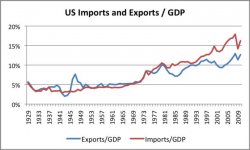
Yes, we should stop all foreign trade and produce everything locally. Only a select few are benefiting from the $1.6 Trillion worth of products that we export per year (second only to China, but 3 times more per person) so I'm sure we won't miss it.
 

Attachments

  • us-import-exports-divided-by-gdp.jpg
    us-import-exports-divided-by-gdp.jpg
    29.1 KB · Views: 4
Last edited:
Made in America: Increasing Jobs through Exports and Trade
U.S. manufacturing employment reached its peak of 19.4 million jobs in 1979 — fourteen years before the implementation of the North American Free Trade Agreements and 22 years before China joined the World Trade Organization. So the downward trend in manufacturing employment, along roughly the same trajectory for 30 years, began long before the common scapegoats for manufacturing job loss even existed.
 
There is no question that free trade is directly beneficial to buyer & seller.
It is also clear that any change in trade (local or international) creates employment displacement.

Ricardo's comparative advantage has been described as one of the more counter-intuitive results in economics. a field that often produces results that defy intuition.

The counter-intuitive nature of much of economics helps explain why so many uneducated people have systematically erroneous beliefs.

http://www.nytimes.com/2015/04/26/u...e-on-this-point-the-wisdom-of-free-trade.html

http://www.igmchicago.org/igm-economic-experts-panel/poll-results?SurveyID=SV_d68906VNWqVmiGN
 
Roger Ramjets said:
Made in America: Increasing Jobs through Exports and Trade
U.S. manufacturing employment reached its peak of 19.4 million jobs in 1979 — fourteen years before the implementation of the North American Free Trade Agreements and 22 years before China joined the World Trade Organization. So the downward trend in manufacturing employment, along roughly the same trajectory for 30 years, began long before the common scapegoats for manufacturing job loss even existed.


Most people are shocked to learn the US produces almost as much steel today as it did in 1980, ~88%, and does so with fewer than 1/3 the number of workers, due to increases in efficiency.
 
There is no question that free trade is directly beneficial to buyer & seller.
It is also clear that any change in trade (local or international) creates employment displacement.

Ricardo's comparative advantage has been described as one of the more counter-intuitive results in economics. a field that often produces results that defy intuition.

The counter-intuitive nature of much of economics helps explain why so many uneducated people have systematically erroneous beliefs.

http://www.nytimes.com/2015/04/26/u...e-on-this-point-the-wisdom-of-free-trade.html

Right. I think the notion that country A is better at say growing apples and country B is better at growing oranges and they trade makes sense with people but the counter intuitive part comes into play when country A could be better at both apples and oranges and it still makes sense to trade. Matt Ridley gave this non intuitive example:

They each make their own Spear and axe, measured in hours worked
Spear Axe Total
OZ 1 2 3
Adam 4 3 7
total hours 10

They trade based on their comparative advantage, Oz makes Spears and Adam Makes Axes. They trade and they each shave off an hours worth of work.
Spear Axe Total
OZ 2 0 2
Adam 0 6 6
total hours 8

Intuition would suggest that since Oz is better at making spears and axes, then why trade with Adam? The above example could be done in terms of human labor, natural resources, carbon emissions, etc.
 
Last edited:
Most people are shocked to learn the US produces almost as much steel today as it did in 1980, ~88%, and does so with fewer than 1/3 the number of workers, due to increases in efficiency.

I'm not shocked by these figures. NAFTA has resulted in exactly what Canadians said it would -- transfer of production from Canada to the USA. Steel mills in Sydney, NS and Hamilton, ON have closed. Production in Canada is now lower than it was in 1980.

http://www.issb.co.uk/americas.html#NAFTA_CSP

But don't worry, the TPP will fix everything.
 
The interesting thing about that article is that it produces charts on imports vs GDP, imports vs employment and price changes of various imported and non-imported items.

But as for the quoted bit? Nothing. We have to take the author's word for it that the decline in manufacturing employment from 1979 has been consistent and uniform with NAFTA and China having no effect on the rate of decline.
 
The anti socialist billionaire and the socialist anti billionaire are on opposite sides in just about every way but they do share the same flawed philosophy when it comes to economic protectionism.

I've no dog in this fight (neither Rep nor Dem), but it appears to me that both major parties are in favor of a centrally planned & controlled economy. An idea as well proven "failed" in practice & theory as any. The anti-free-trade issue is just part of the econo-stupidity. They generally want to interfere with trade internally as well as internationally.

Any rational actor should want to free trade, internally and externally. Not to impose barriers, and particularly not selective barriers (as the massive tax code or regulatory morass represent) that destroy price signalling needed for efficient use of resources.

It's not universally bad in either party, but ALL the apples in either basket appear to have at least a few worms.
 
Last edited:
Right. [...] Matt Ridley[/URL] gave this non intuitive example:

Exactly the point. The consequence of absolute advantage is obvious & intuitive, trivially. People I think accept that. The result of useful trade despite mere comparative advantage is non-obvious unless considered quantitatively.

The peculiar thing is that people who don't bother to study the issue are not undecided, nor is their error randomly distributed among right & wrong - instead they are systematically wrong! Most ppl who don't know basics are anti-free trade.

I *suspect* this has something to do with the sort of common zero-sum thinking bias that your example (similar to Ricardo's original example) decimates.
 
Right. I think the notion that country A is better at say growing apples and country B is better at growing oranges and they trade makes sense with people but the counter intuitive part comes into play when country A could be better at both apples and oranges and it still makes sense to trade. Matt Ridley gave this non intuitive example:

They each make their own Spear and axe, measured in hours worked
Spear Axe Total
OZ 1 2 3
Adam 4 3 7
total hours 10

They trade based on their comparative advantage, Oz makes Spears and Adam Makes Axes. They trade and they each shave off an hours worth of work.
Spear Axe Total
OZ 2 0 2
Adam 0 6 6
total hours 8

Intuition would suggest that since Oz is better at making spears and axes, then why trade with Adam? The above example could be done in terms of human labor, natural resources, carbon emissions, etc.

I find this to be the part of economics that is the least useful. It's fantasy economics. Once we turn our attention to the real world, the view becomes much more complicated.

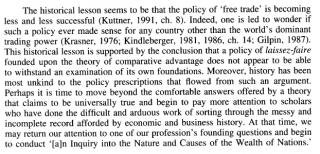
There's also plenty of good critique of the theoretical foundation comparative advantage is built upon. For example: Robert E. Prasch (1996): Reassessing the Theory of Comparative Advantage.

Concluding remarks:

 
Last edited:
I'm not shocked by these figures. NAFTA has resulted in exactly what Canadians said it would -- transfer of production from Canada to the USA. Steel mills in Sydney, NS and Hamilton, ON have closed. Production in Canada is now lower than it was in 1980.


Uh, the Canada-U.S. free trade agreement preceded NAFTA by five years. Also, correlation is not causation.
 
Uh, the Canada-U.S. free trade agreement preceded NAFTA by five years. Also, correlation is not causation.

Scratch "NAFTA". Replace with "Free Trade Agreement".

Per the post I was replying to. The claim was that free trade had not affected US steel production. Something has in Canada. SYSCO does not exist anymore. US Steel closed "its" Hamilton plant.

. . . it makes no sense to be closing two million tons of steel-making capacity in Canada when as many as eight million tons are being imported annually.
Steel Workers Union, October, 2013.

Will be fixed by the TPP.
 
It occurs to me that the difference between Trump and Sanders is that Trump thinks he can just abrogate international treaties by fiat.

That was my first thought when Trump started his claims that he was going to teach China & Mexico a lesson - that he was ignoring WTO & NAFTA.

WRT Mexico Trump has released a more detailed concept -

https://www.donaldjtrump.com/images/uploads/Immigration-Reform-Trump.pdf
Mexico must pay for the wall and, until they do, the United States will, among other things: impound all remittance payments derived from illegal wages; increase fees on all temporary visas issued to Mexican CEOs and diplomats (and if necessary cancel them); increase fees on all border crossing cards – of which we issue about 1 million to Mexican nationals each year (a major source of visa overstays); increase fees on all NAFTA worker visas from Mexico (another major source of overstays); and increase fees at ports of entry to the United States from Mexico [Tariffs and foreign aid cuts are also options]. We will not be taken advantage of anymore.

Mexico receives ~$400m in US aid (2013), and ~$20B in remittances (only a fraction from illegals). It would seem easy to bypass any rule on "no illegal remittances".

Would added visa fees for Mexican CEOs and diplomats be lawful ? Meaningful ? Clearly anti-trade.

Increased fees on border crossing cards (a form of visa) seems reasonable way to pay for any added costs that must be covered (a use tax), these are generally 10yr cards than currently have a $160-190 fees, as I understand it. There are forms of these for workers at multinationals, and students. Using as a punitive tool seems foolish; wouldn't MExico increase it's fees in retaliation ?

NAFTA worker visa fees ? Can this be done under NAFTA ? I thought these were for professionals working both sides of the border.

Increased fees at ports of entry - possible, but stupid as a punative measure.

Tariffs - that's definitely in violation of NAFTA. We'd get fined - both for cost & damage & punative fines.

---

So I don't see many real teeth in Trumps anti-Mexican plan. The big one is NAFTA violating tariffs. The other is trying to identify the status of millions sending small remittances, and plugging all possible channels.


His anti-China plan is even more vague, but appears to involve somehow punishing China for currency manipulation. WTO has some vaguely worded and untested articles against currency manipulation. Possible as a way to shame China - but that's about it.
 
I find this to be the part of economics that is the least useful. It's fantasy economics. Once we turn our attention to the real world, the view becomes much more complicated.

It's a fantasy to you b/c it doesn't conform to your static ideology (perhaps political). In fact Ricardo's CA is one of the most evidenced and long-standing results in econ theory.

There's also plenty of good critique of the theoretical foundation comparative advantage is built upon. For example: Robert E. Prasch (1996): Reassessing the Theory of Comparative Advantage.

Concluding remarks:
[...]

This seems to be a link to the entire paper.
http://www.econ.tcu.edu/harvey/5443/prasch.pdf

Wow one article by an assistant econ prof - arguing only that we need a better theoretical foundation - certainly we should chuck almost 200yrs of evidence on the bonfire for that (esp when it almost matches your ideological biases). Clearly economists have no better model as all papers on trade to this day continue to use Ricardians CA & Heckscher-Ohlin's generalization.

Prasch's argument makes several claims that appear incorrect. Primarily he states that CA fails to address the cost of transferring production from one industry to another. Certainly CA only compares cost and production rates, but not the dynamic transition of these. His complaint is about like arguing that Newtons law of gravity fail to explain electrostatic forces. Unfortunately for Prasch's main argument, many many papers have been written on the topic of the transitory costs of trade on capital and employment. None I'm aware of refute the advantage.

Since you've invoked an appeal to an authority, and no argument allow me ...

Consider the economists on this letter to congress, and their argument,
https://www.whitehouse.gov/sites/default/files/docs/cea_letter.pdf

http://www.igmchicago.org/igm-economic-experts-panel/poll-results?SurveyID=SV_003w6LBGnkOfDuI
(note the universal agreement)

http://www.columbia.edu/~drd28/mars.pdf

http://economics.mit.edu/files/7536
Ricardo’s theory of comparative advantage is not just mathematically correct and non-trivial; it also has significant explanatory power in the data, at least within the scope of our analysis.

https://en.wikipedia.org/wiki/Comparative_advantage#Evidence_of_effects_on_the_economy

http://www.columbia.edu/~drd28/geo3.pdf
Within the context of the models considered, comparative advantage matters both in affecting the broad and fine industrial structure. Even at the four-digit level, from one-third to one-half of OECD manufacturing output seem to be governed by simple comparative advantage

Krugman's 2008(?) Nobel award for for including new features, like economy of scale into comparative advantage.

I could go on forever - there is plenty of empirical evidence supporting comparative advantage, and the strongest objections are that it broadly applies, but needs to be 'tweaked' to create a better model (and/or a more easily testable or general model).
---


No - you need to do better than citing one minor objection (not even based on empirical evidence mind you) before we throw this glorious baby out with the bathwater.
 
Last edited:

ISF - Join now!

Every member here is approved by hand. No bots, no spam, just people who care about evidence and honest debate.

Membership is free!

Create your free account

Back
Top Bottom