The Electric Comet theory

Status
Not open for further replies.
I love this makes me laugh every time

The stardust team (mainstream) said

Comets are small, cold, primordial bodies that formed at the edge of the solar system, near Pluto, except they did'nt!
Your stupidity is showing again Sol88 - read the press kit.

The press release is dated January 2006 - before the analysis of the returned dust showed that some of the material that formed comets in the outer system, formed at high temperatures nearer to Sun.

Comets are small, cold, primordial bodies that formed at the edge of the solar system, near Pluto. Some of the material that formed comets formed at high temperatures nearer to Sun as shown by the results of the Stardust mission.

I love this, makes me laugh every time every time Sol88 shows his ignorance of the scientific literature and quotes from press releases.

But what else can you expect from someone who is so deluded that he thinks that comets with a measured density of ~0.6 g/cc are astoriods with a measured density of ~1.3 g/cc?

This deserves a
:dl:
 
The totally stupid electric comet idea debunked

EC universe: Comets are rocky bodies, comparable to asteriods and probably created in the same event as asteriods (according to Thunderbolts).


Real universe:
  1. Comets have meaured densities that are much less than that of rocks (asteroids).
  2. Comets may not have the composition of asteriods
  3. Deep Impact confirmed that comet nuclei are made of dust and ice not rock. There were a couple of surprises in that the dust was talcum powder rather than sand and the amount of ice was smaller than expected.
    "Analysis of data from the Swift X-ray telescope showed that the comet continued outgassing from the impact for 13 days, with a peak five days after impact. A total of 5 million kilograms (11 million pounds) of water[35] and between 10 and 25 million kilograms (22 and 55 million pounds) of dust were lost from the impact."WPThus the water content of Comet Tempel 1 is 20% to 50%.
  4. Cometary dust as collected by the Stardust mission contain forms of carbon that are not in meteorites.
    Thus comets are not meteorites.
    Meteorites are rocky bodies (meteoroids and sometimes asteroids) that have reached the Earth's surface.
    Therefore comets are not meteoroids or asteriods.
    (or How Sol88 cannot stop shooting himself in the foot)
EC universe: Comet jets, coma and tails are created from material that that is created from rock by electrical discharge machining.(but according to solrey EDM does not mean EDM in the EC universe!).

Real universe:

Start with Tim Thompson's posts about this
Then look at
EC universe: Rocky bodies that have an orbit with an eccentricity above a minimum value will be comets.N.B. Solar activity may cut tails in two but there have been no observations of comets turning off during low solar activity.(Sol88: I may be wrong - if so please provide the citations to these marvelous events.)

However this assertion has the fatal flaw of EC predictions - no mathematics or numbers.
But we can do their work for them can't we Sol88?

There are 4 observed main-belt comets with a minimum eccentricity of 0.1644 (133P/Elst-Pizarro). So the EC minimim must be this (or lower!).

Real universe: There are at least 173,583 asteroids (rocky bodies) that have an orbit with an eccentricity above a minimum value that are not comets. This includes asteroids that have been observed for decades.
There are 459,893 asteroids with eccentricities greater than the minimum observed eccentricity of comets (0.0279).
EC predicts that 100,000's of asteroids should be comets

C universe: solrey pointed out in this post that EC idea expects that the voltage potential a comet experiences would be orders of magnitude higher than that of the cloud to ground voltage potential in a thunderstorm (109 volts).
"Several" is more than a couple so the EC idea expects a voltage drop around a comet of at least 1012 volts.

Real universe: tusenfem pointed out that "Electric Fields and Cold Electrons in the Vicinity of Comet Halley" by Harri Laakso gave the measured potential drop between electrical layers around Comet Halley as 50 kV in this post. This is 10,000 times less than the thunderstorm potential and 10,000,000 times less that requires by the EC idea.

Water, water everywhere (except in the EC idea)
EC universe: Comets are rocky bodies, comparable to asteroids and probably created in the same event as asteroids (according to Thunderbolts). Comet jets, coma and tails are created from material (e.g. water) that that is created from rock by electrical discharge machining. Like everything in the EC idea there are no numbers and so no prediction of the composition of the nucleus. We could say that means that the EC idea predicts no water (0%) but there should be some blowback from the physically impossible (on comets) EDM process.
Asteroids in general have very low amounts of water. So let's just throw in 1% water as an extremely generous guess - IMHO it should be something like 0.01%. Sol88 or solrey should provide a better number if they have it.

Real universe: Comets are bodies with a mixture of rock and ices of various compounds, e.g. CO and water. They are have been described as "dirty snowballs". The volatile material (ices) is heated by the Sun and sublimates to form jets, the coma and the tail.This is supported by actual physical evidence, i.e. the results of the Deep Impact mission where the impact ejected material from the nucleus that was composed of 20-50% water and 80-50% dust.

EC universe: Only give qualitative predictions.
Sol88 posted a list of EC "predictions" for Tempel 1 and Deep Impact. The closes it gets to an actual quantitative predictions is "The most obvious would be a flash (lightning-like discharge) shortly before impact." (emphasis added).

What actually happened was a flash on or after impact followed by a bigger one from deeper in the nucleus (according to NASA).

Real universe: Scientific theories model the data mathematically and produce both qualitative and quantitative predictions.

Someone could start with the papers of Whipple
  1. Whipple, Fred L. (1950). "A Comet Model. I. The acceleration of Comet Encke". Astrophys. J. 111: 375–394.
  2. Whipple, Fred L. (1951). "A Comet Model. II. Physical Relations for Comets and Meteors". Astrophys. J. 113: 464.
  3. Whipple, Fred L. (1955). "A Comet Model. III. The Zodiacal Light". Astrophys. J. 121: 750.
and then go ointo the 1000's of scientific papers and many textbooks about comets. Tim Thompson recommened Introduction to Comets by Brandt & Chapman (Cambridge University Press, 2004, 2nd edition).

EC universe: Turn yourself into a crackpot idea by not publishing papers in peer reviewed journals.
Real universe: Take the risk of being wrong and become part of the scientific process by publishing papers in peer reviewed journals, e.g. Fred L. Whipple.

EC Universe: Turn yourself into a crackpot by quoting press releases and news articles. This has the added advantage of revealing your ignorance of the scientific literature.
Real Universe: Real scientists cite published scientific papers and textbooks.
 
Hi Sol88, I noticed that in the last post I assumed that the electric comet idea has comets with the same composition as asteriods. You have not disagreed with this so far. So here is the science (not as clear cut as the different densities of comets and asteroids).

Physical composition of asteroids

Meteorites also suggest that "Asteroids are believed to contain traces of amino-acids and other organic compounds".

Physical composition of comet nuclei


This suggests that the composition of comets and asteroids differ in that comets have the addition of frozen gases while asteroids generally do not have frozen gases (but may have icy crusts).


Physical composition of comet nuclei

They are composed of rock, dust, water ice, and frozen gases such as carbon monoxide, carbon dioxide, methane and ammonia.[9]
They are often popularly described as "dirty snowballs", though recent observations have revealed dry dusty or rocky surfaces, suggesting that the ices are hidden beneath the crust (see Debate over comet composition). Comets also contain a variety of organic compounds; in addition to the gases already mentioned, these may include methanol, hydrogen cyanide, formaldehyde, ethanol and ethane, and perhaps more complex molecules such as long-chain hydrocarbons and amino acids.[10][11][12]
This suggests that the composition of comets and asteroids differ in that comets have the addition of frozen gases while asteroids generally do not have frozen gases (but may have icy crusts).

So RC, though recent observations have revealed dry dusty or rocky surfaces

Where do they see the water (ices, gas)?
 
So RC, though recent observations have revealed dry dusty or rocky surfaces

Where do they see the water (ices, gas)?
In the gas created by sublimation of the ices.
And of course:
Deep Impact confirmed that comet nuclei are made of dust and ice not rock. There were a couple of surprises in that the dust was talcum powder rather than sand and the amount of ice was smaller than expected.
"Analysis of data from the Swift X-ray telescope showed that the comet continued outgassing from the impact for 13 days, with a peak five days after impact. A total of 5 million kilograms (11 million pounds) of water[35] and between 10 and 25 million kilograms (22 and 55 million pounds) of dust were lost from the impact."WP
P.S.
Are you still deluded enough to think that comets with a measured density of ~0.6 g/cc are asteroids with a measured density of ~1.3 g/cc?
 
Last edited:
The totally stupid electric comet idea debunked

Removed a couple of bad links:
EC universe: Comets are rocky bodies, comparable to asteriods and probably created in the same event as asteriods (according to Thunderbolts).

Real universe:
  1. Comets have meaured densities that are much less than that of rocks (asteroids).
  2. Comets may not have the composition of asteriods
  3. Deep Impact confirmed that comet nuclei are made of dust and ice not rock. There were a couple of surprises in that the dust was talcum powder rather than sand and the amount of ice was smaller than expected.
    "Analysis of data from the Swift X-ray telescope showed that the comet continued outgassing from the impact for 13 days, with a peak five days after impact. A total of 5 million kilograms (11 million pounds) of water[35] and between 10 and 25 million kilograms (22 and 55 million pounds) of dust were lost from the impact."WPThus the water content of Comet Tempel 1 is 20% to 50%.
  4. Cometary dust as collected by the Stardust mission contain forms of carbon that are not in meteorites.
    Thus comets are not meteorites.
    Meteorites are rocky bodies (meteoroids and sometimes asteroids) that have reached the Earth's surface.
    Therefore comets are not meteoroids or asteriods.
    (or How Sol88 cannot stop shooting himself in the foot)
EC universe: Comet jets, coma and tails are created from material that that is created from rock by electrical discharge machining.(but according to solrey EDM does not mean EDM in the EC universe!).

Real universe:


Start with Tim Thompson's posts about this
Then look at
EC universe: Rocky bodies that have an orbit with an eccentricity above a minimum value will be comets.N.B. Solar activity may cut tails in two but there have been no observations of comets turning off during low solar activity.(Sol88: I may be wrong - if so please provide the citations to these marvelous events.)

However this assertion has the fatal flaw of EC predictions - no mathematics or numbers.
But we can do their work for them can't we Sol88?

There are 4 observed main-belt comets with a minimum eccentricity of 0.1644 (133P/Elst-Pizarro). So the EC minimim must be this (or lower!).

Real universe: There are at least 173,583 asteroids (rocky bodies) that have an orbit with an eccentricity above a minimum value that are not comets. This includes asteroids that have been observed for decades.
There are 459,893 asteroids with eccentricities greater than the minimum observed eccentricity of comets (0.0279).
EC predicts that 100,000's of asteroids should be comets

C universe: solrey pointed out in this post that EC idea expects that the voltage potential a comet experiences would be orders of magnitude higher than that of the cloud to ground voltage potential in a thunderstorm (109 volts).
"Several" is more than a couple so the EC idea expects a voltage drop around a comet of at least 1012 volts.

Real universe: tusenfem pointed out that "Electric Fields and Cold Electrons in the Vicinity of Comet Halley" by Harri Laakso gave the measured potential drop between electrical layers around Comet Halley as 50 kV in this post. This is 10,000 times less than the thunderstorm potential and 10,000,000 times less that requires by the EC idea.

Water, water everywhere (except in the EC idea)
EC universe: Comets are rocky bodies, comparable to asteroids and probably created in the same event as asteroids (according to Thunderbolts). Comet jets, coma and tails are created from material (e.g. water) that that is created from rock by electrical discharge machining. Like everything in the EC idea there are no numbers and so no prediction of the composition of the nucleus. We could say that means that the EC idea predicts no water (0%) but there should be some blowback from the physically impossible (on comets) EDM process.
Asteroids in general have very low amounts of water. So let's just throw in 1% water as an extremely generous guess - IMHO it should be something like 0.01%. Sol88 or solrey should provide a better number if they have it.

Real universe: Comets are bodies with a mixture of rock and ices of various compounds, e.g. CO and water. They are have been described as "dirty snowballs". The volatile material (ices) is heated by the Sun and sublimates to form jets, the coma and the tail.This is supported by actual physical evidence, i.e. the results of the Deep Impact mission where the impact ejected material from the nucleus that was composed of 20-50% water and 80-50% dust.

EC universe: Only give qualitative predictions.
Sol88 posted a list of EC "predictions" for Tempel 1 and Deep Impact. The closes it gets to an actual quantitative predictions is "The most obvious would be a flash (lightning-like discharge) shortly before impact." (emphasis added).

What actually happened was a flash on or after impact followed by a bigger one from deeper in the nucleus (according to NASA).

Real universe: Scientific theories model the data mathematically and produce both qualitative and quantitative predictions.


Someone could start with the papers of Whipple
  1. Whipple, Fred L. (1950). "A Comet Model. I. The acceleration of Comet Encke". Astrophys. J. 111: 375–394.
  2. Whipple, Fred L. (1951). "A Comet Model. II. Physical Relations for Comets and Meteors". Astrophys. J. 113: 464.
  3. Whipple, Fred L. (1955). "A Comet Model. III. The Zodiacal Light". Astrophys. J. 121: 750.
and then go ointo the 1000's of scientific papers and many textbooks about comets. Tim Thompson recommened Introduction to Comets by Brandt & Chapman (Cambridge University Press, 2004, 2nd edition).

EC universe: Turn yourself into a crackpot idea by not publishing papers in peer reviewed journals.
Real universe: Take the risk of being wrong and become part of the scientific process by publishing papers in peer reviewed journals, e.g. Fred L. Whipple.

EC Universe: Turn yourself into a crackpot by quoting press releases and news articles. This has the added advantage of revealing your ignorance of the scientific literature.
Real Universe: Real scientists cite published scientific papers and textbooks.
 
Do EC comets switch off at perihelion

Sol88, Yet another problem with the EC idea?
EC universe: Comet jets, coma and tails are created from material that that is created from rock by electrical discharge machining. This happens somehow because of some unspecified electrical potential difference caused by the orbit of the comet.
So consider a hypothetical situation where a comet stops moving closer to the Sun. That electrical potential difference will discharge. The time to discharge will be small. The time is impossible to calculate in the EC idea since it is just an idea with no model. But other processes discharge in timescales of seconds (should we mention lightning?).

But comets stop approaching the Sun at perihelion and spend days at the same distance from the Sun. Thus an EC prediction is that comets will switch off (or to be charitable to the EC idea their emissions would diminish) at perihelion.

Possible counter-argument: It is something to do with the solar wind.
Answer: The solar wind is neutrally charged (equal amounts of positively and negatively charged particles). Thus it will not create the electricl difference needed for the EDM. In addition if the solar wind could create jets in the EC rocks (comet nuclei) then it would also create jets from the surface of the Moon.

Real universe: Comet jets, coma and tails are created from the sublimation of ices (water, CO2, etc.) on and below the surface of the comet nucleus. The hotter the comet nucleus, the more sublimation.
The prediction is that comets will be brightest at perihelion.

We observe that comets are brightest at perihelion
 
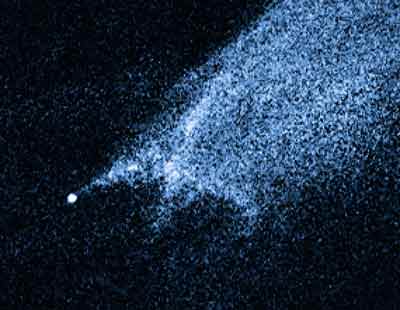
http://www.universetoday.com/2010/02/02/hubble-takes-a-look-at-possible-asteroid-collision/

Mmmmm.... another comet/asteroid

Two comets smashing head on? unlikely

Two asteroids smashing head on? unlikely

An asteroid electricaly discharging? more than likely

RC, what do you think the bright spot at the 9 oclock postion maybe?

asteroid-closeup.jpg
Close-up of Comet-like Asteroid P/2010 A2. Credit: NASA, ESA, and D. Jewitt (UCLA)
 
http://www.universetoday.com/2010/02/02/hubble-takes-a-look-at-possible-asteroid-collision/

Mmmmm.... another comet/asteroid

Two comets smashing head on? unlikely

Two asteroids smashing head on? unlikely

An asteroid electricaly discharging? more than likely

RC, what do you think the bright spot at the 9 oclock postion maybe?

http://www.universetoday.com/wp-content/uploads/2010/02/asteroid-closeup.jpg Close-up of Comet-like Asteroid P/2010 A2. Credit: NASA, ESA, and D. Jewitt (UCLA)
Two asteroids smashing? Likely.
Your inability to understand what you read? Likely
Astronomers have long thought the asteroid belt is being ground down through collisions, but such a smashup has never been seen before.

"This is quite different from the smooth dust envelopes of normal comets," said principal investigator David Jewitt of the University of California at Los Angeles. "The filaments are made of dust and gravel, presumably recently thrown out of the nucleus. Some are swept back by radiation pressure from sunlight to create straight dust streaks. Embedded in the filaments are co-moving blobs of dust that likely originated from tiny unseen parent bodies."

It is what astronomers expect from two asteroids colliding:
  • A tail of dust (no gas, no water, no idiotic EC comet water fro discharging.).
  • The remains of one of the asteroids (the bright spot at the 9 oclock postion)
Since you have no answer to my last suggested problem with the EC idea, I will add it as yet another flaw in the dumb EC idea.
 
Last edited:
The electric comet idea completely debunked

Added yet anothe flaw on the brightness of comets at perihelion :jaw-dropp !

EC universe: Comets are rocky bodies, comparable to asteriods and probably created in the same event as asteriods (according to Thunderbolts).


Real universe:
  1. Comets have meaured densities that are much less than that of rocks (asteroids).
  2. Comets may not have the composition of asteriods
  3. Deep Impact confirmed that comet nuclei are made of dust and ice not rock. There were a couple of surprises in that the dust was talcum powder rather than sand and the amount of ice was smaller than expected.
    "Analysis of data from the Swift X-ray telescope showed that the comet continued outgassing from the impact for 13 days, with a peak five days after impact. A total of 5 million kilograms (11 million pounds) of water[35] and between 10 and 25 million kilograms (22 and 55 million pounds) of dust were lost from the impact."WPThus the water content of Comet Tempel 1 is 20% to 50%.
  4. Cometary dust as collected by the Stardust mission contain forms of carbon that are not in meteorites.
    Thus comets are not meteorites.
    Meteorites are rocky bodies (meteoroids and sometimes asteroids) that have reached the Earth's surface.
    Therefore comets are not meteoroids or asteriods.
    (or How Sol88 cannot stop shooting himself in the foot)
EC universe: Comet jets, coma and tails are created from material that that is created from rock by electrical discharge machining.(but according to solrey EDM does not mean EDM in the EC universe!).

Real universe: Start with Tim Thompson's posts about this
Then look at
EC universe: Rocky bodies that have an orbit with an eccentricity above a minimum value will be comets.N.B. Solar activity may cut tails in two but there have been no observations of comets turning off during low solar activity.(Sol88: I may be wrong - if so please provide the citations to these marvelous events.)

However this assertion has the fatal flaw of EC predictions - no mathematics or numbers.
But we can do their work for them can't we Sol88?

There are 4 observed main-belt comets with a minimum eccentricity of 0.1644 (133P/Elst-Pizarro). So the EC minimim must be this (or lower!).

Real universe: There are at least 173,583 asteroids (rocky bodies) that have an orbit with an eccentricity above a minimum value that are not comets. This includes asteroids that have been observed for decades.
There are 459,893 asteroids with eccentricities greater than the minimum observed eccentricity of comets (0.0279).
EC predicts that 100,000's of asteroids should be comets

EC universe: solrey pointed out in this post that EC idea expects that the voltage potential a comet experiences would be orders of magnitude higher than that of the cloud to ground voltage potential in a thunderstorm (109 volts).
"Several" is more than a couple so the EC idea expects a voltage drop around a comet of at least 1012 volts.

Real universe: tusenfem pointed out that "Electric Fields and Cold Electrons in the Vicinity of Comet Halley" by Harri Laakso gave the measured potential drop between electrical layers around Comet Halley as 50 kV in this post. This is 10,000 times less than the thunderstorm potential and 10,000,000 times less that requires by the EC idea.

Water, water everywhere (except in the EC idea)
EC universe: Comets are rocky bodies, comparable to asteroids and probably created in the same event as asteroids (according to Thunderbolts). Comet jets, coma and tails are created from material (e.g. water) that that is created from rock by electrical discharge machining. Like everything in the EC idea there are no numbers and so no prediction of the composition of the nucleus. We could say that means that the EC idea predicts no water (0%) but there should be some blowback from the physically impossible (on comets) EDM process.
Asteroids in general have very low amounts of water. So let's just throw in 1% water as an extremely generous guess - IMHO it should be something like 0.01%. Sol88 or solrey should provide a better number if they have it.

Real universe: Comets are bodies with a mixture of rock and ices of various compounds, e.g. CO and water. They are have been described as "dirty snowballs", some are better described as "icy dirtballs. The volatile material (ices) is heated by the Sun and sublimates to form jets, the coma and the tail.This is supported by actual physical evidence, i.e. the results of the Deep Impact mission where the impact ejected material from the nucleus that was composed of 20-50% water and 80-50% dust

EC comets switch off at perihelion
EC universe: An EC prediction is that comets will switch off (or to be charitable to the EC idea they will be less bright) at perihelion.

Real universe: We observe that comets are brightest at perihelion .

EC universe: Only give qualitative predictions.
Sol88 posted a list of EC "predictions" for Tempel 1 and Deep Impact. The closes it gets to an actual quantitative predictions is "The most obvious would be a flash (lightning-like discharge) shortly before impact." (emphasis added).

What actually happened was a flash on or after impact followed by a bigger one from deeper in the nucleus (according to NASA).

Real universe: Scientific theories model the data mathematically and produce both qualitative and quantitative predictions. Someone could start with the papers of Whipple
  1. Whipple, Fred L. (1950). "A Comet Model. I. The acceleration of Comet Encke". Astrophys. J. 111: 375–394.
  2. Whipple, Fred L. (1951). "A Comet Model. II. Physical Relations for Comets and Meteors". Astrophys. J. 113: 464.
  3. Whipple, Fred L. (1955). "A Comet Model. III. The Zodiacal Light". Astrophys. J. 121: 750.
and then go ointo the 1000's of scientific papers and many textbooks about comets. Tim Thompson recommened Introduction to Comets by Brandt & Chapman (Cambridge University Press, 2004, 2nd edition).

EC universe: Turn yourself into a crackpot idea by not publishing papers in peer reviewed journals.
Real universe: Take the risk of being wrong and become part of the scientific process by publishing papers in peer reviewed journals, e.g. Fred L. Whipple.

EC Universe: Turn yourself into a crackpot by quoting press releases and news articles. This has the added advantage of revealing your ignorance of the scientific literature.
Real Universe: Real scientists cite published scientific papers and textbooks.

 
EC theory was good up until someone did the physics. Sure some evidence was compelling for a time (deep impact) but I think that the traditional highy charged electric comet theory is dead.

However net charges, voltage drops and plasma properties of its tail could certainly hold credence. The idea that static charge on entering a large bodies atmosphere could accumulate so quickly a large bolt of explosive lightning would hit the ground before the comet is still a very real possibility.
 
EC theory was good up until someone did the physics. Sure some evidence was compelling for a time (deep impact) but I think that the traditional highy charged electric comet theory is dead.
...snipped normal physic. stuff...
The EC idea has always been an idea not a scientific theory. No physics has been done for it because it predicts nothing except in a general sense. What killed it was the physics done to test the existing scientific theories for comets. A side-effect was showing just how invalid the EC idea was.
Deep Impact was the final nail in the coffin but the basic fact that comets are much less dense than asteroids has been known for decades.
 
The EC idea has always been an idea not a scientific theory. No physics has been done for it because it predicts nothing except in a general sense. What killed it was the physics done to test the existing scientific theories for comets. A side-effect was showing just how invalid the EC idea was.
Deep Impact was the final nail in the coffin but the basic fact that comets are much less dense than asteroids has been known for decades.


And with that I realize I actually have no idea to what EC theory you refer. All I remember was a sketchy idea from Thornhill and Talbot.
 
RC Wrote
EC universe: Comets are rocky bodies, comparable to asteriods and probably created in the same event as asteriods (according to Thunderbolts).


Real universe:

1. Comets have meaured densities that are much less than that of rocks (asteroids).
2. Comets may not have the composition of asteriods
3. Deep Impact confirmed that comet nuclei are made of dust and ice not rock. There were a couple of surprises in that the dust was talcum powder rather than sand and the amount of ice was smaller than expected.
"Analysis of data from the Swift X-ray telescope showed that the comet continued outgassing from the impact for 13 days, with a peak five days after impact. A total of 5 million kilograms (11 million pounds) of water[35] and between 10 and 25 million kilograms (22 and 55 million pounds) of dust were lost from the impact."WP
Thus the water content of Comet Tempel 1 is 20% to 50%.
4. Cometary dust as collected by the Stardust mission contain forms of carbon that are not in meteorites.
Thus comets are not meteorites.
Meteorites are rocky bodies (meteoroids and sometimes asteroids) that have reached the Earth's surface.
Therefore comets are not meteoroids or asteriods.
(or How Sol88 cannot stop shooting himself in the foot)


Comets are rocks!!!


"Many people imagined that comets formed in total isolation from the rest of the solar system. We have shown that's not true," said Donald Brownlee back in 2006, principal investigator for Stardust.

Like my narrow minded friend, Reality check, who is still under the impression that comets are primordial left overs!!

but....

"The mission was expected to provide a unique window into the early solar system," the team, led by Jennifer Matzel wrote in their paper, "by returning a mix of solar system condensates, amorphous grains from the interstellar medium, and true stardust – crystalline grains originating in distant stars. Initial results, however, indicate that comet Wild 2 instead contains an abundance of high-temperature silicate and oxide minerals analogous to minerals in carbonaceous chondrites."


so the theory of a dirtysnowball falls flat on it's arse!

“These findings also raise key questions regarding the timescale of the formation of comets and the relationship between Wild 2 and other primitive solar nebula objects.”

Key questions? like the mainstream model is wrong!!!

New Results from Stardust Mission Paint Chaotic Picture of Early Solar System


Tap tap tap, another nail!
 
Comets are rocks!!!
Sol88 still cannot understand that Comets have meaured densities that are much less than that of rocks (asteroids).
For some reason EC proponents cannot grasp that the measured density of comet nuclei is ~0.6 g/cc, the measured density of asteroids is ~3.0 g/cc and that 0.6 is less than 3.0.
The lack of basic math skills is astounding!!!

Like my narrow minded friend, Reality check, who is still under the impression that comets are primordial left overs!!
Unlike my narrow minded friend, Sol88, who is still under the impression that 0.6 is greater than 3.0, I can read and understand the science in science articles.

New Results from Stardust Mission Paint Chaotic Picture of Early Solar System
The mission was expected to provide a unique window into the early solar system," the team, led by Jennifer Matzel wrote in their paper, "by returning a mix of solar system condensates, amorphous grains from the interstellar medium, and true stardust – crystalline grains originating in distant stars. Initial results, however, indicate that comet Wild 2 instead contains an abundance of high-temperature silicate and oxide minerals analogous to minerals in carbonaceous chondrites.

The Stardust mission was designed to study the composition of dust from comet Wild 2. It did not collect anything else except dust. It did not measure the composition of Wild 2 except by taking pictures of its icy nucleus. Thus the paper is not about the composotion of Wild 2. It is about the composition of the dust in Wild 2. In fact it is about the composition of one specific dust particle called Coki.

The collected dust contains an abundance of high-temperature silicate and oxide minerals analogous to minerals in carbonaceous chondrites.

Bury the electric comet idea: it is dead and stinking up the place :jaw-dropp !
 
Do EC comets switch off at perihelion

First asked 19th January 2010
Sol88, Yet another problem with the EC idea?
EC universe: Comet jets, coma and tails are created from material that that is created from rock by electrical discharge machining. This happens somehow because of some unspecified electrical potential difference caused by the orbit of the comet.
So consider a hypothetical situation where a comet stops moving closer to the Sun. That electrical potential difference will discharge. The time to discharge will be small. The time is impossible to calculate in the EC idea since it is just an idea with no model. But other processes discharge in timescales of seconds (should we mention lightning?).

But comets stop approaching the Sun at perihelion and spend days at the same distance from the Sun. Thus an EC prediction is that comets will switch off (or to be charitable to the EC idea their emissions would diminish) at perihelion.

Possible counter-argument: It is something to do with the solar wind.
Answer: The solar wind is neutrally charged (equal amounts of positively and negatively charged particles). Thus it will not create the electrical difference needed for the EDM. In addition if the solar wind could create jets in the EC rocks (comet nuclei) then it would also create jets from the surface of the Moon.

Real universe: Comet jets, coma and tails are created from the sublimation of ices (water, CO2, etc.) on and below the surface of the comet nucleus. The hotter the comet nucleus, the more sublimation.
The prediction is that comets will be brightest at perihelion.

We observe that comets are brightest at perihelion
 
Unlike my narrow minded friend, Sol88, who is still under the impression that 0.6 is greater than 3.0, I can read and understand the science in science articles.

Maybe you should introduce him to the 'leading thinkers' in this ad:


:)
 
another nail!!!!


http://www.nasa.gov/topics/moonmars/features/electric-craters.html

Why dosn't all rock (i.e comets) behave like the moon in the solar "wind" (electric current)?

Seems it happens on Enceladus as well!!

enceladus-is-blowing-bubbles

Measurements from the Cassini Plasma Spectrometer (CAPS) and the Magnetospheric IMaging Instrument (MIMI) show that both the moon and its plume are continuously soaking up the plasma, which rushes past at around 30 kilometers per second, leaving a cavity downstream. In addition, the most energetic particles which zoom up and down Saturn’s magnetic field lines are swept up, leaving a much larger void in the high energy plasma. Material from Enceladus, both dust and gas, is also being charged and forming new plasma.

How exactly?

“Enceladus is the source of most of the plasma in Saturn’s magnetosphere, with ionised water and oxygen originating from the vents forming a big torus of plasma that surrounds Saturn. We may see these spiky features in the wake of Saturn’s other moons as they interact with the plasma but, to date, we have only studied Enceladus in sufficient detail,” said Kanani.

Again what causes the ionisation to happen? RC?

What about our Moon when it passes thru the Earths magnetotail?
 
another nail!!!!
http://www.nasa.gov/topics/moonmars/features/electric-craters.html

Why dosn't all rock (i.e comets) behave like the moon in the solar "wind" (electric current)?
another nail!!!!
First asked 19 April 2010
Sol88
Why dosn't all rock (i.e asteriods) behave like the moon in the solar "wind" (electric current)?

But then there is this idotic prediction from the EC fantasy: EC predicts that 100,000's of asteroids should be comets.

Seems it happens on Enceladus as well!!
enceladus-is-blowing-bubbles
How exactly?
The physical facts about Saturn that you are ignorant of?
Your inability to read the first paragraph?
Seems it does not happens on Enceladus at all!!
Observations from two instruments on the Cassini spacecraft shows the moon Enceladus leaves a complex pattern of ripples and bubbles in its wake as it orbit Saturn. The ringed planet's magnetosphere is filled with electrically charged particles (plasma) originating from both the planet and its moons, and as Enceladus plows through the plasma "spiky" features form that represent bubbles of low energy particles, said Sheila Kanani who led a team of scientists from University College, London who discovered the phenomenon.

Again what causes the ionisation to happen? RC?
[/quoye]
Again: l

What about our Moon when it passes thru the Earths magnetotail?
Exactly what is described in the article and the paper it is based on.

What aout Comets have meaured densities that are much less than that of rocks (asteroids). , Sol88?
 
The electric comet fantasy completely debunked

It looks like Sol88 is admitting that the EC fantasy cannot explain EC comets switch off at perihelion.

EC universe: Comets are rocky bodies, comparable to asteriods and probably created in the same event as asteriods (according to Thunderbolts).


Real universe:
  1. Comets have meaured densities that are much less than that of rocks (asteroids).
  2. Comets may not have the composition of asteriods
  3. Deep Impact confirmed that comet nuclei are made of dust and ice not rock. There were a couple of surprises in that the dust was talcum powder rather than sand and the amount of ice was smaller than expected.
    "Analysis of data from the Swift X-ray telescope showed that the comet continued outgassing from the impact for 13 days, with a peak five days after impact. A total of 5 million kilograms (11 million pounds) of water[35] and between 10 and 25 million kilograms (22 and 55 million pounds) of dust were lost from the impact."WPThus the water content of Comet Tempel 1 is 20% to 50%.
  4. Cometary dust as collected by the Stardust mission contain forms of carbon that are not in meteorites.
    Thus comets are not meteorites.
    Meteorites are rocky bodies (meteoroids and sometimes asteroids) that have reached the Earth's surface.
    Therefore comets are not meteoroids or asteriods.
    (or How Sol88 cannot stop shooting himself in the foot)
EC universe: Comet jets, coma and tails are created from material that that is created from rock by electrical discharge machining.(but according to solrey EDM does not mean EDM in the EC universe!).


Real universe: Start with Tim Thompson's posts about this
Then look at
EC universe: Rocky bodies that have an orbit with an eccentricity above a minimum value will be comets.N.B. Solar activity may cut tails in two but there have been no observations of comets turning off during low solar activity.(Sol88: I may be wrong - if so please provide the citations to these marvelous events.)

However this assertion has the fatal flaw of EC predictions - no mathematics or numbers.
But we can do their work for them can't we Sol88?

There are 4 observed main-belt comets with a minimum eccentricity of 0.1644 (133P/Elst-Pizarro). So the EC minimim must be this (or lower!).

Real universe: There are at least 173,583 asteroids (rocky bodies) that have an orbit with an eccentricity above a minimum value that are not comets. This includes asteroids that have been observed for decades.
There are 459,893 asteroids with eccentricities greater than the minimum observed eccentricity of comets (0.0279).
EC predicts that 100,000's of asteroids should be comets

EC universe: solrey pointed out in this post that EC idea expects that the voltage potential a comet experiences would be orders of magnitude higher than that of the cloud to ground voltage potential in a thunderstorm (109 volts).
"Several" is more than a couple so the EC idea expects a voltage drop around a comet of at least 1012 volts.

Real universe: tusenfem pointed out that "Electric Fields and Cold Electrons in the Vicinity of Comet Halley" by Harri Laakso gave the measured potential drop between electrical layers around Comet Halley as 50 kV in this post. This is 10,000 times less than the thunderstorm potential and 10,000,000 times less that requires by the EC idea.

Water, water everywhere (except in the EC idea)
EC universe: Comets are rocky bodies, comparable to asteroids and probably created in the same event as asteroids (according to Thunderbolts). Comet jets, coma and tails are created from material (e.g. water) that that is created from rock by electrical discharge machining. Like everything in the EC idea there are no numbers and so no prediction of the composition of the nucleus. We could say that means that the EC idea predicts no water (0%) but there should be some blowback from the physically impossible (on comets) EDM process.
Asteroids in general have very low amounts of water. So let's just throw in 1% water as an extremely generous guess - IMHO it should be something like 0.01%. Sol88 or solrey should provide a better number if they have it.

Real universe: Comets are bodies with a mixture of rock and ices of various compounds, e.g. CO and water. They are have been described as "dirty snowballs", some are better described as "icy dirtballs. The volatile material (ices) is heated by the Sun and sublimates to form jets, the coma and the tail.This is supported by actual physical evidence, i.e. the results of the Deep Impact mission where the impact ejected material from the nucleus that was composed of 20-50% water and 80-50% dust

EC comets switch off at perihelion
EC universe: An EC prediction is that comets will switch off (or to be charitable to the EC idea they will be less bright) at perihelion.

Real universe: We observe that comets are brightest at perihelion .

EC universe: Only give qualitative predictions.
Sol88 posted a list of EC "predictions" for Tempel 1 and Deep Impact. The closes it gets to an actual quantitative predictions is "The most obvious would be a flash (lightning-like discharge) shortly before impact." (emphasis added).

What actually happened was a flash on or after impact followed by a bigger one from deeper in the nucleus (according to NASA).


Real universe: Scientific theories model the data mathematically and produce both qualitative and quantitative predictions. Someone could start with the papers of Whipple
  1. Whipple, Fred L. (1950). "A Comet Model. I. The acceleration of Comet Encke". Astrophys. J. 111: 375–394.
  2. Whipple, Fred L. (1951). "A Comet Model. II. Physical Relations for Comets and Meteors". Astrophys. J. 113: 464.
  3. Whipple, Fred L. (1955). "A Comet Model. III. The Zodiacal Light". Astrophys. J. 121: 750.
and then go ointo the 1000's of scientific papers and many textbooks about comets. Tim Thompson recommened Introduction to Comets by Brandt & Chapman (Cambridge University Press, 2004, 2nd edition).

EC universe: Turn yourself into a crackpot idea by not publishing papers in peer reviewed journals.
Real universe: Take the risk of being wrong and become part of the scientific process by publishing papers in peer reviewed journals, e.g. Fred L. Whipple.

EC Universe: Turn yourself into a crackpot by quoting press releases and news articles. This has the added advantage of revealing your ignorance of the scientific literature.
Real Universe: Real scientists cite published scientific papers and textbooks.
 
Status
Not open for further replies.

Back
Top Bottom