
lomiller
Penultimate Amazing

- Joined
- Jul 31, 2007
- Messages
- 13,208
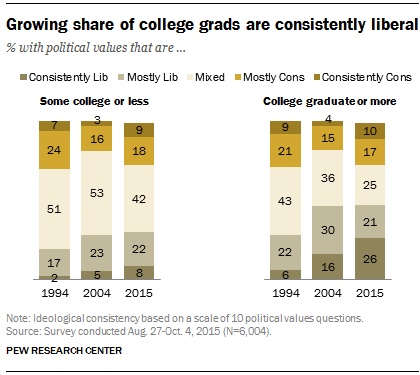
There used to be a pretty strong positive correlation between the level of education a person had and their likelihood of voting Republican. High school dropouts voted for the Democrats in strong numbers, high school grads in less strong numbers, while those with a college degree tended to go for the Republican. At the advanced degree level things did swing back to the Democrats, so if you want to raise the argument that the very highest and very lowest information voters were Dems, feel free.
My point is that since Trump, things have changed. High school dropouts are now reliable GOP voters and college grads have shifted over to the Democrats. I see no alternative to believing that now, in fact the low-information voters are more likely to be Republicans. As a partisan you may wish that was always the case, but remember the Democrats have always billed themselves as the party of the working man (well, until they substituted working family).
Back in the 90's there was no clear edge for either side and it's been trending Democrat ever since.
It's also worth remembering that many people with some college or even an undergraduate degree form a special class of low information voter. Undergraduate level courses generally lack nuance and at times give students just enough knowledge to be dangerous.
Eg in Economics these early courses focus on basic free market theory while the more advanced courses look at how the basic theory breaks down and what can be done about it. Conservatives exposed to only the idealized basic theory don't know about the practical problems associated with it and are vulnerable to claimed the more nuanced practical implementations of free markets are "socialism" because they require regulation and government action. Thus these voters tend to reject functional implementations of free markets while believing themselves to be pro free market.
Historically, something similar has happened a lot on the Liberal side as well, with students learning about social issues first but not getting into the more advanced topics on the complexities of resolving these issues. This leads them to support simplistic but unworkable fixes to complex issues.


