• Quick note - the problem with Youtube videos not embedding on the forum appears to have been fixed, thanks to ZiprHead. If you do still see problems let me know.

The best science and medicine books

Mindware: Tools for Smart Thinking Hardcover – August 18, 2015
by Richard E. Nisbett (Author)

http://www.amazon.com/Mindware-Thinking-Richard-E-Nisbett/dp/0374112673

This book is a big deal. I highly respect Dweck, Haidt and Gilbert, when I saw these reviews, I was intrigued...

All the wisdom of twentieth- and twenty-first-century psychological research has been distilled into one superb book--for your everlasting benefit! You will take a giant step on the path to better decisions in your life. (Carol Dweck, author of Mindset: The New Psychology of Success)

Mindware will make you a better thinker, investor, parent, consumer, and leader. There are surprises and delights on each page. Every country should scrap a year or two of math education and require all citizens to read this book instead. (Jonathan Haidt, author of The Righteous Mind: Why Good People Are Divided by Politics and Religion)

The bad news is that our intuitive ways of thinking about the world are wrong. The good news is that it isn't hard to set them right. Nobody knows more about these things than the eminent psychologist Richard E. Nisbett, who has dedicated his life to understanding the shortcomings of the human mind and to finding ways to fix them. This book should be required reading at every university. (Daniel Gilbert, author of Stumbling on Happiness)

I say it's destined to become a classic...

Scientific and philosophical concepts can change the way we solve problems by helping us to think more effectively about our behavior and our world. Surprisingly, despite their utility, many of these tools remain unknown to most of us.

In Mindware, the world-renowned psychologist Richard E. Nisbett presents these ideas in clear and accessible detail. Nisbett has made a distinguished career of studying and teaching such powerful problem-solving concepts as the law of large numbers, statistical regression, cost-benefit analysis, sunk costs and opportunity costs, and causation and correlation, probing the best methods for teaching others how to use them effectively in their daily lives. In this groundbreaking book, Nisbett shows us how to frame common problems in such a way that these scientific and statistical principles can be applied to them. The result is an enlightening and practical guide to the most essential tools of reasoning ever developed-tools that can easily be used to make better professional, business, and personal decisions.
 
Einstein : Walter Isaacson
Bad Science : Ben Goldacre
Isaac Newton : James Gleick
On Relativity : Albert Einstein
Mind Change : Susan Greenfield
The Selfish Gene : Richard Dawkins
How The Mind Works : Steven Pinker
Self Comes To Mind : Antonio Damasio
The Fabric Of The Cosmos : Brian Greene
Our Mathematical Universe : Max Tegmark
Climbing Mount Improbable : Richard Dawkins
13 Things That Dont Make Sense : Michael Brooks
17 Equations That Changed The World : Ian Stewart
Why Does E Equal mc Squared : Brian Cox / Jeff Forshaw
Paradox : The Nine Greatest Enigmas In Physics : Jim Al Khalili
What Came Before The Big Bang : Cycles Of Time : Roger Penrose
 
The Alchemy of Air: A Jewish Genius, a Doomed Tycoon, and the Scientific Discovery That Fed the World but Fueled the Rise of Hitler

by Thomas Hager


A good read filled with history [Nitrate wars, Petermen, etc.] as well as the science and engineering of ammonia synthesis. Without the Haber process, the world population would be a very hungry 4 billion.
 
The entire search for a way to measure longitude at sea is a fascinating read and John Harrison an unikely hero
Something similar (altitude/latitude?) is discussed in the below recommendation by Loss Leader. Highly recommend the hardback illustrated edition.
And, of course, the best book ever written by anybody about anything: Bill Bryson's A Short History of Nearly Everything.
A contribution from an unscientific mind...
what if? serious scientific answers to absurd hypothetical questions
by the creator of webcomic xkcd.
 
My apologies for contributing months late. I haven't been around the forums much lately. Also: Everyone listed nonfiction books, whereas I'm citing a novel. So this may be a digression from the OP's intent. Despite that, I post this because this book is one of the best works on the medical field that I've read:

Arrowsmith_zps3v4y4kks.jpg

Arrowsmith. By Sinclair Lewis.

Why this book? Because it did the best job of anything I've read to communicate:
  1. The basic tension between idealism in pursuit of a scientific career vs. demands of career advancement, human desire for societal station, etc. And related: The push-pull of self-centered and occasionally outright selfish desires vs. dedication and intellectual honesty.
  2. The rush and stumbles of the fields of medicine (including academic research, public health service, and patient care) from poorly empirical practices to more rational, evidence based, scientifically influenced professionalism.
  3. The existence of medical quackery and outright fraud that nonetheless sports populist appeal, and coexistence with it as a science and medical professional.
Arrowsmith follows a man's travels through his medical education, his stint as a private practitioner, his work as a government health official, and other stops in various research, hospital, and other facilities. Along the way, the book well portrays the protagonist going from idealism to purity to commercialism to service and back again... yet not quite really back to the start, but rather back to idealism, and purity, and commercialism, and so on, but with a more experienced and weathered wisdom. All the while, you don't forget that this is a book about a medical practitioner; the medical science, professional practice, and academic and commercial medical research is never out of sight. Neither are the tensions, triumphs, setbacks, and experiences of each of the careers he samples.

Admittedly, it's not a perfect book. Lewis's satirical bent too often results in characters who are less fully rounded people and more unidimensional epitomies of bad conduct or other negativities which he clearly believes the reader should rail against. And it's possible to view the protagonist less as a person being pulled between idealism and personal desires and more as an inconsistently drawn character whose faults are not organic but more the result of an author who can't make up his mind. Furthermore, the book can feel miserably bleak at times.

But that is literary criticism. Through the collaboration with bacteriologist Paul de Kruif, the actual science in the book feels real, as does the journey of the student towards the professional with stops, pauses, and ponderings between all the various directions a then student of medical science could take. The novel has often been used in history of medicine courses - and indeed, as some doctors have testified, in medical programs - to help students get a feel for what the professional practice of medicine is like. As author and medical doctor Howard Markel had noted in 2001:
"My battered paperback copy of Arrowsmith is annotated throughout with the same pen-scrawled comment: “Still true!” I am hardly alone: from its publication to the present, countless men and women have been inspired to pursue careers in research because of (the protagonist's) intense devotion to science."

This book often has a place in any history of western medicine course. And for good reason. This is why I note it in this thread: It's one of the best "Field of Medicine" books I've read, fiction or not.

Further reading:
 
Algorithms to Live By: The Computer Science of Human Decisions

All our lives are constrained by limited space and time, limits that give rise to a particular set of problems. What should we do, or leave undone, in a day or a lifetime? How much messiness should we accept? What balance of new activities and familiar favorites is the most fulfilling? These may seem like uniquely human quandaries, but they are not: computers, too, face the same constraints, so computer scientists have been grappling with their version of such issues for decades. And the solutions they've found have much to teach us.

In a dazzlingly interdisciplinary work, acclaimed author Brian Christian and cognitive scientist Tom Griffiths show how the algorithms used by computers can also untangle very human questions. They explain how to have better hunches and when to leave things to chance, how to deal with overwhelming choices and how best to connect with others. From finding a spouse to finding a parking spot, from organizing one's inbox to understanding the workings of memory, Algorithms to Live By transforms the wisdom of computer science into strategies for human living.
https://www.amazon.com/Algorithms-Live-Computer-Science-Decisions/dp/1627790365

http://rationallyspeakingpodcast.or...-and-brian-christian-on-algorithms-to-li.html
 
Last edited:
Trespassing on einstein's Lawn - Amanda Gefter

17834895.jpg


Amanda and her dad join in a quest for the nature of reality, in the course of which she goes from faking being a journalist to access physics conferences, to actually being a science journalist, meets the top theoretical physicists of our time, and discovers that reality is...

But I won't spoil it for you. A wonderfully entertaining read that tries to explain, without the maths, where modern theoretical physics is going, and the puzzles being solved on the way.
 
513y+n7l7DL.jpg


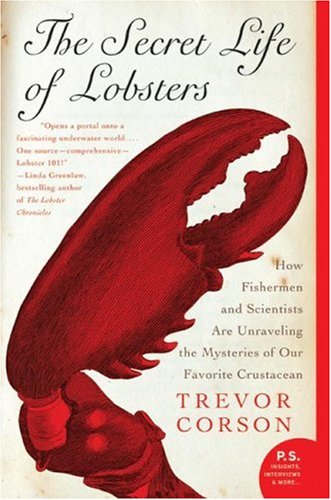
The Secret Life of Lobsters
Who knew ??

Reminds me a bit of Song of the Dodo - it's a good tale...well told with solid science and I'm better informed. Can't ask for much more than that. Highly recommended

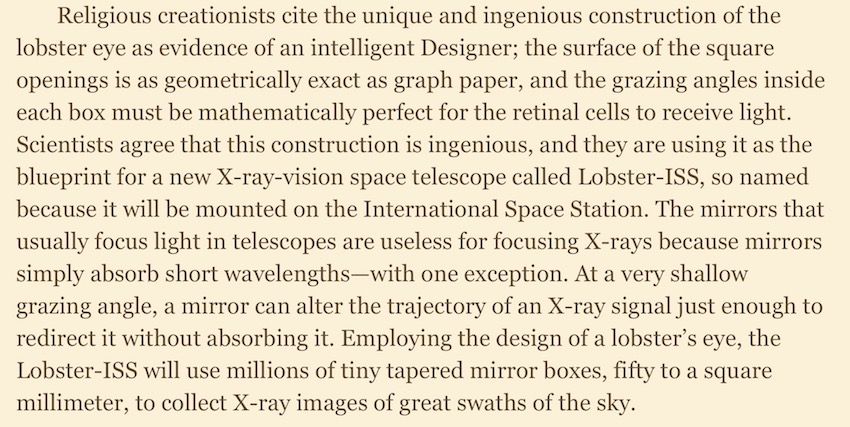
neat bit using lobster tech for the latest Xray telescope on the ISS

Screen%20Shot%202016-08-31%20at%20Aug%2031%20%20%20%202016%20%20%20%202.34.19%20PM_zpsdqtjqunk.jpg
 
.....Longitude....
It's an amazing story of a man far far ahead of his peers.....so far ahead ....that a clock he designed but was never funded to build was recently built and tested...........

Great book..........but your sentence here is misleading. Harrison built 3 chronometers himself, and the fourth (and 5th) he paid another engineer/ watchmaker to make (although only the first was finished). His number 4 was tested on a voyage to the West indies, and proven a complete success. He was funded by the Admiralty throughout. What you may be eluding to is that they refused to pay him the prize money on offer until he petitioned the King decades later.

As an aside, and to give you an idea of how single minded the man was, he had to present his works to the Admiralty in London, yet he lived in York, well over 200 miles away. He simply strapped the big things on his back each time and walked.
 
A practical book, not a science book; but every home should have one: Merck Manual, Professional Edition for obviously, healthcare pros; Consumer Edition for, well you guessed it....
 
This

51b9px3bkWL.jpg


was an impulse buy .....came on on BookBub for $1.99 and was pitched in the same vein as Jarad Diamond and it's usually $15.99 on Kindle !!!
I would not pay $15.99 for it before I got into it....
NOW...it's worth every penny of that. Truly insightful well written science.
 
From the blurb
The fabrication of weapons, the mastery of fire, and the technologies of clothing and shelter radically restructured the human body, enabling us to walk upright, shed our body hair, and migrate out of tropical Africa.
So we mastered fire and clothing before we learned to walk upright? Granted it's possible the author didn't write the blurb but, good lord.
From a review
incredibly, he argues that dumping CO2 into the atmosphere, far from being a bad thing, is actually *helping* by preventing the real danger---another ice age.

I remain skeptical!
 
So you are commenting on a book you haven't read? how credible....:rolleyes:

meanwhile

61QIXvyEDRL._SY344_BO1,204,203,200_.jpg


absolutely amazing read .....so much I never knew. Extreme climbing meets extreme tree biology...starts slow astonishing true story develops....
 
Last edited:
Trex and Valley of Doom is just superb....learning so much with the cross discipline discovery

Good story telling....
And damn I think that's the same RIchard Muller at Berkeley who took the wind out of the AGW deniers.
Highly recommended

FTFThis: unfortunately they are still full of hot air!!!!! The kind that chokes you in a crowded elevator when one of them farts!!!!!
 
From the blurbSo we mastered fire and clothing before we learned to walk upright? Granted it's possible the author didn't write the blurb but, good lord.
From a review

I remain skeptical!
No one knows every field real well and some of them think they do anyway!!!!!
Remember Linus Pauling and Vitamin C???
 
0c26943092874676fda956281b8fd969.jpg

Laugh if you want, but this is the best science book I have ever read, not least because it taught me an awful lot while I was on the toilet. The pages are arranged in chronological order by scientific development, and each development is explained in simple language in no more than a page and a half, plus any appropriate "see also page x." Thus, entire concepts are served up in bite-sized chunks.

A sample:
cc9f7de3b06217b9f6a21d02c8e04191.jpg

This book won't get you a college degree, but it will take you past high school. More importantly, it should give you enough knowledge to recognize when a "scientific" claim just doesn't sound right.

This signature is intended to irritate people.
 
a total delightful triology - you'll find yourself every few pages exclaiming loudly .....I never knew that !!!...it's both accessible and intensely developed and erudite.

Please, please forgive me for my pedantry, because I really think that you're passionate about these books, but I cannot help myself. I really appreciate your passion, really I do, but... you can't say "both" and then list three items. It's just not allowed.
 
Laugh if you want, but this is the best science book I have ever read, not least because it taught me an awful lot while I was on the toilet. The pages are arranged in chronological order by scientific development, and each development is explained in simple language in no more than a page and a half, plus any appropriate "see also page x." Thus, entire concepts are served up in bite-sized chunks.

A sample:

This book won't get you a college degree, but it will take you past high school. More importantly, it should give you enough knowledge to recognize when a "scientific" claim just doesn't sound right.

This signature is intended to irritate people.
<snipped images>

Laugh? Not even slightly. I personally enjoy books that make the hard sciences accessible.

You should feel no shame stepping up to that plate. You do not only stand upon the shoulders of giants, you stand among them, rubbing shoulders with Newton and Einstein et al. You should be lauded.
 

Back
Top Bottom