• Quick note - the problem with Youtube videos not embedding on the forum appears to have been fixed, thanks to ZiprHead. If you do still see problems let me know.

Szamboti's Missing Jolt paper

Part of our problem here may be that it is assumed that there would be a jolt, as in verinage, because we are thinking of thje upper-block core columns taking part in driving the collapse, as do all the columns in a building taken down by verinage.

Problem with this thinking is that it is driven mostly by the floor slabs. Once enough of them collapsed or slumped out of their seats, starting a cascade of failures, any jolt would be rather minimal.

You don't even need the rest of the block to drive collapse of the floor slabs.

The structure of the towers was more than stiff enough to transmit the deceleration to the roofline. In fact, it was probably stiffer than the Verinage buildings which all show a deceleration.
 
Tony's problem is a whole lot more basic than that. He is hung up on principles a 3rd year engineering student will breeze past.

On a relative scale based on what I see you say here, if I am hung up on principles a 3rd year engineering student could breeze past then you have to be back at the kid taking his placement test to get into college.
 
The structure of the towers was more than stiff enough to transmit the deceleration to the roofline. In fact, it was probably stiffer than the Verinage buildings which all show a deceleration.

So you're saying that the WTC towers were stiffer than multistory reinforced concrete buildings? That's what you're going with? Really?

:dl:
 
Posted by Myriad
<snip>
Come to think of it, buildings are so fragile that many of them can actually be damaged by earthquakes! A mere few seconds of shaking! Can you imagine an empty cardboard box being damaged by being shaken by an earthquake (that is, without something else falling on it)? Ridiculous! Cardboard boxes are vastly stronger, that's why many of them able to support hundreds of times their own weight.

Intuition is usually very unreliable when it comes to effects of scale. Incredulity based on such intuition will lead even well-meaning and intelligent people to ridiculous conclusions. Correct quantitative analysis and intellectual honesty in accepting the results of such analysis even if counterintuitive, are the usual ways around that problem. But developing better intuition might also help.


Thank you Myriad . It’s not obvious that small inputs can have large effects. The Towers were structurally vulnerable to just the type of event that occurred; 32,000 sf of wispy floor bar joists with no interior columns or beams.

T. Samboti mistakenly believes Huge Building requires Huger Forces to knock it down. He believes “upper block cannot crush lower block,“ like Gage’s humiliating clueless boxes demonstration.

Please review the following video.
Like structural judo, one small cause has an enormous effect.

The video is over when the fat guy laughs.


I’m sure T. Szamboti can provide the math to disprove what you’re seeing.

---------------------------------------------------------------
You cannot reason someone out of something they were not reasoned into - Swift
 
If you want to have an e-mail debate through DGM that is fine with me. He is a non-truther and offered that in this thread today. He has my e-mail address.
That would be OK with me.

tfk PM me if you want my email address.

Tony, would it be OK for you to debate here if tfk confided his identity to me?
 
Last edited:
Many people have measured this fall in WTC 1 now and it is evident that there was no deceleration and that the upper section continuously accelerated during its fall.

Oh Tony Szamboti, you silly man. You just got done arguing the upper section was decelerated at 32.2 ft/s^2 for the last 40 years! Now "...there was no deceleration..." You can't have it both ways Tony Szamboti.
 
That would be OK with me.

tfk PM me if you want my email address.

Tony, would it be OK for you to debate here if tfk confided his identity to me?

No, but I would agree to an e-mail debate where if there is a resolution it can be posted.
 
Oh Tony Szamboti, you silly man. You just got done arguing the upper section was decelerated at 32.2 ft/s^2 for the last 40 years! Now "...there was no deceleration..." You can't have it both ways Tony Szamboti.

I am saying the deceleration required to amplify the insufficient static load above, so that it can demolish the columns below, needs to be significantly greater than 32.2 ft/sec^2.

There needs to be a higher force than the static weight to break the columns and the only thing that can change is the deceleration as the mass is constant.

You apparently didn't understand as it seems has been the problem with a number of others. I would be careful who I called silly until I was sure I understood what was being said.
 
Last edited:
So you're saying that the WTC towers were stiffer than multistory reinforced concrete buildings? That's what you're going with? Really?


The modulus of elasticity of steel is approximately seven times that of concrete. I would bet you didn't know that.
 
Last edited:
Regarding my reference to one of his posts on the first page of this thread, Dave Rogers wrote:
Funnily enough, when I posted that, Tony's response was to pretend it was my misunderstanding, but then, when it was confirmed by a couple of people he was prepared to listen to, to revise the paper so as to eliminate the smoothing function.
They may have removed the smoothing function from the prose, but they left the misleadingly smoothed data in Figures 2, 3, 4, 5, and 6. Until you posted the above, I had assumed your earlier post was referring to the smoothing evident in those figures. I guess the early draft you saw had discussed the smoothing in the text of the paper as well, which would have been less misleading than what they actually published.

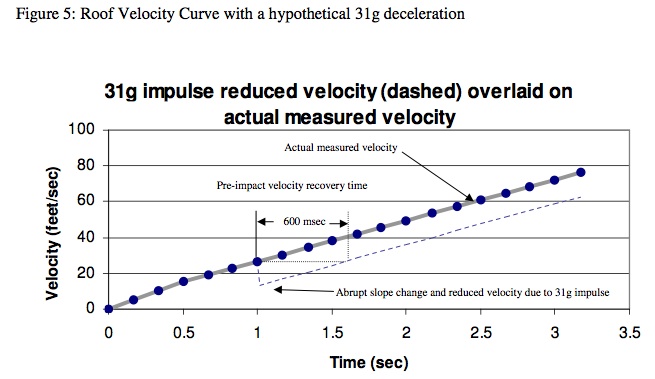
Here is Figure 5 from their paper:

figure5original.jpg


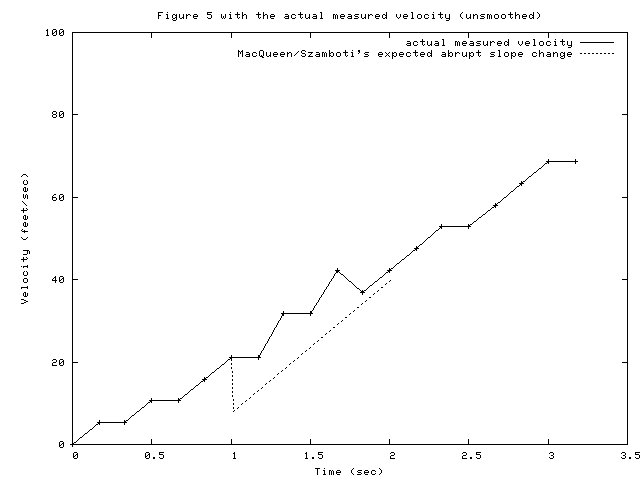
Although Figure 5 above claims to present "actual measured velocity", that is a lie. Here are the actual measured velocities, as computed directly from their unsmoothed data in the table on pages 6-7:

figure5honest.jpg


Their sampling rate was only 6 Hz, and their sampling error for distances was at least the 0.88 foot distance corresponding to a single pixel, so their sampling error for velocities is at least 5.28 ft/sec. That is also the quantum for their velocity measurements. A horizontal interval of 1/6 second doesn't mean anything unless the velocity measured for the following 1/6 second increases by two quanta or more (10.56 ft/sec).

As can be seen from the unsmoothed data in my graph, there appear to have been three mild jolts around 1.00, 1.33, and 1.67 seconds. Tony's expected delta-V of 13.13 ft/sec is shown in the dashed line, followed by the subsequent 1g acceleration implied by their model (instead of the incorrect reduced acceleration shown in their Figures 5 and 6, which was also incorrectly labelled as "reduced velocity"). If you compare the solid and dashed lines at 2 seconds, you will see that the sum of the three (or more) mild jolts was equal to Tony's expected jolt to within quantization error.

Hence jolts summing to the magnitude Tony expected have been there in his data all along, but Tony's expected big jolt was divided into at least three smaller jolts. That confirms the consensus hypothesis that the jolts were smeared out over time, and disproves Tony's hypothesis that the upper section collided so solidly with the lower section that there was only one big jolt.

Had MacQueen and Szamboti graphed their data properly, that would have been obvious.

 
I am saying the deceleration required to amplify the insufficient static load above, so that it can demolish the columns below, needs to be significantly greater than 32.2 ft/sec^2.

There needs to be a higher force than the static weight to break the columns and the only thing that can change is the deceleration as the mass is constant.

You apparently didn't understand as it seems has been the problem with a number of others. I would be careful who I called silly until I was sure I understood what was being said.

Yes sir Tony!

lol, all kidding aside I'm just pointing out you've really got to get a grip on your terminology if you want to be taken seriously.
 
I can prove what I am saying. Can you?

Simple logic. The towers were designed to sway in the wind. The buildings that were brought down by verinage were not.

The buildings demolished by verinage had bearing columns pretty much evenly-distributed across all floors. The towers had columns around the outside and clumped together in the middle. The towers had expansive free-span steel truss floors. These are remarkable fragile, especially if compromised by fire, as compared to the more conventional croncrete slab floor, or to steel-truss floors with less free-span area.

No buildings in the world had more free-span floor trusses than the towers.

What happens to the columns after initiation of collapse is irrelevant. The only way they acted from that point onward may have had to do exclusively with the perimeter columns' acting as levers to more quickly break lower floor seats as the columns were pushed outward by the growing volumn of debris inside the tube.

The core columns below the point of failure just stood there doing nothing until a mechanical resonnance (observable in the spires of the north tower) shook them to pieces following the collapse of the floors that had held them upright.

Once collapse was initiated, the only important calculation is the weight needed to break the floors. The evidence suggests that some floor slabs failed prior to collapse initiation, and initiation of collapse added to the excess static load and dynamic load of rubble on the yet-unbroken slabs.

So, to make your figures worth something, you need to confine your examination to how muich energy was available and needed to break the floor slabs.
 
Regarding my reference to one of his posts on the first page of this thread, Dave Rogers wrote:

They may have removed the smoothing function from the prose, but they left the misleadingly smoothed data in Figures 2, 3, 4, 5, and 6. Until you posted the above, I had assumed your earlier post was referring to the smoothing evident in those figures. I guess the early draft you saw had discussed the smoothing in the text of the paper as well, which would have been less misleading than what they actually published.

Here is Figure 5 from their paper:

[qimg]http://www.ccs.neu.edu/home/will/Music/Jokes/Szamboti/figure5original.jpg[/qimg]

Although Figure 5 above claims to present "actual measured velocity", that is a lie. Here are the actual measured velocities, as computed directly from their unsmoothed data in the table on pages 6-7:

[qimg]http://www.ccs.neu.edu/home/will/Music/Jokes/Szamboti/figure5honest.jpg[/qimg]

Their sampling rate was only 6 Hz, and their sampling error for distances was at least the 0.88 foot distance corresponding to a single pixel, so their sampling error for velocities is at least 5.28 ft/sec. That is also the quantum for their velocity measurements. A horizontal interval of 1/6 second doesn't mean anything unless the velocity measured for the following 1/6 second increases by two quanta or more (10.56 ft/sec).

As can be seen from the unsmoothed data in my graph, there appear to have been three mild jolts around 1.00, 1.33, and 1.67 seconds. Tony's expected delta-V of 13.13 ft/sec is shown in the dashed line, followed by the subsequent 1g acceleration implied by their model (instead of the incorrect reduced acceleration shown in their Figures 5 and 6, which was also incorrectly labelled as "reduced velocity"). If you compare the solid and dashed lines at 2 seconds, you will see that the sum of the three (or more) mild jolts was equal to Tony's expected jolt to within quantization error.

Hence jolts summing to the magnitude Tony expected have been there in his data all along, but Tony's expected big jolt was divided into at least three smaller jolts. That confirms the consensus hypothesis that the jolts were smeared out over time, and disproves Tony's hypothesis that the upper section collided so solidly with the lower section that there was only one big jolt.

Had MacQueen and Szamboti graphed their data properly, that would have been obvious.

Your graph is based on the error being in favor of your position all the time, which is statisically improbable. Additionally, the error would not be an entire pixel or 0.88 feet but half of that.

This is a bogus use of the data you are showing here.

We also did not conclude there was no jolt simply because it wasn't obvious on the graph but because there was no velocity loss commensurate with the energy dissipation that would have occurred. Your bogus distortion of the data in an attempt to show some sort of step still can't eliminate that anomaly.
 
Last edited:
The modulus of elasticity of steel is approximately seven times that of concrete. I would bet you didn't know that.

You are still not making sense here. Are you, as suggested by other posters, trying to convince us that concrete is more flexible than steel?:boggled:
 
Simple logic. The towers were designed to sway in the wind. The buildings that were brought down by verinage were not.

The buildings demolished by verinage had bearing columns pretty much evenly-distributed across all floors. The towers had columns around the outside and clumped together in the middle. The towers had expansive free-span steel truss floors. These are remarkable fragile, especially if compromised by fire, as compared to the more conventional croncrete slab floor, or to steel-truss floors with less free-span area.

No buildings in the world had more free-span floor trusses than the towers.

What happens to the columns after initiation of collapse is irrelevant. The only way they acted from that point onward may have had to do exclusively with the perimeter columns' acting as levers to more quickly break lower floor seats as the columns were pushed outward by the growing volumn of debris inside the tube.

The core columns below the point of failure just stood there doing nothing until a mechanical resonnance (observable in the spires of the north tower) shook them to pieces following the collapse of the floors that had held them upright.

Once collapse was initiated, the only important calculation is the weight needed to break the floors. The evidence suggests that some floor slabs failed prior to collapse initiation, and initiation of collapse added to the excess static load and dynamic load of rubble on the yet-unbroken slabs.

So, to make your figures worth something, you need to confine your examination to how muich energy was available and needed to break the floor slabs.

Sorry, but the analysis proves your simple logic wrong.
 
You are still not making sense here. Are you, as suggested by other posters, trying to convince us that concrete is more flexible than steel?:boggled:

No, but it will deform more per unit stress than steel. That is what the modulus of elasticity is a measure of.

The axial stiffness of a column is a function of modulus of elasticity, cross sectional area, and length.

Don't take my word for it look it up.
 
Sorry, but the analysis proves your simple logic wrong.

Why do any columns below the initiation point need to be crushed by vertical forces to produce the effects seen? We see perimeter columns being forced outward by the expansion of the rubble pile, we see floor slabs falling on each other, and we see the core slowly discombobulating by some means far, far behind the collapsing front. We do not see columns below the point of failure being crushed by a vertical force. Thus, we must conclude that the force driving the collapse is applied almost exclusively to the floor connectors and the slabs.

The energy budget to do this work is far smaller than that which would crush the columns downward.
 

Back
Top Bottom