• Quick note - the problem with Youtube videos not embedding on the forum appears to have been fixed, thanks to ZiprHead. If you do still see problems let me know.

Stupid Christian Article on Evolution

Your first pic was not a scan. So why are you reluctant to show the text that goes along with it?

Surely that would be easier than taking blurry cell-phone pics that don't address the question.

ETA: so you are saying you posted the entire scan of the text. Ok, so Haeckel is not highlighted in this one textbook, but the same technique illustrating a failed concept is, imo.
 
Last edited:
"Darwin's theories greatly stimulated...." more research? That's your point. I appreciate the effort but it was a simple request. What is the text say in relationship to the pictures, not just the caption.
 
However, it doesn't mention Haeckel's role in the development of that idea, instead heavily implying that it was all Darwin's idea. It even credits Darwin for the creation of the science of comparative embryology! Haeckel's own role in the foundations of that field are completely ignored!

So the textbook made stuff up to hide Haeckel's influence?

Even Darwin himself credits Haeckel, and prior to that Von Baer who insisted Darwin misused his evidence. Darwin accepted Haeckel to the point he even accepted mischaracterization of Haeckel in that Darwin advocated adult form recapitulation as evidence for evolution in the later editions of "The Origin of the Species."

But continue to try to skew history if it makes you feel better.....
 
ETA: so are you going to review all of the textbooks from the 60s, 70s and 80s or cherry-pick them.

A suggestion. Just go with the text. Go to the back. See if Haeckel is mentioned. Quote the text then and mention if there is either a diagram backing up Haeckel and is it based on any of his drawings.

Obviously, Haeckel did more than one drawing.
 
Last edited:
Your first pic was not a scan. So why are you reluctant to show the text that goes along with it?

BlueGrid.jpg


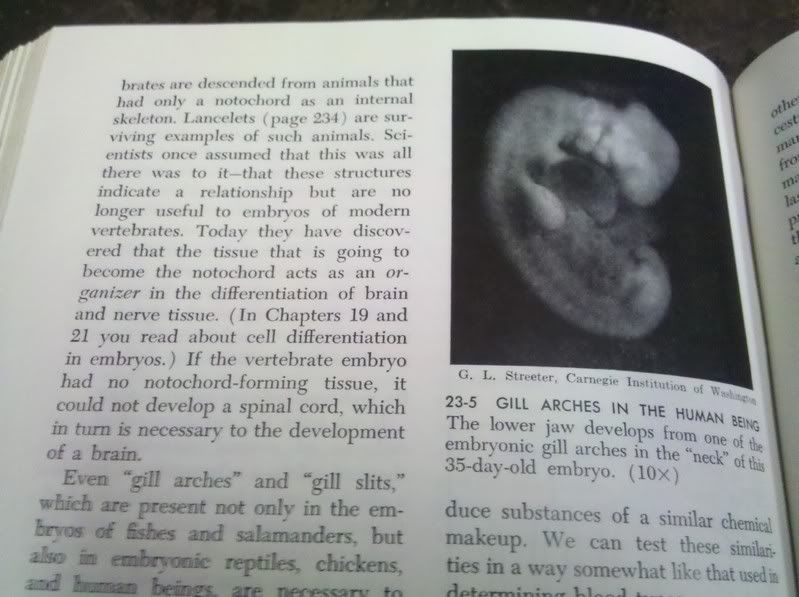
IMG_20110318_145712.jpg


:boggled:
 
ETA: so are you going to review all of the textbooks from the 60s, 70s and 80s or cherry-pick them.

A suggestion. Just go with the text. Go to the back. See if Haeckel is mentioned. Quote the text then and mention if there is either a diagram backing up Haeckel and is it based on any of his drawings.

(Everything underlined below is an actual link, not an underlining for emphasis or anything)

Somebody did that already (for the 60's, at least). You not only linked to that list, you cut and pasted it into a post.

When I pointed out to you that the list you yourself posted indicated whether they used Haeckel's drawings or not, you completely denied that and mockingly asked if the "not Haeckel's drawings" counted stuff like merely adding color to Haeckel's drawings and calling it different.

In response, I said no, they were counting stuff like completely redrawn embryo images showing features Haeckel never showed, stages of development he never showed, and animals he never showed:

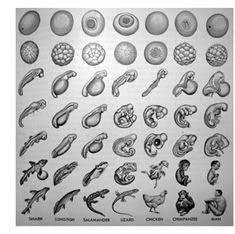
BlueGrid.jpg


You first demanded to know where I got that diagram (despite my telling you right in the same post containing the image), then demanded I post the accompanying text for that diagram in the original source textbook.

So I did. And I didn't just transcribe the text and expect you to take my word for it that that was the text. I took photographs of the text. And then I did the exact same thing for the text of a textbook that used the same diagram, that you didn't even ask for.

Your response?

To demand that I post the text, and go through all the textbooks of the 60's, 70's, and 80's, and make a note to see if they use Haeckel's drawings or not.

So I'm done with you. I'm going to post the rest of the pictures I took of the other three textbooks, because I found them interesting and I'm sure they'll be of interest to the other people in this thread. But you, I'm through with.

I'll just leave you alone as you await the Inevitable Imminent Collapse of Evolution That's Gonna Happen Any Day Now, You'll See. I hope you brought a book along, though.

Because you're going to be waiting a long, long time.
 
Last edited:
ETA: so are you going to review all of the textbooks from the 60s, 70s and 80s or cherry-pick them.

A suggestion. Just go with the text. Go to the back. See if Haeckel is mentioned. Quote the text then and mention if there is either a diagram backing up Haeckel and is it based on any of his drawings.

Obviously, Haeckel did more than one drawing.

There go the goalposts.
 
ETA: so are you going to review all of the textbooks from the 60s, 70s and 80s or cherry-pick them.

A suggestion. Just go with the text. Go to the back. See if Haeckel is mentioned. Quote the text then and mention if there is either a diagram backing up Haeckel and is it based on any of his drawings.

Obviously, Haeckel did more than one drawing.

Have you ever considered doing any research yourself?
 
Just as I expected. You demonstrate conclusively that Heckel's work isn't held as gospel truth and randman demands you go back 40 or 50 years and prove that it wasn't back then. :rolleyes: Thank you, ANTpogo; those are fantastic pictures, and clearly demonstrate that Heckel isn't the be-all end-all randman assumes. Very cool pictures of development of animals.
 
Dangit!

Guys, in sorting through my hundred-and-score images in preparation for posting the information from the rest of the textbooks, I discovered I screwed up something somewhere and in all the textbook-searching and picture-taking I forgot to get two particular images, or (more likely) I somehow deleted them when I weeded out all the unusably blurry ones.

The pictures in question are the index to the 1966 textbook, and a particular image in the 1981 textbook.

The 1966 index I'm less concerned about, since I took pictures of the part of the book where Haeckel's drawings obviously would be, if the book actually used Haeckel. To wit:

IMG_20110318_154011.jpg


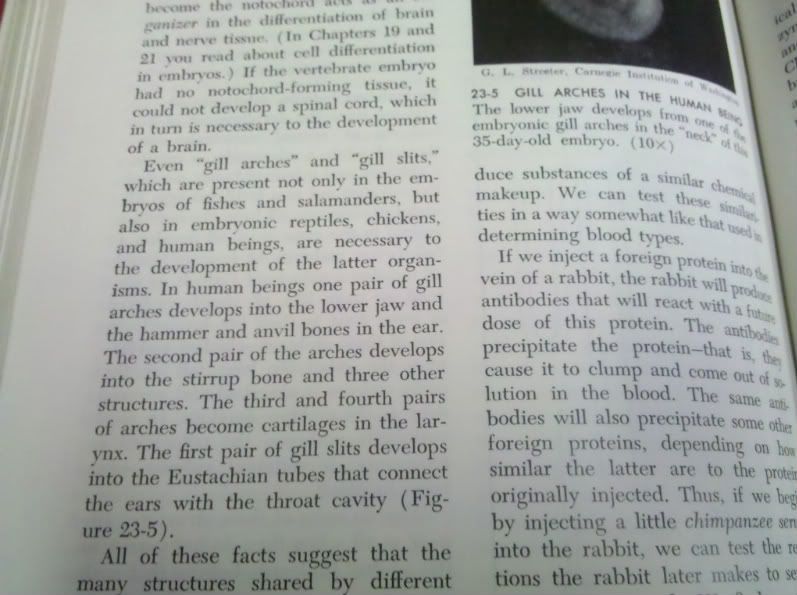
IMG_20110318_154016.jpg


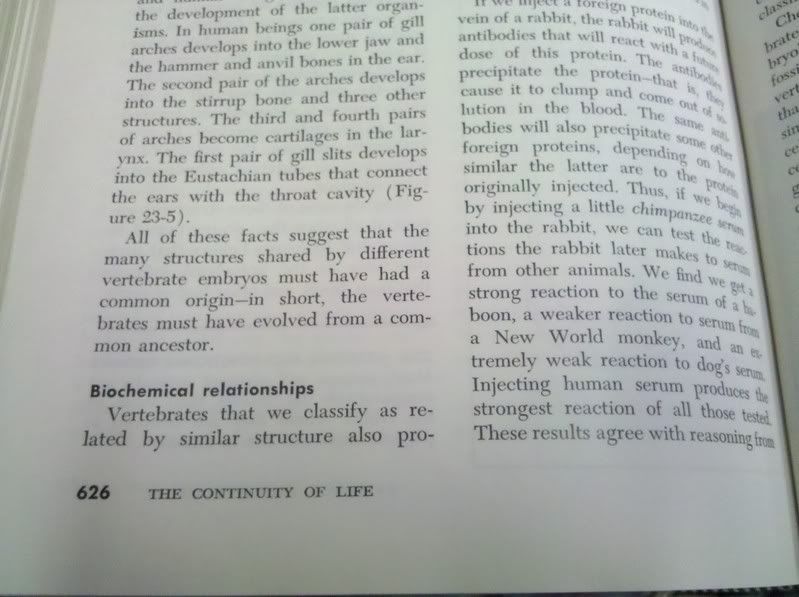
IMG_20110318_154021.jpg


The text even mentions that vertebrate embryos are similar to each other across species, but the only illustration is not a drawing, but a sole photograph of a human embryo. I have pictures of the pages before and after this section, and a comparative diagram of any type does not appear anywhere. The Textbook History survey confirms this: according to the database, the text in question, Smith's Exploring Biology, stopped showing comparative diagrams of any type after the 1949 edition.

More problematic is the missing figure from the 1981 book. Haeckel is not mentioned in the index (and I do have the index for that book), and the context of the reference indicates it's simply a picture or depiction of the human embryo alone (as in the 1966 text). I do have the parts of the 1981 book that make it pretty clear that comparative embryology is considered a disused dead-end as far as evolutionary evidence is concerned (focusing instead on anatomical similarities in adult organisms), so given all the above I'm pretty sure that the missing image wasn't a comparative diagram. (EDIT: Not to mention that the 1981 book was co-authored by Stephen Jay Gould, who had a particular dislike for Haeckel, and so was unlikely at best to include Haeckel's drawing or anything derived from it in one of his textbooks).

I also only took pictures of limited sections of the 2002 book, but that was deliberate, because the pictures I took say everything that needs to be said regarding that book's view of Haeckel.

I don't give a single crap what randman thinks about this, but do you guys want me to go back and get confirmatory pictures of the missing information?

 
Last edited:
(Everything underlined below is an actual link, not an underlining for emphasis or anything)

Somebody did that already (for the 60's, at least). You not only linked to that list, you cut and pasted it into a post.

When I pointed out to you that the list you yourself posted indicated whether they used Haeckel's drawings or not, you completely denied that and mockingly asked if the "not Haeckel's drawings" counted stuff like merely adding color to Haeckel's drawings and calling it different.

In response, I said no, they were counting stuff like completely redrawn embryo images showing features Haeckel never showed, stages of development he never showed, and animals he never showed:

[qimg]http://i479.photobucket.com/albums/rr157/antpogo/BlueGrid.jpg[/qimg]

You first demanded to know where I got that diagram (despite my telling you right in the same post containing the image), then demanded I post the accompanying text for that diagram in the original source textbook.

So I did. And I didn't just transcribe the text and expect you to take my word for it that that was the text. I took photographs of the text. And then I did the exact same thing for the text of a textbook that used the same diagram, that you didn't even ask for.

Your response?

To demand that I post the text, and go through all the textbooks of the 60's, 70's, and 80's, and make a note to see if they use Haeckel's drawings or not.

So I'm done with you. I'm going to post the rest of the pictures I took of the other three textbooks, because I found them interesting and I'm sure they'll be of interest to the other people in this thread. But you, I'm through with.

I'll just leave you alone as you await the Inevitable Imminent Collapse of Evolution That's Gonna Happen Any Day Now, You'll See. I hope you brought a book along, though.

Because you're going to be waiting a long, long time.
All I am asking is where you got the pic from. Linking to the past conversation does not show that.

I don't see why you would not just post the link and say, here, this is where I got it from.
 
One last thing before I head off to bed:

Speaking of things Haeckelian, in my research into this I came across this interesting article published in Cabinet (which describes itself as "a quarterly magazine of art and culture that confounds expectations of what is typically meant by the words "art," "culture," and sometimes even "magazine."").

It's about Haeckel's drawings, but not from a scientific perspective (though the author is not unaware of the scientific problems; the footnotes cite Richardson's Science article about Haeckel's fakery). Instead, it considers Haeckel's work from an art perspective, describing him as being the progenitor of a style and genre the author calls "microbial baroque" (and the article is illustrated with a number of other works of the same genre.

Definitely a different perspective on what we've been talking about here.
 
All I am asking is where you got the pic from. Linking to the past conversation does not show that.

I don't see why you would not just post the link and say, here, this is where I got it from.

I assumed (foolishly) that you actually bothered to read the pages you yourself link to. Because if you had, then you wouldn't even be asking that particular question. You'd know where it came from.

Not that I think for even a moment that you'd have posted a single thing different from what you did about the diagram found in the Blue Book.
 
Last edited:
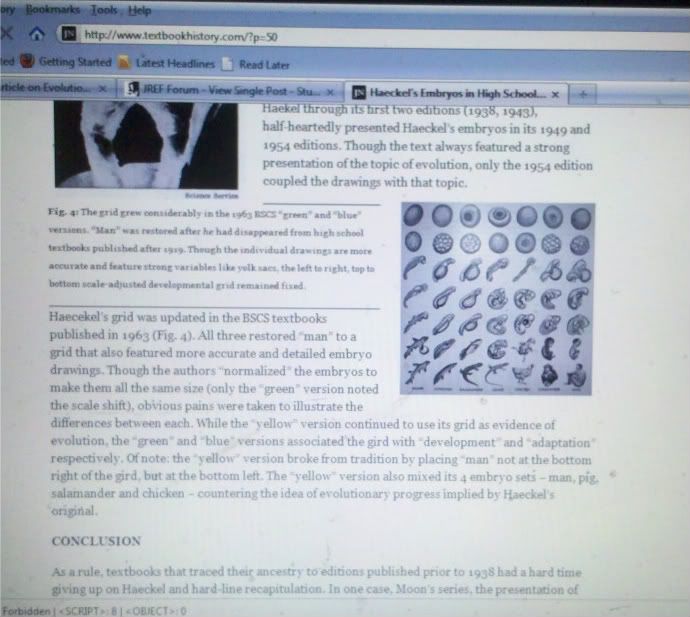
That's from the "blue" (or molecular biology) version of the final 1963 version of the textbook released by the Biological Sciences Curriculum Study, a group set up in 1959 specifically to review the state of biology textbooks in America and create a textbook more in line with actual, current scientific knowledge (the BSCS was led by active, working bio scientists).

The diagram above is not Haeckel's. It's not taken from anything Haeckel ever did in his lifetime, either, since it depicts animals he never examined, and depicts almost three times as many intermediate embyrological stages as he did. These depictions are also drawn from scratch from new embryos - you'll note that they include the yolk sacs that Haeckel omitted from his drawings.

The "yellow" (or cellular biology) version of the same textbook, also published in 1963, even rearranges the order of animals in the diagram, to make it resemble Haeckel's "fish-bird-man" left to right progression even less.

Why do you think the actual biologists behind the BSCS effort to bring textbooks more in line with current knowledge changed diagrams, randman? Why did they abandon Haeckel's diagrams and make their own? Why would they go to such lengths to make their new diagrams as unlike Haeckel's as possible?

This is the thing: all I asked in response to this was to show the site where you got the pic from since it didn't seem to be hand-scanned. You've gone and hand-scanned a few textbooks rather than do that. If you said you did not get it off the internet, you could just say that. But you did not.

So that raises the demand again and again to simply provide the site so we can see the text involved, whether it is an effort to preach evolution along Haeckelian lines or not. Apparently it is not a diagram related to evolution at all? Just biology.

Anyway, it makes no sense if textbooks had more accurate (though not to scale, etc,...) to go back to cruder drawings? Isn't that sort of some kind of deceit? I think cherry-picking and lining up depictions not to scale side by side is a bit of propaganda in the first place. Was it just not good enough that they had to go back to worse and faked drawings?

In other words, it's good that some textbooks started getting rid of Haeckel in order to be more in line with reality, but why then would they go back?

You say because working scientists did? Isn't that even worse? They knew it was hogwash but resorted to it again?
 
One last thing before I head off to bed:

Speaking of things Haeckelian, in my research into this I came across this interesting article published in Cabinet (which describes itself as "a quarterly magazine of art and culture that confounds expectations of what is typically meant by the words "art," "culture," and sometimes even "magazine."").

It's about Haeckel's drawings, but not from a scientific perspective (though the author is not unaware of the scientific problems; the footnotes cite Richardson's Science article about Haeckel's fakery). Instead, it considers Haeckel's work from an art perspective, describing him as being the progenitor of a style and genre the author calls "microbial baroque" (and the article is illustrated with a number of other works of the same genre.

Definitely a different perspective on what we've been talking about here.
Definitely a work of art, and as art, I think you can admire Darwinism. One artist who became famous in statecraft did so very much.

But thanks for linking a different perspective.

ETA: it's a bit bothersome though for you to link something stating Haeckel was a father of the faith so to speak and then denigrate me for pointing out the historical fact.

You may not have heard of Ernst Haeckel (1834-1919), but for 50 years or so, until his death, he was the most influential evolutionary theorist on the map. He did more to spread the gospel of evolution than all his fellow snow-capped honorees combined, lecturing, demonstrating, thundering, and publishing dozens of books, some technical, some popular. In the decades before World War I, prominent display of Haeckel's books was de rigeur in European or American households seeking to seem educated, up-to-date, and non-dogmatic; his opinions—spiritual, aesthetic, philosophical, political—carried the imprimatur of unquestioned scientific objectivity.
 
Last edited:
Still don't get it, do you?

Here's evidence showing it was used in textbooks long before the 90s.

The embryos were reproduced in a majority of high school and college biology textbooks from the mid-1930s through at least the 1960s (See table). Generations of students took away the incorrect but easy to accept and generally cool idea that we pass through a fish-like stage, complete with gill slits, on our way to becoming human.

http://www.textbookhistory.com/?p=50

That's your post. That's the URL you yourself provided in that post. So, I went to that URL you yourself provided in that post.

And in that article at that linked URL that you yourself provided in that post, I read...this:

IMG_20110318_235951.jpg


So, I looked up the referenced textbook in the research library's card catalog, saw we had a copy of the 1968 edition, and went down there to look for myself. And lo and behold, there it was, just like it said at that URL that you yourself provided in that post. I snagged their image because I knew it was true, and didn't think to bother to take pictures on my own (not until you went on your "what's the text!!!" goalpost-shifting run, at least).

So, when you ask where I got that image from, the answer, randman, is you. You told me where to find that image. I never even would have thought to look at the old BSCS books we had at the library here, if it weren't for you.

That's what makes this whole thing so beautiful.
 
Last edited:
Still don't get it, do you?


That's your post. That's the URL you yourself provided in that post. So, I went to that URL you yourself provided in that post.

And in that article at that linked URL that you yourself provided in that post, I read...this:

[qimg]http://i479.photobucket.com/albums/rr157/antpogo/IMG_20110318_235951.jpg[/qimg]

So, I looked up the referenced textbook in the research library's card catalog, saw we had a copy of the 1968 edition, and went down there to look for myself. And lo and behold, there it was, just like it said at that URL that you yourself provided in that post. I snagged their image because I knew it was true, and didn't think to bother to take pictures on my own (not until you went on your "what's the text!!!" goalpost-shifting run, at least).

So, when you ask where I got that image from, the answer, randman, is you. You told me where to find that image. I never even would have thought to look at the old BSCS books we had at the library here, if it weren't for you.

That's what makes this whole thing so beautiful.
Glad if I helped you look at data for itself. You spent a lot of time though avoiding a simple question. I just wanted a link to where you got the pic from so we could see if the site stated anything about it's context.

Keep in mind though you are gonna have to likely scan about 100 textbooks to obtain any meaningful data as far as the extent Haeckel was used. The 60s, you already admitted, widely used Haeckel. So I wouldn't waste time on that since your findings are not likely to contradict Haeckel being widely used.

So look at the 70s and 80s. That would be a service to historical truth.

The thing is though....up-front, you need to know that if can somehow substantiate the illogical claim textbooks used Haeckel for decades until the 70s and 80s but then put him back in textbooks in the 90s, that's not very helpful to your claims overall and supports my contention of evo misuse of data even to the point of resorting to faked data.

His almost mystical obsession with a rational and progressive march toward biological perfection was far removed from the random impersonality of natural selection, and his contempt for religion did not stop him from establishing one of his own.

http://www.cabinetmagazine.org/issues/7/ernsthaeckel.php

I think he did and it's still with us today.
 
The 60s, you already admitted, widely used Haeckel.

I told you I was through bothering with your repeated untruths about what scientists, textbooks, and evolutionary theory say. But I humbly request that you not tell untruths about what I say as well.

Randman makes particular mention of the original article's statement that the majority of textbooks in the 40's and 50's had comparative diagrams that reproduce or are derived from Haeckel's work. And that's true: of the 28 textbooks published from 1940 to 1960, 17 of them (61%) are noted as having comparative diagrams that reproduce or are derived from Haeckel's work.

An astute person would wonder why that particular date is the cutoff for the calculation of that majority percentage. Randman certainly didn't, because he'd have noted that of the 11 textbooks published from 1960 to 1969, only three have comparative diagrams that reproduce or are derived from Haeckel's work (or 27%). All of the others either have no comparative diagram, or use original illustrations that aren't Haeckel's or derived from Haeckel's work (with the vast majority using completely original diagrams that don't reference anything Haeckel produced).

And even those three texts that do use a derived diagram aren't actually different textbooks. They're all successive editions of the same book, Moon's Modern Biology. And there were actually four editions of that book published between 1960 and 1969; the last edition of the book that decade, published in 1969, finally drops those Haeckel-derived drawings as well.
 
This is from your link.

Haeckel established and convinced the public, really more than Darwin.

You may not have heard of Ernst Haeckel (1834-1919), but for 50 years or so, until his death, he was the most influential evolutionary theorist on the map. He did more to spread the gospel of evolution than all his fellow snow-capped honorees combined, lecturing, demonstrating, thundering, and publishing dozens of books, some technical, some popular. In the decades before World War I, prominent display of Haeckel's books was de rigeur in European or American households seeking to seem educated, up-to-date, and non-dogmatic; his opinions—spiritual, aesthetic, philosophical, political—carried the imprimatur of unquestioned scientific objectivity.

This was a religious issue for him (still is for many evos today).

and his contempt for religion did not stop him from establishing one of his own.

He even established his own evo church. This is a big part of the fabric of evo thinking, just done more informally.

As his theories developed, he began to attack not only anti-scientific ritualism, but dualism in general. Evolution proved that man and nature were not separable, and thus neither were matter and mind. "Crystal souls"4 inhered in the very minerals we were made of, human intellect being simply their higher expression achieved by means of the evolutionary drama. Accordingly, there was no need to project the existence of a creator outside the physical world: spirit lay within. In 1906, Haeckel founded a progressive church based on this quasi-scientific pantheism, calling it the Monist League in opposition to the dualistic religions. The Judeo-Christian ancestry was no more than a living fossil that could now be left behind.

http://www.cabinetmagazine.org/issues/7/ernsthaeckel.php

Darwinism is not real science in a lot of ways. It's more a matter of faith. That's why it's considered acceptable for darwinists to use faked and doctored data and misleading arrangements to convince people. The emphasis is not so much on understanding the data, the strengths and weaknesses of the theory, but on belief, on convincing people that not only is it true but that everything shows it's true. It never phases them when they say something shows evolution to be true, when we fine out the exact opposite, to insist that is strong evidence too.

The Universal Genome was heralded as proof of evolution (Darwinism), a very stupid concept in a lot of ways. Then, as that was thrown out, the fact genetic complexity increased so that simple organisms had simpler genomes and more complex ones had more complex ones was heralded as proof too despite this being completely different than a Universal Genome.

At least, the linking of genetic complexity with morphological complexity made sense based on Darwinism. But now, we see that idea too is wrong, and as you and evos here make clear, people like you will insist evolutionism predicted it all along.....all known facts support Darwinism....kind of like Big Brother in 1984.

It's a doctrinal and religious issue with you guys. From the comments above, anyone that knows the history of the debate can see that you guys will insist that even three different and opposing sets of data must all be evidence for evolution.

I have someone on this very forum arguing that despite evos insisting pseudogenes were particularly strong evidence for evolution, that the discovery of pseudogenes being a myth, that they are functional does not change a thing......it MUST BE all evidence of evolution.

That's the real reason Haeckel's faked data was used and will be so again. It is true data in the eyes of evos. It supports Darwinism and that's the measure for evolutionism whether something is true or real or not.
 
I told you I was through bothering with your repeated untruths about what scientists, textbooks, and evolutionary theory say. But I humbly request that you not tell untruths about what I say as well.
Except that more than 11 texbooks were published. Yea, an evo tries to put his best spin on it. Haeckel was used in the 60s, 70s, 80s and 90s about as much or more than the 40s and 50s in textbooks.
 

Back
Top Bottom