• Security incident: ISF was recently accessed by intruders. Please change your password, and change it anywhere else you used it. Read more

Stimulus doesn't work, but tax breaks for the rich do?


No, it's not. You don't understand what the broken window fallacy is.

From your own source:
The fallacy of the onlookers' argument is that they considered only the benefits of purchasing a new window, but they ignored the cost to the shopkeeper.

If you replace a window with a new, better, and more valuable window, you're indeed richer. You're richer by the difference in value between the old one and the new one.

The broken window fallacy is ignoring the value of the old window you had to get rid of. It's an easy and common mistake to make, which is why people teach it.

You're making the opposite mistake, in ignoring the value of the new window. That's a much harder mistake to make, which is why I feel confident that the ignorance is feigned and that you're actually telling a lie.
 
If you replace a window with a new, better, and more valuable window, you're indeed richer. You're richer by the difference in value between the old one and the new one.

The broken window fallacy is ignoring the value of the old window you had to get rid of. It's an easy and common mistake to make, which is why people teach it.

You're making the opposite mistake, in ignoring the value of the new window. That's a much harder mistake to make, which is why I feel confident that the ignorance is feigned and that you're actually telling a lie.

But the old cars were destroyed. They had to be, under the law. It certainly seems analogous -- the difference being the cars were paid for, then destroyed. So whle I think you can draw a legitimate distinction, I think you're going far overboard in your accusations of dishonesty. It would be better to point out the flaw as you see it, rather than dismiss it, because I am betting the people using the analogy are being quite honest about it.
 
The reason that raising taxes on 'the rich' is a bad idea is that increasing marginal tax rates reduces economic growth.

There is a moral issue as well: whose tax money is it? For some, taxation is a matter of necessity: therefore taxes should be as low as possible, preferably (say the libertarians) 0%. For others, it's a matter of social justice: the rich are unfairly exploiting the poor and therefore taxes should be as high as possible, preferably (say the communists) 100%.

The big difference between the stimulus and lowering taxes for the rich -- or for anybody -- is that in one case the government takes more tax money and spends it as it wishes, and in the other it takes less tax money and let people spend it as they wish.

Perhaps both don't work as advertised. Indeed I'm sure they don't. But I rather have a government which, in an economic crisis, wishes to tax and spend less, not one whose first instinct is to spend $800,000,000,000 of tax money @ $250,000 per job created in order to "save the economy".

Because, remember, it isn't "the government" which is spending this money. It's the taxpayer.
 
No, it's not. You don't understand what the broken window fallacy is.

From your own source:
The fallacy of the onlookers' argument is that they considered only the benefits of purchasing a new window, but they ignored the cost to the shopkeeper.

If you replace a window with a new, better, and more valuable window, you're indeed richer. You're richer by the difference in value between the old one and the new one.

Minus what you had to pay for the new window. You're leaving that part out, and that makes all the difference. You still had to pay to replace the window. That you decided to spend more money that you needed to for an exact replacement, in order to buy an even better window, makes no difference. You're still out the cost of a window. That's money that, had you not had to spend it to replace the window, you could have spent to put food on your table, or fuel in your car, or spent it in any number of ways that you now cannot, because you had to spend it to replace a broken window.
 
Last edited:
But the old cars were destroyed. They had to be, under the law. It certainly seems analogous -- the difference being the cars were paid for, then destroyed.


…out of taxpayer money. Three billion dollars was spent to buy up valuable assets, just to destroy these assets. Three billion dollars of my money, and your money, and every other American's money, outrageously squandered, in a massive, fraudulent wealth-destroying scam. In private industry, such conduct would be criminal. People would be fired, and many of them prosecuted for fraud and embezzlement for pulling a scam such as this.

Unfortunately, those who pulled off this scam will probably never be held accountable for it, or for the damage that they caused with it. At least we have a chance to fire a great many of them in a few months from now.
 
It is possible that neither tax cuts or stimulus will work in the current situation. The problem is lack of activity not lack of money in the economy.

In the UK it looks as if most of the Fiscal Stimulus money was parked by banks either to strengthen their balance sheets or in paper assets (shares and bonds) it is not circulating through the economy.

Likewise many companies and individuals are paying down debt not taking on more. As savings rates go up there is less cash circulating, people are drawing in and that is the big danger.

It's almost as if the money is circulating on a very short cycle and at the point it reaches the banks it is stopping.

Steve
 
But the old cars were destroyed. They had to be, under the law. It certainly seems analogous -- the difference being the cars were paid for, then destroyed. So whle I think you can draw a legitimate distinction, I think you're going far overboard in your accusations of dishonesty. It would be better to point out the flaw as you see it, rather than dismiss it, because I am betting the people using the analogy are being quite honest about it.

And the first twenty-five times Bob and the rest of the YEC's made this argument, I did simply point out the flaw.

Pointing the flaw in his argument to Kent Hovind is one of the reasons I know he's lying. He repeats the same argument at the next opportunity without changing a syllable.

And that's also one of the reasons I know that Bob is being actively dishonest. Because, like "Dr." Hovind, he knowingly repeats the same discredited canards despite having had the flaws pointed out to him directly.
 
Minus what you had to pay for the new window. You're leaving that part out, and that makes all the difference. You still had to pay to replace the window.

Again, form your own wiki link

Bastiat is not addressing production – he is addressing the stock of wealth. In other words, Bastiat does not merely look at the immediate but at the longer effects of breaking the window.


The broken window parable is attempting to show that you need to look at all the effects not just cherry pick the ones that suit a predetermined position. You are out the money needed to repair the window, but someone else has gained that money and may now spend it, and that merchant may spend it as well, and so on. The point of the fallacy is that you need to consider these positive effects as well.

Of course you need to consider the effects of you spending the money on something else, but the whole point of the paradox of thrift was that during a recession people don’t spend the money at all.

When all is said and done, if people who were not working and get jobs producing replacements for older cars which are then destroyed there is a clear increase in the total stock of wealth. If there wasn’t a recession going on the result may (most certainly would) be different, but that just gets back to the point of the broken window parable demonstrating the fact you need to look at all the effects.
 
Of course you need to consider the effects of you spending the money on something else, but the whole point of the paradox of thrift was that during a recession people don’t spend the money at all.
Maybe if I bold this, it will help.
 
Of course you need to consider the effects of you spending the money on something else, but the whole point of the paradox of thrift was that during a recession people don’t spend the money at all.

…which turns your argument into one that if government doesn't think the people are spending their money as it thinks they should, as freely as they think it should, then government is justified in taking their money away from them and spending it as it thinks it should be spent.

See the the last phrase in the Fifth Amendment.
 
And the first twenty-five times Bob and the rest of the YEC's made this argument, I did simply point out the flaw.
·
·
·​
And that's also one of the reasons I know that Bob is being actively dishonest. Because, like "Dr." Hovind, he knowingly repeats the same discredited canards despite having had the flaws pointed out to him directly.

Again, you are certainly in no position to be casting any aspersions on my honesty or alleged lack thereof. The “Cash for Cluckers” scam destroyed wealth. Destroying wealth is bad for the economy. Period. You know this, I know this, everyone with any vestige of sense knows this. If you claim otherwise, then it is you who is flat-out lying.
 
Destroying wealth is bad for the economy.


That's true, as far as it goes. But what was the wealth of the new cars purchased? Lower or higher than the destroyed cars? What is the typical rate of depreciation of a car? It's rather high, isn't it? That is, it loses its (assessed) value rather quickly.

And even with the cars destroyed, the scrap left over still has some value. Just not as much as when the scrap was still assembled into a functioning automobile.
 
Last edited:
Here's a fascinating graph showing what the "austere" Germans did to help their economy recover from the fiscal crisis compared to our "run away" government spending:

http://krugman.blogs.nytimes.com/2010/09/10/ever-expanding-government/

Yes, the Germans stimulated their economy more than we did, and their economy has recovered better than ours. SHOCKING.

A side note, this should make everyone more upset at Germany for forcing austerity measures on Greece.
 
Again, you are certainly in no position to be casting any aspersions on my honesty or alleged lack thereof.

Sure I am.

I pointed out that you were incorrect. I presented evidence that CFC did not destroy wealth (most notably in the relevant economic statistics). On this thread alone, I pointed out that you're misusing the "broken window fallacy."

I stand by my writing.

And furthermore,

If you claim otherwise, then it is you who is flat-out lying.

Unsupported accusations of lying are hardly a defense to a someone pointing out your own lies.
 
ABC News recently did a segment they called "Fact Checking" on this which consisted largely of asking CEOs how much money this would cost them and then how many people they'd have to fire as a result. One CEO said he'd "have to" fire about 2 to 4 employees if the Bush tax cuts weren't extended. But this makes no sense if you understand how businesses work. People are either worth hiring because they produce at least as much value as the cost of employing them is, or they are not. The marginal tax rate on the CEO's earnings over $250,000 doesn't affect this.

Here is that segment.

Another propaganda win for republicans.
 
…which turns your argument into one that if government doesn't think the people are spending their money as it thinks they should, as freely as they think it should, then government is justified in taking their money away from them and spending it as it thinks it should be spent.

The government taxes to pay for things that are needed by everyone but not e adequately funded otherwise. that's it's job. It takes money people would have spent on something else and spends it on things like roads, military, education, and yes even a better economy...
 
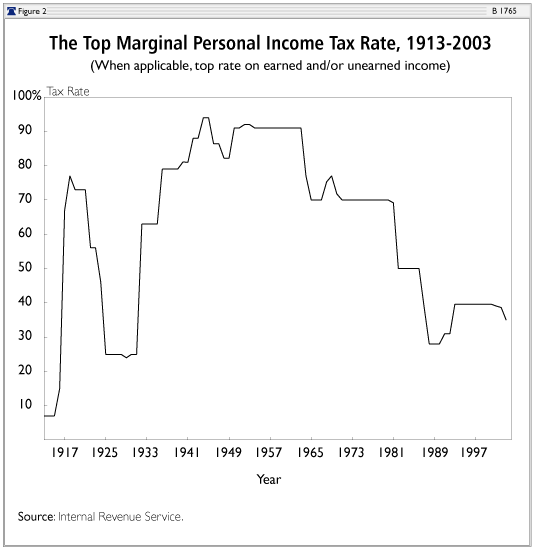
top_marginal_personal_income_tax_rate.gif

ipy5p4.png

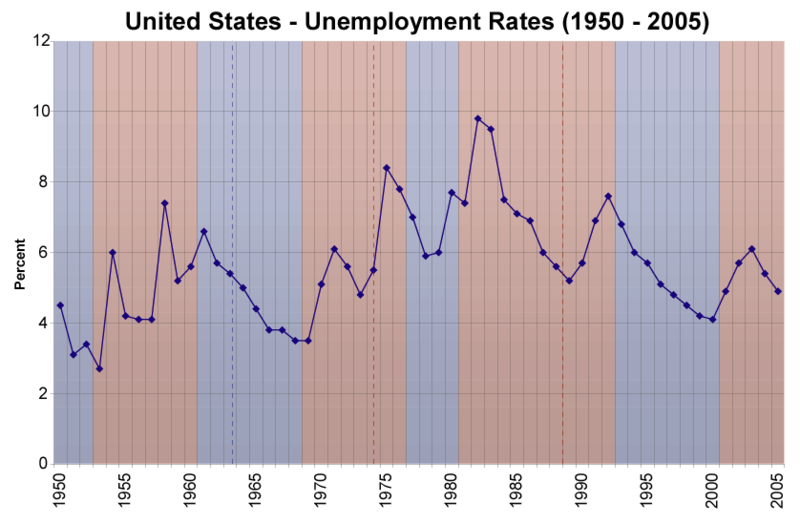
800px-Us_unemployment_rates_1950_2005.png


Doesn't look to me like there's any correlation one way or the other between unemployment, GDP growth and the top marginal tax rate.
 
top_marginal_personal_income_tax_rate.gif

ipy5p4.png

800px-Us_unemployment_rates_1950_2005.png


Doesn't look to me like there's any correlation one way or the other between unemployment, GDP growth and the top marginal tax rate.

Probably because you've presented a conclusion based on false premises.

The top marginal tax rate is a red herring of a concept. Reason, it coexisted with numerous allowed tax dodges and shelters. These were all cut out, along with most of the average-guy's deductions on Sch A and B. Seriously.

So what you have to actually use to base the argument on is ACTUAL PAID tax percentages.
 

ISF - Join now!

Every member here is approved by hand. No bots, no spam, just people who care about evidence and honest debate.

Membership is free!

Create your free account

Back
Top Bottom