• Quick note - the problem with Youtube videos not embedding on the forum appears to have been fixed, thanks to ZiprHead. If you do still see problems let me know.

So did they find thermite or not?

adkinsjr

Thinker
Joined
Oct 11, 2010
Messages
206
My guess is probably not. But that's just a guess, I already know how truthers are capable of lies, myths, and downright stupidity. This specific claim is one I've never been able to get to the bottom of because I don't understand much about the subject.

I hear claims again and again that thermite was found in WTC dust. Exactly what is present in the dust that has the "truth" cult so convinced that thermite was there? Just chemicals or elements consistent with thermite? I keep hearing about the Iron-rich microspheres? Are there any reasons for thermite to be there other than to be used in state of the art hush-a-bombs?

The paper that I keep running into on the internets:

http://www.bibliotecapleyades.net/archivos_pdf/activethermitic_911.pdf

I'm sure anyone who's researched the cult mythology has seen that paper. I don't have any technical knowledge of chemistry. I only have a basic knowledge of physics and mathematics, still finishing up diff eq in school.

Plus, if they used this thermite, then why do truthers use the "lateral ejection of debri" canard all the time? And the crumbling of the building? How does thermite do that? My guess is, it doesn't. But like I said, I'm not an expert.:rolleyes:

Thermite is an incindiary from what I've read, meaning it would have cut the steel, and that's how the high priests of the cult often describe it.

Thermite would not have pulverized or launched debri into the air- which Richard Gage often sites as evidence for his controlled demolition cockamamie.
 
My guess is probably not. But that's just a guess, I already know how truthers are capable of lies, myths, and downright stupidity. This specific claim is one I've never been able to get to the bottom of because I don't understand much about the subject.

I hear claims again and again that thermite was found in WTC dust. Exactly what is present in the dust that has the "truth" cult so convinced that thermite was there? Just chemicals or elements consistent with thermite? I keep hearing about the Iron-rich microspheres? Are there any reasons for thermite to be there other than to be used in state of the art hush-a-bombs?

The paper that I keep running into on the internets:

http://www.bibliotecapleyades.net/archivos_pdf/activethermitic_911.pdf

I'm sure anyone who's researched the cult mythology has seen that paper. I don't have any technical knowledge of chemistry. I only have a basic knowledge of physics and mathematics, still finishing up diff eq in school.

Plus, if they used this thermite, then why do truthers use the "lateral ejection of debri" canard all the time? And the crumbling of the building? How does thermite do that? My guess is, it doesn't. But like I said, I'm not an expert.:rolleyes:

Thermite is an incindiary from what I've read, meaning it would have cut the steel, and that's how the high priests of the cult often describe it.

Thermite would not have pulverized or launched debri into the air- which Richard Gage often sites as evidence for his controlled demolition cockamamie.

1 "They" did noty find thermXte;
2 Even if they had found it there was no demolition at WTC on 9/11;
3 So it would not matter in the least if there was a hundred tonne heap of thermXte at ground zero ---- it wasn't used for demolition.

That's all you need to know.
 
1 "They" did noty find thermXte;
2 Even if they had found it there was no demolition at WTC on 9/11;
3 So it would not matter in the least if there was a hundred tonne heap of thermXte at ground zero ---- it wasn't used for demolition.

That's all you need to know.

1) By "they" I'm referring to the authors Niels H. Harrit et. al.

2) I know.

3) It matters to truthers. It's a key part of their 9/11 myth. Thermite is to the "truth" cult as the resurrection of Jesus is to the Christian cult.

But I do see your point, even if thermite were found, the scenario that they are proposing is still too far-fetched and preposterous; the presence of thermite alone doesn't even remotely prove their CD cockamamie.
 
I am curious about this topic as well. What are a few basic debunking points for the whole "Thermite residue/paint chips/microspheres found in WTC dust indicative of thermite" claim?
 
1) By "they" I'm referring to the authors Niels H. Harrit et. al.

2) I know.

3) It matters to truthers. It's a key part of their 9/11 myth. Thermite is to the "truth" cult as the resurrection of Jesus is to the Christian cult....
1 Yes.
2 Understood.
3 Yes. It is a truther myth nearly as strong as the "free fall == demolition" myth -- i.e. that free fall inevitably means demolition and only occurs with demolition. Both wrong.
...But I do see your point, even if thermite were found, the scenario that they are proposing is still too far-fetched and preposterous; the presence of thermite alone doesn't even remotely prove their CD cockamamie.
True. There simply was no demolition and the evidence stands on its own, independent of whether or not Jones Harrit found thermXte in the dust.

So the "thermXte in the dust" thing, if it has any purpose, that purpose is to provide a distraction or diversion. The "truther" goal is to avoid reaching a truthful (i.e. no demolition) conclusion. Truthers are aware that lots of "debunkers" enjoy debating the diversions for the implicit technical interest so that liking of the debunkers plays into the truthers hands.
 
I am curious about this topic as well. What are a few basic debunking points for the whole "Thermite residue/paint chips/microspheres found in WTC dust indicative of thermite" claim?

Probably the most basic one is that "Thermitic reaction" has a specific meaning. There is a theoretical upper limit on the energy released by a reaction meeting this definition. The data in the paper shows values well above this.
So whatever it was that was measured in the study, by definition it wasn't thermite.
 
no, they did not find thermite.

if they did..they would have sent their samples to universities all over the USA to confirm the findings.
 
I am curious about this topic as well. What are a few basic debunking points for the whole "Thermite residue/paint chips/microspheres found in WTC dust indicative of thermite" claim?

The most basic debunking points are as followed:

  1. They ignited 4 similar looking "chips" and measured the energy release per weight unit. The results ranged from 1.5 to 7.5 kiloJoules per gram, a wide spread that makes "high-tech nano-stuff" an unlikely explanation. More importantly, 2 of the sample released more than 4kJ/g of energy, which is the maximum energy thermite could possibly release due to the basic laws of this universe. This data alone disproves unequivocally that the material cannot possibly be the kind of thermite they claim to have found (aluminium + Fe2O3)
  2. They claim to have found elemental Aluminium, one key ingredient to thermite, in a fifth chip. However, this fifth chip is of a different material than the four others, as is proven by their own data presented in figures 6 and 14. They did NOT dind free aluminium in any of the material that they igited and claimed to be or contain thermite
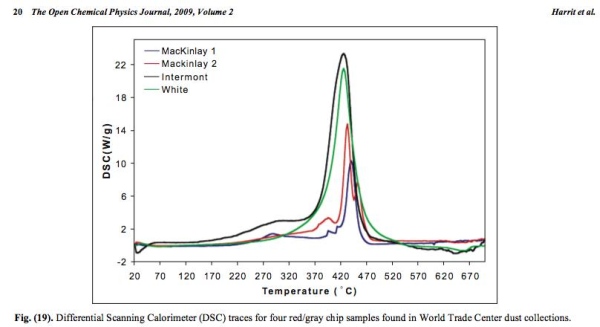
  3. They compared the exothermic behaviour of their 4 ignition samples with that of real (nano-?) thermite found in literature, and claimed that the graphs are very similar. They are not: Compare figure 19 with figure 29 and note how the position of the peak differs significantly both on the X-axis (by more than 100°C) and the Y-axis (by a factor of 2 to 4.5). This result proves that their samples are not the kind of thermite known to science. (Note too how in figure 29 they only repeat the lowest of the 4 peaks from fig. 19 to make it not quite so apparent that their samples released waaay too much energy/power.)
  4. Sunstealer has identified in insightful posts back in april 2009 that the crystaline structures we see in figures 8-10 resemble kaolinite (aluminiumsilicate) and hematite (iron oxide, Fe2O3). Their elemental composition as per the Harrit paper too points to kaolinite (Al, So Edit: Si, O) and hematite (Fe, O). Since Harrit found all of this embedded in an organic matrix, and since both kaolinite and hematite have been used throughout the ages and still used today as key ingredients to red paint, there can be no dount that the 4 red-grey chips from the ignition experiments is simply a red paint.
  5. Sunstealer just the other day found that in a newer presentation, co-author Steven Jones showed XEDS spectra of primer paint they had scratched from original WTC structural steel. This spectrum resembles the spectrum in figure 14 nearly to a t! Hence, the fifth chip (which they soaked in MEK to find elemental Al) is thus proven to be primer paint from WTC steel

These are the main points where Harrit. Jones e.al. debunk themselves.

Much earned criticism also goes to the choice of Bentham as publishing house (zero impact in the scientific community, bad reputation for accepting even total junk as long as the pay-to-publish 800$ check clears. It has been establiched that not the journal and its editor-in-chief controlled the peer-review process, but instead the authors themselves were in control of their own "peer-review".
 
Last edited:
The most basic debunking points are as followed:

  1. They ignited 4 similar looking "chips" and measured the energy release per weight unit. The results ranged from 1.5 to 7.5 kiloJoules per gram, a wide spread that makes "high-tech nano-stuff" an unlikely explanation. More importantly, 2 of the sample released more than 4kJ/g of energy, which is the maximum energy thermite could possibly release due to the basic laws of this universe. This data alone disproves unequivocally that the material cannot possibly be the kind of thermite they claim to have found (aluminium + Fe2O3)
  2. They claim to have found elemental Aluminium, one key ingredient to thermite, in a fifth chip. However, this fifth chip is of a different material than the four others, as is proven by their own data presented in figures 6 and 14. They did NOT dind free aluminium in any of the material that they igited and claimed to be or contain thermite
  3. They compared the exothermic behaviour of their 4 ignition samples with that of real (nano-?) thermite found in literature, and claimed that the graphs are very similar. They are not: Compare figure 19 with figure 29 and note how the position of the peak differs significantly both on the X-axis (by more than 100°C) and the Y-axis (by a factor of 2 to 4.5). This result proves that their samples are not the kind of thermite known to science. (Note too how in figure 29 they only repeat the lowest of the 4 peaks from fig. 19 to make it not quite so apparent that their samples released waaay too much energy/power.)
  4. Sunstealer has identified in insightful posts back in april 2009 that the crystaline structures we see in figures 8-10 resemble kaolinite (aluminiumsilicate) and hematite (iron oxide, Fe2O3). Their elemental composition as per the Harrit paper too points to kaolinite (Al, So, O) and hematite (Fe, O). Since Harrit found all of this embedded in an organic matrix, and since both kaolinite and hematite have been used throughout the ages and still used today as key ingredients to red paint, there can be no dount that the 4 red-grey chips from the ignition experiments is simply a red paint.
  5. Sunstealer just the other day found that in a newer presentation, co-author Steven Jones showed XEDS spectra of primer paint they had scratched from original WTC structural steel. This spectrum resembles the spectrum in figure 14 nearly to a t! Hence, the fifth chip (which they soaked in MEK to find elemental Al) is thus proven to be primer paint from WTC steel

These are the main points where Harrit. Jones e.al. debunk themselves.

Much earned criticism also goes to the choice of Bentham as publishing house (zero impact in the scientific community, bad reputation for accepting even total junk as long as the pay-to-publish 800$ check clears. It has been establiched that not the journal and its editor-in-chief controlled the peer-review process, but instead the authors themselves were in control of their own "peer-review".

Excellent post. Just what I was looking for :) Thanks!
 
Exactly what is present in the dust that has the "truth" cult so convinced that thermite was there?
They effectively analysed two types of red paint. They also separated by magnet some other "rusted crap" - I use that highly technical term on purpose, see Fig 31 of the paper (christ I can even quote Figs without looking them up - sad).

I'll do a quick proof of one of the paints found then direct you to the proper thread.

Step 1: OK - Look at Fig 14 in the paper. I want you to enlarge that fig and keep it open.

Step 2: Open this video of Jones and go to around 2.45. http://www.youtube.com/watch?v=oPSSyDnQkR0#at=120 Pause the video when you see the big red spiky graphs.

Note how Jones is saying that the graph on the right, which is an EDX spectra for WTC primer paint, collected from a memorial, isn't the same as samples a-d, as shown by Fig 7 in the paper. He's right they are not a match, however, he doesn't read his own paper because he hasn't looked at Fig 14.

Now compare the two - Fig 14 in the paper and the graph from Jones' lecture.


picture.php


OK done that. What do you notice?

Yep - they are the same material. You show those two graphs to anyone who has a good understanding of EDX and they will say it's the same material. Data does not lie.

In the spoiler I had to correct Fig 14 - they don't label some peaks in the paper namely Mg and K at 1.3 and 3.3KeV respectively and Jones has the peak at 3.7KeV in his lecture mislabelled - it should be Ca (Calcium) not C (Carbon) because we see the K beta edge energy at 4.01KeV, which is labelled. If you get that then there must be the K alpha edge energy at 3.7KeV.

See how sloppy he is? See how smug and arrogant he is in the lecture?

There is a lovely little tool for checking peak labels although you do need some practical SEM experience to use it. http://csrri.iit.edu/periodic-table.html

So to conclude. Fig 14 in the paper, the chip they soaked in MEK IS WTC primer paint. They didn't realise this at the time and they claim this chip is thermite.

As the Americans say, "Go figure".

N.B The other samples; a-d, which were subjected to DSC firstly have strong evidence to suggest an aluminosilicate particle called kaolin or kaoilinite in the material. This is a natural material often found in paints. Secondly 2 of these samples exceed the theoretical maximum output of 3.9Kj/g for thermite in the DSC thus proving that they are not thermite.

QED

P.S. There are so many errors (technical, methodology, analysis etc, etc..) in the paper it would take weeks to write a full critique.

N.B. Here is the original thread. http://www.internationalskeptics.com/forums/showthread.php?t=140017&highlight=active+thermitic
 

There is a theoretical upper limit on the energy released by a reaction meeting this definition. The data in the paper shows values well above this.
So whatever it was that was measured in the study, by definition it wasn't thermite.

The most basic debunking points are as followed:

  1. They ignited 4 similar looking "chips" and measured the energy release per weight unit. The results ranged from 1.5 to 7.5 kiloJoules per gram, a wide spread that makes "high-tech nano-stuff" an unlikely explanation. More importantly, 2 of the sample released more than 4kJ/g of energy, which is the maximum energy thermite could possibly release due to the basic laws of this universe. This data alone disproves unequivocally that the material cannot possibly be the kind of thermite they claim to have found (aluminium + Fe2O3)
The points made above can be verified just by looking at pages 19, 27, and 28 of the paper itself:
Harrit et al said:
Proceeding from the smallest to largest peaks, the yields are estimated to be approximately 1.5, 3, 6 and 7.5 kJ/g respectively.
Harrit et al said:
It is striking that some of the red/gray chips release more energy in kJ/g than does ordinary thermite, as shown in the blue bar graphs above. The theoretical maximum for thermite is 3.9 kJ/g [27]....As this test was done in air it is possible that some of the enhancement of energy output may have come from oxidation of the organic component.
Harrit et al said:
We observe that the total energy released from some of the red chips exceeds the theoretical limit for thermite alone (3.9 kJ/g). One possibility is that the organic material in the red layer is itself energetic.
From the above, you can see that half of their samples generated more heat than the theoretical maximum for thermite. From that undisputed fact, the obvious conclusion is that their samples couldn't have been thermite.

Instead of drawing that obvious conclusion, Harrit et al speculate about how their samples could have been thermite mixed with something else. In particular, they speculated that the excess heat could have come from an "organic component" or material. In truth, for all they know, all of the heat could have come from organic material.

They should have ruled out oxidation of an organic component by conducting their tests under an inert atmosphere (without oxygen). Thermite, you see, burns without oxygen because it contains its own oxidizer: iron oxide. That isn't rocket science: It's one of the most basic facts about thermite. Conducting their calorimetric tests in the presence of air was thus a clear signal of incompetence. (Less obviously, there are standard laboratory tests for thermite. Instead of running those standard tests, they relied on spectography and calorimetry, ran those tests incompetently, and interpreted the results imaginatively.)

When interpreted competently and objectively, the paper's results demonstrate that their chips cannot be any form of thermite that anyone has ever seen. Instead of acknowledging that fact straightforwardly, the authors speculated that their chips must be double top secret nano-thermite.

I'm not even a chemist, but all of the above (except for the parenthetical remark) was obvious to me on my first reading of the paper. When studied more carefully, the paper looks even worse.

  • They claim to have found elemental Aluminium, one key ingredient to thermite, in a fifth chip. However, this fifth chip is of a different material than the four others, as is proven by their own data presented in figures 6 and 14. They did NOT dind free aluminium in any of the material that they igited and claimed to be or contain thermite
  • They compared the exothermic behaviour of their 4 ignition samples with that of real (nano-?) thermite found in literature, and claimed that the graphs are very similar. They are not: Compare figure 19 with figure 29 and note how the position of the peak differs significantly both on the X-axis (by more than 100°C) and the Y-axis (by a factor of 2 to 4.5). This result proves that their samples are not the kind of thermite known to science. (Note too how in figure 29 they only repeat the lowest of the 4 peaks from fig. 19 to make it not quite so apparent that their samples released waaay too much energy/power.)
  • Sunstealer has identified in insightful posts back in april 2009 that the crystaline structures we see in figures 8-10 resemble kaolinite (aluminiumsilicate) and hematite (iron oxide, Fe2O3). Their elemental composition as per the Harrit paper too points to kaolinite (Al, So, O) and hematite (Fe, O). Since Harrit found all of this embedded in an organic matrix, and since both kaolinite and hematite have been used throughout the ages and still used today as key ingredients to red paint, there can be no dount that the 4 red-grey chips from the ignition experiments is simply a red paint.
  • Sunstealer just the other day found that in a newer presentation, co-author Steven Jones showed XEDS spectra of primer paint they had scratched from original WTC structural steel. This spectrum resembles the spectrum in figure 14 nearly to a t! Hence, the fifth chip (which they soaked in MEK to find elemental Al) is thus proven to be primer paint from WTC steel

These are the main points where Harrit. Jones e.al. debunk themselves.

Much earned criticism also goes to the choice of Bentham as publishing house (zero impact in the scientific community, bad reputation for accepting even total junk as long as the pay-to-publish 800$ check clears. It has been establiched that not the journal and its editor-in-chief controlled the peer-review process, but instead the authors themselves were in control of their own "peer-review".
 
Sunstealer, Clinger, thank you for those posts as well. I have tried sifting through a very lengthy thread before on the subject but never came up with the definitive answers. This clears it up nicely. Again, thank you.
 
Here is the differential scanning calorimeter chart of from "Active Thermitic Material Discovered in Dust from the 9/11 World Trade Center Catastrophe" (Harrit/Jones et. al) : note how the peak of the "Active Thermitic Material" reaction is about 420 o Centigrade.
HarritChart.jpg


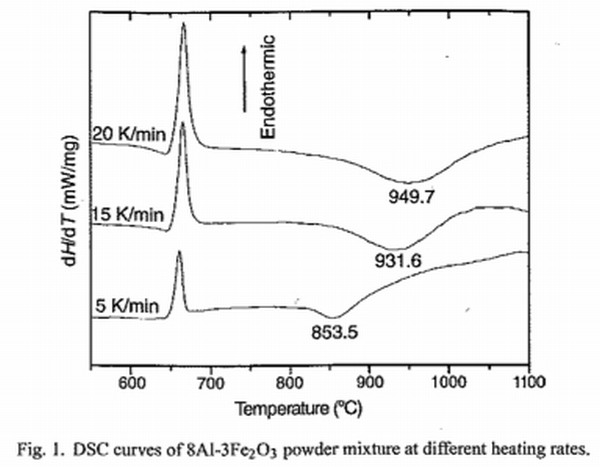
In contrast, here's the exact same type of measurement - with a differential scanning calorimeter - on real thermite. This is from the paper Kinetics of thermite reaction in Al-Fe2O3 system" by Run-Hua Fana, Hong-Liang Lü, Kang-Ning Sun, Wan-Xia Wang and Xin-Bing Yi: The peaks at 650 o C are from the aluminum melting (endothermic). The exothermic ("thermitic") reaction occurs at 850 o C to 950 o C, at least 400 o C higher than the supposed "thermite" measured by Harrit and Jones.
real_thermite.jpg


Harrit et. al. even admit this, but don't admit this also skewers their thermite demolition hypothesis.

 
Instead of drawing that obvious conclusion, Harrit et al speculate about how their samples could have been thermite mixed with something else. In particular, they speculated that the excess heat could have come from an "organic component" or material. In truth, for all they know, all of the heat could have come from organic material.
Another good summation regarding DSC. If I may add to it briefly.

If the excess energy above 3.9Kj/g was from a reaction other than the thermite then there would be two distinct peaks in the DSC thermograms. We don't see that so their speculation is wrong. The data indicates that the organic material is the most likely source of the output.
 
Truthers have yet to discover that iron oxide, aka "Rust", is capable of being on steel components. Plus Truthers really don't think about the consequences of a steel high rise near a salty atmosphere such as the North Atlantic Ocean. Salt & exposed sections of steel don't mix well.

Also the Truthers plum forgot that the FDNY were drowning out the fires in the debris with water taken from the Husdon River, this could also speed up the rusting process. It took (I think) 9 months to clear out the "bowl" where the Towers once sat. Time enough for rust to form!

Not to mention the clean up efforts of the steel workers cutting up the remaining steel to get it out of there.

You try to explain that to a Truther and they'll simply stick their fingers in their ears & go: "La la la la la la!"
 
Last edited:
Yah, and Ryan Mackey pointed out a long time ago that due to the small size of Al grains in real nanothermite, the energy density is even lower than that of ordinary thermite.

Instead of 3.9 J/g Tillotson et al. get about 1.5 J/g. Oh, I've found Ryan's post

'Integration of the exothermic peak in Fig. 3 resulted in a heat of reaction value of 1.5 kJ/g. This is significantly lower than the theoretical value of 3.9 kJ/g. One potential explanation involves the aluminum fuel itself. We know from HRTEM analysis that the UFG Al used in this sample has an oxide coating of ~5 nm. With 30 nm diameter Al this oxide coating represents a large amount of the mass of the sample. In fact, a simple calculation, based on the volume of the oxide coating, indicates that the UFG aluminum used is actually 70% Al2O3 weight.'
 
ps thanks again Sunstealer for your great explanations and observations!

Jones and his crew are gonna cringe when they read your posts..hehe. Bastards!
 
Yah, and Ryan Mackey pointed out a long time ago that due to the small size of Al grains in real nanothermite, the energy density is even lower than that of ordinary thermite.

Instead of 3.9 J/g Tillotson et al. get about 1.5 J/g. Oh, I've found Ryan's post

'Integration of the exothermic peak in Fig. 3 resulted in a heat of reaction value of 1.5 kJ/g. This is significantly lower than the theoretical value of 3.9 kJ/g. One potential explanation involves the aluminum fuel itself. We know from HRTEM analysis that the UFG Al used in this sample has an oxide coating of ~5 nm. With 30 nm diameter Al this oxide coating represents a large amount of the mass of the sample. In fact, a simple calculation, based on the volume of the oxide coating, indicates that the UFG aluminum used is actually 70% Al2O3 weight.'

And Tillotson has done his DSC under pure argon atmosphere, not air!
;)
 
Truthers have yet to discover that iron oxide, aka "Rust", is capable of being on steel components. Plus Truthers really don't think about the consequences of a steel high rise near a salty atmosphere such as the North Atlantic Ocean. Salt & exposed sections of steel don't mix well.

Also the Truthers plum forgot that the FDNY were drowning out the fires in the debris with water taken from the Husdon River, this could also speed up the rusting process. It took (I think) 9 months to clear out the "bowl" where the Towers once sat. Time enough for rust to form!

Not to mention the clean up efforts of the steel workers cutting up the remaining steel to get it out of there.

You try to explain that to a Truther and they'll simply stick their fingers in their ears & go: "La la la la la la!"

Trust Chewy to come up with bad arguments.
Jones, Harrit e.al. descibe well the provenience of their dust samples. It is pretty clear that they came from deposits of the dust clouds from the collapses, and hence it is also clear that these samples were surely not, or extremely marginally, contaminated by what went on after the clean up.
Furthermore, the red layer of Harrit's chips is paint. The "rust" found in these specimen did not stem from rusting steel. It is a component of the paint (pigment) and has been put there deliberately by the manufacturer of the paint, and by the painter.
 

Back
Top Bottom