CapelDodger
Penultimate Amazing

One really truly hopes for this, even some of us 'Murricans.
When those good ol' boys warned against "foreign entanglements" they were talking sense.

One really truly hopes for this, even some of us 'Murricans.
For a modern war rather a high percentage of the fighting has been between regular forces.

Russia has had local hegemony in the Caucasus for a while now. This conflict merely demonstrates what was already either clear or almost inevitable.From the Russian end, I think it rather more significant than you give it credit for. Of such things are local/regional hegemony built.
Georgia obviously thought differently. And wrongly.Russia has had local hegemony in the Caucasus for a while now.
Agreed.egslim said:This conflict merely demonstrates what was already either clear or almost inevitable.
A unipolar world functions like an international dictatorship, a multipolar one like a democracy. The latter tends to be more stable, because it allows fewer rash and stupid decisions.
How Russia and China behave at home is irrelevant, as long as their foreign policy is rational. US foreign policy often is not.
For the vast majority of the 6.6 billion people alive.Little importance for the 2000 people dead?

Unfortunately, the same is true for democracies.A dictatorship is interested in maintaining its regime in power and/or furthering its ideological goals...
Or describe any opposition as "unpatriotic".unlike democracies which at least have to pay lip service to doing what is best for their citizens.
Axis of Evil, anyone?This is without even going into the demonization and nationalist/ideological posturing that authoritarian regimes typically get into
Waging war is rational if the benefits obtained from said conflict outweigh the costs of fighting it. The benefit of a rational foreign policy is not to prevent conflicts, but to keep them predictable.So their foriegn policy may be rational in their eyes but because they have different aims it may not prevent conflict, or even appear rational from our point of view.
Back then few realized the much greater destructiveness of industrial-age wars. Nowadays, everyone knows. And there were no nukes to act as a deterrent. There are now.And as to "tends to be more stable, because it allows fewer rash and stupid decisions." - I take it you have never heard of World War 1?

The US audience is so deeply parochial it probably won't notice any of that. Something I've noticed (and wasn't surprised by) is how many people assume that somehow this is all about the US when in reality (there's that word again) it's just another little bust-up in the Caucasus.
Who will Russia invade next? Ukraine or Estonia?
Russia already destroyed Chechnya. Funny thing is that most americans probaly don"t even know where Chechnya is and who is Ramzan Kadyrov.


Chechnya has a population of 15,300 km².

I find this to be rather unlikely.
I strongly disagree.
A multipolar world made up of democracies might well be stable, but the presence of dictatorships skews things. A dictatorship is interested in maintaining its regime in power and/or furthering its ideological goals... unlike democracies which at least have to pay lip service to doing what is best for their citizens.
This is without even going into the demonization and nationalist/ideological posturing that authoritarian regimes typically get into in order to justify their rule over their populace (and such posturing can create momentum that is very hard to stop - riding the tiger - without enraging the population such that the regime fears being overthrown).
So their foriegn policy may be rational in their eyes but because they have different aims it may not prevent conflict, or even appear rational from our point of view.
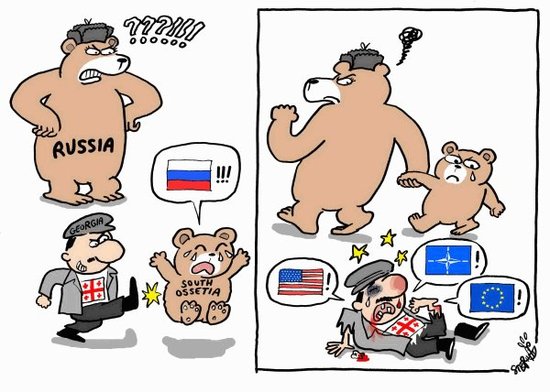
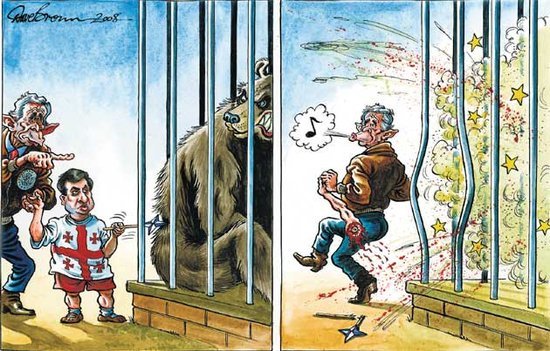
Georgia is US-supplied and backed, or at least it was before this fiasco.
So far the prediction that the US' response would amount to little more than quietly saying "go to war if you must, but make it fast and please, please think of the children!" (i.e. nothing of substance) have proven accurate. This could have involved the US. So far the US have prudently decided not to follow that path.
Anyway, the BBC reports that the end of the conflict is near:
http://news.bbc.co.uk/2/hi/europe/7555858.stm
Doesn't need to invade anyone. Anyone who it dcould invade is now nicely worried and is going to avoid activly anoying Russia.
 .
.Chechnya has a population of 15,300 km². If it were an idependent country that would put it between Swaziland and East Timor. Population wise it is between Cyprus and Swaziland. Most of the world doesn't know where Chechnya is (and the locals would probably rather you called it Ichkeria). Even those that do are not going get much beyond it is in the Caucasus somewhere.

Who will Russia invade next? Ukraine or Estonia? Russia already destroyed Chechnya. Funny thing is that most americans probaly don"t even know where Chechnya is and who is Ramzan Kadyrov.
Nailed it
There are two distinct parts to Chechnya. The mountains in the south are typical bandit country, but the steppe in the north was colonised by Russians from the mid-19thCE. (Before that it was Ottoman and the haunt of Cossacks - population close to zero.) So it's just a southward Slavic extension, and is to all intents and purposes part of Russia.
There was more Russian immigration during the Grozny oil-rush of the early 20thCE. That's what Grozny was built on - the only city of note in the entire region. The oil's long gone, of course, but the land is still good. As long as the maniacs are penned-up in the mountains everything's OK.
The Russians are doing everybody a favour by leaning heavily on the Chechens. They're Europe's Pashtuns, and must be held in check. What you mustn't do is hand them the keys to a sovereign nation and hope you can still be friends.