• Quick note - the problem with Youtube videos not embedding on the forum appears to have been fixed, thanks to ZiprHead. If you do still see problems let me know.

Romney's Religion: Magical Mormon Underwear

Theofrak

Scholar
Joined
May 3, 2012
Messages
77
underwear.jpg


As a former Mormon, I thought I might be able to shed some light on Mitt Romney's religion. I don't think most people appreciate how strange Mormon beliefs are. On my blog, I started a series of posts beginning with Romney's Religion: What does it mean to be a "true believing" Mormon. I plan to post additional stories on Romney from time to time in order to give potential voters a complete perspective on his belief system.

One issue that seems to have captured the imagination of the press is "magical Mormon underwear" (or "holy garments of the priesthood" or simply "garments" in Mormon parlance). Mormons resent the term "magic underwear." However, while this is a slight distortion, this is not far from the truth.

All "temple-worthy" Mormons wear garments. They are supposed to wear them "night and day," and have to certify to their bishop that they do so ever few years in order to renew their "temple recommends," which allows them to attend the temple.

The injunction to wear garments "night and day" has been interpreted by some Mormons to include wearing them during intercourse, although this is probably not the norm (some church leaders, however, have boasted about fathering all of their children through the "portal of the priesthood," a euphemism for wearing garments during sex). Most Mormons remove their garments during sex, as well as for activities in which the garments would be visible to the public, i.e., sports. However, Mormons are told to replace the garments as soon as possible after the activity (i.e., no sleeping naked after sex).

It is a good thing that Mormons hide the garments. They are some of the ugliest underclothing designed by man, even the current, two-piece variety that became available in 1979. I'm sorry for Mormons before 1979, like my parents, who had to wear the one-piecers (which still exist). Even worse, I can't imagine the horrible wrist-to-ankle version that all worthy Mormons wore before 1923 and continued to wear in the temples until 1975 (you had to change out of your two-piecers and don the traditional garb).
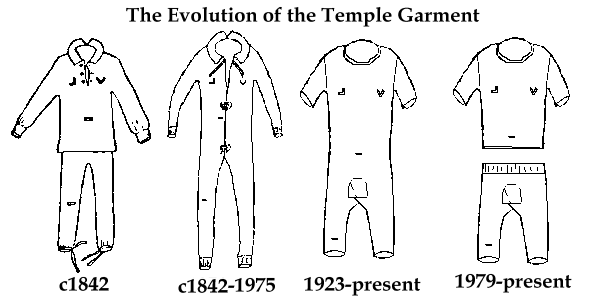
mormon_garments2.gif


Garments actually started as a way to identify people who Joseph Smith had brought into practice of polygamy. They allowed you to identify a "brother" who was part of the conspiracy. The original garment was designed only for men, after the pattern of mid-nineteenth century long johns. It was originally a one-piece garment made of plain, unbleached cotton cloth that covered the body from ankles to wrists. No buttons were used on the garment. Four to five tie-strings took their place to hold the front closed. The garment had little collars which were not visible from the outside of the shirt worn over it. In the crotch area was a large flap, which ran from the back below the waist all the way under the body and met the front tie closing.

Mormon garments are covered with Masonic symbols (the square, the compass, etc.) that denote various covenants Mormons make in the temple. The LDS temple ritual is Masonic in origin, including signs and phrases taken directly out of Freemasonry. At one time, Mormons had to strip naked in the temple, be ritually washed, and then put on the garments, after which the symbols were cut into the cloth.

Mormon are told that their garments represents the garment given to Adam when he was found naked in the garden of Eden. This is why many Mormons are Young Earth Creationists. So much of Mormon doctrine relies on the literal existence of Adam and Eve, the Flood, the Tower of Babel, etc.

The reference to "magic" underwear probably originates from a number of sources. For example, when a pair of holy garments becomes "worn out," the owner of the garment must take a pair of scissors and cut out the embroidered symbols on the breast, navel, and knees. These symbols must then be burned by fire as they are treated as "holy relics". The worn out garment can then be disposed of by throwing the garment into the trash. I can attest that this is still done by devout Mormons.

More significant, however, is the fact that Mormons are told in the temple that the garment will be a "shield and a protection to you against the power of the destroyer until you have finished your work here on earth." In general, Mormons view the garment as a symbolic and spiritual shield against the powers of Satan. Some LDS people believe that the garment provides them with "supernatural powers" of physical protection. Bill Marriott, prominent Mormon and owner of Marriott Hotels International, stated in an interview with Mike Wallace of 60 Minutes that he believed his garments protected him from being burned during a boating accident. There are numerous anecdotal stories about Mormons being burned (or cut) up to the garment line, after which they were "miraculously" protected.

In this sense, the Mormon garment functions as a type of "talisman," i.e., an object considered to possess supernatural or magical powers. According to Mormon "prophets," the protection of the Mormon garment appears depends on the worthiness of the wearer and can be lost if the garment is defiled (Mormons are warned to not let the garment touch the ground).

Deceased Mormons will be buried in their temple garments, presumably to protect the corpse until the "resurrection." Dressing the corpse is done by the ward's Relief Society President if the mortician is not an endowed member, so as not to reveal anything and "cast pearls before swine."

Mormons are commanded to not modify the garment in any way in order to wear popular (or even seasonal) clothing. For this reason, Mormons emphasize a particular brand of modesty, e.g., no sleeveless tops, shorts must go to the knee, etc. Even children are told that they need to start dressing modestly so that they will be able to adapt to the requirements of the temple garments. In some families, two-piece swimsuits are banned, even for toddlers!

I can remember going to Hawaii after I was first married and sweltering in the tropical sun while wearing the garment of the holy priesthood. I felt like an idiot.

However, there are consequences for not wearing garments. How do people know when you are not wearing them (aside from "immodest" clothing)? Garments go down to the knee, and the Church has conveniently added a hem along the leg that is typically visible through one's pants. Also, Mormons can look for the circular outline of the garment top under your shirt. Mormons often call it the "eternal smile."

If you are caught not wearing your garments, there will be a lot of talk and speculation, most frequently along the lines of "did he/she commit adultery." When Mormons are disciplined (excommunicated) for sexual sins, they are told to not wear their garments. Also, when Mormons become disaffected, they stop wearing garments. In other words, if you are caught not wearing your garments outside of one of the few exceptional situations, you are branded an adulterer or an apostate.

I don't think any Mormon really enjoys wearing garments, but they tend to become a security blanket after many years of use. Mormons especially don't like it when other Mormons cheat. This is why they often fall into the role of the "Garment Police," trying to spot other people who are not wearing garments and reporting this information to the Bishop.

From public statements, as well as confirmation from people I know who know Romney, he is a "temple-worthy" Mormon. Ergo, he almost certainly wears garments. The only question is whether he wears one-piece or two-piece garments. I'm voting for one-piece. Romney, like my father, first went through the temple before 1979. Old habits die hard.

Why is any of this relevant to the upcoming election? Because people have a right to know that a presidential candidate carries or wears a talisman covered with arcane symbols. Personally, I don't want to turn over the nuclear arsenal of this country to a person who exhibits magical thinking (garments), who listens to voices in his head telling him to do things (Holy Ghost), and who has sworn oaths of obedience to God as interpreted by Church leaders.

Link to article
 
Why is any of this relevant to the upcoming election? Because people have a right to know that a presidential candidate carries or wears a talisman covered with arcane symbols.

I certainly hope JFK never carried around a rosary.

Personally, I don't want to turn over the nuclear arsenal of this country to a person who exhibits magical thinking (garments), who listens to voices in his head telling him to do things (Holy Ghost), and who has sworn oaths of obedience to God as interpreted by Church leaders.

You mean like every president before has? Little late to be worried about that sort of thing now.
 
Last edited:
I certainly hope JFK never carried around a rosary.


You mean like every president before has? Little late to be worried about that sort of thing now.

Good points. I'm obviously not a Catholic, but do they believe that a rosary provides magical protection?

George W. Bush said that he listened to the voice of God telling him how to govern, so I agree that we have already "been there, done that." However, Mormons have a much stronger relationship with their prophet than, I believe, Catholics do with the Pope. Mormons are taught "uncompromising loyalty" to the church. Their children repeat "Follow the Prophet" over and over in their songs in church. Mormon adults swear oaths of obedience in their temples. They are taught not to think anything contrary to what their leaders tell them. To quote one of their "prophets": "When our leaders speak, the thinking has been done. When they propose a plan-it is God's plan. When they point the way, there is no other which is safe. When they give direction, it should mark the end of controversy. God works no other way. To think otherwise, without immediate repentance, may cost one his faith, may destroy his testimony, and leave him a stranger to the kingdom of God."
 
Last edited:
And that's pretty much exactly what was said about Kennedy and the Catholic Church: that as a Catholic, his true loyalty was to the priests and Pope of the RCC, over and above any nation or government. In fact, that's basically been a core tenet of anti-Catholicism since the Protestant Reformation.

Mitt Romney is not a danger because he's a Mormon. Mitt Romney is a danger because he's Mitt Romney.
 
And that's pretty much exactly what was said about Kennedy and the Catholic Church: that as a Catholic, his true loyalty was to the priests and Pope of the RCC, over and above any nation or government. In fact, that's basically been a core tenet of anti-Catholicism since the Protestant Reformation.

Mitt Romney is not a danger because he's a Mormon. Mitt Romney is a danger because he's Mitt Romney.

Catholics don't believe the Rosary is a 'talisman'.

Most, if not all Catholics put God first, El Papa second. Look around you, aside from 'frocked' members how many catholics do you know that really believe that contraceptives are bad. There are flavours of catholic, I agree, Mel Gibsons variety, probably the best known.

I think the OP's point was, that to practice Mormonism demands a high level of kooky obedience to his 'Elders' and traditions, not practiced by 'main-stream' xtians.
 
Most, if not all Catholics put God first, El Papa second. Look around you, aside from 'frocked' members how many catholics do you know that really believe that contraceptives are bad. There are flavours of catholic, I agree, Mel Gibsons variety, probably the best known.

And I'm saying that there's no difference between how Catholics are "supposed" to act vs. how they really do act in everyday life, and how Mormons are "supposed" to act vs. how they really do act in everyday life.

Because, pretty much literally, all these same accusations have been leveled at Catholics too. As I said, this was a huge issue in Kennedy's campaign in 1960.

I think the OP's point was, that to practice Mormonism demands a high level of kooky obedience to his 'Elders' and traditions, not practiced by 'main-stream' xtians.

I not only disagree, I completely fail to see how anyone could even think that's a potential risk in a Romney presidency. I mean, just look at his actions as governor of Massachusetts.

EDIT: It's not like Romney just appeared all of a sudden right from the Salt Lake City Temple. He's been active on the public and political stage for decades. His past actions in that regard are far more important when it comes to judging his suitability as president than spooky stories about secret magic Mormon underwear.
 
Last edited:
I disagree with your disagreement. I'm not from the USA so his local political failures/successes are not widely publicised here and I have no interest in seeking them out.
 
I think the OP's point was, that to practice Mormonism demands a high level of kooky obedience to his 'Elders' and traditions, not practiced by 'main-stream' xtians.

I don't really see it practiced by most "mainstream" Mormons either. There's a kooky fringe in any religion, and honestly, the very fact that somebody claims to talk to invisible people and thinks the invisible people want to torture me because I don't believe they're real, is enough to sour me on all religious politicians, so any of their little quirks beyond that hardly matter.

Fortunately, most people don't actually act like they believe what they say they do. You don't see "magic underwear" on the Mormons who dance half naked on Dancing with the Stars, for example, because grinding flesh in a suggestive manner against a casual friend of the opposite sex is an athletic activity for which there's an exception, don'tcha know?

One can find the same kinds of examples where people behave like people, regardless of what religion they profess. I'm not even talking about things they do in secret and know are wrong; I mean things they do publicly and justify within their beliefs. So really, one has to look at an individual and how they apply what they claim as their religion, rather than make assumptions about them based on their religion.
 
As a former Mormon, I thought I might be able to shed some light on Mitt Romney's religion. I don't think most people appreciate how strange Mormon beliefs are.
Interesting article, most informative, I had no idea about this stuff.

Thanks Theofrak :)

Yuri
 
I like Mormons. The reaction most other Christians sects have to them perfectly captures how most atheists view Christians: generally nice people, a little too straight-laced, believe some kooky stuff, but alright so long as you don't give them a chance to proselytize.
 
I also like Mormons.

I invite them in to talk every once in a while, they're very nice, they sit straight, they leave when you ask, and they smile a lot.
 
I read a fascinating book a few years ago about how the Mormon society sets itself up for problems.
It was in no way an anti-Mormon book. Rather it was how problems can arise in the internal community.
The author profiled the rather infamous fraud/forger who preyed upon the Mormon fascination with historical documents. He would use standard forgery techniques (stealing aged paper from old books, concocting his own "vintage" inks) to manufacture spurious historical documents and sell them to gullible fellow Mormons.
He being a Mormon, you see, couldn't be bad... He finally got involved in a couple of spectacular homicides and his arrest shocked everyone.

As well, the author explored the love of Mormons by various federal agencies, particularly the FBI. This led to the situation that arose some years back where the FBI had gotten very, very "white" and the upper strata of leadersip was imposing Mormon ideals on the agency and by extension the nation...
This carried over to other agencies as well... As noted they tend to be clean -cut and hard-working and enthusiastic...
 
Good points. I'm obviously not a Catholic, but do they believe that a rosary provides magical protection?

No, a rosary, while blessed (what isn't?), is simply a prayer counting device. But please don't look into what scapulars and medals mean. :)

Actually, they are all classed under the common name of "sacramentals". They are blessed, they should be treated with respect, they represent some special emphasis within catholicism (some, like the rosary, almost completely general, others quite arcane), and they all have superstitious meanings for most all Catholics that are passed from user to user, but are not generally recognized by the church.
 
Magic Underwear? Look I think the idea is nuts, k=heck if Pres Obama came out wearing a mylar coated foil hat and said he needed it to protect his mind from Reaper Indoctrination I would also think He is nuts.
 
Magic Underwear? Look I think the idea is nuts, k=heck if Pres Obama came out wearing a mylar coated foil hat and said he needed it to protect his mind from Reaper Indoctrination I would also think He is nuts.

But if President Obama specifically asked for the help of an invisible creature before making an important decision, you wouldn't? Because I'm betting if he doesn't, most Presidents have.
 
strange undies

Mormon beliefs are not that different than mainstream Xtian beliefs.

Zombie Jesus?

It's just that we are not used to hearing about their beliefs that make them sound strange.
 
Mormon beliefs are not that different than mainstream Xtian beliefs.

Zombie Jesus?

It's just that we are not used to hearing about their beliefs that make them sound strange.

Exactly. What I find disappointing is that mainstream Christians can get even skeptics on their side, by pointing out how people like Kennedy or Romney are weird or unsuitable because of their religion. Yet, objectively speaking, the only reason their religions sound weird is that mainstream Christians have convinced people that mainstream Christianity is normal.

Mainstream Christians would use the exact same tactics against an atheist candidate. Playing along with them now is only going to bite skeptics in the butt later, when non-religious Presidential hopefuls start to have a chance.
 

Back
Top Bottom