
-
Security incident: ISF was recently accessed by intruders. Please change your password, and change it anywhere else you used it. Read more
You are using an out of date browser. It may not display this or other websites correctly.
You should upgrade or use an alternative browser.
You should upgrade or use an alternative browser.
RFC: Bazant and Zhou Simple Analysis refuted
- Thread starter GregoryUrich
- Start date

Fast is MACH 3, initiation of the WTC started at zero mph! Fast!?
Therefore after they think they have destroyed a simple model of collapse, they will be void of truth and failed to attack the real problem. Did they missed the full scale model of the WTC hit by planes, burning, and failing?
Not fast, just like you fall off your roof, it may seem fast but you started at zero.
Fast is MACH 3, the fastest speeds on 9/11 were the objects hitting the ground first, 200 plus mph. The fall of the WTC started with slight bowing, and took a long time, not fast; it is gravity. It was not a fast process it was a large mass falling event. BTW, while the truther engineers and truther want to be engineers tear up the paper, they will never understand the WTC was a floor failure event, as they fail to even model that which they really need to study. Have you noticed not a single truther engineer or want to be, has sated the weight need to fail just one floor of the WTC?But in the videos I've seen it is a very fast process.
Therefore after they think they have destroyed a simple model of collapse, they will be void of truth and failed to attack the real problem. Did they missed the full scale model of the WTC hit by planes, burning, and failing?
Not fast, just like you fall off your roof, it may seem fast but you started at zero.
Beachnut,
As I mentioned, there was only inward belding along one horizontal line along one face of one tower observed.
And as if to refute me, you show the very facade I mentioned.
Each building has 4 sides, so that leaves 7 facades on which inward buckling was not observed.
However, outward peeling during the "collapses" was observed from all sides of each building.
Beachnut writes:
Which "WTC"? Which facade?
You have one line of bending on one facade and you want to make a general theory of it?
As I mentioned, there was only inward belding along one horizontal line along one face of one tower observed.
And as if to refute me, you show the very facade I mentioned.
Each building has 4 sides, so that leaves 7 facades on which inward buckling was not observed.
However, outward peeling during the "collapses" was observed from all sides of each building.
Beachnut writes:
The fall of the WTC started with slight bowing, and took a long time, not fast; it is gravity.
Which "WTC"? Which facade?
You have one line of bending on one facade and you want to make a general theory of it?
You are not reading! That post was for someone else, not you! Do you have problems understanding things? Your ideas are so far out, there is not need to debunk you; you do it yourself. Look at your collection of photos proving a gravity collapse, no thermite, no blast effects. Just impact, fire, and collapse did all the damage you see. You fail to even calculate the energy of a falling WTC! How can you make any conclusions?Beachnut,
As I mentioned, there was only inward belding along one horizontal line along one face of one tower observed.
And as if to refute me, you show the very facade I mentioned.
Each building has 4 sides, so that leaves 7 facades on which inward buckling was not observed.
However, outward peeling during the "collapses" was observed from all sides of each building.
Beachnut writes:
Which "WTC"? Which facade?
You have one line of bending on one facade and you want to make a general theory of it?
Sorry, you were debunked the moment you said hello, albeit with the word "test"! And of course your first post of false information reference the false work of Max Photo. Oops!
Gravy
Downsitting Citizen

- Joined
- Mar 27, 2006
- Messages
- 17,078
Major Tom, that you call yourself a collector of photographs, yet you're not aware of the photographs and videos that show inward bowing of exterior columns on both towers, is...
expected.
Why are you here? What benefit do you derive from wasting intelligent peoples' time?
expected.
Why are you here? What benefit do you derive from wasting intelligent peoples' time?
Gravy
Downsitting Citizen
- Joined
- Mar 27, 2006
- Messages
- 17,078
You're another one who's been "investigating" for a long time, but you're not aware of the photos that show the inward bowing long before the collapses? That's...The perimeter pulling is an interesting and hot topic. The last I've seen about it was a posting by a debunker called "Gravy" he posted two pictures, on the first you see more or less intact columns and on the second one a failed column. The time stamp was however the same, this implies that it was a very fast process.
expected.
So why are you here, einsteen? What benefit do you derive from choosing to remain ignorant?
Last edited:
WTC2 - a sequence before the tower fell! WTC2 - I repeat, WTC2, as in TWO too. Oops, you did not read NIST http://wtc.nist.gov/NISTNCSTAR1-5A_chap_9-AppxC.pdfBeachnut,
As I mentioned, there was only inward belding along one horizontal line along one face of one tower observed.
And as if to refute me, you show the very facade I mentioned.
Each building has 4 sides, so that leaves 7 facades on which inward buckling was not observed.
However, outward peeling during the "collapses" was observed from all sides of each building.
Which "WTC"? Which facade?
You have one line of bending on one facade and you want to make a general theory of it?
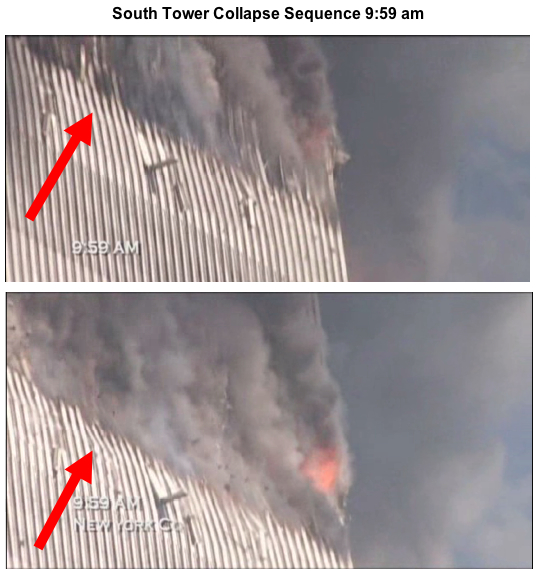
WTC2 bowing!
Next we have WTC1, as in ONE also. WTC1 the other tower of the twins.
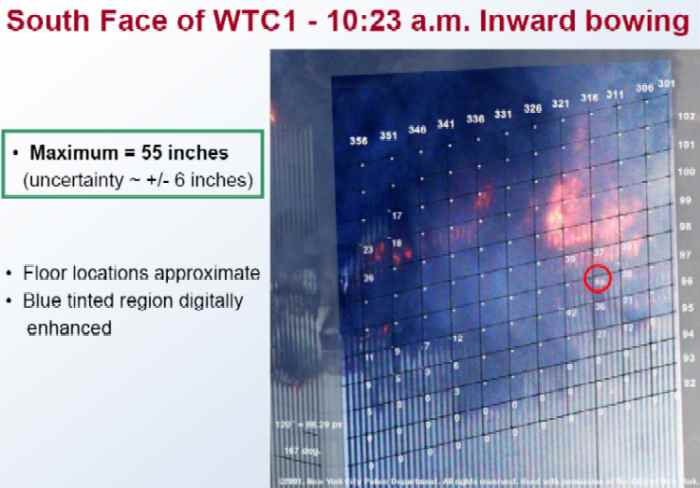
WTC1 bowing! WTC1
Now you have two tower, both bowing before collapse! You failed to do your home work! See http://wtc.nist.gov/WTC_Conf_Sep13-15/session6/6McAllister.pdf for more information! Not that you need it mister radio controlled bombs.
As you have been wrong before, so you are again.
Yes, the buildings were twins! Is this why you fail to understand both had bowing?
I see your refute you and your website, and raise the fact you refute yourself and now refuted you post of a post not to you.
Last edited:
AZCat
Graduate Poster

- Joined
- Feb 6, 2007
- Messages
- 1,672
You got me.
Now you have 2 of 8 facades on which bowing was observed.
That means that 3 of the 4 facades of each tower had no inward buckling observed.
Yes. Do you find that insufficient? Do you think all four sides of the building had to fail in order to cause collapse?
DGM
Skeptic not Atheist

The big honking hole from the plane doesn't count.Yes. Do you find that insufficient? Do you think all four sides of the building had to fail in order to cause collapse?

Gravy
Downsitting Citizen
- Joined
- Mar 27, 2006
- Messages
- 17,078
You debunkers are always splitting hairs and moving goalposts. Please stick to the subject, which is inwardly-buckled columns. How you can count columns that aren't even there as inwardly buckled is beyond me.The big honking hole from the plane doesn't count.
Last edited:
rwguinn
Penultimate Amazing

Ultimate is correct IFF you recalculate the stiffness and strength based on the stress/strain curves once yield occurs. You cannot continue using the linear portion of the curve for the material past yield.Ironically enough, Heiwa said much the same thing about us discussing your analysis in this thread, back around post #100.
Personally, I think your choice of ultimate strength is appropriate if you're trying to test whether it's inevitable that collapse would have propagated, and hence is consistent with the highly conservative assumptions in the Bazant model. If you're trying to disprove collapse propagation you'd need a much more complex model, and for a convincing disproof I'd want to see that the yield strength wasn't exceeded, because there's such clear evidence that the initial failure was buckling of the perimeter columns due to pull-in.
Dave
That has been my point.
So you end up with more than 1 stiffness for the column. It ain't simple no more, folks.
As NB says--it gets iterative. Welcome to non-linear analysis.
GregoryUrich
Graduate Poster

- Joined
- May 16, 2007
- Messages
- 1,316
It can be very iterative. You have to know the right answer to one question before getting the second, but the first question involves the second answer. Welcome to engineering
You could assume that the upper block deaccelerates from full velocity to zero velocity (i.e. just barely or not overcoming the lower block) to be conseravtive in favor of collapse prevention without being absurd.

And then of course Pdyn is dependent on the stiffness which the displacement is dependent on...
Using your value of 414MJ (should be somewhat less) for the losses in the initial failure and 4m/sec. The wave propagates all the way to the ground. I'm still splitting the energy evenly between the upper and lower springs which isn't realistic. I end up with an overload ratio of 1.00.
GregoryUrich
Graduate Poster
- Joined
- May 16, 2007
- Messages
- 1,316
Ultimate is correct IFF you recalculate the stiffness and strength based on the stress/strain curves once yield occurs. You cannot continue using the linear portion of the curve for the material past yield.
That has been my point.
So you end up with more than 1 stiffness for the column. It ain't simple no more, folks.
As NB says--it gets iterative. Welcome to non-linear analysis.
Actually it is simpler, IFF the maximum deflection is less than the offset yield point. If the deflection goes beuond that, Einsteen suggests that the energy consumed in the plastic phase prior to failure would be higher (even if it is non-linear). Do you know if this is true?
I think the enhanced photo of WTC1 South face at 10.23 am showing an alleged buckle in the wall with max indent >1 meter at the center of the indent is suspect. Such an indent cannot be the result of pull in of floors!
The wall is still intact and such a buckle has little impact on total strength of the wall/grid as the compressive static stress in the wall grid is <0.2 yield as Nist suggests that at that time the compressive load in the wall was reduced 7% due to load re-distribution.
The compressive stress in the East/West walls may be slightly higher but still <0.3 yield.
The wall is still intact and such a buckle has little impact on total strength of the wall/grid as the compressive static stress in the wall grid is <0.2 yield as Nist suggests that at that time the compressive load in the wall was reduced 7% due to load re-distribution.
The compressive stress in the East/West walls may be slightly higher but still <0.3 yield.
I think the enhanced photo of WTC1 South face at 10.23 am showing an alleged buckle in the wall with max indent >1 meter at the center of the indent is suspect. Such an indent cannot be the result of pull in of floors!
What do you think caused the upper section of WTC1 to tilt southwards in that case?
stateofgrace
Unregistered
- Joined
- Aug 31, 2006
- Messages
- 3,843
Some maybe Off Topic comments to above (they are Off Shore
<snip>
Your obedient servant later sorted out the matter at minimum cost and highest safety. Obviously the (ir)responsible parties prefer to be anonymous.
Stop lying and stay on topic as requested by the OPer.
The reason I have left you alone is because of the said request. Incidents of this nature are NEVER kept quiet offshore, they are reported as LTI's ( Lost Time Incidents) or NM's ( near misses) again they are industry standards and something else you are blissfully unware of. Any single incident offshore,of such a serious nature,that results in down time has to be reported and flash notices submitted to other operators.A full review would take place and lessons are then learnt to ensure it does not happen again. Offshore operators operate under the NO BLAME culture, That being no blame is ever aportioned and people are encouraged to report anything that is unsafe and all accidents/incidents must be reported.Incidents like this are viewed as a failing of procedures which are always in place for every single operation that takes place offshore. When the procedures fail or are wrong they are corrected to ensure it does not happen again.The offshore industy does not cover up incidents of this nature and they never remain anonymous apart from in your fantasy world.Here they remain anonymous of course so nobody can check out your ludicious stories.
I could ask you to tell me who the operator was, who's crane it was, who contracted you etc, ect but since you lied anyway there is no point.
In future stay on topic or don't post in this thread or as requested by the OPer start a new thread.
Keep living the dream.
Last edited:
Dave Rogers
Bandaged ice that stampedes inexpensively through

Using your value of 414MJ (should be somewhat less) for the losses in the initial failure and 4m/sec. The wave propagates all the way to the ground. I'm still splitting the energy evenly between the upper and lower springs which isn't realistic. I end up with an overload ratio of 1.00.
Speaking as a scientist, I would say that an overload ratio of 1.00 doesn't prove collapse propagation would occur. Speaking as a hypothetical juror on a criminal case where it's the key evidence for the prosecution, though, I'd say it's good enough for an instant acquittal.
Dave
Last edited:
If you go to http://wtc.nist.gov/WTC_Conf_Sep13-15/session6/6McAllister.pdf
then there is one picture with a time stamp 09:53
the 9:58:55 pictures clearly show inward bowing but at that moment the collapse was almost starting. No idea what they want to say with 09:21, it's a little bit a fuzzy report. It looks indeed like during the time after the impact the fire had a relevant influence on that wall (although I would like to see a longer movie) but it is hard to imagine that only this is responsible for the total failure of all the columns, see this view for example (difference 3 seconds)

http://i16.tinypic.com/6z9i9e9.jpg
How can that wall initiate collapse while the core is still standing? On the other hand I'm also no fool and understand that it is also hard to imagine that something like (conventional) explosives would survive there. Greening said that the initiation in fact started with the plane impact and that the toppling was in fact ongoing but not visible.
then there is one picture with a time stamp 09:53
the 9:58:55 pictures clearly show inward bowing but at that moment the collapse was almost starting. No idea what they want to say with 09:21, it's a little bit a fuzzy report. It looks indeed like during the time after the impact the fire had a relevant influence on that wall (although I would like to see a longer movie) but it is hard to imagine that only this is responsible for the total failure of all the columns, see this view for example (difference 3 seconds)
http://i16.tinypic.com/6z9i9e9.jpg
How can that wall initiate collapse while the core is still standing? On the other hand I'm also no fool and understand that it is also hard to imagine that something like (conventional) explosives would survive there. Greening said that the initiation in fact started with the plane impact and that the toppling was in fact ongoing but not visible.
Last edited:
GregoryUrich
Graduate Poster
- Joined
- May 16, 2007
- Messages
- 1,316
Speaking as a scientist, I would say that an overload ratio of 1.00 doesn't prove collapse propagation would occur. Speaking as a hypothetical juror on a criminal case where it's the key evidence for the prosecution, though, I'd say it's good enough for an instant acquittal.
Dave
Suppose Bazant's paper is the only evidence, what does the hypothetical juror say in terms of finding the building guilty of collapse propagation?