Tell us about this PhD. What was your thesis?...Since I know that I have completed a PhD on the basis of my physics knowledge...

-
Security incident: ISF was recently accessed by intruders. Please change your password, and change it anywhere else you used it. Read more
You are using an out of date browser. It may not display this or other websites correctly.
You should upgrade or use an alternative browser.
You should upgrade or use an alternative browser.
Merged Relativity+ / Farsight
- Thread starter Farsight
- Start date
I've said there's certain mathematics I can't give, because it really isn't easy. But I've described how the photon becomes an electron and a positron.Um, I have no conviction, you have failed to explain what it is is or how it works. You have admitted you can't and won't do it.
I've shown how, but I can't show why the values are what they are. We measure the values.When you show what it is and how it works you may change some minds. You have yet to show how photons become electrons or why things have the values that they do.
It's in post #282 with a restatement in #338 and #341. Posts #351 and 353 are good re mass. Here's a list of posts to read.I checked your posts again, you have shown pictures, but no where that I saw did you explain how the photon get to be an electron. Please show me that, where does the mass and charge come from? (If you posted this please repost it.)
http://www.internationalskeptics.com/forums/showpost.php?p=5700809&postcount=1
http://www.internationalskeptics.com/forums/showpost.php?p=5700835&postcount=2
http://www.internationalskeptics.com/forums/showpost.php?p=5703975&postcount=13
http://www.internationalskeptics.com/forums/showpost.php?p=5714509&postcount=34
http://www.internationalskeptics.com/forums/showpost.php?p=5721879&postcount=79
http://www.internationalskeptics.com/forums/showpost.php?p=5728013&postcount=120
http://www.internationalskeptics.com/forums/showpost.php?p=5729710&postcount=139
http://www.internationalskeptics.com/forums/showpost.php?p=5729770&postcount=141
http://www.internationalskeptics.com/forums/showpost.php?p=5730227&postcount=154
http://www.internationalskeptics.com/forums/showpost.php?p=5731708&postcount=185
http://www.internationalskeptics.com/forums/showpost.php?p=5731836&postcount=193
http://www.internationalskeptics.com/forums/showpost.php?p=5742320&postcount=256
http://www.internationalskeptics.com/forums/showpost.php?p=5742498&postcount=267
http://www.internationalskeptics.com/forums/showpost.php?p=5742905&postcount=282
http://www.internationalskeptics.com/forums/showpost.php?p=5743172&postcount=295
http://www.internationalskeptics.com/forums/showpost.php?p=5743353&postcount=300
http://www.internationalskeptics.com/forums/showpost.php?p=5745048&postcount=306
http://www.internationalskeptics.com/forums/showpost.php?p=5746465&postcount=312
http://www.internationalskeptics.com/forums/showpost.php?p=5746819&postcount=319
http://www.internationalskeptics.com/forums/showpost.php?p=5748732&postcount=327
http://www.internationalskeptics.com/forums/showpost.php?p=5748946&postcount=338
http://www.internationalskeptics.com/forums/showpost.php?p=5749016&postcount=341
http://www.internationalskeptics.com/forums/showpost.php?p=5749040&postcount=342
http://www.internationalskeptics.com/forums/showpost.php?p=5749670&postcount=353
http://www.internationalskeptics.com/forums/showpost.php?p=5749803&postcount=355
It can't be done. I said why here:Exactly, with derivation of values.
http://www.internationalskeptics.com/forums/showpost.php?p=5749844&postcount=357
If you genuinely want me to describe it afresh I'll do so. You have to understand the twist/turn of the electromagnetic field, and then appreciate the photon geometry, understand that it is spacewarp, and that if it travels through itself its path changes. If it travels entirely through itself, its path changes constantly. Since light normally travels in straight lines, this path change means space is curved, though curled is a better word.
If you're asserting that I haven't described anything, then forget it. For your convenience, here's #282 again:
No. Tunnelling per se doesn't apply any more. There are no barriers, and no billiard balls, everything is action, or stress/energy "kick" - spatial distortion, essentially Weyl gauge change as per the extension of a gravity wave. Tunnelling turns into one particular distortion slipping between two other distortions, like clumps of frogspawn squeezing past one another, but without surface. This is a "knot" of distortion, it can't slip outside of itself.
I didn't think it was an issue. A distortion distorts a distortion when they meet. The plane-polarized photon action is something like this ↕ going this way → at c, pushing those lattice lines up such that from the side it takes the lemon-like shape of a wavepacket, but without the interior waves. (see http://arxiv4.library.cornell.edu/abs/0803.2596?context=physics). The electron is a rotational version of the same. Vector subtraction is applied to the photon action, and vector addition is applied to the electron action, so the rotation isn't quite a circle any more, so the electron moves. Its photon path isn't a neat circle, it's cycloid if the circle is facing you, or helical if its edge-on.
You need something else to interact with first, such as a nucleus or another photon. And conservation of angular momentum applies, so you can't make an electron out of one photon alone, nor can you make just an electron using a photon and a nucleus.
You know I said the photon action is something like this ↕ ? If two photons are approaching one another head-on, then if photon 1 passes photon 2 at ten o'clock, it will rotate clockwise whilst rotating upward to "get over the hump" of photon 2. You now have two rotations. If they're severe enough such that the photon 1 action now encounters itself, it can continue. This is symmetrical with photon 2. If it continues and continues and continues, you've got an electron and a positron, and it isn't going to not continue. I really need an animated lattice model to show you this, and probably to show you the Compton effect too. But I don't have it, and as you can see, getting people interested is not easy.
Kwalish Kid
Muse
- Joined
- Feb 24, 2010
- Messages
- 509
No. This thread is about your claims, bizarre claims that you have yet to provide evidence for.Tell us about this PhD. What was your thesis?
I will repeat my questions since you apparently are trying to dodge them again.
You seem unable to understand that the mathematics of two fields accurately describes the measurements that we get. So you have to use a single field explanation that reproduces these results. So far, you have not given any evidence that this is the case.
If you really want to provide evidence, show that your theory can produce the same predictions as standard theory. That's all I ask.
You keep citing the same passage from Minkowski, but you have given no evidence that what Minkowski means is anything like what you have said. All you need to do is go through the actual content of the Minkowski piece and show what parts of that content are relevant to the passage that you have quoted and how they are also relevant to your theory.
So far, the evidence is that you misunderstand the analogy that Minkowski is making in the passage. It is up to you to defend your interpretation. Unless, of course, you want to withdraw your claim because you are unable to defend your claim.
You have to make clear what you actually endorse in Williamson's paper. In the past you have admitted that you do not endorse everything in the papers that you cite, so we need to see exactly what the reasoning it that you are employing in your own theory.
Page 7 of that document does not have any equations governing the transformation of a photon into an electron. This means that either you do not understand any of the relevant mathematics in that paper or you were simply mistaken on the page number. If the latter option is the case, then you can prove to us that you do understand these things by actually taking us through the calculations. If you do not do this, your accumulated errors leave us no choice but to conclude that you have been deceiving us about your ability.
The Man
Unbanned zombie poster

I've said there's certain mathematics I can't give, because it really isn't easy. But I've described how the photon becomes an electron and a positron.
No you’ve described how you would like to think “the photon becomes an electron and a positron”, but you certainly have not described how a bound photon (apparently just bound to itself) results in the charge of an electron or positron.
I've shown how, but I can't show why the values are what they are. We measure the values.
Then you simply have not shown “how” those values result from the configuration you imagine.
It's in post #282 with a restatement in #338 and #341. Posts #351 and 353 are good re mass. Here's a list of posts to read.
http://www.internationalskeptics.com/forums/showpost.php?p=5700809&postcount=1
http://www.internationalskeptics.com/forums/showpost.php?p=5700835&postcount=2
http://www.internationalskeptics.com/forums/showpost.php?p=5703975&postcount=13
http://www.internationalskeptics.com/forums/showpost.php?p=5714509&postcount=34
http://www.internationalskeptics.com/forums/showpost.php?p=5721879&postcount=79
http://www.internationalskeptics.com/forums/showpost.php?p=5728013&postcount=120
http://www.internationalskeptics.com/forums/showpost.php?p=5729710&postcount=139
http://www.internationalskeptics.com/forums/showpost.php?p=5729770&postcount=141
http://www.internationalskeptics.com/forums/showpost.php?p=5730227&postcount=154
http://www.internationalskeptics.com/forums/showpost.php?p=5731708&postcount=185
http://www.internationalskeptics.com/forums/showpost.php?p=5731836&postcount=193
http://www.internationalskeptics.com/forums/showpost.php?p=5742320&postcount=256
http://www.internationalskeptics.com/forums/showpost.php?p=5742498&postcount=267
http://www.internationalskeptics.com/forums/showpost.php?p=5742905&postcount=282
http://www.internationalskeptics.com/forums/showpost.php?p=5743172&postcount=295
http://www.internationalskeptics.com/forums/showpost.php?p=5743353&postcount=300
http://www.internationalskeptics.com/forums/showpost.php?p=5745048&postcount=306
http://www.internationalskeptics.com/forums/showpost.php?p=5746465&postcount=312
http://www.internationalskeptics.com/forums/showpost.php?p=5746819&postcount=319
http://www.internationalskeptics.com/forums/showpost.php?p=5748732&postcount=327
http://www.internationalskeptics.com/forums/showpost.php?p=5748946&postcount=338
http://www.internationalskeptics.com/forums/showpost.php?p=5749016&postcount=341
http://www.internationalskeptics.com/forums/showpost.php?p=5749040&postcount=342
http://www.internationalskeptics.com/forums/showpost.php?p=5749670&postcount=353
http://www.internationalskeptics.com/forums/showpost.php?p=5749803&postcount=355
It can't be done. I said why here:
http://www.internationalskeptics.com/forums/showpost.php?p=5749844&postcount=357
So then your speculating is pointless.
If you genuinely want me to describe it afresh I'll do so. You have to understand the twist/turn of the electromagnetic field, and then appreciate the photon geometry, understand that it is spacewarp, and that if it travels through itself its path changes. If it travels entirely through itself, its path changes constantly. Since light normally travels in straight lines, this path change means space is curved, though curled is a better word.
If you're asserting that I haven't described anything, then forget it. For your convenience, here's #282 again:
You certainly have described you speculations, but that is the easy part. The hard part is putting some math, actual values and predictions to those mere speculations “because it really isn't easy”, but that is what separates actual theories from mere speculations.
dafydd
Banned

- Joined
- Feb 14, 2008
- Messages
- 35,398
Can you demonstrate any of this with the proper mathematics?
No chance.
dafydd
Banned
- Joined
- Feb 14, 2008
- Messages
- 35,398
I don't hold truck with "the laws of nature". It's symmetry that underpins them anyway, and it's all to do with rotations and action and how stress-energy moves. What tells me electrons are composed of something else is pair production and annihilation, along with spin, magnetic moment, etc, see above. So don't give me all that genesis stuff. You're the one dismissing scientific evidence here, along with Minkowski and Maxwell etc. Because it isn't what you were taught, and because it isn't in your textbook. You're treating mathematics like runes that are more important than experiment and observation, and you're treating your textbook like a bible that's more important than logic and discussion. Now come on, start thinking for yourself.
Stundie?
dafydd
Banned
- Joined
- Feb 14, 2008
- Messages
- 35,398
Originally Posted by Farsight
Sol: I said your motion does not affect the spaceship. You said:
Now pay attention and listen: when you're observing a spaceship, and you move, you don't affect that spaceship one iota. Your measurements change. That's all.
All: I'm disappointed that nobody is putting sol straight on this kind of basic stuff.
Sol: no, the neutrino is not merely a lightweight electron without charge.
What a delightful mixture of ignorance and arrogance.
Reality Check
Penultimate Amazing
I reiterate, experimental results show that the speed of light does not vary.I reiterate, experimental results show that the speed of light varies.
I go one better and give you some citations rather than just your unsupported assertions.
Experimental Basis of Special Relativity
3.4 Measurements of the Speed of Light, and Other Limits on it
In 1983 the international standard for the meter was redefined in terms of the definition of the second and a defined value for the speed of light. The defined value was chosen to be as consistent as possible with the earlier metrological definitions of the meter and the second. Since then it is not possible to measure the speed of light using the current metrological standards, but one can still measure any anisotropy in its speed, or use an earlier definition of the meter if necessary.
- Mulligan, Am. J. Phys. 44 no. 10 (1976), pg 960. A report on measurements by the NBS.
- Rowley et al., Opt. and Quantum Elect. 8 (1976), pg 1. A review article on the set of precision frequency and wavelength measurements that became the basis for the 1973 value of c. This is the best single reference for this.
- Woods et al., Appl. Optics 17 (1978), pg 1048; Rowley, Opt. Comm. 34 (1980), pg 429. Baird and Whitford, Opt. Comm. 31 (1979), pg 363, pg 367. Measured c = 299792458.8 ± 0.2 meter/s, with 1.2 meter uncertainty due to realization of the Kr meter standard used. The fact that the Kr standard for the meter became the limit on accuracy was a major reason for the 1983 redefinition of the meter in terms of the definition of c and the definition of the second.
- Goldman, J. O. S. A. 70 (1980), 1640. Discussion of three proposals for a new definition of the meter (pre-1983).
- Jennings et al., J. Res. N.B.S. 92 (1982), pg 11. Review of methods to relate c to the meter, and results for further measurements checking the 1973 determination of c leading to the 1983 adoption of the new meter standard in terms of the definition of c and the definition of the second.
- Giacomo, “The New Definition of the Meter”, Am. J. Phys. 52 no. 7 (1984), pg 607. An overview of past definitions of the meter with emphasis on the guidelines that governed the choice of the new definition in 1983 in terms of the definition of the second and the definition of the speed of light.
- Petley, “New Definition of the Metre”, Nature 303 (1983), pg 373. A review article discussing the reasons for the re-definition of the meter in 1983 in terms of the definition of the second and the definition of the speed of light.
- Bates, Am. J. Phys. 56 (1986), pg 682. Bates, Am. J. Phys. 51 (1983), pg 1003. A summary of measurements of c. The second paper describes measuring c by measuring frequency and wavelength and describes a college-level lab experiment.
Reality Check
Penultimate Amazing
The fine structure constant does not tell you the relative strength of the electromagnetic force as compared to the strong force. That's a fact.The fine structure constant tells you the relative strength of the electromagnetic force as compared to the strong force. That's a fact.
The fine structure constant is a coupling constant indicating strength of the electromagnetic field by itself. That's a fact.
It is one of the coupling constants defined for the 4 fources that we know about. That's a fact.
Comparing the fine structure constant to the
- gravitational coupling constant gives an indication of the relative strength of the electromagnetic force as compared to the gravitational force.
- weak coupling constant gives an indication of the relative strength of the electromagnetic force as compared to the weak force.
- strong coupling constant gives an indication of the relative strength of the electromagnetic force as compared to the strong force.
Reality Check
Penultimate Amazing
You are really confused about this, Farsight.I'm really not confused about this, RC. The fine structure constant takes the value that it does because of an intimate relationship between the electromagnetic force and the strong force. When you perform that low-energy proton-antiproton annihilation to end up with photons, the strong force is no longer apparent. But it's still there behind the scene.
The fine structure constant takes the value that it does because it is defined as the interaction between 2 electrromagntic fields.
There is no stong force "behind the scenes" except in your head.
When you perform that low-energy proton-antiproton annihilation to end up with photons, the strong force is not longer there because the proton and antiproton no longer exist. This experiment has nothing to to with the fine structure constant.
I don't dodge your questions. I answer them, then you pretend that I haven't, then you ask them again. And again.No. This thread is about your claims, bizarre claims that you have yet to provide evidence for. I will repeat my questions since you apparently are trying to dodge them again.
The evidence is in my opening posts, and is common knowledge. An electron has an electromagnetic field, which is apart from the small magnetic dipole moment, is isotropic with a spherical disposition. Arrange a number of electrons into a vertical column, and the field disposition is cylindrical. If you employ a test electron which is not in relative motion with respect to this, the test electron will move away, and we draw "electric field lines" like so:You seem unable to understand that the mathematics of two fields accurately describes the measurements that we get. So you have to use a single field explanation that reproduces these results. So far, you have not given any evidence that this is the case.
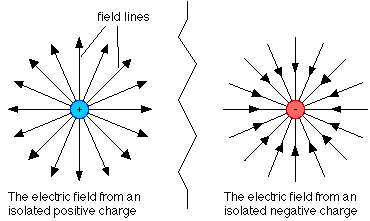
If however the test electron starts with a vertical motion down the stack, we see a cicular motion around "magnetic field lines" that are drawn thus:
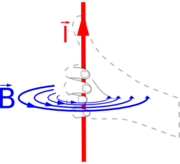
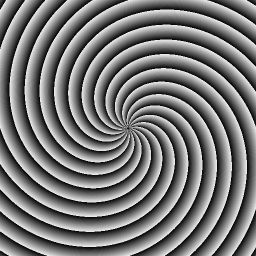
But there's only one field there, the electromagnetic field. It's three-dimensional, and isotropic around an electron, and to depict a slice through it we have to combine the radial and circular field lines like this:
What I'm telling you about the electromagnetic field is standard theory. It's the electromagnetic field, one field, not two. How many times do I have to say this before it sinks in? See http://en.wikipedia.org/wiki/Electromagnetic_field:If you really want to provide evidence, show that your theory can produce the same predictions as standard theory. That's all I ask.
"In the past, electrically charged objects were thought to produce two types of field associated with their charge property. An electric field is produced when the charge is stationary with respect to an observer measuring the properties of the charge, and a magnetic field (as well as an electric field) is produced when the charge moves (creating an electric current) with respect to this observer. Over time, it was realized that the electric and magnetic fields are better thought of as two parts of a greater whole — the electromagnetic field."
Knowing this, then with the above, you can then move beyond your current understanding to visualise the dynamical geometry of the electromagnetic field. You can think in terms of twist which results in a turning action when in motion through it. You apply this to a light wave saying the strength of the field-variation is giving the degree of twist, and you've got the photon-pulse geometry. Apply your knowledge of electron angular momentum and magnetic dipole moment along with pair production to the image above, and the electron is the vorton in the middle that's described by the Dirac equation. There is no point particle there.
You keep ignoring that passage. And I've said previously, the rest of Space and Time suffers from Minkowski's lack of understanding of time. He didn't know that time is an emergent property of motion, so he employs time instead of relative motion, and fails to depict the three-dimensional electromagnetic field.You keep citing the same passage from Minkowski, but you have given no evidence that what Minkowski means is anything like what you have said. All you need to do is go through the actual content of the Minkowski piece and show what parts of that content are relevant to the passage that you have quoted and how they are also relevant to your theory.
I understand the analogy. A wrench turns a bolt, which has a screw thread. Rotational motion is converted into linear motion and vice versa. Minkowski refers to Maxwell on the previous page. He knows about Maxwell’s On Physical Lines of Force and the screw mechanism, see: http://en.wikipedia.org/w/index.php?title=File:On_Physical_Lines_of_Force.pdf&page=53. That's why he referred to the separation of the field into electric force and magnetic force.So far, the evidence is that you misunderstand the analogy that Minkowski is making in the passage. It is up to you to defend your interpretation. Unless, of course, you want to withdraw your claim because you are unable to defend your claim.
No I don't. And I'm not going to waste hours doing so to pander to your smokescreen of digression.You have to make clear what you actually endorse in Williamson's paper. In the past you have admitted that you do not endorse everything in the papers that you cite, so we need to see exactly what the reasoning it that you are employing in your own theory.
Now you're just making it up as you go along. Here's the link again, http://www.cybsoc.org/electremdense2008v4.pdf, and here's the start of the section on page 7:Page 7 of that document does not have any equations governing the transformation of a photon into an electron. This means that either you do not understand any of the relevant mathematics in that paper or you were simply mistaken on the page number. If the latter option is the case, then you can prove to us that you do understand these things by actually taking us through the calculations. If you do not do this, your accumulated errors leave us no choice but to conclude that you have been deceiving us about your ability.
Williamson said:V. ELECTRON-POSITRON PAIR CREATION
The tools neccessary to understand the continuous process of electron-positron pair creation within electromagnetism are now in place. The simplest framework required to find the form of the solution is through the energy and momentum density of the field and the invariant scalar (pivot) term. The work will be carried out in terms of energy (scalar) and momentum (space-time bivector) and not in the more conventional terms of energy-momentum 4-vector. It is a relatively simple matter to translate a posteriori to the 4-vector form, if desired.
The Hermitian conjugate within the algebra corresponds to reversing the sign of all components which square to -1. For the fields this reverses the sign of the magnetic field but leaves the electric field unchanged, corresponding to a field with reversed phase development, a counter-propagating field.
Consider a detailed evolution of a field F corresponding to one incident photon and a counter-propagating field Fy corresponding to a photon travelling in the opposite direction. Ignoring for a moment the quantised nature of the incident fields and concentrating purely on the electromagnetic aspects, the initial fields are well described by the free space Maxwell equations in the Lorenz gauge (P = 0) with charge zero everywhere...
A little further on, still on page 7, he gives equation 22. Over the page he gives equation 23 and says: "It is these new terms which are the key to understanding how rectilinear photon propagation in the initial state may be transferred to rotational, vortex-like solutions to the final state corresponding to an electron-positron pair."
You know, I'm getting a little tired of your lack of sincerity. You're acting like a witch-doctor confronted by a pharmacist. There's no attempt on your part to enter into what ought to be an interesting physics discussion. All you're doing is attempting to stifle it. And for what? To preserve your privileged status? The one you shield with mumbo-jumbo that mere mortals cannot possibly understand? You can't explain anything, and it's crystal clear that you bitterly resent anybody who can. You're a timewaster. No wonder there's Trouble with Physics.
Wish it were true, but sadly it isn't. String theory is "an actual theory", replete with mathematics, but it predicts nothing, and even after forty years has no experimental support whatsoever. It's entirely speculation, there's no evidence for any of it. And do note that my descriptions are chock full of supporting evidence.You certainly have described your speculations, but that is the easy part. The hard part is putting some math, actual values and predictions to those mere speculations “because it really isn't easy”, but that is what separates actual theories from mere speculations.
Yeah, these guys really take the biscuit daffy.What a delightful mixture of ignorance and arrogance.
Kwalish Kid
Muse
- Joined
- Feb 24, 2010
- Messages
- 509
But you don't answer questions, as the rest of your post shows.I don't dodge your questions. I answer them, then you pretend that I haven't, then you ask them again. And again.
This is the problem: you post vague drawings when in actual tests and applications we have detailed measurements and predictions of exactly what will or should happen and then you refuse to address these important details. Everyone here is asking for details, not drawings that you could have done with crayons.The evidence is in my opening posts
<snip>
If you employ a test electron which is not in relative motion with respect to this, the test electron will move away, and we draw "electric field lines" like so:
But there's only one field there, the electromagnetic field.
Everyone already knows this. But they also can't understand how your finger-painting has anything to do with actual science. So you need to show the details behind your drawings if there actually are any details.
So are you saying that Minkowski's paper doesn't support your work because he didn't understand the electromagnetic field properly?You keep ignoring that passage. And I've said previously, the rest of Space and Time suffers from Minkowski's lack of understanding of time. He didn't know that time is an emergent property of motion, so he employs time instead of relative motion, and fails to depict the three-dimensional electromagnetic field.
OK, so show that this analogy is correct because of what Minkowski actually does in that paper. As it stands now, your vulgar understanding of "wrench" doesn't match the physics definition of "wrench" so it looks like you haven't read Minkowski's paper and you are making things up.I understand the analogy. A wrench turns a bolt, which has a screw thread. Rotational motion is converted into linear motion and vice versa.
Show us the relevant equations that Minkowski used.Minkowski refers to Maxwell on the previous page. He knows about Maxwell’s On Physical Lines of Force and the screw mechanism, see: http://en.wikipedia.org/w/index.php?title=File:On_Physical_Lines_of_Force.pdf&page=53. That's why he referred to the separation of the field into electric force and magnetic force.
You were the one who brought Williamson into this in order to support your theory. Now you don't want to do what any academic would do: support your position. It really looks like you can't support your position.No I don't. And I'm not going to waste hours doing so to pander to your smokescreen of digression.
None of that is equations. None of it addresses the question, of how the photon turns into an electron with charge.Now you're just making it up as you go along. Here's the link again, http://www.cybsoc.org/electremdense2008v4.pdf, and here's the start of the section on page 7:
In the words of the author immediately following, that equation, "is the conventional expression for the energy-momentum density of the electromagnetic field but again with the proper multivector form of energy(scalar) andmomentum (space-time bivector) made explicit."A little further on, still on page 7, he gives equation 22.
So it appears that you did not bother to actually read the paper or you really do not understand the very basics of the paper.
OK, so provide us the "rotational, vortex-like solutions". This may be what we are asking for.Over the page he gives equation 23 and says: "It is these new terms which are the key to understanding how rectilinear photon propagation in the initial state may be transferred to rotational, vortex-like solutions to the final state corresponding to an electron-positron pair."
What is the difference, ideally, between a witch-doctor and a pharmacist? I'd like to think that a pharmacist has statistical evidence about the medicines that they distribute. Do you have statistical evidence? So far, the answer is no. You cry and moan whenever you are asked to provide the simplest answers.You know, I'm getting a little tired of your lack of sincerity. You're acting like a witch-doctor confronted by a pharmacist.
Where is the physics? All you have so far is drawings.There's no attempt on your part to enter into what ought to be an interesting physics discussion.
I was able to sit in a class given by Lee Smolin. What did he do in that class? Provide the mathematical equations underlying relativity theory and quantum field theory. Where is your appreciation of gauge symmetries? Until you are able to show a gauge invariant representation of a photon turning into an electron, you should probably not try to invoke the work of Smolin.No wonder there's Trouble with Physics.
Kwalish Kid
Muse
- Joined
- Feb 24, 2010
- Messages
- 509
Actually, string theory does make predictions. Some versions of string theory are actually off the table now because of their failed predictions. Some versions are waiting for more detailed and accurate experiments in order to get tested. So far, you have drawings that you won't even show match any measurement ever done.Wish it were true, but sadly it isn't. String theory is "an actual theory", replete with mathematics, but it predicts nothing, and even after forty years has no experimental support whatsoever. It's entirely speculation, there's no evidence for any of it. And do note that my descriptions are chock full of supporting evidence.
My assertions are supported. I gave you the NIST fountain clock, the GPS clock adjustment, the Shapiro delay, the astronauts holding light clocks, and New varying speed of light theories by Joao Magueijo. You can find out more at http://en.wikipedia.org/wiki/Variable_speed_of_light, but doubtless you'll dismiss it all as unsupported assertions, just like a creationist.I reiterate, experimental results show that the speed of light does not vary. I go one better and give you some citations rather than just your unsupported assertions. Experimental Basis of Special Relativity
So it's time you tried again. Read about the NIST fountain clock at http://tf.nist.gov/cesium/fountain.htm and see http://en.wikipedia.org/wiki/Second for the definition of the second:
"Since 1967, the second has been defined to be the duration of 9,192,631,770 periods of the radiation corresponding to the transition between the two hyperfine levels of the ground state of the caesium 133 atom. This definition refers to a caesium atom at rest at a temperature of 0 K (absolute zero), and with appropriate corrections for gravitational time dilation."
The NIST fountain clock employs lasers to cause hyperfine transitions, which are electron spin flips within caesium atoms. It's an electromagnetic phenomena which emits light of a given "frequency", which is measured by a detector. But note that frequency is measured in hertz, which is defined as cycles per second, so we have to count cycles to define the second. The detector is counting incoming microwave peaks, so if the second is bigger those microwaves are travelling slower, QED. It's as obvious as the nose in front of your face. And what else ought to be obvious, is that if you use the motion of light to define the second and thence the metre (the distance travelled by light in free space in 1⁄299,792,458th of a second) you will always measure the local speed of light to be 299,792,458 m/s.
Now let's see you dismiss your way out of that.
OK, list the predictions of string theory.Actually, string theory does make predictions...
This will be fun.
What is the value of the fine structure constant? Let's have a look shall we?The fine structure constant does not tell you the relative strength of the electromagnetic force as compared to the strong force. That's a fact...
http://physics.nist.gov/cuu/Constants/alpha.html
"The fine-structure constant is of dimension 1 (i.e., it is simply a number) and very nearly equal to 1/137. It is the "coupling constant" or measure of the strength of the electromagnetic force that governs how electrically charged elementary particles (e.g., electron, muon) and light (photons) interact."
But this is just a number. It's a measure of the strength, but there's no units. There are no Newtons here. So it's a comparitive measure of strength. OK, so what is this measure of strength being compared with?
The nominal value of the strong coupling constant is 1. There's nothing about "1" that tells me anything about the relative strength of electromagnetic force. Not until I chuck in that 1/137. And that's a fact. Time you went back to school, RC:...strong coupling constant gives an indication of the relative strength of the electromagnetic force as compared to the strong force. That's a fact.
http://www.schoolforchampions.com/science/forces_fundamental.htm
"The relative strength of the electromagnetic force is 1/137 of the strong nuclear force."
Hellbound
Merchant of Doom

OK, list the predictions of string theory.
This will be fun.
One string theory (asking for predictions of string theory is not clear, ythere are many variations to it) predicts a radically stronger gravitational force at very short distances (it assumes the curled up dimensions are larger than previous theories have predicted). If the LHC ever does produce a micro-black hole, it will be evidence for this variation.
Additionally, other theories make other predictions; it's just that most require energy levels we cannot yet attain. A large part of research into string theory currently is trying to find low-energy tests of said theories.
And there is much more evidence for string theory than for your theory, because string theory does NOT contradict the results of experiment which we currently have access to.
Last edited:
Kwalish Kid
Muse
- Joined
- Feb 24, 2010
- Messages
- 509
You keep referencing Lee Smolin; surely you know some of his work on loop quantum gravity makes specific claims about the granularity of spacetime that differs from different kinds of string theory and some other forms of quantum gravity. This got quite a bit of coverage in Scientific American, even.OK, list the predictions of string theory.
This will be fun.
But this is yet another attempt of yours to dodge the real questions--this is not about string theory. So get to work and answer the questions about your own theory.