• Quick note - the problem with Youtube videos not embedding on the forum appears to have been fixed, thanks to ZiprHead. If you do still see problems let me know.

Merged Relativity+ / Farsight

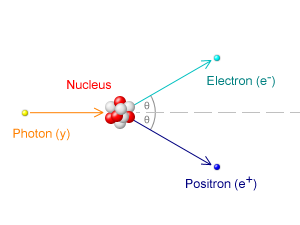
Until then, look at the evidence of electron/positron pair production and annihilation. You typically achieve the former by splitting a +1022keV photon over a nucleus.
I don't know what that means but I'm fairly sure its wrong. The interactions of 1022 keV photons are dominated by Compton scattering and the photoelectric effect.

The nucleus persists, but the photon has gone, and now you have an electron and a positron. When they annihilate, the typical result is two 511keV photons.
Well the electron you just made is unlikely to annihilate with anything any time soon.

The important thing to grasp is this: there's nothing else there.
In what sense?
 
Aaaargh! It's not an electric field! It's an electromagnetic field. And yes, it's not quite isotropic, but it's not something different to "the electron's magnetic field".

In any given reference frame, the EM field breaks down uniquely into an E field and a B field. This is a perfectly clear way to discuss it and you have no grounds for objecting.

If you weren't singling out the electric component of the EM field, and singling it out in the electron's rest frame, then you'd never have used the word "isotropy" to begin with. Looking at it in any other frame, there's nothing even isotropic (except azimuthally) about the EM field at all. Heck, if you're close enough to the source, classically speaking, the magnetic dipole term dominates.
 
Farsight, I think my previous questions are worth thinking about in some depth. If you want your model to have a fighting chance, you need to demonstrate that it does indeed yield Maxwell's equations plus the Lorentz force law in the classical limit - or at least yields the same observable behaviour. Also, the scattering of light by charged particles needs to be considered. These are the two most fundamental aspects of electromagnetism.

Pair production... well, its nice to have a visual model, but remember hard numbers are king. When you do come to consider particle creation/annihilation processes, remember that electron-positron annihilation doesn't always give two photons. Your model should be capable of predicting the correct branching ratios for the different outcomes. IMHO consideration of high-energy processes could probably come later in your analysis - park it for now by all means - but it can't be glossed over forever.

Just my 2p-worth.
 
I'll come on to the "how" of it once we've got past the electromagnetic field. Until then, look at the evidence of electron/positron pair production and annihilation. You typically achieve the former by splitting a +1022keV photon over a nucleus. The nucleus persists, but the photon has gone, and now you have an electron and a positron. When they annihilate, the typical result is two 511keV photons. The important thing to grasp is this: there's nothing else there.

(Not nothing: you've transferred momentum and one unit of spin to the nucleus.)

Secondly: so what about "there's nothing else there"? I can also emit a photon from a radio antenna. It crashes into another radio antenna and makes some electrons move up and down. "There's nothing else there" in this case too. The only thing there is to grasp about this is that photons do not carry any conserved quantum numbers. Again, I will note that QED has been keeping track of every measurable detail of pair production perfectly well for 60+ years.
 
What is confusing you? I stated that there is only one field. That field is called the electromagnetic field. That field has 2 components. One component is called the electric field. The other component is called the magnetic field. These can be treated as one in a tensor formulation where the separate components of each field appear are commonly written as the elements of a matrix.
Do you still not get it? It's one field.

No, it is produced. What there is an electromagnetic field from an electron. When there is no relative motion there is only an electric field (ignoring the electron's intrinsic magnetic moment). The magnetic field component is zero. When the electron has a motion relative to the observer then the magnetic field component becomes non-zero, i.e. is "produced".
Nope. It's always an electromagnetic field. When you're an electron without relative motion your motion is simple - just outward from the source. When you move through it, it isn't. One field causes all the motion.

It is generated by the relative motion of the observer. Read the wiki article at http://en.wikipedia.org/wiki/Electromagnetic_field, as I quoted to you before and you are quoting back at me.
You read it, all of it. Not just the bits that fit with your hazy understanding. Do some research. Read the whole article:

"Once this electromagnetic field has been produced from a given charge distribution, other charged objects in this field will experience a force (in a similar way that planets experience a force in the gravitational field of the Sun). If these other charges and currents are comparable in size to the sources producing the above electromagnetic field, then a new net electromagnetic field will be produced. Thus, the electromagnetic field may be viewed as a dynamic entity that causes other charges and currents to move, and which is also affected by them. These interactions are described by Maxwell's equations and the Lorentz force law."

What part of "produced when the charge moves" is hard to understand? What part of "two parts of a greater whole" is hard to understand?
The part that suggests a magnetic field is "created" when you move a charged particle. It isn't. They aren't two parts of a greater whole, just two aspects. Two ways of seeing it.

The mathematical treatment of the electromagnetic field as two parts of a greater whole is better described using tensors in the Electromagnetic tensor article.
If it is, why don't you understand it?
 
I'd like to add a little more to my previous point.
If you really want your theory to be given serious consideration, the best thing to do is predict some phenomenon that has yet to be observed, and is not predicted by the standard model. Are there any candidates? E.g. it seems to me that if the electron is not point-like, this should show up at suitably high energies.
 
"Once this electromagnetic field has been produced from a given charge distribution, other charged objects in this field will experience a force (in a similar way that planets experience a force in the gravitational field of the Sun). If these other charges and currents are comparable in size to the sources producing the above electromagnetic field, then a new net electromagnetic field will be produced. Thus, the electromagnetic field may be viewed as a dynamic entity that causes other charges and currents to move, and which is also affected by them. These interactions are described by Maxwell's equations and the Lorentz force law."

I'm guessing your unfamiliar with Maxwell's equations which concern the divergence and curl of electric fields and magnetic fields.
 
But if you trap an electron, or e/m field, in a confined space you don't just have one possible frequency. There is a whole range of vibrational modes. How do you exclude the higher frequency modes?
You don't. You have tighter loops and more of them.

And incidentally, I think you need to demonstrate how a photon can trap itself in this manner.
Let's come back to that at more once I've caught up.
 
Farsight said:
What part of "produced when the charge moves" is hard to understand? What part of "two parts of a greater whole" is hard to understand?
The part that suggests a magnetic field is "created" when you move a charged particle. It isn't. They aren't two parts of a greater whole, just two aspects. Two ways of seeing it.
This is bordering on a purely semantic argument. If I observe an electron moving past me with uniform velocity, I can measure a magnetic field. I can also define it rigorously as the axial vector obtained from the space-space components of the e/m tensor field. It's every bit as real as the notion of energy, or momentum, or indeed velocity. They're not Lorentz invariant concepts, sure, but directly relate to measurements I can make in a particular reference frame.
 
Last edited:
That's not what inertia means. Inertia is basically the same thing as mass. Momentum is mass times velocity. Nobody would look at a moving object and say "it doesn't have inertia any more, now it has momentum".
Shows how much you know. A photon has no mass, but it does have momentum p=hf/c. An electron which is motionless with respect to you has mass but no momentum. Now annihilate it with a positron, and look at that 511keV photon zipping away at c. Hey presto, momentum but no mass.

See http://en.wikipedia.org/wiki/Mass_in_special_relativity#The_relativistic_energy-momentum_equation. Imagine you perform pair production, but there's insufficient energy to separate the electron and the positorn, so they annihilate shortly thereafter. That's a flip-flop from momentum to mass and back again. Simple.

Yep, that's totally standard physics. (Note that putting a photon into a box does not make the box electrically charged.)
Noted. But the positron and electron had +ve and -ve charge, and the two 511keV photons have their sinusoidal electromagnetic field variations. As one goes by you feel an electromagnetic field rising then dropping and going negative then zero again. And there's no charge there. Instead there's current. The photon is alternating current. But it isn't like some electron shuttling back and forth.

I'm sure you have a very visual mental picture of this, but I assure you there is no actual physics in that picture. You will not find any way to generate a photon-scattering-off-itself in Maxwell's Equations, nor in QED. You are inventing a new aspect of E&M, guessing (unconvincingly so far) that it gives you something that looks like an electron, and further perhaps you anticipate guessing that this new aspect of E&M is consistent with everything else we know.
Shrug. Maxwell's equations are Heaviside's equations, and if you actually read the original Maxwell you'd understand that I didn't invent this. It was Maxwell:

A motion of translation along an axis cannot produce a rotation about that axis unless it meets with some special mechanism, like that of a screw.

See http://en.wikipedia.org/wiki/File:On_Physical_Lines_of_Force.pdf
page 53, try this link: http://en.wikipedia.org/w/index.php?title=File:On_Physical_Lines_of_Force.pdf&page=53

Dismiss Maxwell if you like. But physics is science. Dismissing scientific evidence like pair produciton and annihilation because you can't do the maths, isn't.
 
Last edited:
You don't. You have tighter loops and more of them.
I'm not making myself understood, perhaps. For a given length L of closed twisted path, any wave with a wavelength L/n (for n=1, 2, ...) could wrap itself around that path without interfering destructively (assuming we can get photons to travel in such a way in the first place). The energy of the nth mode would be nhc/L (h is Planck's constant, c the speed of light). The mass of the system is given by this energy. Thus, if an electron-like particle is possible, with the correct mass, then so is a particle with n times the electron's mass for each n. There's no way to prevent it unless the higher-frequency photons somehow escape the binding mechanism.
Postulating tighter loops multiplies the issue - for each size loop you'll have another series of modes.
This is, of course, assuming a one-dimensional loop. Presumably you envisage a 2- or 3-dimensional volume in which the photon moves. The number of modes increases accordingly - I'm sure Wiki has an article on waves in a 3d box, to get an idea - and each mode would be an observable particle in your model. Now, this would be a good thing if it meant your theory predicted the correct masses for the mu and tau leptons (relative to the electron mass, presumably), but the lepton masses don't follow such a simple progression AFAIK. So instead you need a mechanism for inhibiting these modes, and perhaps another mechanism for explaining the mu and tau.
 
Noted. But the positron and electron had +ve and -ve charge, and the two 511keV photons have their sinusoidal electromagnetic field variations. As one goes by you feel an electromagnetic field rising then dropping and going negative then zero again. And there's no charge there. Instead there's current. The photon is alternating current. But it isn't like some electron shuttling back and forth.
You need to expand on this. An e/m wave is not the same thing as an alternating current in the usual sense of the phrase. A current involves a flux of charged particles across a surface. In AC (in the normal sense), the positive flux during the first half-cycle is cancelled by the negative flux in the second half-cycle, but there is still a flow of charged particles.
Are you thinking of displacement "current" by any chance?
 
Shows how much you know. A photon has no mass, but it does have momentum p=hf/c. An electron which is motionless with respect to you has mass but no momentum. Now annihilate it with a positron, and look at that 511keV photon zipping away at c. Hey presto, momentum but no mass.

I wasn't giving a lecture on relativistic energy-momentum conservation, I was pointing out that you misuse (or used oddly) the word "inertia".

Noted. But the positron and electron had +ve and -ve charge, and the two 511keV photons have their sinusoidal electromagnetic field variations.

But you're claiming to put one photon into a knot with itself and get a charge.

As one goes by you feel an electromagnetic field rising then dropping and going negative then zero again. And there's no charge there. Instead there's current. The photon is alternating current. But it isn't like some electron shuttling back and forth.

There's no current in a photon. Just fields.

Shrug. Maxwell's equations are Heaviside's equations, and if you actually read the original Maxwell you'd understand that I didn't invent this. It was Maxwell:

A motion of translation along an axis cannot produce a rotation about that axis unless it meets with some special mechanism, like that of a screw.

I don't see any way in which that is relevant to your theory.
 
If it is, why don't you understand it?

Farsight: the reason I cited old Mr. Singularitarian is that he was also someone whose major activity on this board was accusing everyone who disagreed with him of not knowing basic physics. It made for some amusing but basically pointless threads. You are in danger of tacking in that direction.

The people disagreeing with you are perfectly in touch with mainstream physics, at least the level of this conversation (and let's not speculate about beyond that). You're insisting on the "one EM field vs. separate electric and magnetic fields" distinction, and you've gone beyond "annoyingly pedantic" into "error by overcorrection"---it's not that you are always describing it wrongly, but at the you're tendentiously denouncing things, like RC's statement about the B field appearing, which in fact are perfectly acceptable rephrasings of the truth.
 
I don't know what that means but I'm fairly sure its wrong. The interactions of 1022 keV photons are dominated by Compton scattering and the photoelectric effect.
Look it up: http://en.wikipedia.org/wiki/Pair_production. Check it out:

Pairproduction.png


Well the electron you just made is unlikely to annihilate with anything any time soon.
Some of the +1022keV is lost to the nucleus, but not much because it's so massive and conservation of momentum applies. Take out the 1022keV to make the electron and positron, and if there's not much left the electron and positron don't fly apart fast enough. Then they attract one another and annihilate.

Re: The important thing to grasp is this: there's nothing else there. In what sense?
You started with light, you performed pair production then annihilation, so you ended up with light. In between you had this electron in front of you, with its magnetic dipole moment. You can't have magnetic dipole moment unless there's some kind of rotation going on. See http://en.wikipedia.org/wiki/Electron_magnetic_dipole_moment#Magnetic_moment_of_an_electron and this bit:

"From classical electrodynamics, a rotating electrically charged body creates a magnetic dipole with magnetic poles of equal magnitude but opposite polarity."

And look a little further down at http://en.wikipedia.org/wiki/Electron_magnetic_dipole_moment#Spin_magnetic_dipole_moment

"The magnetic moment of an electron is approximately twice what it should be in classical mechanics. The factor of two difference implies that the electron appears to be twice as effective in producing a magnetic moment as the corresponding classical charged body."

What's rotating in there? Nothing? Because electron spin is mysterious and "intrinsic", incompatible with classical physics, and it surpasseth all human understanding. And you know this because that's what your textbook says, and that's what you've been taught. So much so, that you can't even consider that spin 1/2 might have something to do with a moebius strip, and you can't even consider pair production and annihilation to wonder if it might just conceivably be light that's rotating in there. Me, I'm skeptical.

toroid2.jpg


And so to bed.
 
What's rotating in there? Nothing? Because electron spin is mysterious and "intrinsic", incompatible with classical physics, and it surpasseth all human understanding. And you know this because that's what your textbook says, and that's what you've been taught. So much so, that you can't even consider that spin 1/2 might have something to do with a moebius strip, and you can't even consider pair production and annihilation to wonder if it might just conceivably be light that's rotating in there. Me, I'm skeptical.

a) Ah, the argument from incredulity. You don't find the intrinsic spin of the electron personally satisfying, so therefore it's wrong. Lacking a specific way in which it went wrong you blame it on a textbook learning and a lack of out-of-the-box thinking. Seriously, though: everything in quantum mechanics is compatible with classical physics. The whole shebang is nonclassical. Spins, magnetic moments, CP violation, atoms, diffraction, pi-bonding, bremsstrahlung, quantum dots, superconductors. Don't insist that classical intuition is somehow "privileged" over quantum mechanics---that's an accident of history (Newton was born first) and of size (humans are very large compared to any relevant quantum size scale.)

b) We can't consider that it's a Mobius strip---unless you want to get into topological defects, which I don't think you do---because that's a mechanical model and therefore incompatible with the quantum mechanical nature of particles.

c) A photon going in a circle doesn't have generate a magnetic moment.

d) Pair production and annihilation has nothing to do with photons specifically. There's an absolutely-identical process involving two neutrinos (nu nubar -> e+ e- and e+ e- --> nu nubar) or two quarks (e+ e- --> q qbar) or almost anything you like. At low energies the cross section is very small, but at collider energies (200+ GeV) the two processes are very similar. Should we be getting all excited about how the electron is really "made of" a self-trapped neutrino? No, because there is no evidence anywhere in particle physics that this is a productive way of thinking.

 
Do you still not get it? It's one field.
Yes I do get it. That one field is called the electromagnetic field. That field has 2 components. One component is called the electric field. The other component is called the magnetic field.

Nope. It's always an electromagnetic field. When you're an electron without relative motion your motion is simple - just outward from the source. When you move through it, it isn't. One field causes all the motion.
Nope. It's always an electromagnetic field. When you're an electron without relative motion that one field has only electric components. When you're an electron with relative motion that one field has electric and magnetic componennt.

You read it, all of it. Not just the bits that fit with your hazy understanding. Do some research.
...
The part that suggests a magnetic field is "created" when you move a charged particle. It isn't. They aren't two parts of a greater whole, just two aspects. Two ways of seeing it.
You are wrong.
If you have a stationary electron then the electromagnetic field just has electric components. There is only an electric field. There is no magnetic field.
If you have a moving electron the electromagnetic field electric and magnetic components. There is an electric field. There is a magnetic field.
The motion of the electron realtive to the observer has created a magnetic field. That magnetic field did not exist before. It can be removed by moving with the electron.
 

Back
Top Bottom