• Security incident: ISF was recently accessed by intruders. Please change your password, and change it anywhere else you used it. Read more

"Recovery!" WHAT Recovery??

Anyone invested in MBSs or the securitization would gladly have given up 1% to avoid the sort of risk involved IF THEY SAW IT.

Er, no.

They saw the risk, but thought they could get out in time. If they had been willing to forego that extra 1%, they would have simply sold out when they had "enough" profit.
 
We are chasing the problem farther into the hidden spaces where it may be more damaging.

Good post.

Re. hidden spaces. Did you know when you posted this that the new financial regulations exempt the SEC from FOI requests from the public?

Seems like transparency just don't mean what it used to.

You made a good point about bubbles not always busting. I have to ask. Are busts always preceded by bubbles? In other words. Can things be bad and then get much worse?
 
The point was that most of the wealthiest people in the country (those that are ridiculously, filthy, stinking rich) didn't start that way. Only a very small percentage of those people inherited that wealth...most of them created it, and a significant portion created their wealth in an industry that didn't even exist when they were born.

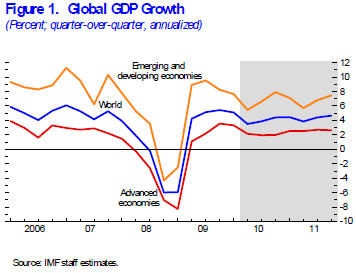
So what's your point? Is the global economy recovering or not?

Here's a good place to begin your quest in earnest: http://www.imf.org/external/pubs/ft/weo/2010/update/02/index.htm.

1.jpg
 
There was a bubble (by your definition) in swine flu shots recently - but the fact that these are denominated in dollars has nothing to do with the bubble. Monetary policy would not correct the valuation. The current issue, the Fed is now supposed to police the non-FedReserve banks for risk, but there is no objective measure. The Federal reserve is likely to make similar errors in evaluating secondary market securities risks as investors..


I already did in post 126. The semiconductor industry valuation increased at hyper exponential rates (Sornette's definition of bubble) in the 1970s. They transitioned away from these extreme valuation growth rates without a major crash. That's not just benign, it's a net positive that we can grow a new industry at such rates. The problem I proposed is that the Fed is not clever enough to distinguish the next benign/positive semiconductor bubble from the next dot-com bubble. There have been two little bubbles and busts in wheat prices since 2002 - benign.

You might enjoy this, tho he and his collegues have a lot of good web papers.
http://www.amazon.com/Why-Stock-Markets-Crash-Financial/dp/0691096309
The book is a little dated compared to his recent work, but the point is that bubbles can be characterized as hyper exponential growth in value, and end in a "regime change" which may involve reduced growth, negative growth or a bust.


That's a trivial but true statement We all know the market will go up and down ,we just don't know when .... and of course it's meaningless to claim that we "know" anything useful on that basis. If investors actually believed that the risk of a bust was large they would have sold. That they didn't sell is proof that they did not see the risk of a bust as sufficient to act on, up to the actual bust. If you think that pro investors are dumb enough to buy-and-hold while risk rises to unacceptable levels you are wrong.

If you consider the dot-com bubble/burst then one can easily argue that there is no solid ground for the "intrinsic value" that Tippet claims is the key. It's based on future growth and that is fundamentally unknowable except ex post facto. For example Yahoo value had some hiccups, but it was never vastly overvalued. OTOH the valuation of JDS Uniphase (a fiber optic supplier) took a huge harsh crash - the valuation was IN HINDSIGHT far beyond the "intrinsic value". Who is brilliant enough to foresee the future clearly enough to distinguish these ? Obviously not very intelligent highly motivated investors. Just as obviously not the Fed.

So I disagree. Yes Goldman-Sachs seems to have been the first to actually act on the increasing risk and they got away half-scorched. But their very exit was in part the trigger for the bust. Nearly everyone else was caught flat-footed. Your argument that they "knew" but didn't sell isn't a realistic description. More accurately many investors had increasing concern about risk (uncertainty of risk, not knowledge), but not enough to justify selling.

The other point is that a bust is NOT the necessary consequence of a bubble. The growth estimations can be realized and also become easier to estimate ... so then the high pricing can stabilize and value pricing becomes more easily estimable. Sometimes the punchbowl is emptied by 10pm and everything works out fine. Again see Sornette.


Anyone invested in MBSs or the securitization would gladly have given up 1% to avoid the sort of risk involved IF THEY SAW IT. They didn't evaluate the risk accurately and neither would the Fed.

OK well you got a lame quote in so here is mine - Generals always prepare to fight the last war. Similarly we can arm the Fed to examine risk in investment banks and secondary securities, but that just means that growth will be curtailed there and the risk and some bubble will appear elsewhere. Actually it always comes from an unexpected source, the watched pot may not boil, but there are plenty of unwatched pots. We are chasing the problem farther into the hidden spaces where it may be more damaging.

Very interesting post. I agree that people who think a market crash is imminent are not going to ride it out till the last minute to squeeze out an extra 1%. There were Cassandras sounding the alarm before the crash (e.g., Roubini), but they were mocked until after the fact.
 
Very interesting post. I agree that people who think a market crash is imminent are not going to ride it out till the last minute to squeeze out an extra 1%. There were Cassandras sounding the alarm before the crash (e.g., Roubini), but they were mocked until after the fact.

Oh puh-leeze. There were thousands of people who predicted that the bubble would burst. Mostly they were ignored, not mocked.
 
... partly because for some of them, it's the only song they can play.

True. But rational people know that all bubbles burst. But every time one does, there is always someone who comes along claiming to be the only person who predicted it.

Guarantee: 5 years from now, gold prices will be far lower than they are now. There, I predicted it.
 
Last edited:
Here is something where some experts weigh in. One is a former Federal Reserve official now at Princeton and the other is a former economic adviser to John McCain, who is the chief economist at Moody's Analytical. According to them, the great depression 2.0 was avoided between the TARP, stress tests, the Obama stimulus package, and asset purchases by the Fed. According to this paper which claims empirical evidence the GDP would be about 11.5% lower than it is now along with 8.5 million fewer jobs.

It will be interesting to see how this report plays out. Even if it's only half way right though, with those figures we avoided a huge downturn. If nothing else there are some tables and such where they show their work. Perhaps those who comment here on economics who actually work in the field will chime in with their responses.
 
Er, no.

They saw the risk, but thought they could get out in time.

Er, YES ! Not being able to get out in time is the risk that they failed to correctly assess. Investment banks are not the cartoon simpleton characters you imply, yes they considered this risk in advance. The several days of market illiquidity was a result of low offer price. You are ignoring that the bust was already underway (low volumes, low prices) when they recognized this specific risk.


If they had been willing to forego that extra 1%, they would have simply sold out when they had "enough" profit.

You need to define your terms, and show some evidence for your points. First, what is "enough profit" ? That's a goofy term that throws any reasonable discussion off the tracks. When I invest in a company I expect that as part of their management's fiduciary responsibility to me that they will attempt to maximize my value in the company consistent with law. They are supposed to maximize profit - it's their charter.


Yes, there was some recognition that risk was increasing, but that same could be said of the rapid semiconductor growth of the 1970s or the rapid dot-com valuation growth of the late 1990s thru 2001. Perhaps you missed the main point but investment is about trading off risk and reward by attempting to correctly assess these. Having the Fed tamp down these bubbles would perhaps (it's a arguable) prevent busts, but it would certainly reduce growth.

So you haven't shown that anyone recognized "the problem" which is the incorrect risk assessment, in advance of the illiquidity (the inability to exit, the bust). Yes we all know the trivial uninformative case that markets fluctuate and "bad stuff "is possible. Incorrectly evaluating the risk is the problem, and it is inherent to the financial system and the human condition generally. There is no reason to think the Fed has a better crystal ball.

[[A point for another thread, but it will be possible to take market positions in anticipation of the Fed action, new sources of risk arising directly from the risk reduction regulation !]]
 
Last edited:
Oh puh-leeze. There were thousands of people who predicted that the bubble would burst. Mostly they were ignored, not mocked.

So what ? Do you not understand why this is not evidence ?

Do you remember Elaine Garzerelli ? She was an Lehman's analysyt who predicted the 1987 crash, and made a modest career out of it. She never again made any brilliant prescient prediction of a market turn. One hit wonder.

Every week I get a few fliers from so-called investment analysts claiming that some market change is nigh. Gold will skyrocket, inflation will rise and ruin savings ,employment will crash, commodities will zoom .... It's nothing but data mining (cherry picking) to claim that the fliers sent in late 2007 about a housing crash were brilliant and the others were trash.

Yes there were undoubtedly thousands of people who claimed that the housing market would crash circa late 2007, but in a warehouse filled with broken clocks there are always several that are correct. What you want is a single clock that that is correct more than twice a day.

If there was such a clock; If there was a single market analyst who could correctly call market turns even 60% of the time, this guy would be richer than Bill Gates within a decade. It's defacto proof that no one willing to invest has the ability to foresee market turns. You might like Taleb's book "fooled by randomness" where he extensively digresses on this fact. To be fair I listen to the Roubini's and the Jimmy Roger's and other, but you have to understand these are clocks that are right 2.01 times per day.


Those GS24s would not be working for the Fed if they had such an amazing ability.
 
Last edited:
Er, YES ! Not being able to get out in time is the risk that they failed to correctly assess. Investment banks are not the cartoon simpleton characters you imply, yes they considered this risk in advance. The several days of market illiquidity was a result of low offer price. You are ignoring that the bust was already underway (low volumes, low prices) when they recognized this specific risk.


You need to define your terms, and show some evidence for your points. First, what is "enough profit" ? That's a goofy term that throws any reasonable discussion off the tracks. When I invest in a company I expect that as part of their management's fiduciary responsibility to me that they will attempt to maximize my value in the company consistent with law. They are supposed to maximize profit - it's their charter.

You're making my point for me. Most of the players knew that there was an (eventual) downturn in the works, but were not allowed -- structurally -- to exit the market. (Actually, the fidicuary duty was a very small part of it. Any mutual fund manager that opted to withdraw from the market "to preserve capital against market risks" would be legally in the clear -- but by failing to squeeze every dime out of the market, much of the money would flee for more aggressive funds.)

In other words, mutual fund managers are (over)incentivized to take imprudent risks. Since the hypothetical government board does not have that incentive, it would be freer to act to prevent bubbles and crashes.

This isn't a new view by any stretch of the imagination; the long-term Fed chair William Martin famously stated that the role of the Fed is "to take away the punch bowl just as the party gets going", which is exactly what this new government panel is supposed to do (since the Fed, under neo-libertarian Alan Greenspan completely abrogated that particular responsibility, first during the dot.com boom and later during the housing boom).

And, again, it's no secret that the bubbles were happening. Greenspan himself spoke about the "irrational exuberance" of the markets in 1996, but failed to take any action to address it.

Yes, there was some recognition that risk was increasing, but that same could be said of the rapid semiconductor growth of the 1970s or the rapid dot-com valuation growth of the late 1990s thru 2001. Perhaps you missed the main point but investment is about trading off risk and reward by attempting to correctly assess these. Having the Fed tamp down these bubbles would perhaps (it's a arguable) prevent busts, but it would certainly reduce growth.

That's right. That's what it's supposed to do.

So you haven't shown that anyone recognized "the problem" which is the incorrect risk assessment, in advance of the illiquidity (the inability to exit, the bust).

Sure I have. The bubble was well recognized by the very agencies that we would expect to recognize it, but they weren't explicitly charged with keeping the bubbles under control and so failed to do so. The new agency would be explicitly charged with identifying bubbles in progress (which we know can be done) and doing something about them (which we also know can be done, but which no one did during the most recent bubbles, to disasterous effect.)
 
Last edited:
Yes there were undoubtedly thousands of people who claimed that the housing market would crash circa late 2007, but in a warehouse filled with broken clocks there are always several that are correct. What you want is a single clock that that is correct more than twice a day.

What you'd want are people who both called the bust and accurately described the causes/catalysts ahead of time. Also they should have been consistent on their prediction over a span of time. Of course infinite monkeys with infinite typewriters will predict every 1 point move of the Dow, but just maybe some of those monkeys are pulling more weight than the rest.
 
What you'd want are people who both called the bust and accurately described the causes/catalysts ahead of time. Also they should have been consistent on their prediction over a span of time. Of course infinite monkeys with infinite typewriters will predict every 1 point move of the Dow, but just maybe some of those monkeys are pulling more weight than the rest.

"This will not end well" - Charles T. Munger (2005, discussing easy credit as it related to housing)

He was one of thousands who knew the causes. A smaller number would have predicted exactly how it would play out, down to every last detail, but the above is good enough for me.
 
"This will not end well" - Charles T. Munger (2005, discussing easy credit as it related to housing)

He was one of thousands who knew the causes. A smaller number would have predicted exactly how it would play out, down to every last detail, but the above is good enough for me.

Not familiar with Munger's writings but some things really won't end well, human default optimism is flawed. The man who fears the worst should be protected..
 
Last edited:
Hey! Watch out, structured note bubble:

http://www.bloomberg.com/news/2010-...et-s-next-bubble-institutional-risk-says.html.

Funny how everything's a bubble nowadays. I bet some sort of molybdenum currency standard and deflationary death spiral would make short work of all this.

Tippit!!!

I spoke too soon: http://www.bloomberg.com/news/2010-...drops-on-earnings-ebay-climbs-in-germany.html.

None of this would have happened if we had a solid fluorine-based currency.
 
None of this would have happened if we had a solid fluorine-based currency.

A currency based on solid fluorine? Doesn't fluorine melt at like 70K? That would require really well-insulated purses, wouldn't it?
 

ISF - Join now!

Every member here is approved by hand. No bots, no spam, just people who care about evidence and honest debate.

Membership is free!

Create your free account

Back
Top Bottom