• Quick note - the problem with Youtube videos not embedding on the forum appears to have been fixed, thanks to ZiprHead. If you do still see problems let me know.

Record Heat in UK

The US arm of The Don family mostly resided in Las Vegas.

We used to visit every couple of years in July and August and back in the early 1970's with temperatures in the 110-120 range but humidity in low single digits it was excruciatingly hot but at least sweat evaporated immediately. It still wasn't too bad in the late 80's, the last time we visited as a family.

Mrs Don and I went back a few years ago for the first time in three decades and I don't know whether it's due to the much increased population, the greater number of water features and the like, climate change or just the weather that June week, but humidity was far, far worse, into the twenties and thirties. Being outside was more or less unbearable.
 
Most of the places in the US that regularly go to these temperatures are a lot dryer which helps a lot.

Temperatures as low as 35 Deg C (101 deg F) can be un-survivable to mammalian life at around 70% relative humidity because they can no longer cool their bodies via evaporation. There was no danger of this in the UK obviously; no place in the world reaches this combination of temperature and humidity today. By 2100 there is likely to be at least some placed on earth where this happens on a somewhat regular basis.

Getting close though, even in Australia.

Cairns, in Far North Queensland, experiences hot and humid summers and mild, dry winters. The average annual maximum temperature is 29°C (84.2°F), with 62% humidity.

That’s the average. This summer:

The Bureau of Meteorology recorded a 42.6-degree temperature at Cairns Airport at 12.24pm

That temperature even with average humidity is oppressive.

I reckon those temperature and humidity levels would have been experienced in Singapore for one.
 
London reached 105°F, not 115.

Since that short heat wave, August in central Europe hast been mild under average, with the last couple of days tons of rain here, which was long overdue. The plants are happy again. :)
 
London reached 105°F, not 115.

Since that short heat wave, August in central Europe hast been mild under average, with the last couple of days tons of rain here, which was long overdue. The plants are happy again. :)


And here we continue to plod along with daytime highs in the mid 90s, and "feels like" temps in the three digits thanks to the humidity and high dew points.

Yet another sauna day.
 
London reached 105°F, not 115.

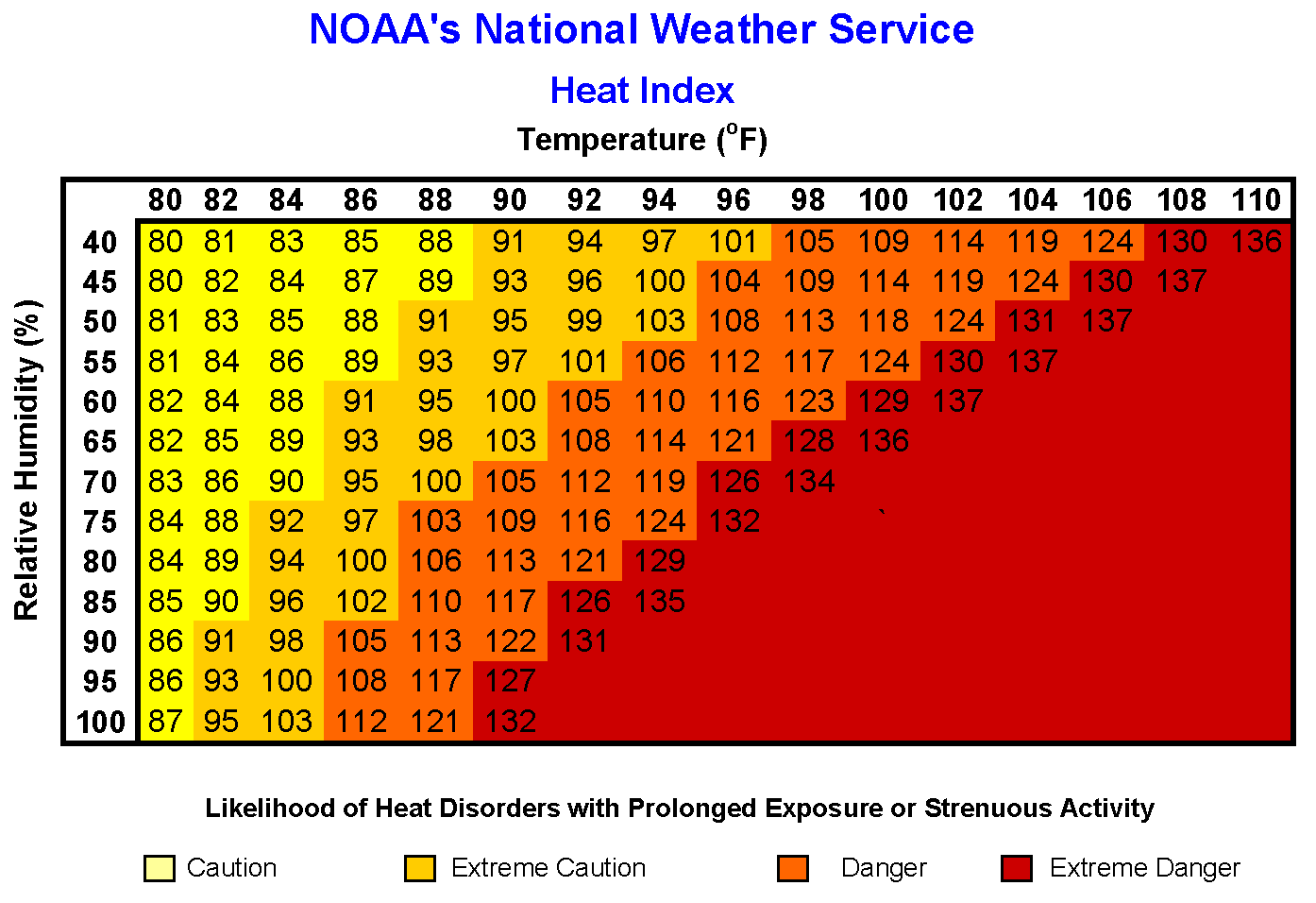
The Heat index for London went over 115 which is into the danger range. Humidity plays a big role in how easily the human body can cool itself. Heat index factors that in.

heatIndex.png
 
And here we continue to plod along with daytime highs in the mid 90s, and "feels like" temps in the three digits thanks to the humidity and high dew points.

I’m not of the “feels like” as a description for heat index. It works better as a description for heat index than wind chill, but you still don’t really feel the effects of heat index immediately, you feel it more over time as your body struggles to get rid of excess heat.


Provided you are protected from the wind, you may actually at be much greater risk of hypothermia with temperatures near freezing and high humidity than you are at -20 Deg C and the air is dry. Part of the problem is that the air can feel warmer on your skin even when you are loosing body heat more rapidly because the insulation value of your clothes drops when it’s humid.

The popular “feels like” metric for cold doesn’t account for this at all, instead it looks at the effect if wind on exposed skin. This is important when there is a possibility of frostbite on exposed skin but may not capture the risk of hypothermia.
 
I used to tell people to try sticking their head in the oven if they wanted to experience what a dry heat feels like. That said, we've actually had a pretty mild summer by Phoenix standards, June was gorgeous with almost no 100+ days (very unusual), July was normal hot. August has been hotter than normal and we have not had many monsoons, which means I have to water my trees regularly.

Last summer was also unusually mild, with the heat amazingly breaking in mid-September (mid-October is more normal). Of course, here everybody has A/C; going without is not really an option.

Same basically, one state east here in ABQ. Except the spring was exceptionally cool and wet, like dipped into the 40's around Memorial Day. Been hovering around 100 most days in August. The weather forecast keeps saying around 95, then they revise it day of. Finally got a tiny bit of rain last night, just a quick heat storm rolling off Sandia.

I will gladly take the dry heat though. Stay out of the sun and its bearable at least, unlike humid heat.
 
The Heat index for London went over 115 which is into the danger range. Humidity plays a big role in how easily the human body can cool itself. Heat index factors that in.


That makes sense but you wrote

Heat index in London reached as high as 115 Deg F


Here in Germany that heat wave was rather dry and with a healthy wind, so I didn't suffer too much (although I felt like starting a thread in Forum Community complaining about it ;)).
 
I’m not of the “feels like” as a description for heat index. It works better as a description for heat index than wind chill, but you still don’t really feel the effects of heat index immediately, you feel it more over time as your body struggles to get rid of excess heat.


Provided you are protected from the wind, you may actually at be much greater risk of hypothermia with temperatures near freezing and high humidity than you are at -20 Deg C and the air is dry. Part of the problem is that the air can feel warmer on your skin even when you are loosing body heat more rapidly because the insulation value of your clothes drops when it’s humid.

The popular “feels like” metric for cold doesn’t account for this at all, instead it looks at the effect if wind on exposed skin. This is important when there is a possibility of frostbite on exposed skin but may not capture the risk of hypothermia.


Okay. I can dig it.

This time of year the local weather critters often use it synonymously with "heat index", which they also use in their reports. I put "feels like" in quotes because ... well ... I was quoting it.

This time of year in NC, and even more so this year it is highly unlikely that anyone is going to be confusing it with "wind chill".

We're having plenty of wind. Micro-burst downdrafts are doing an unusual amount of damage, along with garden variety very high winds. But they aren't of the chilly variety.
 
...and what? No and. Deg F is one dimension on your two-dimensional heat index chart.

So you were commenting on the absence of a unit? Why didn't you just say so?

Personally, I’m not to worried about the presence of a unit in that case because it was a casual conversation and the unit was easily inferred. Also worth noting is that while Deg F is the official unit for Heat Index (It was popularized by the US government), think using the units of Temperature are little misleading because it’s not actually a temperature. I also favor the old unit for wind chill (W/m^2) over the popular but misleading“feels like X Deg C” for many of the reasons I already discussed above.
 
This time of year the local weather critters often use it synonymously with "heat index", which they also use in their reports. I put "feels like" in quotes because ... well ... I was quoting it.

I get that. I was just pointing out that “it feels like X Deg” isn’t a great way to describe numbers like this (heat index, humidex, wind chill, etc) because they don’t really feel the same. Temperature plus humidity that push the heat index to 120 doesn’t feel like 120 Deg F in dry air.

The real information is about danger level for certain heat related issues, and to understand that you need the additional information that a heat index of 120 is in the “danger” area.
 

Humans are somewhat immune to ecosystem breakdowns, but the economic damage is going to be serious and that reduced our ability to deal with climate change. Still, if it’s just climate change I think humanity and some measure of our society can survive.

OTOH, Ocean Acidification is death. If that reaches a certain threshold, the evolutionary history of the earth tells us animals of our size do not survive, period.
 
I get that. I was just pointing out that “it feels like X Deg” isn’t a great way to describe numbers like this (heat index, humidex, wind chill, etc) because they don’t really feel the same. Temperature plus humidity that push the heat index to 120 doesn’t feel like 120 Deg F in dry air.

The real information is about danger level for certain heat related issues, and to understand that you need the additional information that a heat index of 120 is in the “danger” area.

They offer such evaluations ... with corresponding charts across geographic regions ... regularly during this season. Although I believe they tend to place the "danger" level at somewhat less than 120°F.
 
Last edited:
OTOH, Ocean Acidification is death. If that reaches a certain threshold, the evolutionary history of the earth tells us animals of our size do not survive, period.
The temperature of the oceans will rise as the world warms and warm water can't dissolve as much CO2 as cold, so surely there's a limit to ocean acidification?
 
OTOH, Ocean Acidification is death. If that reaches a certain threshold, the evolutionary history of the earth tells us animals of our size do not survive, period.

Would it have a knock-on effect that makes the atmosphere or general climate impossible for land animals? I'm not disputing what you're saying, but a quick read about mass extinctions doesn't explain why large mammals might be wiped out unless they depend directly on the sea (polar bears, walruses etc spring to mind)
 

Back
Top Bottom