
-
Security incident: ISF was recently accessed by intruders. Please change your password, and change it anywhere else you used it. Read more
You are using an out of date browser. It may not display this or other websites correctly.
You should upgrade or use an alternative browser.
You should upgrade or use an alternative browser.
Racism is baseless
- Thread starter The Sparrow
- Start date
-
- Tags
- racism
aleCcowaN
imperfecto del subjuntivo

Let's add Attila, the black death and Landrú to racism and chant how bad they are. We can also fart it in technicolor and cinemascope.
Why don't you point me to the definition of racism is this thread, and the connection between racism and the concept of race. I can't found either. Maybe I skimmed lots of post too quickly.
I do know that a legal definition of unlawful discrimination is "forming opinions about others not based in individual merits but rather their membership in a group with assumed characteristics". Doesn't discrimination based on race exist just because some think race is not an operative notion?
Why don't you point me to the definition of racism is this thread, and the connection between racism and the concept of race. I can't found either. Maybe I skimmed lots of post too quickly.
I do know that a legal definition of unlawful discrimination is "forming opinions about others not based in individual merits but rather their membership in a group with assumed characteristics". Doesn't discrimination based on race exist just because some think race is not an operative notion?
Pup
Philosopher

- Joined
- Dec 21, 2004
- Messages
- 6,679
The problem we're running into today is that the old races are getting so diluted they hardly have meaning. Slaves may have been brought to America, for example, with a relatively pure black bloodline among a few related tribes going back for many generations, meeting a relatively pure white bloodline, bred in the British Isles and then with closely related other Brits in the US. But as soon as they started breeding with each other--and it didn't take long--the races were disappearing. They're almost gone now, except in some rare isolated people. Some of those undiscovered tribes in Brazil might still be a race, maybe some impoverished Africans who don't travel, but people are pretty much interbreeding.
If they become isolated again, there could be new pure races, like moonies and martians and asteroidites, who get dropped off in a few batches and then left alone. But it's going to take quite a bit of isolation and quite a few years.
If they become isolated again, there could be new pure races, like moonies and martians and asteroidites, who get dropped off in a few batches and then left alone. But it's going to take quite a bit of isolation and quite a few years.
macdoc
Philosopher

they aren't unless you think some Denosovians or Neanderthals are hidden there.Some of those undiscovered tribes in Brazil might still be a race

aleCcowaN
imperfecto del subjuntivo
they aren't unless you think some Denosovians or Neanderthals are hidden there.
...a google search told you
aleCcowaN
imperfecto del subjuntivo
Cuatro declaraciones sobre la cuestión racial / Four statements on the race question
Declaración sobre la raza y los prejuicios raciales / Declaration on Race and Racial Prejudice / Déclaration sur la race et les préjugés raciaux (it provides access to the Chinese, Russian and Arabic versions)
Declaración sobre la raza y los prejuicios raciales / Declaration on Race and Racial Prejudice / Déclaration sur la race et les préjugés raciaux (it provides access to the Chinese, Russian and Arabic versions)
arthwollipot
Limerick Purist Pronouns: He/Him

I repeat - race and species aren't the same thing.they aren't unless you think some Denosovians or Neanderthals are hidden there.
macdoc
Philosopher
I agree they are indeed different
....race in human terms is a construct with no valid biological base in modern humans ,
species a taxonomic rank with a valid biological basis...
Time to move on from the former tho one could make a case ...as this person does that Neanderthals and Denisonvians are indeed an extinct race of humans.
http://www.livinganthropologically.com/anthropology/denisovans-neandertals-human-races/
"So, let us accept Neandertals, Denisovans, and other so-called archaics as members of the human species, perhaps as a true sub-species or race. "
.....seems that exactly what I said....there are none lurking in the ghettos despite the bigots fondest day dreams....
....race in human terms is a construct with no valid biological base in modern humans ,
species a taxonomic rank with a valid biological basis...
Time to move on from the former tho one could make a case ...as this person does that Neanderthals and Denisonvians are indeed an extinct race of humans.
Anthropology can now confidently report that Neandertals, Denisovans, and others labelled archaic are in fact an interbreeding part of the modern human lineage. We are the same species. There has been extensive admixture across modern humans for tens of thousands of years, and at least some admixture across several archaic groups. Neandertals, Denisovans, and other archaics may be the best example of a true human race or sub-species. They are also fully part of the human lineage, with almost all contemporary humans showing genetic admixture with archaics in our genetic signatures.
So, let us accept Neandertals, Denisovans, and other so-called archaics as members of the human species, perhaps as a true sub-species or race. But let’s retain the beauty of the original multiregional model proposed by Franz Weidenreich, with human populations “being interconnected by nearly continuous gene flow throughout the Pleistocene, with the gene flow being of sufficient magnitude such that the human continental populations define an intertwined trellis. There is no tree of human populations of any sort in Weidenreich’s figure” (Templeton, Genetics and Recent Human Evolution, 2007:1509).
This last point brings up the idea of metaphors and how we should represent human evolution–see blog-post The Tangled Bank and the blog-post by Jonathan Marks, Clades versus Rhizomes: “I think human evolution is strongly rhizotic.” Indeed, the rhizome model is strikingly similar to the Weidenreich’s intertwined trellis. I was interested to see Dienekes Anthropology blog take up the same issue in the 2012 blog-post Admixture matters: “It’s time to give up trees and embrace networks!” It seems when everyone is dropping the tree taxonomies and embracing networks (or maybe even rhizomes?), we are in a new place to appreciate the complexity of human becoming, and More Mothers than Mitochondrial Eve.
http://www.livinganthropologically.com/anthropology/denisovans-neandertals-human-races/
"So, let us accept Neandertals, Denisovans, and other so-called archaics as members of the human species, perhaps as a true sub-species or race. "
.....seems that exactly what I said....there are none lurking in the ghettos despite the bigots fondest day dreams....
arthwollipot
Limerick Purist Pronouns: He/Him
That doesn't look like a peer-reviewed publication to me, though I admit I didn't follow all the links. Is it a generally accepted scientific consensus, or just one guy's article?
If the former, then it is new to me. But I don't follow the latest (2012 is latest, right?) in anthropological findings.
If the former, then it is new to me. But I don't follow the latest (2012 is latest, right?) in anthropological findings.
aleCcowaN
imperfecto del subjuntivo
That doesn't look like a peer-reviewed publication to me, ...
Peer reviewed is not needed, but you're right, it's kind of "they didn't let me say it in Nature, so I'm saying it here".
What macdoc pretends is for everyone to swallow what he already bought and got invested in: that race in human terms is equivalent to being on the verge of reproductive isolation.

And as always we've devolved into semantics with an agenda, which actually isn't a horrible working definition of race as a concept.
Scientifically speaking on taxonomical level "race" is weird. It sorta is acknowledged as a informal level between subspecies and strain, but also sorta not. It seems to be used to describe distinct phenotypic populations within populations that haven't achieved genetic isolation from each other enough to separate into different species or subspecies.
This is why a statement like "Blacks have a higher probability of sickle cell" is not racists (or at least not the "bad racist" if we want to add another layer of meaningless semantics onto it) but "Blacks are worse people" most certainly is and rightfully so.
So "race" is possibly half-way legit biological concept that has some value in purely abstract sense, but on a social level is for all practical purposes meaningless enough that invoking it as a way to classify someone certainly has ulterior motives.
Scientifically speaking on taxonomical level "race" is weird. It sorta is acknowledged as a informal level between subspecies and strain, but also sorta not. It seems to be used to describe distinct phenotypic populations within populations that haven't achieved genetic isolation from each other enough to separate into different species or subspecies.
This is why a statement like "Blacks have a higher probability of sickle cell" is not racists (or at least not the "bad racist" if we want to add another layer of meaningless semantics onto it) but "Blacks are worse people" most certainly is and rightfully so.
So "race" is possibly half-way legit biological concept that has some value in purely abstract sense, but on a social level is for all practical purposes meaningless enough that invoking it as a way to classify someone certainly has ulterior motives.
aleCcowaN
imperfecto del subjuntivo
Race is a macro-tribal concept. It has been proved as successful to keep ethnic or phenotypical characteristics as the Indian caste system did: not much.
Pup
Philosopher
- Joined
- Dec 21, 2004
- Messages
- 6,679
they aren't unless you think some Denosovians or Neanderthals are hidden there.
I don't mean subspecies, which is what I think Denosovians and Neaderthals are.
I mean race. It would be more equivalent to
Genus: Canis
Species: lupus
Subspecies: familiaris
Race/Breed: greyhound (or beagle, or german shepherd, etc.)
And that's what I was talking about. Once you go below "Species" in taxonomy there's not really a single "right" way to sub-divide any more.
Race, subspecies, breed, strain, etc are all used willy-nilly both by lay people and more "officially" without a lot of rhyme or reason to the point that the terms are essentially meaningless.
Race, subspecies, breed, strain, etc are all used willy-nilly both by lay people and more "officially" without a lot of rhyme or reason to the point that the terms are essentially meaningless.
macdoc
Philosopher
good post.
The "willie nillie" is damaging in the case of use of the term "race" ....when minorities are asked to self identify their "race" on tests, they do worse than on a test where that identifying question is not asked.
It is a stressor that simply has no place in a society attempting to move to egalitarian.
In my view all tests should be blind from the sense that the person marking them does not know who the test taker is ......just a number that the taker marks on the sheet they hand in they can check against results posted.
Posting peoples names with their results is simply wrong.
This eliminates gender, age and cultural bias in the marking of test results that are not simply composed of check mark answers.
When blind testing was instituted for orchestral seats ....women started to get their fair share...
...we are ALL blinkered whether we acknowledge it or not.
Don't beleive me? ....take the test
https://implicit.harvard.edu/implicit/canada/takeatest.html
heed the warning ...you may not like the outcome.
The "willie nillie" is damaging in the case of use of the term "race" ....when minorities are asked to self identify their "race" on tests, they do worse than on a test where that identifying question is not asked.
It is a stressor that simply has no place in a society attempting to move to egalitarian.
In my view all tests should be blind from the sense that the person marking them does not know who the test taker is ......just a number that the taker marks on the sheet they hand in they can check against results posted.
Posting peoples names with their results is simply wrong.
This eliminates gender, age and cultural bias in the marking of test results that are not simply composed of check mark answers.
When blind testing was instituted for orchestral seats ....women started to get their fair share...
...we are ALL blinkered whether we acknowledge it or not.
Don't beleive me? ....take the test
https://implicit.harvard.edu/implicit/canada/takeatest.html
heed the warning ...you may not like the outcome.
Last edited:
aleCcowaN
imperfecto del subjuntivo
...so you acknowledge the motivation of your lot is just political, not scientific.
How did in the test the students who were asked to mark with a cross in a calendar the date of the last time they masturbated? did they better than those asked about their race? What about those who were asked their favourite colour? Do you know how to spot a biased studied from a good one?
How did in the test the students who were asked to mark with a cross in a calendar the date of the last time they masturbated? did they better than those asked about their race? What about those who were asked their favourite colour? Do you know how to spot a biased studied from a good one?
Caper
Philosopher

- Joined
- Jun 18, 2007
- Messages
- 5,742
This reminds me of the tales of Catholic schools and institutions in Ireland, which in turn got me thinking..... where I live, the nearest equivalent to the experience of the indigenous community would probably be Irish Travellers. There you have a group that is seen pretty negatively and has some of the same problems - 70% don't have a high school education for example. As I understand it, they also have a traditional way of life which from the 19th Century onwards has become increasingly untenable, or at least at odds with the expectations of everybody else. The thing is, I don't recall anybody claiming they are genetically incapable of living like the rest of the population, the whole difficulty is culture.
.
Ha. I have like 10 facebook friends that I think are Irish travellers. Made them through a specific type of racehorse. A weird lot.
macdoc
Philosopher
The Brits did their damnest to make the Black Irish subhuman.
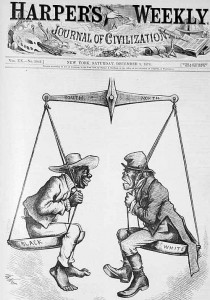
Interesting, dismaying read...
https://thesocietypages.org/socimages/2011/01/28/irish-apes-tactics-of-de-humanization/
Roma certainly have been heavily discriminated against yet their roaming lifestyle presents real issues.
Interesting, dismaying read...
Irish Apes: Tactics of De-Humanization
Lisa Wade, PhD on January 28, 2011
In the last few hundred years, dark-skinned peoples have been likened to apes in an effort to dehumanize them and justify their oppression and exploitation. This is familiar to most Americans as something that is done peculiarly to Black people (as examples, see here, here, and here). The history of U.S. discrimination against the Irish, however, offers an interesting comparative data point. The Irish, too, have been compared to apes, suggesting that this comparison is a generalizable tactic of oppression, not one inspired by the color of the skin of Africans.
https://thesocietypages.org/socimages/2011/01/28/irish-apes-tactics-of-de-humanization/
Roma certainly have been heavily discriminated against yet their roaming lifestyle presents real issues.
Vortigern99
Sorcerer Supreme

Thanks for that, madoc. The demonization of the Irish is a key bit of history supporting the assertion that race is not a valid biological concept.
If "white"-skinned groups can be oppressed and ostracized by other so-called "whites" on the basis of perceived racial differences, what is the truth value of race? Where does one group end and the other begin? If the Dutch, Scandinavians, Germans and English are "white", but the Irish are "black" or "apes" and Arabs and Jews are "swarthy" even though they have pale skin, what exactly does "white" mean?
The whole concept of race is invented, lacks truth value and clear delineation between groups, and worst, encourages discrimination and oppression.
If "white"-skinned groups can be oppressed and ostracized by other so-called "whites" on the basis of perceived racial differences, what is the truth value of race? Where does one group end and the other begin? If the Dutch, Scandinavians, Germans and English are "white", but the Irish are "black" or "apes" and Arabs and Jews are "swarthy" even though they have pale skin, what exactly does "white" mean?
The whole concept of race is invented, lacks truth value and clear delineation between groups, and worst, encourages discrimination and oppression.