
• Quick note - the problem with Youtube videos not embedding on the forum appears to have been fixed, thanks to ZiprHead. If you do still see problems let me know.

Question about light

The_Animus

Illuminator
Joined
Nov 24, 2006
Messages
3,584
Please note from the start of this that my knowledge on this subject is limited, hence the asking for clarification.

To my understanding this is how light works. Light is emitted from a source, (sun, lightbulb, etc.), and either travels to your eye, or reflects off an object and into your eye. From there it reacts with the rods and cones in your eyes which take the wavelength and the number of photons hitting your eye in a unit time and turns it into what you see as color and brightness.

Also the wavelength is a result of the energy of the light in electron volts eV.

So essencially the color and brightness we precieve from a lightsource or reflected from an object is determined by the amount of energy the light has and the photon density?

White light is a combination of all wavelengths of visible light. So when it is reflected off an object we percieve as blue it means that the object absorbed all of the wavelengths except the blue one, or possibly changed the eV of the light so it's now a blue wavelength?.

So does this mean that all objects are actually colorless? I know there is light and pigment, but even pigments need light to be seen. What causes objects to absorb only certain wavelengths/energy levels or to affect intensity?

And I know that light exists both as a wave and a particle, just not at the same time. I would assume with a wavelength the light would be in wave form, but for brightness it's the number of photons in a given time, which I would assume means particle state. So I know I'm not understanding something correctly here.

It's just interesting that a large amount of light can come from a source, such as the sun, and that all this light starts off basically the same, but ultimately changes as it interacts with any object which results in us seeing green plants, and brown dirt, and blue sky and so forth. It's almost like as light interacts with an object that object imprints information on it and then that information is there to be found, whether by our eyes or some device like a camera.

Any clarification or corrections on what I've said would be most excellent. I've been thinking about this after observations of the moon during a walk at night but haven't taken the time to learn more about it until now.
 
Last edited:
So does this mean that all objects are actually colorless? I know there is light and pigment, but even pigments need light to be seen. What causes objects to absorb only certain wavelengths/energy levels or to affect intensity?

Color is simply the perception of different wavelengths of light. We are able to perceive a certain range of wavelengths, which our brains interpret as color. Other organisms can perceive a smaller or larger range; the latter see colors that are invisible to us.

Each element has a particular color signature, which is what allows us to determine the composition of faraway objects. In fact, this is how the element helium was discovered, by observing its color signature in the sun, before it was ever found on Earth.
 
Please note from the start of this that my knowledge on this subject is limited, hence the asking for clarification.

To my understanding this is how light works. Light is emitted from a source, (sun, lightbulb, etc.), and either travels to your eye, or reflects off an object and into your eye. From there it reacts with the rods and cones in your eyes which take the wavelength and the number of photons hitting your eye in a unit time and turns it into what you see as color and brightness.

Also the wavelength is a result of the energy of the light in electron volts eV.

So essencially the color and brightness we precieve from a lightsource or reflected from an object is determined by the amount of energy the light has and the photon density?

White light is a combination of all wavelengths of visible light. So when it is reflected off an object we percieve as blue it means that the object absorbed all of the wavelengths except the blue one, or possibly changed the eV of the light so it's now a blue wavelength?.

So does this mean that all objects are actually colorless? I know there is light and pigment, but even pigments need light to be seen. What causes objects to absorb only certain wavelengths/energy levels or to affect intensity?
I would say that all objects have the color of the light that they produce either by emission or by reflections form other sources of light. That is beacuse the definition of color is what an object looks like to us.
You may want to read the Wikipeida article on color.

And I know that light exists both as a wave and a particle, just not at the same time. I would assume with a wavelength the light would be in wave form, but for brightness it's the number of photons in a given time, which I would assume means particle state. So I know I'm not understanding something correctly here.
It is more exact to say that light always has wave and particle properties (at the same time). The difference comes when you try to make a measurement of light.
If you conduct an experiment that measures a wave property (e.g. measure its wavelength using interference) then you see light acting as a wave. If you conduct an experiment that measures a particle property (e.g. look at the photoelectric effect) then you see light acting as a particle.
 
Just so you know. I'm addressing this question with the stuff I learned in solid state physics.

Photons couple to electrons as they transition from one energy state to another. Consider a lone hydrogen atom. The energy state of the electron is related to it's attraction to the proton in the nucleus. An electron may move into a higher "orbit" and absorb a photon with energy equal to this transformation. Alternatively, an electron may fall to a lower "orbit" and emit the lost energy as a photon. Note that the energy levels of the elctrons are quantized. In mathematical terms, an electron can only be in a state allowed by the solution of the Schroedinger equation which predicts discreet orbits around the proton. That means the electrons could be at orbit level A, the next highest orbit level B, but the electron cannot be in between A and B. Therefore, hydrogen atoms emit discreet bands of light when exited because electrons can only jump from A to B, A to C, B to C and so on.

In a material or molucule things become more complicated. The electrons exist inside a much more complicated electric field because they're now attracted to protons in neighboring atoms. The Schroedinger equation predicts many more allowable energy levels in this case. In a silicon crystal lattice, for example, the original discreet energy levels of an individual atom are blurred into a distribution called the state density function. This function has energy peaks with plenty of room for electrons, valleys with little room, and forbidden regions where no electron can exist. The end result is that some transitions are favored over others. Hence the color of Silicon crystals (greenish grey).
 
Last edited:
Wow, there's a lot to address in the OP, so I'll just stick to one specific thing for now... the question of the wave-particle duality of light.

First, you should read up on this curious feature of light here.

People are often confused when confronted with the fact that light behaves like a particle and, at the same time, it also behaves like a wave. How can it be both?

Here's an analogy to help you with your thinking on this point - one taught to me years ago by one of my physics professors when I had a similar question:

Imagine that you are an astronaut who journeys to a distant planet populated by intelligent beings. The environmental conditions on this world are such that only solids and gases can exist, so the aliens have no concept of what a liquid phase is.

You attempt to explain to them the concept of "liquid" by stating that it has the properties and behaviors of both solids and gases. The molecules within a liquid are cohesive and bound like a solid, yet they can move past one another and the liquid flows just like a gas. So a liquid has the properties of both solids and gases, yet it is not entirely one or the other - it's something else.

This is how I like to think about light. I hope it helps you.
 
To my understanding this is how light works. Light is emitted from a source, (sun, lightbulb, etc.), and either travels to your eye, or reflects off an object and into your eye. From there it reacts with the rods and cones in your eyes which take the wavelength and the number of photons hitting your eye in a unit time and turns it into what you see as color and brightness.

Pretty much.

Also the wavelength is a result of the energy of the light in electron volts eV.

It's not a result of the energy, energy and wavelength both describe exactly the same thing. The relationship between them is given by the de Broglie hypothesis.

So essencially the color and brightness we precieve from a lightsource or reflected from an object is determined by the amount of energy the light has and the photon density?

Yes.

White light is a combination of all wavelengths of visible light. So when it is reflected off an object we percieve as blue it means that the object absorbed all of the wavelengths except the blue one, or possibly changed the eV of the light so it's now a blue wavelength?.

The first one. We see objects as certain colours because they reflect light of certain wavelengths more than others. In order to get an object to emit light, it either needs to be at a high enough temperature to emit black body radiation of the relevant wavelength, or meet certain conditions to allow it to emit light in other ways, such as fluoresence. Since the majority of objects are too cold to emit visible light and can't emit light in other ways, they can only look blue, or any other colour, due to reflected light.

So does this mean that all objects are actually colorless? I know there is light and pigment, but even pigments need light to be seen.

Depends how you define "colour". Since colour is a property of light, it doesn't really make sense to talk about it in the absence of light. It's kind of like asking what a vacuum smells like.

What causes objects to absorb only certain wavelengths/energy levels or to affect intensity?

Well, PingOfPong has given a fairly detailed answer. Basically, it's all about electrons, which can only exist in certain energy levels in atoms and molecules. If the energy of a photon is the same as the difference in energy between two levels, it will be absorbed, if not, it won't. Pigments are simply molecules that happen to absorb most wavelengths in the visible spectrum, while reflecting the remainder very well. As for intensity, that can depend a lot on the structure of an object as well as it's chemical composition. For example, a highly polished metal will reflect almost all light, regardless of wavelength.

And I know that light exists both as a wave and a particle, just not at the same time. I would assume with a wavelength the light would be in wave form, but for brightness it's the number of photons in a given time, which I would assume means particle state. So I know I'm not understanding something correctly here.

It's as MattusMaximus says. Wave-particle duality does not mean photons, or other particles, exist either as waves or particles at different times, they exist as both all the time. Or, more accurately, they are neither but have properties of both. As I said earlier, the wavelength of a ray of light and the energy of a photon are both exactly the same thing, and the intensity of a ray of light and the number of photons are also the same things. All that changes is the way you measure it. If you measure light in a way that expects it to be particles, you will see particles. If you measure it in a way that expects it to be waves, you see waves. The reality is both and neither.

It's just interesting that a large amount of light can come from a source, such as the sun, and that all this light starts off basically the same, but ultimately changes as it interacts with any object which results in us seeing green plants, and brown dirt, and blue sky and so forth.

Well, it depends what you mean by it changing. Each indiviual photon stays pretty much the same, what changes is the proportion of photons with particular energies. If something reflects green light but absorbs red, the green photons that reach your eye are still the same as they were when they left the Sun, all that has changed is that the red photons are no longer there.

It's almost like as light interacts with an object that object imprints information on it and then that information is there to be found, whether by our eyes or some device like a camera.

Pretty much. Quite handy really.
 
People are often confused when confronted with the fact that light behaves like a particle and, at the same time, it also behaves like a wave. How can it be both?


I think you're misunderstanding the OP's question. He's not asking about the light, he's asking if an object has any intrinsic color of its own if color is nothing more than the wavelength of light that is reflected by the object.

I brought up the riddle of whether a tree falling in the forest makes a sound, because the answer depends on how you define sound. This problem is similar in that you have to define what you mean by color.


Steve S.
 
So when it is reflected off an object we perceive as blue it means that the object absorbed all of the wavelengths except the blue one, or possibly changed the eV of the light so it's now a blue wavelength?.

It depends on the object, as well as the amount of light, and the color of the light, as well as your eyes.

Simple example. A green leaf, full sunlight, healthy normal eyes. Pigments in the leaf absorb everything except what you see. So the green leaf actually is red, orange, yellow, blue, indigo and violet. What it is not, is green. So you see green, because those are the photons the leaf is not absorbing. Pigments in your eye absorb the green photons, which is why a leaf is green. Even when green is what it is not.

So does this mean that all objects are actually colorless?

It depends on what you mean by color.

I know there is light and pigment, but even pigments need light to be seen. What causes objects to absorb only certain wavelengths/energy levels or to affect intensity?

The electrons in the atoms and molecules absorb the photons. If an object doesn't absorb any photons, (or very few), it appears silver, or metal looking. Shiny, like stainless steel or un-oxidized aluminum. The color we associate with metals is actually the free electrons that are the surface of a metal. Reflecting the photons.

So you could say shiny metals are colorless.

But only if you want to start a huge row.
 
I brought up the riddle of whether a tree falling in the forest makes a sound, because the answer depends on how you define sound. This problem is similar in that you have to define what you mean by color.

If you define sound as shock waves traveling through a medium, a tree falling makes a sound. If you define it as those shock waves impinging on the sensory apparatus in your ear, which triggers a stimulus to your brain, which we call sound, then if you don't hear it, it makes no sound.

If you define color as what light is not absorbed by an object, an object has no color without light. Or, if you define color as what we see, it has no color unless we look at it.

If you define color as the photons that an object does not absorb, or emits, (like a hot object), then an object always has color. Like a bell always has a note, but only if you hit it. Unless you don't hear it, or something.

Everything depends on definitions. But we know how to define stuff, so that isn't a problem.
 
White light is a combination of all wavelengths of visible light. So when it is reflected off an object we percieve as blue it means that the object absorbed all of the wavelengths except the blue one, or possibly changed the eV of the light so it's now a blue wavelength?.

It's usually blue because it absorbs red/orange/yellow/etc. and reflects blue---that's why blue paint, or blue fabric, etc., appear blue. As usual, though, there are complications.

How about blue-colored glass? Rather than reflecting blue light, a blue filter might absorb everything except blue, and transmit blue. Or it might reflect some blue, transmit some blue, and absorb everything else. You can make glasses that do several different things--- for example, it might transmit red, reflect blue, and absorb everything else---these are called "dichroic". This sort of glass will look red if there's a light source behind it, but look blue if there's a light source in front of it.

And then there's fluorescence. You know those posters/paints that glow under "black light"? Those are absorbing high-energy photons (UV) and reemitting lower-energy photons (blue). So, under UV illumination, these materials look blue. Scientists use "fluors" all over the rainbow---things that absorb red and emit IR, or absorb green and emit yellow, etc.,---but the UV-to-blue ones are the only ones you're likely to see in daily life.
 
So essencially the color and brightness we precieve from a lightsource or reflected from an object is determined by the amount of energy the light has and the photon density?
What we perceive as color isn't quite as simple as you described here. Our eyes don't perceive color directly. They essentially have three color receptors which respond to different mixes of wavelengths in different ways. This leads to technology used in color TV and computer monitors that an appropriate mix of the three colors red, green and blue can be used to cause you to see any color in the spectrum.

This may not be relevant to your actual question, but if you really are asking about what we perceive it's important to know.
 
Colour is not always linked directly to the intensity of the light source, the Purkinje effect is perhaps the best known example of this exception

http://en.wikipedia.org/wiki/Purkinje_effect

In low light situations, the eye will actually only see in black and white, that is why the landscape often looks so different when viewed by the light of the Moon
 
In low light situations, the eye will actually only see in black and white, that is why the landscape often looks so different when viewed by the light of the Moon

It's also why you can't tell the difference between a blue sock and a brown sock in the morning when the light isn't on.

Steve S.
 
I think you're misunderstanding the OP's question. He's not asking about the light, he's asking if an object has any intrinsic color of its own if color is nothing more than the wavelength of light that is reflected by the object.

I brought up the riddle of whether a tree falling in the forest makes a sound, because the answer depends on how you define sound. This problem is similar in that you have to define what you mean by color.


Steve S.

If a tree falls in the forest it makes a sound (physically, as pressure-waves in the atmosphere), but is it a crashing sound or a tinkling sound :)? Like colour, that's to do with our perceptions, it's not intrinsic to the physical phaenomenon.
 
It's also why you can't tell the difference between a blue sock and a brown sock in the morning when the light isn't on.

Steve S.

Sidebar : the Islamic definition of dawn is the moment that a white thread can be distingushed from a black thread. It matters because that's when the muezzin launches his first shriek of the day.
 
Thank you all very much. Your explanations and detailed information were very helpful in clearing up a lot of my questions. I won't say I completely understand, but I do understand many things better than I did before.

So let's see...

If you consider colour to be soley a fuction of human vision. As in nothing has colour, it is all just various wavelengths of light until the point at which your eyes turn it into what we see as colour. Then nothing actually has colour, there is only various wavelengths of lights and different objects absorb, reflect, or transmitt these wavelengths. And there is also no such thing as light or dark, only the number of photons.

If you consider colour to be independent of an observer then objects have the colours of the wavelengths that are absorbed. And light has the colour of whatever wavelengths make it up. There was an example given about a leaf being every colour except green because it absorbs all wavelengths except green. Wouldn't this mean that most objects are brown/black/grey coloured as most objects absorb most colours except one or two?

The absense of light results in us seeing nothing, or seeing pitch black depending on how you want to refer to it. Would this mean that the things we see as black are absorbing almost all wavelengths but a very small amount still gets reflected? Which would basically mean that the things we see as black are actually just a really dark grey/blue or something?
 
Last edited:
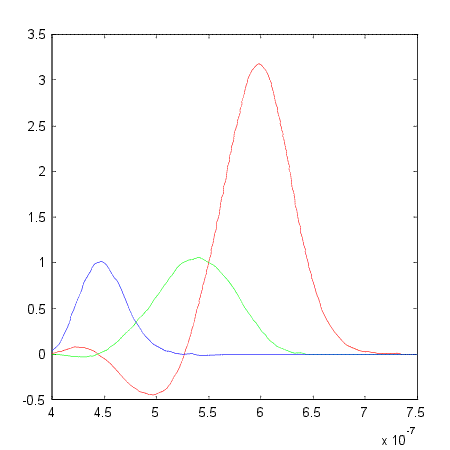
Our eyes don't perceive color directly. They essentially have three color receptors which respond to different mixes of wavelengths in different ways. This leads to technology used in color TV and computer monitors that an appropriate mix of the three colors red, green and blue can be used to cause you to see any color in the spectrum.
Technically, untrue. Monochromatic light at certain frequencies can only be matched with a subtractive red filter. Since RGB monitors are purely additive, they cannot reproduce those colors, which are particular shades of blue-green. Relative responses vs. wavelength in meters:
rgb_response.png

There is a bit of that for green as well. Better color reproduction could be done by adding a fourth channel to the standard RGB scheme.
 
Last edited:
There was an example given about a leaf being every colour except green because it absorbs all wavelengths except green.
I wouldn't phrase it like that. Rather, it is green because it absorbs all wavelengths except those we see as green.

Wouldn't this mean that most objects are brown/black/grey coloured as most objects absorb most colours except one or two?
If the object absorbs most colors except one or two, then it is a mixture of those colors (e.g., a mixture of red and green is yellow).

The absense of light results in us seeing nothing, or seeing pitch black depending on how you want to refer to it. Would this mean that the things we see as black are absorbing almost all wavelengths but a very small amount still gets reflected? Which would basically mean that the things we see as black are actually just a really dark grey/blue or something?
That's a reasonable definition, yes. If an object absorbs 99.95% of blue and much more (say, 99.99%) of other colors, then it could be said to be very dark blue, which under almost all light conditions would be indistinguishable from black.
 

Back
Top Bottom