QE3 -- Third Times' a Charm?

What does the current CPI exclude? Energy, food, and housing costs - the things everyone has to pay for ...

CPI doesn't exclude housing costs, it has a rental cost equivalent, which presumably is to prevent speculative purchasing from being counted towards actual inflation. Energy and food are excluded because they are volatile and do not necessarily give an adequate representation of rising/falling prices.
 
Facts like this in isolation are absolutely worthless.

It means that 98% of its purchasing power has been transferred to someone else (stolen), over a long period of time. The fact that tech and productivity gains have offset this somewhat is utterly and completely irrelevant to the fact that the purchasing power was still stolen. It's like saying that even though someone broke in my house and stole all of my possessions, I still have my house, and maybe it's even appreciated a little! Someone, somewhere (cronies of the Fed, of course) received a vast amount of something for absolutely nothing. This fact is of course, not worthless. It's important to understand.
 
CPI doesn't exclude housing costs, it has a rental cost equivalent, which presumably is to prevent speculative purchasing from being counted towards actual inflation. Energy and food are excluded because they are volatile and do not necessarily give an adequate representation of rising/falling prices.

They are excluded from core inflation, which is an important metric for detirmining when the economy is heating up or cooling down. The headline number, however, does include these
 
It means that 98% of its purchasing power has been transferred to someone else (stolen), over a long period of time. The fact that tech and productivity gains have offset this somewhat is utterly and completely irrelevant to the fact that the purchasing power was still stolen. It's like saying that even though someone broke in my house and stole all of my possessions, I still have my house, and maybe it's even appreciated a little! Someone, somewhere (cronies of the Fed, of course) received a vast amount of something for absolutely nothing. This fact is of course, not worthless. It's important to understand.

I know what people like YOU think it means. I also know you like to ignore the benefits of the evils of fiat and fractional lending that have gone hand in hand with these “tech and productivity” gains, by asserting that such gains have occurred “in spite” of such “counterfeiting” factors. The purchasing power, taken by itself, is irrelevant. If my dollar’s purchasing power has decreased by 98%, it doesn’t matter if I have relatively more dollars in my hand.

Nominal+Wage+and+Price.JPG


http://andolfatto.blogspot.com.au/2011/03/ron-pauls-money-illusion-sequel.html
 
Last edited:
They are excluded from core inflation, which is an important metric for detirmining when the economy is heating up or cooling down. The headline number, however, does include these

Yes, and nobody has been using core inflation to support their arguments.
I referred to headline inflation to refute balrog's assertion, and specifically the food component of inflation to refute balrog's assertion that the price of food had doubled in the last 4 years.
 
I know what people like YOU think it means. I also know you like to ignore the benefits of the evils of fiat and fractional lending that have gone hand in hand with these “tech and productivity” gains, by asserting that such gains have occurred “in spite” of such “counterfeiting” factors. The purchasing power, taken by itself, is irrelevant. If my dollar’s purchasing power has decreased by 98%, it doesn’t matter if I have relatively more dollars in my hand.

what about the money (probably not you but others) have earned and saved away over the years? we've been at negative real interest rates on and off since 2002, and +ve real rates are gone for good now until this whole system implodes and is replaced.

[qimg]https://lh6.googleusercontent.com/-wlsc9XsFBGs/TX9_apO4FLI/AAAAAAAAAac/ACBB_JUNrs8/s1600/Nominal+Wage+and+Price.JPG[/qimg]

http://andolfatto.blogspot.com.au/2011/03/ron-pauls-money-illusion-sequel.html

ah the one and only blogger who is allowed to be quoted and is of course completely independent, although he is a Federal Reserve employee

its not like he would want to attempt to justify or make excuses for 100 years of perfectly-bankster enriching debasement is it? lol
 
Last edited:
what about the money (probably not you but others) have earned and saved away over the years? we've been at negative real interest rates on and off since 2002, and +ve real rates are gone for good now until this whole system implodes and is replaced.

We're talking about the debasement of purchasing power since 1912 (or whichever year the crazies which to choose). Nobody is carrying around their 98% debased 1912 dollar anymore.

ah the one and only blogger who is allowed to be quoted and is of course completely independent, although he is a Federal Reserve employee

Actually, it's a blogger Tippet was nice enough to introduce me to when cherry picking Macromania's arguments. Since he's good enough for Tippet, and since he has posted on the subject of which we speak, he is a relevant source.

Your complaint re using that particular source is comical, given your obsession with zerohedge which you post at every opportunity.

its not like he would want to attempt to justify or make excuses for 100 years of perfectly-bankster enriching debasement is it? lol

Your assertions bereft of supporting evidence are noted. I'm sorry if a few basic facts fly in the face of your nutty opinions. Yeah Kevsta, everyone was much better off 100 years ago because $1 bought so much more then. Haha.
 
We're talking about the debasement of purchasing power since 1912 (or whichever year the crazies which to choose). Nobody is carrying around their 98% debased 1912 dollar anymore.

dodge noted. I'll ask again, what about people who have worked and saved all their lives? do they deserve to have their money continually inflated away ?

what about your parents pensions funds? all good? everybody should be happy with a 30% reduction in (USD) purchasing power in the last 11 years?

it all looks fine if you don't actually look at how much things have actually gone up and just swallow the government nonsense blindly.

so this, really doesnt ring any warning bells at all?

the debasement has been continuous and is now accelerating to the Nth power, glad you're happy with that, it implies to me that you own little and owe much, that you defend the dishonest but largely hidden inflation theft and a fully debt-based lifestyle.

Actually, it's a blogger Tippet was nice enough to introduce me to when cherry picking Macromania's arguments. Since he's good enough for Tippet, and since he has posted on the subject of which we speak, he is a relevant source.

Your complaint re using that particular source is comical, given your obsession with zerohedge which you post at every opportunity.

it wasn't a complaint, just noting that its the only blogger you ever quote, and that quoting (100% biased) blogs is ok when they support your argument.

Your assertions bereft of supporting evidence are noted. I'm sorry if a few basic facts fly in the face of your nutty opinions. Yeah Kevsta, everyone was much better off 100 years ago because $1 bought so much more then. Haha.

yes because the global & banking elites have done just terribly since the Fed's inception haven't they? :rolleyes:

some of the pseudoskeptics who inhabit this board's blind adherence to authorities' so obviously doctored data is really quite worrying.

I have a question for all who think the modern numbers are more accurate or reliable than the way we used to calculate it all before all the hedonics, imputations and distortions started getting used to keep numbers low, were gradually introduced..

..presumably then, because as we now know those numbers in the past weren't accurate, and inflation was obviously much lower (if the modern methods are used to look back) and unemployment was obviously much lower too..

so this must means all previous crises weren't actually ever crises at all, inflation was actually low in the 70's the great depression never happened, it was just a financial reporting error?

because if we use the same methodologies of those times, we find we are in as bad condition now, as then?

why are "skeptics" here so willing to accept government driven accounting changes today which lead to apples to oranges comparisons with previous periods in history without going back and revising the history books as being incorrect?

 
Last edited:
I know what people like YOU think it means. I also know you like to ignore the benefits of the evils of fiat and fractional lending that have gone hand in hand with these “tech and productivity” gains, by asserting that such gains have occurred “in spite” of such “counterfeiting” factors. The purchasing power, taken by itself, is irrelevant. If my dollar’s purchasing power has decreased by 98%, it doesn’t matter if I have relatively more dollars in my hand.

It's obviously not irrelevant, if you had to actually work to acquire those dollars, where a central banker conjured massive amounts of it out of thin air and lent it to his cronies.

Andolfatto is a clown. Monetary debasement typically inflates asset prices which are not counted as part of the general price level. So wealth is effectively condensed to the elite beneficiaries of money printing in the form of acquiring assets for no cost. The rest of us, who own various financial assets, are somewhat immunized, and the poor, who own virtually no financial assets, are destroyed. A loss of your purchasing power is always relevant, because absent economic calamity, it represents theft. Nothing more, nothing less. The fact that those who benefit from institutional counterfeiting ultimately recycle these dollars back into the economy by selling assets and exchanging the proceeds for real goods and services (thereby causing the price level, and later wages to rise), doesn't change the fact that you were ripped off to begin with.
 
That's not how it works.

Bonds are auctioned off in the market. The higher the bid for the bond, the lower the effective interest rate. So it is the market not the government that sets the interest rate on the bonds.

Except that Bernanke is the biggest participant in that market. The Fed holds ~ $1.7Trl of Treasuries and is the largest holder (China is #2 at $1.15Trl).. A good fraction of this was purchased by the Fed at auction during operation twist where the Fed was purchasing as much as 65%of offered notes & bonds.

Further, monetary easing involves purchase of Treasuries or other assets in exchange for cash, and this impact the price of bonds & notes in an upward direction (lower interest rates). Of course QE3 is planning to purchase half a trillion dollars of mortgage backed securities per year to add to the Fed's ~$1.25Trl of MBS. More central planning - jack up the housing market by printing money and absorbing debt.

H*ll yes the Fed impacts Treasury rates, and also mortgage rates.

But QE should also increase inflation eventually. If we consider the quantity theory of money then the current modest inflation might be attributed to low velocity of money. Consumer spending is back to a near peak, but investment and biz capital spending are way off.

Bernanke argues that hyperinflation only happens when nations try to monetize foreign debt, but that's too glib by half.


The more money there is, the more that is bid on bonds. So printing money has the benefit of reducing the servicing cost of government debt. However, you can only go so far with this before you bring the whole house of cards crashing down.

There is some real inflation already - tho' modest, but generally above the 10yr bond rate. So people are oddly people buying bonds can expect negative real returns.

Stagflation is the basis of neo-Keynesian revisions, and they argue that it's caused by supply reduction rather than increased consumption & demand. So the lack of business capital (small biz can't readily borrow today), the lack of business growth and things like international trade disruptions would play into the stagflation scenario.

So if we grow nicely out of the current doldrums we can see demand side inflation explode. If Asia or the MiddleEast get ugly or our biz capitalization problems continue, or eve nif the deficit is closed we'll see supply side inflation. I'd strongly prefer the former, but believe the latter is more likely.

Either way US debt service and social spending will get (more) out of control while destroying the savings of the elderly and pension funds. I won't call "crash", econ systems are shockingly resilient, but it's pretty easy to see that possibility in the cards. BTW some studies show economies can survive even 50%-100%/month inflation !

Third time's the harm, perhaps, but the day of reckoning is unpredictable.
 
They are excluded from core inflation, which is an important metric for detirmining when the economy is heating up or cooling down. The headline number, however, does include these

By "headline" you mean CPI.
By "important metric for detirmining when the economy is heating up or cooling down" you mean unsupportable data distortion to support defective economic theory that can't account for volatility.

I got the newspeak translation memo.

Bpp has some reasonable pretension of accuracy and objectivity, CPI is a crude attempt at same.. Core is not - it's a political fantasy,
http://bpp.mit.edu/usa/
 
Last edited:
It's obviously not irrelevant, if you had to actually work to acquire those dollars, where a central banker conjured massive amounts of it out of thin air and lent it to his cronies.

It is irrelevant in isolation, just like I said. Nobody is holding onto their 1912 dollars for 100 years only to find their purchasing power “stolen”.

Andolfatto is a clown.

Except when he agrees with you, right?

Monetary debasement typically inflates asset prices which are not counted as part of the general price level. So wealth is effectively condensed to the elite beneficiaries of money printing in the form of acquiring assets for no cost. The rest of us, who own various financial assets, are somewhat immunized, and the poor, who own virtually no financial assets, are destroyed. A loss of your purchasing power is always relevant, because absent economic calamity, it represents theft. Nothing more, nothing less. The fact that those who benefit from institutional counterfeiting ultimately recycle these dollars back into the economy by selling assets and exchanging the proceeds for real goods and services (thereby causing the price level, and later wages to rise), doesn't change the fact that you were ripped off to begin with.

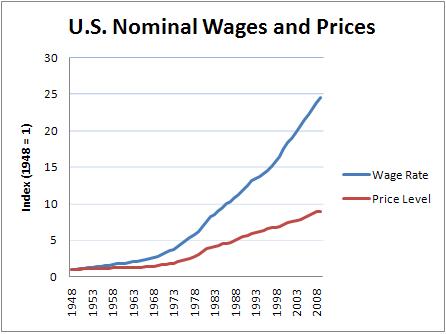
I’m not disputing the fact that monetary debasement finds its way into asset prices. But the “98% theft” of 1912 dollars doesn’t refer solely to asset prices; crazies will refer to how much bread or milk could be bought 100 years ago for a dollar compared to today. But the fact is that the poor of today are far better off than they were 100 years ago, monetary debasement or not. As the graph I posted shows, wages increased 2.5x compared to the general price level since 1948. Hence, your average workers’ purchasing power has increased more than two times in that period. When purchasing power of single units was actually increasing, ie during the Depression, nobody had any money but crazy people that look at purchasing power of single units in isolation think that was a good thing?
 
By "headline" you mean CPI.

Yes, the headline CPI number does include food and energy. If you see it referred to as core, it does not.


By "important metric for detirmining when the economy is heating up or cooling down" you mean unsupportable data distortion to support defective economic theory that can't account for volatility.

No I mean it's an important indicator for when there is more money in circulation than the economy needs. Volatile items like food and energy change for other reasons are are therefor not a good way to make money supply decisions.
 
It is irrelevant in isolation, just like I said. Nobody is holding onto their 1912 dollars for 100 years only to find their purchasing power “stolen”.

The example demonstrates the perpetuality and scope of the looting. It doesn't require you or your ancestors to have actually saved a 1912 dollar in order to have been looted.

Except when he agrees with you, right?

Nonsense. Even clowns can be right twice per day.

I’m not disputing the fact that monetary debasement finds its way into asset prices. But the “98% theft” of 1912 dollars doesn’t refer solely to asset prices; crazies will refer to how much bread or milk could be bought 100 years ago for a dollar compared to today. But the fact is that the poor of today are far better off than they were 100 years ago, monetary debasement or not.

For the last time, just because productive people have created more and more of what dollars can buy, doesn't justify the dilution of dollars for the benefit of the few. You can spin this or call it irrelevant as much as you want, but it doesn't make it any less true.

As the graph I posted shows, wages increased 2.5x compared to the general price level since 1948. Hence, your average workers’ purchasing power has increased more than two times in that period. When purchasing power of single units was actually increasing, ie during the Depression, nobody had any money but crazy people that look at purchasing power of single units in isolation think that was a good thing?

The purchasing power of dollars increased because, as Milton Friedman correctly pointed out:

“The Federal Reserve definitely caused the Great Depression by contracting the amount of money in circulation by one-third from 1929 to 1933.”

No surprise there. If you were lucky enough to have a job, or the foresight to short the market and/or get all cash, you were doing pretty well, assuming the wheels of production didn't grind to a complete halt, which it didn't.
 
It is irrelevant in isolation, just like I said. Nobody is holding onto their 1912 dollars for 100 years only to find their purchasing power “stolen”.

[snip]


Aren't they? What are the people saving in gold and silver doing then?? :rolleyes:
 
The example demonstrates the perpetuality and scope of the looting. It doesn't require you or your ancestors to have actually saved a 1912 dollar in order to have been looted.

And you continue to ignore the fact that ~everyone has more of the individual units, the value of which have been “looted”. Average US wage in 1912 ~$750. Average wage in 2012, over ~$40,000. (these aren’t intended as exact figures, just lazy google searches to give an approximation.) So again, in isolation, the fact that 1912 dollars are virtually worthless today is irrelevant. If on the other hand, you could show that the average 2012 wage was still around $750, then you might have a point to make. As it stands though, alone, the statistic is meaningless.

For the last time, just because productive people have created more and more of what dollars can buy, doesn't justify the dilution of dollars for the benefit of the few. You can spin this or call it irrelevant as much as you want, but it doesn't make it any less true.

And again, you continue to ignore the role that fiat currencies and your other favourite, fractional lending, have played in allowing “productive people” to be more productive, efficient, creative or ingenious. You continually assert, but do not support, that such production has occurred “in spite” of said looting, but have not shown how it has been anything other than concurrent.

The purchasing power of dollars increased because, as Milton Friedman correctly pointed out:

“The Federal Reserve definitely caused the Great Depression by contracting the amount of money in circulation by one-third from 1929 to 1933.”

No surprise there. If you were lucky enough to have a job, or the foresight to short the market and/or get all cash, you were doing pretty well, assuming the wheels of production didn't grind to a complete halt, which it didn't.

No role played by the Gold Standard at all, haha!
 
I thought this was rather telling from the full transcript of the Romney 47% comments.

Romney: Yeah, it's interesting…the former head of Goldman Sachs, John Whitehead, was also the former head of the New York Federal Reserve. And I met with him, and he said as soon as the Fed stops buying all the debt that we're issuing—which they've been doing, the Fed's buying like three-quarters of the debt that America issues. He said, once that's over, he said we're going to have a failed Treasury auction, interest rates are going to have to go up. We're living in this borrowed fantasy world, where the government keeps on borrowing money. You know, we borrow this extra trillion a year, we wonder who's loaning us the trillion?

The Chinese aren't loaning us anymore. The Russians aren't loaning it to us anymore. So who's giving us the trillion? And the answer is we're just making it up. The Federal Reserve is just taking it and saying, "Here, we're giving it.' It's just made up money, and this does not augur well for our economic future.


You know, some of these things are complex enough it's not easy for people to understand, but your point of saying, bankruptcy usually concentrates the mind. Yeah, George.
 
Last edited:
No role played by the Gold Standard at all, haha!

yes it's all the fault of an inert piece of metal isn't it, nothing to do with the human gyrations and machinations of the time

Others including Federal Reserve Chairman Ben Bernanke and Nobel Prize winning economist Milton Friedman place most or all of the blame for the severity of the Great Depression at the feet of the Federal Reserve, mostly due to the deliberate tightening of monetary policy.[14] The US economic contraction in 1937, the last gasp of the Great Depression, is blamed on tightening of monetary policy by the Federal Reserve resulting in a higher cost of capital and weaker securities markets, a reduced net government contribution to income, the undistributed profits tax, and higher labor costs.[15
:rolleyes:
 
Last edited:
Clearly you've never read anything Bernanke has written on the subject. I am not surprised. Have fun with Wiki, pleb.
 

Back
Top Bottom