• Quick note - the problem with Youtube videos not embedding on the forum appears to have been fixed, thanks to ZiprHead. If you do still see problems let me know.

Merged Puzzling results from CERN

I've merged some of smaller threads about this topic into this thread, hopefully it's not too confusing.
Posted By: Darat
 
This isn't the first rumor of a violation of C.

You're right. This is in fact the second violation of causality at the LHC this year. The first one is coming up in December.
 
No. You've misunderstood what that's a formula for.

SR says exactly the opposite. Assuming the two photos are moving in opposite directions, their relative velocity is 2c is all reference frames.

But if one photon is the reference frame, then that formula results in 1c.
 
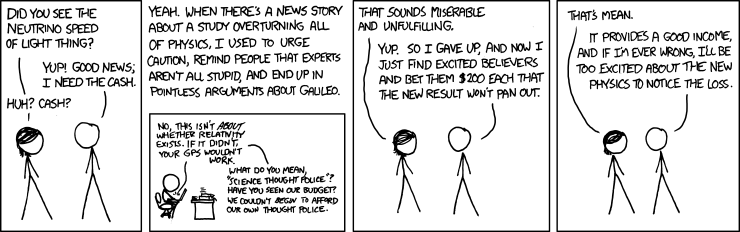
And of course, Mr. Monroe hits it out of the park

neutrinos.png

http://xkcd.com/955/
 
Anybody else wondering when will we see the first crackpot thread that claims this validates their crazy 'theory'?
Or the first fundamentalist screaming, "Look, science was wrong again!"

It's really too bad they can't understand that this is not an embarrassment to science, but in fact an object lesson in how science at its best works, and how tremendously exciting this development is if the results hold up. And how we will still have learned something (flaws in the measurement, an overlooked glitch in the experiment protocol, whatever) if the results don't hold up.


An interesting analysis about the experiment on another forum:

http://www.bautforum.com/showthread.php/121344-Speed-of-light-exceeded?p=1937635#post1937635

Will be interesting to see how this will turn out! Physics is such a wonder science - if the fundamentalists would only understand how embarrasingly primitive they are when they start competing with science about understanding the natural world...
Yes, exactly.
 
There was a pretty reasonable piece on the bbc radio news. a physicist, who's name I didn't catch described her interpretation of the arvix paper and the significance of the result, were it show to be true.
* the distance measurement seems pretty solid.
* she suspects error in synchronizing the two clocks
* breaking the c limit means breaking conservation of energy

Can't wait for the free energy dudes to latch onto that last one :)
 
I think xkcd has the proper perspective on the subject.

I agree with xkcd that this will eventually end up on the 'oh dear we were not right, these things did not go faster than light.' Not sure how long it will take though. There will be heaps of people looking at these results though.
 
Some of the future tense jokes here are hilarious. :D

This makes the Picard Maneuver feasible, yah?
 
A lot of people are focussing on possible errors on the travel distance, but there's another important distance that's just as important - cables. Electrical signals take time to travel, and in experiments where such short times are being measured, cable lengths are absolutely critical. Obviously I'm not suggesting they haven't thought of this, since presumably they know what they're doing, but it's a very easy area for errors to creep in. I know we've had issues before with timing not matching up properly because one cable out of thousands wasn't quite the right length.

And it's not just cables that can cause problems like this. You also need to know things like how long it takes for a bit of code to run, how fast your detector responds to a hit, how fast your electronics can respond to that detector signal, and so on. Again, I'm not saying they won't have considered this, but this is an area where it's very easy for mistakes to go unnoticed and be difficult to track down even if you suspect they're there. All it takes is one piece of code to take a couple of CPU cycles less to run than in testing, or a cable to be a few centimetres shorter than you thought (30cm will give about 1ns delay), and there's your missing nanoseconds.
 
You also need to know things like how long it takes for a bit of code to run, how fast your detector responds to a hit, how fast your electronics can respond to that detector signal, and so on. Again, I'm not saying they won't have considered this, but this is an area where it's very easy for mistakes to go unnoticed and be difficult to track down even if you suspect they're there. All it takes is one piece of code to take a couple of CPU cycles less to run than in testing, or a cable to be a few centimetres shorter than you thought (30cm will give about 1ns delay), and there's your missing nanoseconds.

The IT Security guys were running an unapproved software scan at the time.

At least, that's what is always happening when the timing on my computer goes wonky during the busiest time of the day (still don't understand why they have to do these things in the middle of the work day...every time).
 
Last edited:

Back
Top Bottom