• Quick note - the problem with Youtube videos not embedding on the forum appears to have been fixed, thanks to ZiprHead. If you do still see problems let me know.

punctuated equilibrium

hammegk said:


Good supporting evidence will be speciation from say, wheat, to palm trees. Queer fruit flies with legs where the eyes should be also show that gene manipulation controls structure, BFD.

Still waiting on Darwin to support his contention.


I'd say that this would be a great proof of a miracle, to go from a wheat plant to a palm tree would be very cool and probably magiacl.

This is somewhat akin to asking a tree to go from seed to towering majesty and then split cords of firewood.

My point is that the shift from one species to another does require the shift from one trait to another and the addition of traits, there is little evidence that there was this miracle transformation overnight. There is the evidence of the gradual shift of a species over geologic time.
 
Dancing David said:

I'd say that this would be a great proof of a miracle, to go from a wheat plant to a palm tree would be very cool and probably magiacl.
I'd agree that was Too much hyperbole. Evolutionists have denigrated the word "species" to be meaningless in the actual world of obviously different life-forms, so look at it as an attention getter.

Note that the discussion of punctuated equilibrium vs. 'slower' change brings nothing to the discussion other than arguing over whether "real speciation -- if you get my drift here" occurs over 10's of millions of years, or much more rapidly. In either case having faith that random change and environmental variability are the meaningful directive factors. I.E. unquestioningly accept that only an objective physical world exists.

If you feel comfortable with that assumption, so be it; just admit that is your assumption held on faith. Science works equally well under idealism or under physicalism.
 
hammegk said:


My kudos to all above for their brilliant responses and enlightening comments in re punctuated equilibrium.
A :rub: for each of you.

Get yer hands offa me, creep!
 
hammegk said:

. In either case having faith that random change and environmental variability are the meaningful directive factors. I.E. unquestioningly accept that only an objective physical world exists.

When the change is observed and the variability is observed, there is no need for faith.

Please pander elsewhere.
 
hammegk:
Evolutionists have denigrated the word "species" to be meaningless in the actual world of obviously different life-forms, so look at it as an attention getter.
The use of the word species does in fact fail tests of consistency. Nobody would look at the fossils of chihuahuas and great danes and conclude that they were the same species. And wolves, hounds, and coyotes are considered different species yet interbreed readily. There are many other examples but that's a nicely common demonstration.
hammegk:
Note that the discussion of punctuated equilibrium vs. 'slower' change brings nothing to the discussion other than arguing over whether "real speciation -- if you get my drift here" occurs over 10's of millions of years, or much more rapidly.
Since you failed to notice, I'd like to point out that that was, in fact, the discussion in progress in this thread.
hammegk:
In either case having faith that random change and environmental variability are the meaningful directive factors. I.E. unquestioningly accept that only an objective physical world exists.
Unquestioningly accept? No. Accept after, say, offering a million dollars for evidence to the contrary, and searching all over for any such evidence that can stand up to any sort of scrutiny? That's not faith, I'm afraid.

When ALL the evidence points in one direction, that direction is not an unreasonable assumption.
hammegk:
If you feel comfortable with that assumption, so be it; just admit that is your assumption held on faith. Science works equally well under idealism or under physicalism.
Faith in the tenets of empiricism, perhaps, which BTW essentially means faith in the very concept of evidence. I'll accept that, although I don't think it's what you meant.
 
Pyrian said:
The use of the word species does in fact fail tests of consistency. Nobody would look at the fossils of chihuahuas and great danes and conclude that they were the same species. And wolves, hounds, and coyotes are considered different species yet interbreed readily. There are many other examples but that's a nicely common demonstration.

A correction here, Pyrian. The BSC no longer relies on morphology except for paleobiology and microbes. Dog, wolf and coyote karyotypes have been analyzed, and the differences found to be small enough to reclassify them. My dogs are now Canis lupus familiaris, a recognition that they are wolves. (They want me to add, much better looking. Of course.)

Cheers,
 
hammegk said:
My kudos to all above for their brilliant responses and enlightening comments in re punctuated equilibrium.
A :rub: for each of you.

He's been a smarmy sack of s*** (I think SSoS will be my new pet name for him) for as long as I can remember, but for some reason, I gusss masochism I just can't stop replying sometimes.

While discussing speciation (yes, tangental from abiogenesis, but an opinion was offered by SSoS:

Originally posted by SSoS
Good supporting evidence will be speciation from say, wheat, to palm trees. Queer fruit flies with legs where the eyes should be also show that gene manipulation controls structure, BFD.

Still waiting on Darwin to support his contention.

Aside from that fact he's so ignorant he doesn't know that wheat turning into a palm tree would completely destroy common descent not support it he was presented with evidences that do support speciation and validate common descent.

Since he appears to be too lazy, wilfully ignorant or concerned that facts might upset his fiendishly clever tactic of obfuscation and hand waving, let's just cut and past a relatively simple evidence for him in the hopes that he might have enough knowledge of the scientific method to understand it, and what it means.

http://www.talkorigins.org/faqs/comdesc/section4.html#pseudogenes
Prediction 4.4: Molecular evidence - Redundant pseudogenes

Other molecular examples that provide evidence of common ancestry are curious DNA sequences known as pseudogenes. Pseudogenes are very closely related to functional, protein-coding genes. The similarity involves both the primary DNA sequence and often the specific chromosomal location of the genes. The functional counterparts of pseudogenes are normal genes that are transcribed into mRNA, which is in turn actively translated into functional protein. In contrast, pseudogenes have faulty regulatory sequences that prevent the gene from being transcribed into mRNA, or they have internal stop codons that keep the functional protein from being made. In this sense, pseudogenes are molecular examples of vestigial structures.

However, pseudogenes are included here under a separate prediction because many pseudogenes are unusual in an additional way. Morphological vestiges have lost their original function, and the organism carrying the vestige has likewise lost that function. In contrast, pseudogenes have lost their original function, yet the organism itself may still retain that function if it carries the functional counterpart of these pseudogenes. Pseudogenes that are vestigial in the morphological sense, like the vitamin C synthesis pseudogene, are considered in prediction 2.3. The remaining type of pseudogene, in which an organism carries both a functional gene and one or more counterpart pseudogenes, is hereafter termed a "redundant pseudogene."

Most pseudogenes are largely non-functional. There are several lines of evidence that support this conclusion. First, the presence or absence of most specific pseudogenes has no measurable effect on organismal phenotype. Second, there are good mechanistic, genetic arguments indicating pseudogenes have little, if any, function. Pseudogenes have complex sequences highly similar or identical to those required for the proper function of other enzymatic or structural proteins. These normal genes are actively transcribed and translated into proteins, whereas pseudogenes are not. Thus, pseudogenes cannot perform the functions of the proteins they encode. If pseudogenes do have a function, they must perform relatively simple functions for which the protein encoded by them was not designed. Note that some pseudogenes are the non-functional counterparts of structural or enzymatic RNAs that are never normally transcribed into protein. In fact, the first pseudogenes ever discovered were broken pseudogenes related to normal ribosomal RNA genes.

Third, simple functions do not require highly specific, complex DNA sequences. If a pseudogene has little or no function, then most mutations in the pseudogene will have no functional consequences, and the mutations will not be weeded out by purifying selection. Therefore, we expect that pseudogenes should accumulate mutations at the background rate of mutation. As expected if pseudogenes have little, if any, function, the majority of pseudogenes accumulate mutations at the fastest rate known for any region of DNA in animal genomes. Furthermore, the rate of mutation inferred for pseudogenes from phylogenetic analysis matches very closely the measured rates of spontaneous mutations. For more information and references, see Prediction 5.8.

Fourth and finally, we understand how redundant pseudogenes are created, and we have observed the creation of new redundant pseudogenes in the lab and in the wild. Redundant pseudogenes originate by gene duplication and subsequent mutation. Many observed processes are known to duplicate genes, including transposition events, chromosomal duplication, and unequal crossing over of chromosomes.

These facts offer strong support for the conclusion that most pseudogenes have little, if any, function. Like transpositions (see prediction 4.3), the creation of new redundant pseudogenes by gene duplication is a rare and random event and, of course, any duplicated DNA is inherited. Thus, finding the same pseudogene in the same chromosomal location in two species is strong evidence of common ancestry.

Confirmation:
There are very many examples of redundant pseudogenes shared between primates and humans. One is the øç-globin gene, a hemoglobin pseudogene. It is shared among the primates only, in the exact chromosomal location, with the same mutations that destroy its function as a protein-coding gene (Goodman et al. 1989). Another example is the steroid 21-hydroxylase gene. Humans have two copies of the steroid 21-hydroxylase gene, a functional one and a untranslated pseudogene. Inactivation of the functional gene leads to congenital adrenal hyperplasia (CAH, a rare and serious genetic disease), giving positive evidence that the 21-hydroxylase pseudogene lacks its proper function. Both chimpanzees and humans share the same eight base-pair deletion in this pseudogene that renders it incapable of its normal function (Kawaguchi et al. 1992).

Potential Falsification:
As explained above, observed gene duplications are rare and random events. Thus, it is highly unlikely that other mammals would have these same redundant pseudogenes in the same chromosomal locations, with the same mutations that cripple their normal functions. For instance, it is essentially impossible for mice to carry the 21-hydroxylase pseudogenes, in the same genomic location, with the same eight base-pair deletion that destroys its enzymatic function.

Furthermore, once a gene is duplicated and mutations render it a redundant pseudogene, it is inherited by all descendents. Thus, once certain organisms are found that carry the same pseudogene, common descent requires that all organisms phylogenetically intermediate must also carry that pseudogene. For example, suppose we find that humans and old world monkeys share a certain redundant pseudogene. According to common descent, all apes (including chimpanzees, gorillas, orangutans, and siamangs) must also necessarily carry that same redundant pseudogene in the same chromosomal location. This conclusion rests on the premise that there are no mechanisms for removing pseudogenes from genomes (or that the mechanisms are very inefficient). This apparently is true for vertebrates, but some organisms with short generation times, such as bacteria, protists, and Drosophila are known to have mechanisms that remove excess DNA.

Note that, though pseudogenes are curious because they are usually non-functional, this confirmation and potential falsification are independent of whether a specific pseudogene has a function or whether it is completely non-functional, for the same reasons explained in the prediction on morphological vestiges. Like any other genetic element, evolutionary opportunism may occasionally take a pseudogene and press it into a new and different function.

Let's see if he can address even a single important evidence for speciation and common deseent. I'm guessing we'll get the "change the topic" or "handwave." I'm quivvering with anticipation as to which it will be... :rolleyes:
 
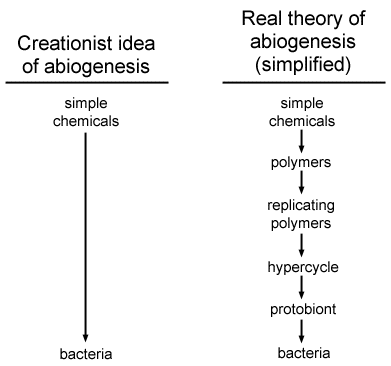
Anyway since SSoS is instant that we ignore his assertion about speciation, let's go ahead and address abiogenesis and one of the major misconceptions about it - life suddenly coming from non-life.

http://www.talkorigins.org/faqs/abioprob/abioprob.html

views.gif


Note that the real theory has a number of small steps, and in fact I've left out some steps (especially between the hypercycle-protobiont stage) for simplicity. Each step is associated with a small increase in organisation and complexity, and the chemicals slowly climb towards organism-hood, rather than making one big leap [4, 10, 15, 28].

Where the creationist idea that modern organisms form spontaneously comes from is not certain. The first modern abiogenesis formulation, the Oparin/Haldane hypothesis from the 20's, starts with simple proteins/proteinoids developing slowly into cells. Even the ideas circulating in the 1850's were not "spontaneous" theories. The nearest I can come to is Lamarck's original ideas from 1803! [8]

Given that the creationists are criticising a theory over 150 years out of date, and held by no modern evolutionary biologist, why go further? Because there are some fundamental problems in statistics and biochemistry that turn up in these mistaken "refutations".

The rest of the article is worth reading. I hope SSoS will not be too lazy to actually read it.
 
UnrepentantSinner said:


He's been a smarmy sack of s*** (I think SSoS will be my new pet name for him) for as long as I can remember, but for some reason, I gusss masochism I just can't stop replying sometimes.
And this from someone who proudly proclaims his ego as the highest power that exists, after blind acceptance of the intuitive notion that "the objective physical world exists" and that he is at best a bit of miscellaneous supervenience.


Aside from that fact he's so ignorant he doesn't know that wheat turning into a palm tree would completely destroy common descent ...
As previously mentioned by me, perhaps you should check up on the use of hyperbole as an attention getter (something like whacking an unmoving jackass in the head with a 2x4 to alert him you've lit a fire under his belly).


Since he appears to be too lazy, wilfully ignorant or concerned that facts might upset his fiendishly clever tactic of obfuscation and hand waving, let's just cut and past a relatively simple evidence for him in the hopes that he might have enough knowledge of the scientific method to understand it, and what it means.
You are an egotistical ass, aren't you?

Ignoring that minor problem, let's consider abiogenesis first. So far as I know I think we can even get a YEC to agree that the sequence of intermediate stage guesses you provided for the science example would fit equally well under his side. I do wonder who you think represents the creationist ideal you presented? It isn't me anyway.

Anyway, the problem you choose to ignore with the scientific example is the point at which you will define as life. Terra-centricism implies "after simple chemicals", but neither you or I will ever know the true answer. That is, what is happening at levels we currently analyze as less complex than simple chemicals?

If I tell you "life" is the unpredicable reaction of something to a stimulus, why am I apriori wrong?

In re the deposition on pseudogenes; yup, the terran things meeting our current definition of "life" use the same basic building blocks -- how very amazing!

And the final hurdle none of us will completely determine is 'did we form (terran) life with the physio-chem arrangement we just built, or does "existing life" choose to animate our structure & environment that it finds to its' liking'?

Pyrian said:

Since you failed to notice, I'd like to point out that that was, in fact, the discussion in progress in this thread.
I noticed it, thanks. I was just pointing out that the PE controversy is nothing more than a red herring, diverting attention from other troubling aspects of the Theory.
 
Actually you lying SSoS I have never once claimed my ego to be the highest power that exists. I have repeatedly offered during our exchanges that I feel many other levels of "power" are superior to my own sensations of such.

Hey, I'm half tempted to tell you about some personal details in my life to prove that sex and personal gratification does NOT overpower love and self-sacrifice, but I'm afraid you'd think I was lying at my wholly truthful and unfortunately pathetic anecdote.

Anyway, I'm nearing my bed time (night shift you know) and I must offer both kudos and thank yous for the (comparatively) lengthy reply. I shall endevour to reply as ernestly later this weekend.
 
hammegk said:
And this from someone who proudly proclaims his ego as the highest power that exists, after blind acceptance of the intuitive notion that "the objective physical world exists" and that he is at best a bit of miscellaneous supervenience.

...

Ignoring that minor problem, let's consider abiogenesis first. So far as I know I think we can even get a YEC to agree that the sequence of intermediate stage guesses you provided for the science example would fit equally well under his side. I do wonder who you think represents the creationist ideal you presented? It isn't me anyway.

Anyway, the problem you choose to ignore with the scientific example is the point at which you will define as life. Terra-centricism implies "after simple chemicals", but neither you or I will ever know the true answer. That is, what is happening at levels we currently analyze as less complex than simple chemicals?

If I tell you "life" is the unpredicable reaction of something to a stimulus, why am I apriori wrong?

In re the deposition on pseudogenes; yup, the terran things meeting our current definition of "life" use the same basic building blocks -- how very amazing!

And the final hurdle none of us will completely determine is 'did we form (terran) life with the physio-chem arrangement we just built, or does "existing life" choose to animate our structure & environment that it finds to its' liking'?


I noticed it, thanks. I was just pointing out that the PE controversy is nothing more than a red herring, diverting attention from other troubling aspects of the Theory.
Wow. I am awed by ... by ... something.

hammy, I want to participate in this discussion with you, but I have to get in the right frame of mind. What are you doing? Blotter? Windowpane? Microdot?

Anyway, as usual, you are as a clear as mud. But you have revealed a clue above:
... the final hurdle none of us will completely determine is 'did we form (terran) life ...
So this is the embarassing family member locked in the attic of your delusion? Please enlighten us some more about the extra-terrestrial origins of life on Earth that your magic *I* has perceived. You do a great disservice to science and humanity by withholding in a maze of riddles.
 
from hammegk:
In re the deposition on pseudogenes; yup, the terran things meeting our current definition of "life" use the same basic building blocks -- how very amazing!
Face it, UnrepentantSinner, this guy is simply unable to understand even as clear an argument as you cited.
 
Hammy, if you move the problem of abiogenisis "off planet" how does that make it less intractible?.
 
Sorry, kids. I don't intend to move the abiogenesis problem of terran life off-world, only to point out that our earth-centric "life" definition may be the blind man examining the elephant, and that even "terran, rna/dna/H-C/life" may be an insignificant subset of "life".
 
I'm sorry, but how does the existence (or non-) of extraterrestrial life in any way change observed evolution on this planet?

For everyone, please forgive me if this starts Hammbone off on a rant.
 
JSFolk said:
I'm sorry, but how does the existence (or non-) of extraterrestrial life in any way change observed evolution on this planet?

For everyone, please forgive me if this starts Hammbone off on a rant.
Pshaw, JS. Why worry about getting Virginia Ham going? It doesn't take much to get a drive-by venom squirting from this one.

Moving the question off-planet is, simply, question-begging. And reframing the question as either earth-centric or carbon-centric can only be viewed as a strawman.

The basic one-trick pony that is Virginia Ham is the analytic-level-blur. Evolution concerns itself with the question of how life, once started, created such diversity. Abiogenesis concerns itself with the question of how we got from non-life to life. Ham mixes these two together and tries to make spam. When he gets called on this, he goes further. Oh, we're terran-centric. Oh, we're stuck on simple molecules. The real question that we'll never get to is what is below those. No, no, below those. No, no, below that too! You'll never know! Never! Your knowledge is useless! It isn't real! Define energy. See, ya can't do it. Therefore, goddidit.

This is pap. Nonsense. Balderdash. Postmodernist pseudo-intellectual confection. A watershed debate for me was when he popped off on "to know" and "certainty". He demanded 100% or nothing. Then retreated to the "god of the gaps" argument. As monumentally silly as the argument from ignorance is, it is the only one Virginia Ham really has.

Now let the spam spew begin.
 
Sorry, Bill, I should have addressed that question directly to Hamm, as I am well aware that moving the origins off-planet merely pushes back the problem, and that bringing abiogenesis into a discussion of evolution is "shifting the goalposts".

In fact, moving the origins of intelligent life off-planet is one of my favorite things to ask ID'ers about. If the "Intelligent Designer" wasn't god, then did the aliens who designed us evolve naturally? Infinite regress is your friend.
 
JSFolk said:
Sorry, Bill, I should have addressed that question directly to Hamm, as I am well aware that moving the origins off-planet merely pushes back the problem, and that bringing abiogenesis into a discussion of evolution is "shifting the goalposts".
I think I was the one who was unclear here. I knew your comments were directed at hammy. My first comment was intended to poo-poo your concern about getting hammy going. (Its like apologizing for wearing red after you find out there's a deranged bull loose in the shopping district.) The rest was to directly comment on hammy's shoddy reasoning and argumentation.

Cheers,
 
Hammegk:
thanks for the response, I am pondering and will respond when my internet time is more available, I don't think that it is faith but I am considering.
 
hammegk said:

I'd agree that was Too much hyperbole. Evolutionists have denigrated the word "species" to be meaningless in the actual world of obviously different life-forms, so look at it as an attention getter.

Note that the discussion of punctuated equilibrium vs. 'slower' change brings nothing to the discussion other than arguing over whether "real speciation -- if you get my drift here" occurs over 10's of millions of years, or much more rapidly. In either case having faith that random change and environmental variability are the meaningful directive factors. I.E. unquestioningly accept that only an objective physical world exists.

If you feel comfortable with that assumption, so be it; just admit that is your assumption held on faith. Science works equally well under idealism or under physicalism.

I am comfortable myself with secies being a creature that can produce productive offspring by breeding with creature of said species. There for donkeys and horses are not the same species.

As far as random change and enviromental factors leading to the diversification of species. I admit that I have thought about what I take on faith and what I am sceptical of. For me it coemes down to what I percieve as the overwhelming evidence for the age of the universe. Which prabably is a mtter of faith in the end. I have a series of reasoned thoughts to believe that the age of the universe is at least 10 billion years and less than 15 billion years. Can I point to an undisturbed geologic record to prove that no, but I feel that there is a preponderance of evidence that points to the age of the universe.

Which gets me to why i feel that random change can lead to complex creations from that random change. But it depends on the age of the universe.

Thought experiment: If we take a particle, could be an atom, could be a molecule, could be more complex. say that in this experiment it gets one opprtunity to combine or inertact with another particle very year. Say that one interaction in a million prodoces a 'significant' change or ineraction. That means over a billion years a particle will have a thousand 'significant' interactions. So to my mind it is not suprising that we start with a cold bang, add some supernovae and eventually we have very complex molecules in space. Now how does order arisew from seeming chaos. Through the statistics of the large numbers of particle, the large numbers of interactions and the long period of time.

Secondly, life as we see it is not ordered or 'well' designed, it would appear to have arisen chaoticaly and not purposefully.

So perhaps it is faith, but for me it is based on the large numbers involved.
 

Back
Top Bottom