Merged Psychological conditions are illusory

You don't find problems in the brain. YOu find causal associations.

So if someone gets shot in the head, you'd say they don't have a problem with their brain? Does someone with Alzheimer's not have a problem with their brain according to you? Does a schizophrenic not have a problem with their brain either?

A problem is not a physical property, like a brain state. A problem is a social or living event.

I strongly disagree. A broken bone is a problem in and of itself. It doesn't require a particular social or environmental context to be a problem. The same is true of many brain abnormalities.
 
Pain is natural, too. Should we stop using painkillers, since the excruciating physical pain you feel during surgery is oh so natural :insert drawing of ponies and flowers and clear blue sky:? What about people who live with chronic physical pain, should they cease all efforts to relieve their pain because it's a natural body function?

Wow. That was tedious. I'll have to learn some synonyms for "Pain" until next time:p.

Read with a bit more charity.
Or perhaps you could start providing actual evidence soon?
 
And if someone is short, there are reasons for it. Maybe it is genetic and not a big deal, maybe they have had bad nutrition, maybe it is a genetic disease that comes with a host of other effects, maybe it is something else. You don't stop at "hey, that person is REALLY, REALLY short...oh well!"


Do you have a similar attitude about a heart attack? "It's caused by the heart, so let's not look into what's going on inside the heart"? If someone breaks a bone for no apparent reason (force wasn't strong enough to break a bone normally), is that "caused by the bone, so let's not look into why the bone broke"?

Investigating the chain of effect and what is going on is NOT "inventing" causes. It's finding out the cause.


Well, they don't stop at "caused by the brain" now do they? It's more like:

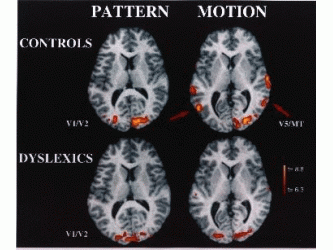
Modern neuroimaging techniques such as functional magnetic resonance imaging (fMRI) and positron emission tomography (PET) have produced clear evidence of structural differences in the brains of children with reading difficulties. It has been found that people with dyslexia have a deficit in parts of the left hemisphere of the brain involved in reading, which includes the inferior frontal gyrus, inferior parietal lobule, and middle and ventral temporal cortex.

There is of course research that backs it up.

Tall and short are comparisons, not absolutes.

I've said this more than a few times: it takes two to make a difference. Brain imagery shows differences, but which one of the two, if any, is the problem or deficit? We have to turn to living for that answer.
 
So if someone gets shot in the head, you'd say they don't have a problem with their brain? Does someone with Alzheimer's not have a problem with their brain according to you? Does a schizophrenic not have a problem with their brain either?


I strongly disagree. A broken bone is a problem in and of itself. It doesn't require a particular social or environmental context to be a problem. The same is true of many brain abnormalities.


A broken bone is a problem if it stops us from walking. It is not a problem if it helps us with eating.

The brain doesn't have problems. People have problems. Otherwise you could argue that someone who is completely happy necessarily has a brain problem and needs surgery to restore it.
 
Tall and short are comparisons, not absolutes.

I've said this more than a few times: it takes two to make a difference. Brain imagery shows differences, but which one of the two, if any, is the problem or deficit? We have to turn to living for that answer.

Your meaning is not clear.
 
One uses the scientific method.


I think this risks becoming a semantic argument. Dyslexia is a classification of a problem based on symptoms, and it is associated with certain brain abnormalities. You could say the brain abnormalities cause dyslexia or are dyslexia. Most importantly, the classification is USEFUL because it determines what sort of treatments are effective.

Again, note that not all reading problems are a result of dyslexia, and treatment for dyslexia does not help all reading problems.

We have to be careful here, that we don't turn a synonym into a causal agent for that which it is synonymous with. For example, is sadness caused by gloominess?

I know that there are "not all reading problems" but again, what is dyslexia?
 
Your meaning is not clear.

A problem is an event that happens in our daily routine. If our brain was made of green cheese on the turn and we were happy then we would not have a problem. That;s why I said that an examination of the brain won't tell us what a problem is.
 
Jonesboy: Please look at the images and read the article below. The MRI scans clearly show differences in the brains of dyslexics and non-dyslexics.

5462470.gif


http://hollergen677s09.weebly.com/
Do you still contend that dyslexia has nothing to do with the brain?
 
A problem is an event that happens in our daily routine. If our brain was made of green cheese on the turn and we were happy then we would not have a problem. That;s why I said that an examination of the brain won't tell us what a problem is.

actually, a problem is a situation defined as being the unknown cause of one or more incidents.
 
I don't think that's true: the changes occurring now are much faster and deeper than the changes that occurred a few generations ago. We're just able to look back at those changes in hind sight and sum up the degrees of change that happened over several decades. Of course that's more extreme than the change that occurs over, say, five years now.

In the last 25 years we went from almost no one having a cell phone to almost everyone in developed countries having them (and a large percentage of those in developing countries as well). The internet was barely visible to most people 25 years ago, now it's a huge part of all our lives.

Worldwide demographic shifts are also extreme, if you look for instance at the number of rural chinese who are moving to the cities.

Advances in healthcare have by no means stopped, and I don't think that purpose-grown organs are far away (just for instance). Look at all the changes that are occurring with drugs that effect our neurobiology. That a person who is depressed can get anti-depressant drugs to deal with that problem is a huge difference from 50 years ago.

Anyway, I'm only saying that technological development, and it's impact on the lives of average people, has not only not slowed but instead accelerated.


I'm not talking about the rate of change. I agree that it is greater in a relative sense. I'm talking about the basic quality of change. Telephony was a very fundamental change in people's lives. Cell phones are a logical extension of that. Dick Tracy's wrist radio anticipated cell phones by decades. People at the time thought it was farfetched because of its size, not because the idea was radical.

The foundations of our current technological revolution were being laid during the beginning and middle of the 19th century. People of that time were very aware of this. The framework was being erected by the end of that century. People then were even more aware, and more disturbed. But the directions being taken were fairly evident.

Since then we have been building on those foundations and fleshing out that framework, but nothing has been as radical as the shift from a primarily agrarian society dependent on hand tools and muscle power. That's what happened in the 1800s.

Gizmos are getting fancier faster. This is true. But they are also much more anticipated.
 
Why invent causes? I can say the thought of a window is caused by the brain. I can say normal behaviour is caused by the brain.
If I am suffering is my suffering caused by suffering condition? Is it an "explanation" to say it is caused by a suffering condition or by the brain? How about happiness? Is that caused by the brain?
You can say any thought or experience is caused by the brain if you want to? Does it add anything?

Why invent empty causes?


Nobody is "inventing" causes. We are discovering them. Learning about them.

We used to think that infectious diseases were caused by evil vapors. That was "invented". We learned by methodical investigation and discovery that many of them were caused by bacteria. Then we learned that others were caused by viruses. We didn't "invent" bacteria or viruses, either. Or prions.

Not all diseases are caused by the same bacteria or viruses. Often the symptoms can be similar. Sometimes different approaches are required to deal with those symptoms.

We have discovered some of these approaches to treatment and healing. We are learning new ones. Some of them really are invented.

But the diseases are not.
 
We have to be careful here, that we don't turn a synonym into a causal agent for that which it is synonymous with. For example, is sadness caused by gloominess?

I know that there are "not all reading problems" but again, what is dyslexia?
People here keep taking care not to confuse the symptom with the cause, yet you continue to ignore this.

What if I define dyslexia as "a physical condition whose principal visible manifestation is difficulty in reading?" Forget for a moment whether my definition is entirely correct. Is it at least comprehensible to you?
 
pTSD is a fictional, medical representation of a natural state.

heart attack is a fictional, medical representation of a natural state.
epilepsy is a fictional, medical representation of a natural state.
septic shock is a fictional, medical representation of a natural state.
 
If I show you an animal you haven't seen before how do you assess whether it is tall or short?
If I show that one is short because of malnutrition, and one is short because of a genetic mutation that caused dwarfism, are you going to argue that both are the same thing? Because that's what you're doing with dyslexia--you're arguing that because one symptom is the same, the cause is the same and the treatment should be the same.

You can find out the cause for allergies, but the cause won't tell you if an allergy is a good thing or not.
You're going to argue that dyslexia is a GOOD THING? I guess that if you've never met a dyslexic you could see it that way. However, I know for a fact that dyslexia costs at least my company a fair number of lost person-hours, and has required them to re-do a few field surveys. I once spent two hours lost in an Alabama swamp due to someone else's dyslexia. It's harmful, whether you want to admit it or not.

You can say any thought or experience is caused by the brain if you want to? Does it add anything?
So you're denying that problems with the brain can directly or indirectly impact a person. You are, in fact, denying ALL of psychology, a huge chunk of medicine, and the entire scientific method. Pretty impressive for one sentence.
 
Then that makes dyslexia a synonym for unnamed further difficulties in reading. A synonym isn't a causal agent.

A synonym is a word, not a phrase. As 'unnamed further difficulties in reading' is a phrase, not a word, it cannot be a synonym. This means that dyslexia is not a synonym, unless someone can find another word with the same meaning.
 

Back
Top Bottom