Yes, looked hotter.
Just imagine the sort of stuff you'd post if you were a twoofer.

Yes, looked hotter.

No. Exactly what about my post did you not understand?So the reported temperature of near 1000C in JOM is an anomoly?
Yes, obviously. That's why they saved those few unusual samples to study.And intergranular melting/rapid oxidation/sulfidization are then anomilies too?
Shouldn't you do your homework before you make your claims? Is there any reason to argue from ignorance, beyond enjoying trolling?And what official report of recent even covers these issues?
Just imagine the sort of stuff you'd post if you were a twoofer.

No. Exactly what about my post did you not understand?
Yes, obviously. That's why they saved those few unusual samples to study.
Shouldn't you do your homework before you make your claims? Is there any reason to argue from ignorance, beyond enjoying trolling?
Third time, Sizzler: present your evidence that the fires in the piles could not have have burned as they did.
Next, present your evidence that explosives or incendiaries like thermite cause months-long, spreading fires in rubble piles.
Time to poop or get off the pot. Stop wasting our time.
How the simple questions always get ignored...
Dude I don't care to reply because your question is stupid.
I can post more than photo of a large fire in an skyscraper that is cited as being 800C.
Thus I use that figure for WTC7 even though the fire is smaller.
So whatever, right.
800C is fair.
Why?So what would happen if we mixed red hot steel with crushed gypsum and a nice thick blanket of dust. Would the steel rapidly oxidize increasing in temperature such that it forms an oven and the steel "burns" and melts itself?
Why?Isnt that what 9-11debunking should have me believe?
Why?Is that what I should believe?
Do you understand that one image of fire in WTC 7, taken long before collapse, is not representative of all the fire and all the temperatures in the building? Yes or no?Thus I use that figure for WTC7 even though the fire is smaller.
Why?
Why?
Why?
Fourth time, Sizzler: present your evidence that the fires in the piles could not have have burned as they did.
Next, present your evidence that explosives or incendiaries like thermite cause months-long, spreading fires in rubble piles.
Time to poop or get off the pot. Stop wasting our time.
Do you understand that one image of fire in WTC 7, taken long before collapse, is not representative of all the fire and all the temperatures in the building? Yes or no?
The evidence was already presented.
We know temperatures of the steel had to be near 1000C according to JOM.
I'm assuming a temperature of 800C for the steel in the office fires. So the fires must have gotten hotter in the rubble piles such that the steel increased 200C. Diffuse oxygen poor fires may smolder longer than open fires, but certainly not hot enough to cause steel to be 1000C.
Remember oxygen is the fuel source. How can removing a lot of the fuel source cause more heat to be released over a longer period of time? It's one or the other.
This is explained on 911debuning.com in the section on "iron burns".
Steel oxidizes faster when it is hot. So if one were to take several red hot steel beams and put a blanket of debris on it, the steel beams would eventually melt away. If gypsum board is added then sulfur will also lower the melting temperature.
But, oxidation requires oxygen. Remeber.....
So I ask you, if I take red hot steel and add crushed gypsum and put a blanket of debris on it, will the steel exibit intergranular melting/rapid oxidation/sufidization?
False. You have not answered these questions, which you need to be able to do to establish your claim.The evidence was already presented.
I'll be waiting for NIST to explain their analysis of that question in their final WTC 7 report. That's because I can't determine how hot the fires were inside the building from looking at a few windows on the outside. Is there any reason that I should guess instead?fine. how hot were the office fires then? simple question.

I may be wasting my time here, but let me try to help. You've made numerous errors here, regardless of what you're trying to conclude -- I wouldn't let a "debunker" get away with these things, either.
The "JOM" is a journal. It doesn't conclude anything. What article are you referring to? Because I can name several that say something quite different. Citation, please.
I'll buy your 800 oC estimate, it's high but not much. But why do you think the piles got hotter? I'm not saying they didn't, I want to know what you're talking about.
"Diffuse oxygen poor fires" such as smouldering coal seams can easily exceed 1000 oC. You're going to have to be more precise, because as you have it stated here, you're wrong.
Oxygen is not a fuel source except in the most extreme cases. It's an oxidizer. Removing a lot of the oxygen almost guarantees heat would be released over a longer period of time, because it lowers the rate of fuel consumption.
Eh, no. "Red hot beams," i.e. beams in the 600-1000 oC range, will not combust without extraordinary circumstances. They'll rust quickly on the surface, but that's not going to have much effect. Adding sulfur will both lower the melting temperature and increase erosion through chemical attack. But it's not quite as simple as you have it here.
It doesn't if there's another oxidizer present, but oxygen is by far the most common oxidizer. Just a nitpick.
This is a fair question. It probably will exhibit some intergranular eutectic reaction with sulfur, but it's not going to be an instant thing. Probably hours, maybe days, maybe more. Sulfur in drywall is not in a particularly favorable form, being already in a stable state. A physical chemist could tell you more. If instead of drywall, you add sulfuric acid for instance, the reaction will be much more pronounced.
How dramatic the reaction is will be a complex function of temperature, chemistry, surface condition, and so on. We'd need a number of experiments to predict how fast it would occur.
A section of an A36 wide flange beam retrieved from the collapsed World Trade Center Building 7 was examined to determine changes in the steel microstructure as a result of the terrorist attack on September 11, 2001. This building was not one of the original buildings attacked but it indirectly suffered severe damage and eventually collapsed. While the exact location of this beam could not be determined, the unexpected erosion of the steel found in this beam warranted a study of microstructural changes that occurred in this steel. Examination of other sections in this beam is underway.
ANALYSIS
Rapid deterioration of the steel was a result of heating with oxidation in combination with intergranular melting due to the presence of sulfur. The formation of the eutectic mixture of iron oxide and iron sulfide lowers the temperature at which liquid can form in this steel. This strongly suggests that the temperatures in this region of the steel beam approached ~1,000ºC, forming the eutectic liquid by a process similar to making a “blacksmith’s weld” in a hand forge.
http://www.tms.org/pubs/journals/JOM/0112/Eagar/Eagar-0112.htmlTypically, diffuse flames are fuel rich, meaning that the excess fuel molecules, which are unburned, must also be heated. It is known that most diffuse fires are fuel rich because blowing on a campfire or using a blacksmith’s bellows increases the rate of combustion by adding more oxygen. This fuel-rich diffuse flame can drop the temperature by up to a factor of two again. This is why the temperatures in a residential fire are usually in the 500°C to 650°C range.2,3 It is known that the WTC fire was a fuel-rich, diffuse flame as evidenced by the copious black smoke. Soot is generated by incompletely burned fuel; hence, the WTC fire was fuel rich—hardly surprising with 90,000 L of jet fuel available. Factors such as flame volume and quantity of soot decrease the radiative heat loss in the fire, moving the temperature closer to the maximum of 1,000°C. However, it is highly unlikely that the steel at the WTC experienced temperatures above the 750–800°C range. All reports that the steel melted at 1,500°C are using imprecise terminology at best.
I thought diffuse hydrocarbon fires burn around 850 or so. Smoldering rubble piles had less oxygen. Longer fires but lower temperatures.
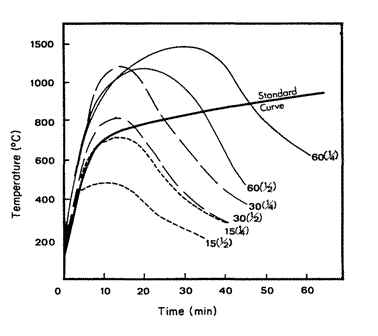
The effect of ventilation and fire load on fire severity is illustrated in Figure 2. Fire tests were conducted in compartments where the fire load and the natural ventilation were varied. The well ventilated compartments experienced lower temperatures and fires of shorter duration. In Figure 2 the numbers identified with each curve indicate the fire load density in kg/m2 (ie 60, 30 or 15) and the ventilation area as a proportion of the façade area (ie ½ or ¼).
The simple facts of temperatures:
1535ºC (2795ºF) - melting point of iron
~1510ºC (2750ºF) - melting point of typical structural steel
~825ºC (1517ºF) - maximum temperature of hydrocarbon fires burning in the atmosphere without pressurization or pre-heating (premixed fuel and air - blue flame)
Diffuse flames burn far cooler.
Oxygen-starved diffuse flames are cooler yet.
Well, I've just presented real-world tests that show regular fires can attain temperatures approaching 1500 degrees C, and that those temperatures are higher when the ventilation is reduced.what does this mean then?
