Polar Bears would self-ignite

One of the purposes of peer-review is to weed out the pointless. "Valid, but says nothing". Which is why we get it via ClimateAudit and mhaze (itself a valid statement which say nothing we don't already know :)).

Or given that they averaged temperature for the globe, and then plugged it into a function that contains T^3, the paper would be "Invalid, and says nothing."
 
Of course, one could just ignore the T^3 in figuring the variation from statistical significance of average surface temperatures. But that would be crude and inaccurate, right?

Observations are used to calculate a global temperature equivalent, and statistics can be applied to those equivalents. T^3 doesn't enter into it; that's to do with physics, not statistics.

Wait a minute...

We've got all these supposed accurate global temps-they must have correctly handled the T^3 term.

See above.

Or did they?

You ask a lot of questions, but you so seldom answer them.

What's this "tropospheric hotspot" of which you often speak?
 
Or given that they averaged temperature for the globe, and then plugged it into a function that contains T^3, the paper would be "Invalid, and says nothing."

See above :). There's no connection between the two. The paper is not only pointless but it's nonsensical. Adolescent self-indulgence.
 
Or given that they averaged temperature for the globe, and then plugged it into a function that contains T^3, the paper would be "Invalid, and says nothing."

Try again. As I initially stated, the formula is as set out by the IPCC. You wanted a reference that explained how to use it , I gave you one.

Do you understand why T^3 is an essential part of the formula?
 
Try again. As I initially stated, the formula is as set out by the IPCC. You wanted a reference that explained how to use it , I gave you one.

Do you understand why T^3 is an essential part of the formula?

You have no comprehension of anything I am posting, do you?

T^3 is obviously a component because it's a factor of radiative heat transfer, which scales along those lines.

However, the equation is not generalized for global temperature. You cannot average temperature and plug it into T^3 and get anything meaningful. Do you comprehend why that is?
 
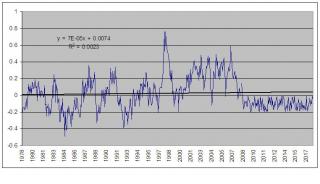
I see David Rodale still has problems both with reading graphs and presenting sources...

Depressing...
 
You have no comprehension of anything I am posting, do you?

T^3 is obviously a component because it's a factor of radiative heat transfer, which scales along those lines.

However, the equation is not generalized for global temperature. You cannot average temperature and plug it into T^3 and get anything meaningful. Do you comprehend why that is?

It seems that you may be at odds with rank and file warmers:

http://climatesci.org/2008/01/24/a-...re-anomaly-to-diagnose-global-warming-part-i/
outgoing longwave radiation is proportional to the fourth power of T. T' = +1 C in the polar latitudes in the winter, for example, would have much less of an effect on the change of longwave emission than T'=+1°C increase in the tropics. The spatial distribution of T' matters, whereas the equation given above ignores the consequences of spatially varying values of T'.

T' at any location is also not a constant with height even near the Earth's surface. Variations of T' over just a few meters of height, particularly on light wind nights, can be significant, as we document in our paper (which will be weblogged on further on a subsequent weblog)

Lin, X., R.A. Pielke Sr., K.G. Hubbard, K.C. Crawford, M. A. Shafer, and T. Matsui, 2007: An examination of 1997-2007 surface layer temperature trends at two heights in Oklahoma. Geophys. Res. Letts., 34, L24705, doi:10.1029/2007GL031652.

Therefore, the use of the equation dH/dt = f -T'/λ to define global warming is flawed.

Rather than use this formulation, the obvious preference should be to directly diagnose (predict) dH/dt, since, as shown in

Pielke Sr., R.A., 2003: Heat storage within the Earth system. Bull. Amer. Meteor. Soc., 84, 331-335.

dH/dt permits the assessment of climate system heat changes in units of heat (Joules) which allows the diagnosis of the magnitude of the global radiative imbalance of the climate system in Watts per meter squared.

http://climatesci.org/2008/01/24/a-...re-anomaly-to-diagnose-global-warming-part-i/
​
What? That's not even the same subject. It has nothing to do with anything.

You're just typing stuff into google and throwing papers at me at this point. That has nothing to do with the equations you posted, which have nothing to do with pretty much anything. I just checked and it's the second result if you do a search for global warming temperature averaging at climatesci.org (the first is a comment on that 'article'). Your technique is uncovered.

Do you or do you not understand why all the math you posted was completely invalid?
 
Last edited:
I believe the core dispute is with the quality of the natural variability as explanation. .
i agree this seems the core.
My understanding is that natural variability does not explain the trend toward increasing temperature in the last half-century better than GW models.
we cannot contrast "natural variability" only with "natural variability+anthropogenic forcing". we only have one, relatively short well-observed period of time with which to determine what "natural variability" is, build the models, and detect a departure from "natural variability".

and, given the state of our understanding and computer power, that is a difficult thing to do. (and as the question is fundamentally one of extrapolation and the duration of observation is so short, it would be hard in any event.)

what standards should a skeptic hold the models too in a case like this? or is the level of model realism all that critical, given the basic physics arguments and the asymmetry between the risks and the costs?
 
I heard this guy on the radio on Friday:
http://www.amazon.com/Doubt-Their-Product-Industrys-Threatens/dp/019530067X

Sort of a discussion of 'Thank You for Smoking' sort of stuff,
starting with asbestos, lead, tobacco and moving on...

The main methods used are:
1. Industry sponsored studies (which they don't aknowledge)
2. A barrage attack on science published
3. A lack of accredited research


Tactic 2 is the main one, they take the actual science and then nit pick it to death, the main goal is to extend the time that toxic products can stay in the economy unregulated by stalling the whole process.

I see something similar here ,especialy when people take data from just the last ten years or the last thirty years as opposed to the last 5000 years or 20,000 years.

The earth's overall temperature is rising as it does in interglacial periods, the earth's rain fall does not rise during interglacials, it fall, the earth's rainfall rises during glacials, this is well established through paleo botany.

Droiught is the most dangerous factor in global warming.

Now as to wether it is man made or not is an issue, however the industry that supports the fight for global warming is the same one the said that lead in gasoline is not a threat and that nothing should be done.

The issue is not if we ARE raising global tempertaure but is it reasonable that we might be raising global temperature.

Drought thet lasts two years is bad, drought that last a hundred years would be lethal to many societies,

 
i agree this seems the core.

we cannot contrast "natural variability" only with "natural variability+anthropogenic forcing". we only have one, relatively short well-observed period of time with which to determine what "natural variability" is, build the models, and detect a departure from "natural variability".

Just a nit pick we have an overwhelming amount of data on global temperature going back fairly far.

The issue is that we don't have as good (if any data) on things like solar radiation and the host of factots which might influence climate. Even things like the cause of the ;Little Ice Age' are still being investigated in terms of soalr radiation, volcanic ash, stratospheric areosols , etc...


Most geologists and climatologists are concerned about global warming, there are some huge concerns with drought in a water sparse continental pattern.
 
I heard this guy on the radio on Friday:
http://www.amazon.com/Doubt-Their-Product-Industrys-Threatens/dp/019530067X
The main methods used are:
1. Industry sponsored studies (which they don't aknowledge)
2. A barrage attack on science published
3. A lack of accredited research

Naomi Oreskes at UCSD has written papers on the use of these tactics in against climate science.


I see something similar here ,especialy when people take data from just the last ten years or the last thirty years as opposed to the last 5000 years or 20,000 years.

this is not really similar, since we only have 30-ish years of "good" satelite data, and it has been only a few hundred since the thermometer was invented.

the quality and coverage of the data really does change drastically between last year and 20,000 years ago.

that said, i agree with your claim that the target question is what is reasonable to believe not what can be proven.
 
i agree this seems the core.

we cannot contrast "natural variability" only with "natural variability+anthropogenic forcing". we only have one, relatively short well-observed period of time with which to determine what "natural variability" is, build the models, and detect a departure from "natural variability".

and, given the state of our understanding and computer power, that is a difficult thing to do. (and as the question is fundamentally one of extrapolation and the duration of observation is so short, it would be hard in any event.)

what standards should a skeptic hold the models too in a case like this? or is the level of model realism all that critical, given the basic physics arguments and the asymmetry between the risks and the costs?

I think rather too much is made of the models. At the extreme, some people claim that they're all that underlies AGW theory, even though models were first created in an attempt to quantify the warming predicted by basic physics. As it happens, models have performed well against observations over the last thirty years.

We can garner climate data from recorded history (with due care, and recognising that it's local or regional at best). The Little Ice Age itself is a historical concept which emerged in Europe and may have been greatly exaggerated as a global phaenomenon. History indicates that climate has not changed rapidly except in response to major vulcanism, and then only for short periods. Global warming at the pace we're experiencing would surely show up in the records had it happened before, and it doesn't.

I generally avoid the cost-benefit question, basically because I regard it as so much hot air. Peak Oil will have far more impact than any policies that might one day be put in place (and probably not implemented with great urgency). AGW is too big, too fundamental, and too gradual for human nature and human institutions to grapple with.

On the up-side, we'll know a great deal more about climate science in fifty years than we do now. There's one heck of an experiment going on out there, and we're observing it in ever-increasing detail.
 
Scientific explanation

See above :). There's no connection between the two. The paper is not only pointless but it's nonsensical. Adolescent self-indulgence.

Why? Could you give a scientific explanation for us? Have you found errors in the formulas or pseudoscientific issues in the article? Perhaps you have found that physics contradicts itself? :D
 
The next formula: ∆T = α [ln (CO2curr/CO2std) / 4(σ) (T)^3 is Arrhenius formula, which has been validated by many authors on thermodynamics. T^3 refers to the standard temperature, which has been determined as 300.15 K. Some people with scarce knowledge on physics have attempted to change the standard temperature by the blackbody temperature (255.15 K); however it is not appropriate because the atmosphere is not a blackbody and it doesn’t act like a blackbody, not any of its components.

The algorithm in that section of the article is correct and correctly applied. The thankfulness message at the beginning of the article is logic because many people in Climate Audit, engineers and scientists known by the author, reviewed the paper and suggested some modifications and improvements on the article. The critic to a gratefulness message is not a scientific way for evaluating a scientific academic work, thus, it constitutes a deceptive argument Ad hominem. :)
 
OTOH, the critics about the use of the word "stored" or "storage" instead "retained" is not serious, I think. If you store something aren't you retaining it? Or... If you are retaining something, aren't you storing it? The lapse you spend on retaining or storing that thing doesn't matter, you are storing/retaining something... :rolleyes:
 
By the way... Biocab counts on the help of several scientists -to whom you won't find at Climate Audit- that makes the labor of reviewing all the papers submitted to Biocab for publication. Biocab doesn't depend on Climate Audit for peer reviews.
 
Climateaudit is just a blog. Biocab doesn't strike me as being much more than just a blog, either. So there are other scientists involved behind the scenes at Biocab? Big whoop. Still doesn't sound like peer review.

There's nothing ad hom about it. Given a choice between peer reviewed science and some activist blog, I'll take the science, thanks.
 
The next formula: ∆T = α [ln (CO2curr/CO2std) / 4(σ) (T)^3 is Arrhenius formula, which has been validated by many authors on thermodynamics. T^3 refers to the standard temperature, which has been determined as 300.15 K. Some people with scarce knowledge on physics have attempted to change the standard temperature by the blackbody temperature (255.15 K); however it is not appropriate because the atmosphere is not a blackbody and it doesn’t act like a blackbody, not any of its components.

The algorithm in that section of the article is correct and correctly applied. The thankfulness message at the beginning of the article is logic because many people in Climate Audit, engineers and scientists known by the author, reviewed the paper and suggested some modifications and improvements on the article. The critic to a gratefulness message is not a scientific way for evaluating a scientific academic work, thus, it constitutes a deceptive argument Ad hominem. :)

Can you please explain to me how a standard temperature was determined? Pay special importance to the part where you can't average temperatures for radiation, because the Temperature term isn't linear. Thus an object, moving linearly from hot to cool side will not radiate heat in a linear manner, destroying the very premise of averaging.
 

ISF - Join now!

Every member here is approved by hand. No bots, no spam, just people who care about evidence and honest debate.

Membership is free!

Create your free account

Back
Top Bottom