• Quick note - the problem with Youtube videos not embedding on the forum appears to have been fixed, thanks to ZiprHead. If you do still see problems let me know.

Please critique this argument against miracles

Yes, absolutely!
Okay, you've answered my question, but I really like the following example I came up in the meantime, so I have to post it, though it's no longer relevant:

What if there was nothing, and then my brain spontaneously formed as a Boltzmann brain in that nothing, and a Big Bang button spontaneously formed next to it, and my Boltzmann brain chose to press that button? Would that count?

Anyway, if we are defining God in such broad terms, then sure, there's a chance. No reason to care though.
 
Last edited:
Hmm, I had a similar background, and for a long time I called myself agnostic simply because I am uncomfortable with absolutes, I prefer thinking in terms of probabilities.
So, if I defined 'god' as "an intelligent being that created the universe" would you say that you are 100% sure that defined entity does not exist? Im sincerely curious how you would respond. I would say that I am 99.999999% convinced the god described in the Bible does not exist, but I am probably 'only' 99-99.9% convinced the god I just defined does not exist. Cause I simply think there is no way to know for sure. I guess that makes me non-committed, and I am totally fine with that too ;)
I'm fine with saying that such an entity doesn’t exist. But it is kind of crazy to put a number on it. I certainly can't prove that a god doesn't exist. But I can say, I have never, not once seen evidence that gives me doubt. And every attempt made that I have seen or read reinforces my position that it's a crock.

Is that knowledge? I cannot say I'm not in the Matrix. That I' might not just be a brain in a vat being fed stimuli.

Let's just say I hate the terms gnostic or agnostic. They are superfluous. I'm totally convinced that Huxley was attempting to make his atheism more palatable. I see the term agnostic to be a cop out. Nevertheless, there are people that give the god claim little thought. While I think it is more than reasonable for these people to say they haven't given it much thought and they are not sure.. They definitely could be described as agnostic. But IMV they are also atheists. If you act as if it exists, you believe. If you don't, you don't believe.
 
Last edited:
Okay, you've answered my question, but I really like the following example I came up in the meantime, so I have to post it, though it's no longer relevant:

What if there was nothing, and then my brain spontaneously formed as a Boltzmann brain in that nothing, and a Big Bang button spontaneously formed next to it, and my Boltzmann brain chose to press that button? Would that count?

Anyway, if we are defining God in such broad terms, then sure, there's a chance. No reason to care though.
Yeah, exactly. Defining god broadly as I did allows me to say 'there's a less than 1% chance of it happening, but using your specific example, probably less than .000000000000000000001% chance. It's all about probabilities ;)
 
I'm fine with saying that such an entity doesn’t exist. But it is kind of crazy to put a number on it. I certainly can't prove that a god doesn't exist. But I can say, I have never, not once seen evidence that gives me doubt. And every attempt made that I have seen or read reinforces my position that it's a crock.

Is that knowledge? I cannot say I'm not in the Matrix. That I' might not just be a brain in a vat being fed stimuli.

Let's just say I hate the terms gnostic or agnostic. They are superfluous. I'm totally convinced that Huxley was attempting to make his atheism more palatable. I see the term agnostic to be a cop out. Nevertheless, there are people that give the god claim little thought. While I think it is more than reasonable for these people to say they haven't given it much thought and they are not sure.. They definitely could be described as agnostic. But IMV they are also atheists. If you act as if it exists, you believe.
If you don't, you don't believe
Thats a fair response and I agree with the highlighted to an extent, although IMO the kind of 'belief' I'm talking about wouldn't really affect how I act. Which is another reason I tell people 'if you want to describe 'god' as the "laws of physics"--then fine, god exists.
 
Thats a fair response and I agree with the highlighted to an extent, although IMO the kind of 'belief' I'm talking about wouldn't really affect how I act. Which is another reason I tell people 'if you want to describe 'god' as the "laws of physics"--then fine, god exists.
Pretty much.

But I would say that beliefs inform our actions. I don't step off the top of a tall building because I believe gravity works. If I didn't, I certainly would.
I board a plane because I believe it will safely fly me to my destination. If I didn't, I wouldn't.

But I must concede there are things I believe are likely true and there is no change in my behavior. I believe the Earth is probably around 14 billion years old but that belief other than writing this post doesn't change my actions.

But I doubt that includes belief in the Abrahamic gods.
 
I find it ironic that you use the term "agnostic" in describing Psion I have always found this word as basically non-committal. Coined by Huxley. An attempt to avoid addressing the elephant in the room. Agnostic, being the opposite of gnostic which means knowledge,, the 'a' prefix changes the term to mean 'without knowledge.
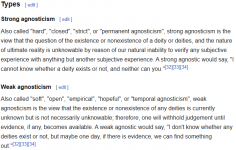
Strong agnosticism is the position that it can't be known, rather than just that it isn't known. Like how strong atheism is the position that god does not exist, rather than that god's existence hasn't been demonstrated.


1752110779894.png
 
Strong agnosticism is the position that it can't be known, rather than just that it isn't known. Like how strong atheism is the position that god does not exist, rather than that god's existence hasn't been demonstrated.


View attachment 62324
I understand how the terms are used today. But even with those definitions it doesn't change that the term is basically a dodge. If you say you don't know but you still go to church, put money in the collection plate and have accepted Jesus Christ as your Lord and Savior saying you're agnostic is superfluous. The same is true if I claim to be an agnostic and ignore it all.
 
Which could be the result of being "emotionally. affected" by the subject. Not that that is a bad thing...
I mean, if I were "aggressively agnostic" about psychics, the natural conclusion isn't that I'm a paragon of logic and scientific inquiry. It probably means that I believe in psychics, or at least desparetely hope that they are real.

Applying this exclusively to God is either extremely pedantic or dishonest.
And the attacks on the arguer step up another notch.

It's no surprise that they come from those who don't want to acknowledge my point that there is a difference between "true" and "believe to be true". Atheists hate to be told they believe something - even if it is that there are no gods.
 
It's no surprise that they come from those who don't want to acknowledge my point that there is a difference between "true" and "believe to be true". Atheists hate to be told they believe something - even if it is that there are no gods.
Not all atheists believe that. Some - those who hold to strong atheism - do, but that's not all atheists.
 
And the attacks on the arguer step up another notch.

It's no surprise that they come from those who don't want to acknowledge my point that there is a difference between "true" and "believe to be true". Atheists hate to be told they believe something - even if it is that there are no gods.
Yeah. Because the "arguer" in this instance strawmans as well as stereotypes atheists. Which is what you did on a previous post and are doing in this post.

And if it makes you happy there is a difference. But that isn't the issue. The issue is whether saying no gods exist requires proof or if thousands of years of claims of gods and the total failure of believers to provide credible evidence is enough.
 
So, if I defined 'god' as "an intelligent being that created the universe"
Who actually does that though? I don't think Deists are a very big movement these days. Except for the context of this specific question, no one refers to "God" meaning an abstracted creator or a superpowered amoeba. They mean their god, the specific incarnation as described in their holy books, which is much easier to disprove because if it weren't, they wouldn't need so much vague handwaving about it.
 
The issue is whether saying no gods exist requires proof or if thousands of years of claims of gods and the total failure of believers to provide credible evidence is enough.
What you are saying is that "thousands of years of claims of gods and the total failure of believers to provide credible evidence is enough" is a good enough reason to believe that gods don't exist.
 
What you are saying is that "thousands of years of claims of gods and the total failure of believers to provide credible evidence is enough" is a good enough reason to believe that gods don't exist.
Probably.

It is enough for me.
 
Who actually does that though? I don't think Deists are a very big movement these days. Except for the context of this specific question, no one refers to "God" meaning an abstracted creator or a superpowered amoeba. They mean their god, the specific incarnation as described in their holy books, which is much easier to disprove because if it weren't, they wouldn't need so much vague handwaving about it.
At least according to my quick google search, some surveys suggest 10-30% of the population have some sort of Deistic belief. Makes sense to me that it would be a growing movement as organized religion and traditional theistic beliefs continue to lose followers. The fanatical religious are the ones who grab all the headlines, but they dont represent everyone.
 
And the attacks on the arguer step up another notch.

It's no surprise that they come from those who don't want to acknowledge my point that there is a difference between "true" and "believe to be true". Atheists hate to be told they believe something - even if it is that there are no gods.
Actually, I know that the God from scripture, and God as he is commonly understood, does not exist. There is no entity that will provide moral objectivity, absolute existential meaning, and eternal paradise. I know this because the fulfilment of such desires is impossible, as all attempts to provide such things inevitably lead to unsolvable paradoxes. Thus, God literally cannot exist.

But sure, if you define "God" as stanfr did, as simply an intelligent something that somehow created the universe, then there's at least a chance. That's not what most people mean when they say "God" though, and such a definition is only useful for philosophical games. No one truly cares whether such an inconsequential God exists.

And I cannot help noticing that you haven't actually provided a workable definition of God, instead relying on the incredibly ambigious nature of the term. So I've simply assumed that you mean the paradoxical God of all actual believers. But maybe I missed it, in which case I apologize.
 
And I cannot help noticing that you haven't actually provided a workable definition of God, instead relying on the incredibly ambigious nature of the term.
Why is it necessary to nail down the definition of "god"?
Is it more meaningful to discuss whether Greek gods exist or don't exist?
Is it more meaningful to discuss whether Roman gods exist or don't exist?
 
Why is it necessary to nail down the definition of "god"?
Is it more meaningful to discuss whether Greek gods exist or don't exist?
Is it more meaningful to discuss whether Roman gods exist or don't exist?
How can you discuss the existence of something if you don't define what that something is? That's just a made up word with an unspoken personal meaning.

So yes, discussing Greek gods is definitely more meaningful. Given the inconsistency and frequent ambiguity of their mythology, a coherent definition would still be helpful, but at least we generally know what they are supposed to be. I'd still want to know whether I'm actually supposed to find them on Olympus or not.
 
How can you discuss the existence of something if you don't define what that something is? That's just a made up word with an unspoken personal meaning.

So yes, discussing Greek gods is definitely more meaningful. Given the inconsistency and frequent ambiguity of their mythology, a coherent definition would still be helpful, but at least we generally know what they are supposed to be. I'd still want to know whether I'm actually supposed to find them on Olympus or not.
I disagree.

To me it would be more meaningful to discuss whether Greek or Roman gods exist than to limit the debate to just one of those sets of gods. Proving that Greek gods don't exist wouldn't say anything about Roman gods.
 

Back
Top Bottom