• Quick note - the problem with Youtube videos not embedding on the forum appears to have been fixed, thanks to ZiprHead. If you do still see problems let me know.

PEAK OIL: Going Mainstream

When will it run out?

That is the stereotypical question asked by a person who doesn't understand peak oil theory. Oil will never "run out". There will always be oil left in the ground and there is likely to be some remnant oil-production industry as long as human civilisation persists. Peak oil is about PEAK production or flow rates, not "when will oil run out." What has run out is cheap oil. The critical turning point, happening right now, is when there is no longer a viable swing producer. In other words it is the point where no humans are able to control the price of oil any longer because nobody can just open the taps and pump more oil, even if they wanted to (and they don't.)

We are currently on the "bumpy plateau", which has turned out to be even bumpier than expected because very few people correctly predicted the level of demand destruction that would occur when oil prices head towards $150 a barrel. Predictions of oil at $400 barrel just after the peak turned out to be way off the mark simply because by the time the price reaches $150, vast numbers of people either reduce their consumption (people in the rich countries driving less) or stopping consuming oil and oil-based products completely (including people in poor countries who can no longer afford to buy food at world open market prices.) The top of the plateau was 2005-2008. We will be starting on the downslope no later than 2013.

What has also become clear is that what is known as the "export land model" is coming into play.

http://en.wikipedia.org/wiki/Export_Land_Model

The Export Land Model...models the decline in oil exports that result when an exporting nation experiences both a peak in oil production and an increase in domestic oil consumption. In such cases, exports decline at a far faster rate than the decline in oil production alone.

The Export Land Model is important to petroleum importing nations because when the rate of global petroleum production peaks and begins to decline, the petroleum available on the world market will decline much more steeply than the decline in total production.

In the few remaining oil-exporting countries, the population is being protected from global free market prices. This means that whilst the oil-importing nations experience demand destruction and recession, the oil-exporters continue to grow economically and consume more and more of their own oil. A combination of falling production and rising domestic consumption means that they cease to be oil exporters far more quickly than most people are expecting. This is happening right now in Saudi Arabia. Some time in the near future we will arrive at a point where the only nation on Earth which is still able to export large amounts of oil is Russia, and they will have a lot of desperate customers. The population of Russia is falling (unlike Saudi Arabia...) and they have played the long game very well indeed. Also, Russia, unlike Saudi, is self-sufficient in food and most other raw materials. Saudi Arabia is going to become a neo-mediaevil hellhole in no time at all.
 
Last edited:
So what is your basis for mocking peak oil theory?

I presume you can explain your reasons.

Sure. We've been at peak oil pretty much every year since about 1973. If we are truly at peak oil this year (or was it last?), then that means the peak oil nuts have been right once and wrong 38 times. I figure if I mock them every year, I'll be right 38 times and wrong once.

I like my odds.
 
Sure. We've been at peak oil pretty much every year since about 1973. If we are truly at peak oil this year (or was it last?), then that means the peak oil nuts have been right once and wrong 38 times. I figure if I mock them every year, I'll be right 38 times and wrong once.

I like my odds.


How do you work that out? I do remember people talking about oil production being a problem in the then-future whilst I was a child in the 1970s, but mostly they seemed to be saying that the problem would hit in "around 30-years", as far as I recall.


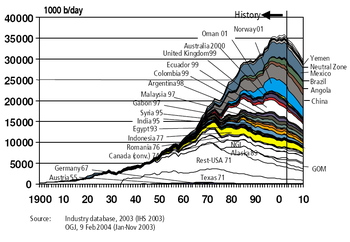
This graph:
350px-Hubbert_world_2004.png


would tend to support Undercover Elephant's contention that we are in a "bumpy peak" at the moment.

The PDF from which this is taken is here:

http://www.fossil.energy.gov/programs/reserves/npr/publications/npr_strategic_significancev1.pdf
 
Last edited:
We've been at peak oil pretty much every year since about 1973.
According to whom?

I figure if I mock them every year, I'll be right 38 times and wrong once.

I like my odds.
What fun! I especially love the way you hedge your bet by acknowledging right up front that sooner or later you will be wrong. That allows you to fully exploit the uncertainty as to when the thing will occur without having to concern yourself with the certainty that exists with regard to whether it will occur.

You know, you could run the same game with regard to the possibility of a major earthquake on the San Andreas fault. Every year that it doesn't happen, you'd get to crow about how you were right and all those silly geologists and seismologists were wrong. It's true that sooner or later, they'll be right and you'll be wrong -- and in a big way -- but that's not what counts. What counts is how many times you were right. Right?
 
How do you work that out? I do remember people talking about oil production being a problem in the then-future whilst I was a child in the 1970s, but mostly they seemed to be saying that the problem would hit in "around 30-years", as far as I recall.


This graph:
[qimg]http://upload.wikimedia.org/wikipedia/commons/thumb/4/41/Hubbert_world_2004.png/350px-Hubbert_world_2004.png[/qimg]

would tend to support Undercover Elephant's contention that we are in a "bumpy peak" at the moment.

The PDF from which this is taken is here:

http://www.fossil.energy.gov/programs/reserves/npr/publications/npr_strategic_significancev1.pdf


You realise that you have provided a non-OPEC graph there ? Is there a similar graph for OPEC ?
 
I do find it quite extra-ordinary how slow many people have been to wake up and smell the Peak Oil roses. I've been following this story since it first emerged as an obscure "internet conspiracy theory" over a decade go. At first it was rejected by almost everybody. It didn't get any mentions in the mainstream media until about 2005, and even then they were few and far between. Now, just six years later, it is regularly discussed in newspaper articles, talked about by politicians (not all of them, but some) and finally this year we have Fatih Birol, head of the IEA (which is the official international body for predicting future oil supplies), changing his story from "there's twenty more years before the peak" to "the peak already happened in 2006" and yet there are still some people confidently rejecting theory as a load of old nonsense.

Never mind that the price of oil is now over $100 a barrel and has spiked already to $150. Never mind that the US is calling on OPEC to raise production by 3 million bpd and OPEC has responded by (a) not increasing production and (b) predicting a shortfall of 1.5 mbpd by this autumn. Never mind the facts! Peak oil is bunkum! ;)
 
Except most of the peak oil stuff I've read tends to ignore (or sideline) technological options which become viable with increased cost of oil. Not only new areas that open up for exploration, but also techniques for improving extraction from existing wells.

Oh, and that graph posted up there (the afterpeakoil one). It's not easy to read, but are they implying this year is the peak year? If so then it shouldn't be too difficult to see how good that prediction is over the next five years.
 
Except most of the peak oil stuff I've read tends to ignore (or sideline) technological options which become viable with increased cost of oil. Not only new areas that open up for exploration, but also techniques for improving extraction from existing wells.

Peak oil stuff I've read addresses these issues thoroughly and concludes that they can, at best, do no more than very slightly offset the speed of decline in production.

Oh, and that graph posted up there (the afterpeakoil one). It's not easy to read, but are they implying this year is the peak year? If so then it shouldn't be too difficult to see how good that prediction is over the next five years.


Indeed. Peak Oil can only identified in retrospect. Some analysts suggest 2008.
 
Except most of the peak oil stuff I've read tends to ignore (or sideline) technological options which become viable with increased cost of oil. Not only new areas that open up for exploration, but also techniques for improving extraction from existing wells.

I don't think most of them ignore this, and I also think this is less relevant than it may have seemed a few years ago. It is true that a higher price of oil means that harder-to-reach deposits may be utilised, but it also means that a lot of people won't be able to afford to buy that oil. Demand destruction kicked in in a big way in 2008 when the price closed in on $150 a barrel. A lot of peak oil theorists got this one very wrong - they were predicting oil at $300 a barrel by this point in the production curve, and they were also imagining that demand would stay high regardless of the price increase. With hindsight, this looks rather naive.

The Deepwater Horizon disaster has also put back deep water drilling for months/years, and will lead to increased opposition to projects that people think might be too difficult to do safely.

Oh, and that graph posted up there (the afterpeakoil one). It's not easy to read, but are they implying this year is the peak year? If so then it shouldn't be too difficult to see how good that prediction is over the next five years.

Five years from now I expect that nobody will be left denying peak oil. What the price of oil will be is not easy to predict, because nobody knows what sort of havoc will be wreaked on the global economy by further financial shocks like Greece defaulting and the US printing even more money, but I believe it will be obvious for all to see that the flow rates are going down.

We have already seen in the last few years what happens when a supergiant field (one of the five Big Ones) approaches the end of its life. As production starts to decline, ever more desperate technofixes are implemented in order to keep the flow rates up. This works for a short while, then production levels fall off a cliff.

http://en.wikipedia.org/wiki/Cantarell_Field

Production decline

Luis Ramírez Corzo, head of PEMEX's exploration and production division, announced on August 12, 2004 that the actual oil output from Cantarell was forecast to decline steeply from 2006 onwards, at a rate of 14% per year. In March 2006 it was reported that Cantarell had already peaked, with a second year of declining production in 2005. For 2006, the field's output declined by 13.1%, according to Jesús Reyes Heróles, the director-general of PEMEX.[4]

In July 2008, daily production rate fell sharply by 36% to 973,668 barrels per day (155,000 m3/d) from 1.526 million barrels per day (243×103 m3/d) a year earlier.[5] Analysts theorize that this rapid decline is a result of production enhancement techniques causing faster short-term oil extraction at the expense of field longevity. By January 2009, oil production at Cantarell had fallen to 772,000 barrels per day (123,000 m3/d), a drop in production of 38% for the year, resulting in a drop in total Mexican oil production of 9.2%, the fifth year in a row of declining Mexican production

Events in Mexico will not have escaped the attention of Saudi Arabia. Do they want the Gharwar (biggest field in the world, has already peaked) going the same way? Not likely. They will not make the same mistake. It is in their interest to allow the Gharwar to age gracefully, which means they won't want to just open the taps and pump at their already-declining maximum rate.

http://www.youtube.com/watch?v=Ulxe1ie-vEY
 
Last edited:
Peak oil stuff I've read addresses these issues thoroughly and concludes that they can, at best, do no more than very slightly offset the speed of decline in production.

Bit difficult to come to that conclusion when there is not data whatsoever around what is actually still out there.

Indeed. Peak Oil can only identified in retrospect. Some analysts suggest 2008.

Except 2010 produced more oil than 2008. So those analysts were wrong. As was Hubbert. Wasn't it supposed to be in the 90s?
 
Bit difficult to come to that conclusion when there is not data whatsoever around what is actually still out there.

Why do you think there is no data....?

Except 2010 produced more oil than 2008.

Says who?

So those analysts were wrong. As was Hubbert. Wasn't it supposed to be in the 90s?

Hubbert may have been out by a decade or so, but nobody who understands the theory could possibly say that it is wrong. It's too simple to be wrong.
 
Last edited:
Why do you think there is no data....?

Because until you hit a field you don't know its capacity.
Or are you thinking we know where all the oil is?

Says who?

The IEA, though I can't find the report now. There is this one, though, in which they pretty confident of an increase in production over the next few years.

Hubbert may have been out by a decade or so, but nobody who understands the theory could possibly say that it is wrong. It's too simple to be wrong.

The idea that oil will run out is fine. However Hubbert got his numbers wrong. Not surprising since there are too many unknowns to take into account. Yes. We will run out. In the meantime prices will rise, resulting in reduced use of oil in the west at the same time as increased capabilities in extraction (due to cost).

I realise that may not be quite as doom and gloom and end-of-civilisation that some seem to enjoy out there in internet-land, but I for one will be quite glad of a soft(ish) landing.
 
Because until you hit a field you don't know its capacity.
Or are you thinking we know where all the oil is?

We know where all the large and easily-accessible fields are.

The IEA, though I can't find the report now. There is this one, though, in which they pretty confident of an increase in production over the next few years.

The head of the IEA has said this year that the peak was in 2006.

If anyone doubts then listen: http://www.youtube.com/watch?v=k22q5KZibtI

The idea that oil will run out is fine. However Hubbert got his numbers wrong. Not surprising since there are too many unknowns to take into account. Yes. We will run out. In the meantime prices will rise, resulting in reduced use of oil in the west at the same time as increased capabilities in extraction (due to cost).

Hubbert's theory is based on the simple truth that for any given area you will always end up finding the biggest fields first. It has to happen this way, because oil prospecting is a bit like a game of "Battleships" - if you just keep sticking wells in the ground then it is much easier to find large fields than small ones.

I realise that may not be quite as doom and gloom and end-of-civilisation that some seem to enjoy out there in internet-land, but I for one will be quite glad of a soft(ish) landing.

Good luck.
 
Last edited:
Except most of the peak oil stuff I've read tends to ignore (or sideline) technological options which become viable with increased cost of oil. Not only new areas that open up for exploration, but also techniques for improving extraction from existing wells.


My understanding of what I've read is that
oil price spikes lead to recession
which leads to demand reduction
which leads to a fall in the price of oil
which makes investment less attractive.

As the economy recovers from recession
prices rise again
until production limits are reached
which triggers another price spike
and so on , to our doom and gloom,
the end-of-civilization,
hair shirts
etc :rolleyes:

Price instability (which undermines long-term investment) rather than simply ever-sky-rocketing prices is how Peak Oil destroys growth-based economies.
 
Last edited:
Price instability (which undermines long-term investment) rather than simply ever-sky-rocketing prices is how Peak Oil destroys growth-based economies.

Yes. Or at the very least this is the justification which will be given by OPEC when they refuse to increase production/development.
 

Back
Top Bottom