
• Security incident: ISF was recently accessed by intruders. Please change your password, and change it anywhere else you used it. Read more

Organic Food: Cultural Revolution or Uninformed Pseudoscience?

skepticalfred

Student
Joined
Nov 7, 2008
Messages
40
My new article, what do you think?

History:
Organic food is a trend that has seen some prevalence in the United States in recent years. Many have fears that current methods of food production are unsafe or less healthy than organic methods. Recently, many large companies have promoted organic offerings. Many organizations are promoting organic food as an alternative to GMO, or genetically modified crops, that increase yields many times over and have the potential to feed many starving people.

Analysis:

Organic milk takes 80 percent more land, produces 20 percent more global warming potential, creates 70 percent more acid rain, outputs twice as much methane, contaminates 60 percent more water and costs the end user 1.8 times more then conventionally harvested milk. Additionally, numerous outbreaks of E. Coli have been associated with organic milk, including one in 2006 that infected and hospitalized at least 3 children. Organic chicken is equally as inefficient. According to large scale studies done in Denmark, Holland, and Austria, 100 percent of organic flocks contain campylobacter, a common food poisoning bacteria (as compared to 25 percent in standard flocks).

According to a meta analysis done by the Mayo Clinic, organic food is no more nutritious than standard food. This is no surprise, but other studies have suggested that organic foods are less consistent in shape, color, and taste, and tend to spoil faster.

Some eat organic food because they wish to support local farmers. In reality, most organic food is produced by large corporations. A single company controls over 70 percent of the market on organic milk, and even large companies like Starbucks have been buying up organic operations. These companies are farming organically for one reason - it’s profitable. Organic products often cost two or three times more than standard products, and are sometimes less regulated than standard operations.

The worst example of the damage the organic food movement can do occurred in Zambia in 2002. Believing the words of GMO protesters, the Zambian government stopped distributing corn sent as aid from the United States. Many Zambians were forced to eat poisonous plants and even domestic pets to survive. One villager was quoted as saying, “If we resort to a new type of root from a plant we are unfamiliar with, we first get the oldest person in the village to test it before the rest of us eat it. This must be a person who is already too ill either because of hunger, disease or age that he is going to die sooner or later anyway. If he lives after eating the roots, we then feed them to the children. If he dies, we won’t.” The corn could have eased the suffering of 2.5 million staving people, and perhaps saved many from death due to eating poisonous plants and prevented a great deal of suffering and disease.

Conclusion:
Organic food is not only harmful to individuals, it is harmful to the environment. If all farming was done organically, land use for farming would have to triple world wide. In a world with limited resources, it is unconscionable to produce food in anything but the most efficient manner possible. People who live in industrialized nations seem to forget that many in our world are starving (815 million according to UN estimates.) When it comes down to it, I believe Dr. Borlaug said it best: “You can’t build a peaceful world on empty stomachs and human misery.” It is my belief that organic methods will only continue to perpetuate death and misery throughout the world.

Graphs and text created by: Fred Cipriano
Edited by: Jen Shipon

For sources, and pictures check out my website: cmdrfred.com
 

Attachments
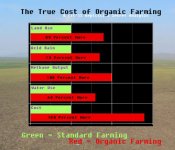
  • organicfarmingvsstandardfarming-aanalysis.jpg
    organicfarmingvsstandardfarming-aanalysis.jpg
    68.7 KB · Views: 21
Last edited:
Are people really starving because crop yields aren't high enough? I find that hard to believe.

This is no surprise, but other studies have suggested that organic foods are less consistent in shape, color, and taste, and tend to spoil faster.

The latter is also no surprise, and none of those are seen as detriments by consumers of organic food. Potatoes aren't supposed to all look alike.
 
Last edited:
Are people really starving because crop yields aren't high enough? I find that hard to believe.
Here, Here and here.

Need more, there are 100's of articles, or you can just think about it logically:
Less production of a product = Less of product to go around

Also, if you now use 3 acres to plant a crop that used to require 1 that does 3 times the damage to the environment.

So how is organic food beneficial again?
 
I'll bet a crisp new dollar that you're a fan of "Penn and Teller's BS". :)

I have no real opinion on organic vs. genetically modified food but I commend you for your passion, your drive and your desire to expose fradulence wherever you see it.

Good for you!
 
*sigh*

What an exercise in strawman-bowling and cherrypicking. If I can actually conquer my disgust over this disingenuous thing, I'll try to find the time to reply in detail.

Without citing anything specific that statement in itself is disingenuous.
 
I'll bet a crisp new dollar that you're a fan of "Penn and Teller's BS". :)

I have no real opinion on organic vs. genetically modified food but I commend you for your passion, your drive and your desire to expose fradulence wherever you see it.

Good for you!
While i do enjoy BS, i heard of this long before the show. Norman Borlaug has always been a personal hero of mine.
 
Are people really starving because crop yields aren't high enough? I find that hard to believe.
No. People are mostly starving because of an issue with distribution. It is because modern countries are using modern crop production and distribution.

However, organic farms have crappy production and less efficient distribution. This makes the food more expensive and this will worsen the food distribution system.
The latter is also no surprise, and none of those are seen as detriments by consumers of organic food. Potatoes aren't supposed to all look alike.
Lack of standardization of foods increases costs and decreases reliability.
 
Less production of a product = Less of product to go around

Yes, but "less of product to go around" != a shortage

Also, if you now use 3 acres to plant a crop that used to require 1 that does 3 times the damage to the environment.

That doesn't follow at all. Number of acres used is not the only measure of damage to the environment. Amount and type of pesticides and herbicides used, and how they are drained off, is another factor. Amount and type of fertilizer used, how it's drained, and its effects on the environment, are another factor.
So how is organic food beneficial again?

Organic food is beneficial to the environment when less pesticides and herbicides end up in groundwater or rivers.

Raising livestock outside with room to move around - which does require more acreage than raising them in enclosed structures - is considered more humane by some people, myself included. It also tends to result in manure being more spread out instead of concentrating it in lagoons.
 
Yes, but "less of product to go around" != a shortage
Less product to go around=increase cost

That doesn't follow at all. Number of acres used is not the only measure of damage to the environment. Amount and type of pesticides and herbicides used, and how they are drained off, is another factor. Amount and type of fertilizer used, how it's drained, and its effects on the environment, are another factor.
More acres used=more water/pesticides etc. used.
Use of organic pesticides=less effective pesticides=more pesticides used.

Organic food is beneficial to the environment when less pesticides and herbicides end up in groundwater or rivers.
No it is the opposite. "Organic" pesticides/herbicides are less effective than industrial products and therefore you require much more to be as effective.

Raising livestock outside with room to move around - which does require more acreage than raising them in enclosed structures - is considered more humane by some people, myself included. It also tends to result in manure being more spread out instead of concentrating it in lagoons.
Not relevant to the economics. If you want to argue ethics, that is a relevant but completely separate issue.
 
Too much standardization can increase the risk of catastrophic loss to a particular pest or infection.
Hence we have crop genetic banks.
Industrial crop production has taken this into account.

How does this make Organic crops more resilient since they are also all genetically standardized crops...didn't know that did you?

Organic crops are exactly the same as industrial crop except for how they are grown with "organic" fertilizers, pesticides etc.
 
I've thought this before but reckoned it was probably too silly to mention ... simple solution - GM super-producing pest-resistant crops grown organically.

[runs and hides]
 
Last edited:
Raising livestock outside with room to move around - which does require more acreage than raising them in enclosed structures - is considered more humane by some people, myself included.


Not relevant to the economics. If you want to argue ethics, that is a relevant but completely separate issue.


I think it is extremely relevant, and I would urge Skepticalfred to address this point. The misconception that "organic" livestock production is more humane than conventional production is behind many people's ill-informed support of the organic movement.

Now, I'm all for extensive livestock production. I'm all for space and room to move around and freedom to express natural behaviour and so on. However, "organic" systems have no monopoly on that. Certainly, the organic rules include prohibitions on the more extreme forms of intensification. However, most livestock systems around here are extensive enough to fit these criteria, if the rest of the "organic" woo was added to the mix. Promotion of the fallacy that conventional farming is all of the "stalag sheep" variety and only organic animals are free to roam around is one of the more insidious and pernicious of the lies told by this bunch of cranks. (Also bear in mind that being outside is not always best for the animal. Where would you rather be in a January snowstorm? Out on the hill, trying to revive your freezing newborn lamb while you yourself are cold and wet, or in a nice cosy shed with a straw bed and a feeding trough and the shepherd only a few yards away?)

Support extensive farming systems on welfare grounds, by all means. Support high-welfare management systems, whether housed or outdoors. However, the minute they slap on the "organic" label, avoid them like the plague. On welfare grounds.

"Science" has spent many decades developing safe and effective veterinary medicines for both therapeutic and preventative purposes. These products contribute immensely to animal welfare, both by preventing diseases which are inherent in the very nature of the animals' life cycles, and by treating disease when it strikes. Safety has to be emphasised here, because very extensive and rigorous testing for safety (of the consumer) is a major part of the pharmaceutical licensing process.

The Luddite nature of the organic movement chooses to regard these products as "evil chemicals", and demonises their use. The ethos is profoundly anti-vaccination, even though there is no possible effect that vaccination can have on the end product. The ethos is also profoundly against prophylactic treatment, in spite of the fact that prophylactic anti-parasite treatment is a major contributor to animal health and welfare. And the ethos also heavily discourages even the treatment of sick animals.

Yes, the guidelines on paper say soothing things indicating that the welfare of the animal must come before the organic certification, but in practice it just doesn't work this way. The loss of organic status consequent on the use of veterinary medicines is a sufficiently important economic factor that instances of animals which should have been treated (or treated much earlier than they in fact were) are common.

Just one anecdote, from the spring of this year. I received into the post mortem room the carcasses of two young ewes. I was surprised by their size, because they looked like six-month-old lambs, but there are no six-month-old lambs in April. The were in fact a year old. They were stunted in growth, and also extremely thin. Body fat was virtually absent. The carcasses were soaked in foul diarrhoea. Routine post mortem examination revealed that they had died because of a severe infestation of gastrointestinal parasites.

I checked the paperwork. It stated that the farm was organic. By this stage, that was no great surprise to me. It also revealed that these were the ninth and tenth fatalities in the group, all with similar signs.

A farmer would not usually expect to lose any of a group of young replacement breeding stock, and while one-off incidents do happen, most would be shouting for help when a second death occurred. The condition that killed these sheep was easily prevented and easily treated - but of course that would have meant using the "evil chemicals". It's also a chronic condition. These poor sheep had been losing condition, getting thinner and thinner and suffering from increasingly severe diarrhoea for weeks. TEN of them (remember, young adults, who should have been in the prime of life) had died before any action was taken. Is this animal welfare? Not in my book.

Oh, but they were free to roam the hills! Well, whoopee. They were Blackface sheep. That's what Blackface sheep do. That's how they're all managed. The only difference was that they were not accorded the right to either preventative or therapeutic medical treatment.

And don't get me started on organic milk.

Oh, but I will give a quick mention to a new poultry farming initiative that's on the drawing board for near where I live. It involves about ten large intensive sheds, which will be pretty intrusive in the countryside. It's actually intended to be large-scale organic production. There's just enough access to outside runs to satisfy the "free-range" tick-boxes. However, don't go away with the impression that these are happy chickens freely pecking away around the farmyard. They ain't.

My opposition to the organic movement in livestock farming is three-fold. First, if there is indeed a problem with drug residues in animal products, action ought to be taken to eliminate this across the board. It's no solution to create a little ghetto of "organic" virtue and ignore the bulk of our food production. However, the fact is that there really isn't such a problem. Regulations governing the use of medicinal products and in particular withdrawal times are effective in preventing residues reaching the consumer. Arbitrary diktats that all withdrawal times should be doubled and/or products avoided altogether for a small sector of the market are simply ideology gone mad, and do nothing to improve consumer protection.

Second, there is the overt animal welfare problem, relating to cases such as I described above.

And third, the is the blatant promotion of absolute woo. I already mentioned the anti-vax element. Even worse than that, the organic movement is heavily into the promotion of homoeopathy, on the grounds that homoeopathic treatments obviously leave no drug resudues. Yes, that's because there's nothing in them! Nothing at all! Frankly, if you're going to deny a sick animal medical treatment on ideological grounds, then at least face up to what you're doing, and please refrain from doling out magic shaken-up sugar pills to kid yourself that you're doing something to help the poor beast.

They're also very much into unlicensed remedies of all sorts, especially anything herbal. The problem here is that herbal remedies, if they do anything at all, also have the potential to leave residues. However, as they're not licensed and there is no established withdrawal time, then that's all right then. These products are "natural", so they must be safe, and should be used in preference to licensed products of proven efficacy. In fact the result of this is often that products of dubious efficacy are relied on, and nobody has the foggiest idea whether or not there might be a residue effect. If of course a product of this nature was seen to have useful efficacy, the probability is that someone would do a formal trial on it and acquire a proper product license and formal evidence of any residue effects (with a statutory withdrawal time) - at which point it would, in the eyes of the organic movement, become an evil chemical to be avoided.

The animal welfare implications of the organic movement are something which it is absolutely essential to consider when discussing this subject. And "organic" methods do not come up smelling of roses. As I said, by all means support high-welfare farming methods and extensive livestock rearing systems. Just remember that many conventional systems are just as free-range as the organic ones, and that the organic ideology is about a lot more than just free-range space.

Rolfe.
 
Last edited:
Thank you Rolfe, for a well thought out and reasoned post. I get too angry at people promoting this sort of thing as a universal panacea to all the world's problems to be able to give a decent rebuttal.
 
I've thought this before but reckoned it was probably too silly to mention ... simple solution - GM super-producing pest-resistant crops grown organically.

[runs and hides]


Actually, it's a perfectly sensible idea.

Sense, however, is not the organic lobby's strongest suit.

Rolfe.
 
A couple of local dairy farmers were talking and I overheard a funny part of their conversation. One asked the other why he didn't consider getting into the 'organic' milk production because the profit margins are so much greater, and the other farm answered with a livid, "I could never do that! I love my cows."

Why the hell do they even call it 'organic'? Does that make other products 'synthetic'?
 
There is a good discussion of the organic food movement in the United States in the book "The Omnivore's Dilemma" by Michael Pollan. I grew up under the ideals of people like Roadale and The Mother Earth News. What Rolfe describes and the current industrial organic movement are a far cry from 'organic', but in this case, I'm not sure it's possible to separate the baby from the bathwater. I do know that the practice of real organic farming persists, but it's not likely that the vast majority of people will come in contact with it.

Linda
 

ISF - Join now!

Every member here is approved by hand. No bots, no spam, just people who care about evidence and honest debate.

Membership is free!

Create your free account

Back
Top Bottom