• Security incident: ISF was recently accessed by intruders. Please change your password, and change it anywhere else you used it. Read more

Open Letter to Dave Thomas

ROFL An object in free fall has GPE but it is not available to do work.

Wrong. You mean it is not doing any work at the same time. Even that is not necessarily right, as it is theoretically possible for parts of rigid assemblies to accelerate downwards at more than g.

All the available GPE has been converted to KE. That is the definition of free fall.

Wrong. During the first 1.75 or so seconds of the WTC7 north wall only part of the GPE has been converted to KE. The rest did work on the perimeter columns. Enough buckling work to allow part of the northwall to then descend near free fall for a little while.
 
Except that the FEA performed by NIST showed the 8-stories of columns buckling. If that doesn't prove it for you, what will?

2 major problems:

1) NIST refuses to release the data used for the FEA suggesting it was cooked.

2) the FEA does not show free fall.
 
Newtons Bit said:
Except that the FEA performed by NIST showed the 8-stories of columns buckling. If that doesn't prove it for you, what will?

604072600.jpg

nmrc2.gif


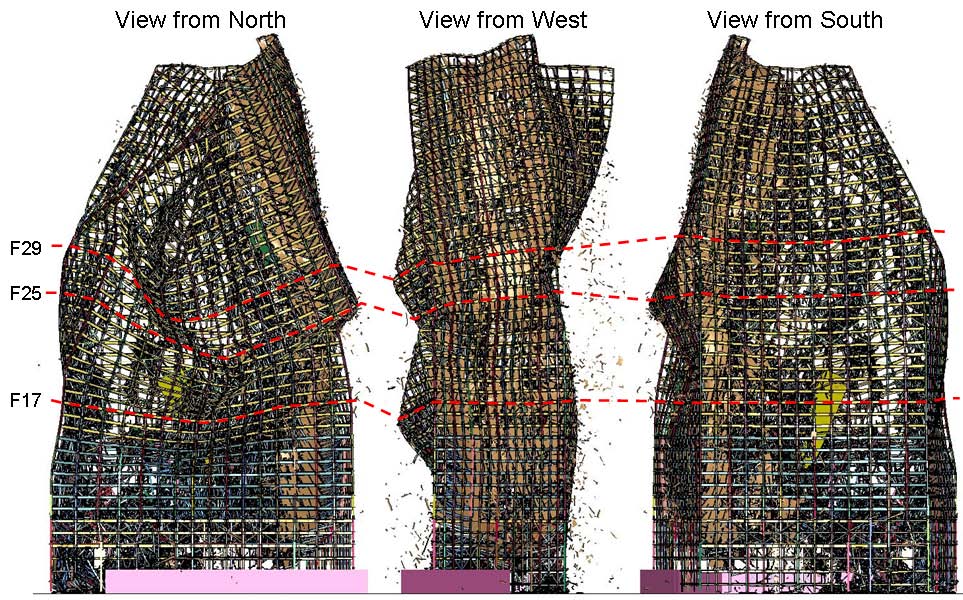
It would be a bit useful that if the NIST FEA behaviour is to be used as proof of actual internal behaviour (that there is obviously no video of)...that someone posts a video of the upper half of WTC 7 actually behaving as-per the NIST FEA renders above (that there is obviously video of)
 
Using the NIST FEA as proof would be perhaps more useful...if you can show me some video of the top of WTC 7 behaving like this...
[qimg]http://femr2.ucoz.com/_ph/7/604072600.jpg[/qimg]
[qimg]http://femr2.ucoz.com/nmrc2.gif[/qimg]

Looks a bit floppy.

See that bulge at the line marked "F29?" If the columns break at the top of that sort of feature, at what speed would the columns above it fall?

I'm guessing right about free-fall speed.

I am not saying that that is the point at which such failure occurred, but I should imagine there were several points like that forming as it all caved in.
 
See that bulge at the line marked "F29?" If the columns break at the top of that sort of feature, at what speed would the columns above it fall?
Floor 29...that we can see in video...that doesn't behave like that...

Just how much time have you actually spent looking at any of these details Lefty ?

I suggest...not a lot.

I'm guessing...

Grab me a video of the top of WTC 7 that matches the FEA animation, and I'll lend more credence to the NIST 8 storey buckle FEA.
 
Grab me a video of the top of WTC 7 that matches the FEA animation, and I'll lend more credence to the NIST 8 storey buckle FEA.

Can you show that no such bulging or folding occurred in the structure? If such a fold formed and then broke, free fall will occur. The south side appears to move south in any video I see shot from above ground level. That has to pull something forweard, and that, too, would cause a fold that would break.

I do not see how any model could be 100% accurate, given that there was no way to watch most of the important points, but the NIST model does show where a free fall drop could have occurred.
 
Can you show that no such bulging or folding occurred in the structure?
Not yet. Can you show video that it did ?

If such a fold formed and then broke, free fall will occur.
A particularly simplistic viewpoint, especially given the number of acceleration curve graphs I've posted of WTC 7 descent...
408829093.gif

(ft/s^2 / s) - Increasing poly-fit order per frame 1 thru 50.

The south side appears to move south in any video I see shot from above ground level. That has to pull something forweard, and that, too, would cause a fold that would break.
I will be tracing movement from the relevant footage, so clear detail correlating vertical and southward movement will then become available. We shall see what unfolds.

I do not see how any model could be 100% accurate
What percentage of accuracy would you apply to the images posted then ?

given that there was no way to watch most of the important points
...and the omission of such factors as the south-side *gash* (Well over 20 storeys) :eye-poppi
265352478.png


but the NIST model does show where a free fall drop could have occurred.
The NIST model shows this...
nmrc2.gif

Floppy upper section whith no lower storey vertical movement a-goin-on.
 
Floor 29...that we can see in video...that doesn't behave like that...

Just how much time have you actually spent looking at any of these details Lefty ?

I suggest...not a lot.

Grab me a video of the top of WTC 7 that matches the FEA animation, and I'll lend more credence to the NIST 8 storey buckle FEA.
You suggest? You make up lies about NIST, and you suggest? Lies you can correct at your own forum.
We are asked to believe that 2,966 gallons of jet fuel, essentially kerosene, caused the collapse of the South Tower.
You sure don't understand models. When will you publish your study which refutes NIST and makes your CD delusion come true? Do you have to make up false statements about NIST to feel good?
 
The NIST model shows this...
[qimg]http://femr2.ucoz.com/nmrc2.gif[/qimg]
Floppy upper section whith no lower storey vertical movement a-goin-on.

About where the north wall bends over here, there are floors attached to the upper part, possibly none below for a good several yards. Seems to me a likely point at which the wall might break, free-falling until it encountered rubble., thereupon crumbling from the bottom up.

This in no way requires explosives or thermite cutters.
 
You sure don't understand models. When will you publish your study which refutes NIST and makes your CD delusion come true? Do you have to make up false statements about NIST to feel good?

This goes beyond inept modelling. It also discounts any hint of fire science. He seems to think we are saying that a kerosene fire did all of the heat damage.
 
This goes beyond inept modelling. It also discounts any hint of fire science. He seems to think we are saying that a kerosene fire did all of the heat damage.
You should always check mined quotes ;) It's from over 18 months ago, and the context is a bunch of folk over at YT who were repeatedly claiming *jet fuel burning at 1800F softened the *steal** LOL.

Poor ol' beachnut like to use the words *lies*/*delusion*/*false*...lots-n-lots.

Always reminds me of a snippet Tolkien wrote...

J.R.R.Tolkien said:
'You lie,' said Wormtongue.

'That word comes too oft and easy from your lips,' said Gandalf. 'I do not lie. See, Théoden, here is a snake! With safety you cannot take it with you, nor can you leave it behind. To slay it would be just. But it was not always as it now is. Once it was a man, and did you service in its fashion. Give him a horse and let him go at once, wherever he chooses. By his choice you shall judge him.'
 
femr2:

You'll have to forgive me in being so tardy in this post, but I've been trying to cut down on on JREF'ing while at work. You've repeatedly posted screenshots and video of a WTC7 collapse model as well as criticism of this model.

femr2 said:
I'm okay with FEA on a small scale, but as I said, FEA becomes very unstable and diverges from reality rapidly as such complex behaviour progresses (ends up looking like soggy linguini, rather than reality).

femr2 said:
Using the NIST FEA as proof would be perhaps more useful...if you can show me some video of the top of WTC 7 behaving like this...

femr2 said:
It would be a bit useful that if the NIST FEA behaviour is to be used as proof of actual internal behaviour (that there is obviously no video of)...that someone posts a video of the upper half of WTC 7 actually behaving as-per the NIST FEA renders above (that there is obviously video of)

femr2 said:
...and the omission of such factors as the south-side *gash* (Well over 20 storeys) :eye-poppi

I agree with you that this model does not correspond to what really happened on 9/11. However this is not the model that I was referring to in my original post. NIST modeled the collapse with an undamaged WTC7 (lacking the gash that you have referred to) and one with the damage, see below.


Source: NCSTAR 1-9 Vol2 p. 588

Notice the line of failure and the "kink" are from floor 7 to floor 14. This comprises an 8-story buckle.

Prior to this diagram, NIST describes the global collapse. See page 586. Please note that they state that, "Once column support was lost in the lower floors, the remaining exterior structure above began to fall vertically as a single unit".

I think this collapse, as well as the "kink", meet many of the descriptions of what happened that day. The modeling is not perfect, but it appears close to what happened that day.

There are just too many variables to accurately determine the behavior of the structure. For one example: A36 grade steel has a yield strength of 36ksi. Seismic codes require that the connections of seismic lateral force resisting connections be stronger than the elements (this is to force a failure in a brace or beam of a moment frame rather than the connection, thus resulting in a more ductile and energy absorbing failure mode). For A36 steel, a designer must assume that the capacity of A36 steel is 40% greater than the A36 spec to account for widely varying capacities of this grade. It would be impossible to every possibility of this variation in capacity as it will be different in most elements.

You've also stated that, "Progressive Collapse is utterly unsuited to FEA." I think you mean that FEA is unsuited to progressive collapse modeling, but let's not quibble over anything grammatical (I'm horrendous at it). And that:

femr2 said:
Systems such as Extreme Loading, utilising AEM (Applied Element Method) rather than FEA would seem to be, by far, the better choice for determining global behaviour, and has been tested against numerous actual builing descents with good correlation between modelled and actual behaviour...

Also:
femr2 said:
The NIST global model behaves like a stack of soggy linguini. (As most FEA tend to do as scale is increased)

I don't think you correctly understand what these terms mean.

Wikipedia defines AEM as:
wikipedia said:
The Applied Element Method (AEM) is a numerical analysis utilized in predicting the continuum and discrete behavior of structures. The modeling method in AEM adopts the concept of discrete cracking allowing it to automatically track structural collapse behavior passing through all stages of loading: elastic, crack initiation and propagation in tension-weak materials, reinforcement yield, element separation, element contact and collision, as well as collision with the ground and adjacent structures.

Now this sounds very fancy to the lay-person. However the method in which it is achieved is to exchange fixed values in the stiffness matrix of a FEM to an non-linear spring equation based on the strain of the object. All high-end FEA suites, such as SAP2000, ANSYS and LS-DYNA do this, or have the option to do this, already. The only piece that is not a common part of FEA suites is to actually disconnect nodes at specific strain levels. This is because a connection failure is never an allowed case in building design.

However NIST has this covered as well:

NCSTAR 1-9 Vol2 p. 540 said:
The primary constitutive model used for modeling the steel framing in WTC7 was the Piecewise Linear Plasticity model (material type 24 in LS-DYNA). This model captured the non-linear behavior and failure of steel, with an effective stress versus effect strain curve and a pre-defined strain to failure to simulate fracture.

Chapter 12 likewise details the methods used by NIST to disconnect nodes at specific strain levels. This is what AEM is all about.

Now, I've told ergo that he is out of his league when talking about sciencey matters. His posts on this thread confirm that. I do not think that this is the case with you. You are the most willing "I'll do it myself!" research in the "truth" movement that I have ever encountered and you have at least a basic understanding of how stuff works. However you are too apt to automatically assume that NIST is doing it wrong on first glance. I think you need to slow down and be less eager to assume that NIST is doing it wrong.
 
Newtons Bit said:
Notice the line of failure and the "kink" are from floor 7 to floor 14. This comprises an 8-story buckle.

Prior to this diagram, NIST describes the global collapse. See page 586. Please note that they state that, "Once column support was lost in the lower floors, the remaining exterior structure above began to fall vertically as a single unit".

I would expect it to do so at about free fall speed, at that. Is this what you have modelled?
 
You'll have to forgive me in being so tardy in this post
Never any rush as far as I'm concerned.

I agree with you that this model does not correspond to what really happened on 9/11. However this is not the model that I was referring to in my original post. NIST modeled the collapse with an undamaged WTC7 (lacking the gash that you have referred to) and one with the damage, see below.

[qimg]http://www.internationalskeptics.com/forums/imagehosting/thum_163294cbe2bdb2f48d.jpg[/qimg]
Source: NCSTAR 1-9 Vol2 p. 588
This one then...
626148965.gif
rather than
nmrc2.gif


I'll note at this point, that NIST did not model the full extent of the *gash*...
158844021.jpg
265352478.png


Notice the line of failure and the "kink" are from floor 7 to floor 14. This comprises an 8-story buckle.
Don't get me wrong, I'm fully aware of the details in the report. My point is the tendency of FEA to behave in such a manner when scale is increased. The second animation also suffers from the same thing, though to a lesser degree.

There are just too many variables to accurately determine the behavior of the structure.
I quite agree. It's not even possible to model accurate element end-point locations resulting from knocking over a virtual shelf full of virtual books.

You've also stated that, "Progressive Collapse is utterly unsuited to FEA." I think you mean that FEA is unsuited to progressive collapse modeling
That sounds better :)

Again, my point is that the system has been used to simulate a number of actual building descents, lending some credence to it's capabilities.

The correlation between the numerous simulated descents and the actual video footage of the real event are remarkably similar. (The stadium demolition correlation was very good indeed)

The bespoke modifications to the AnSys system are AFAIK untested in any other environment, and being *of unprecedented scale* there's no other NIST/ANSYS building descent simulation to use as a control.

However you are too apt to automatically assume that NIST is doing it wrong on first glance. I think you need to slow down and be less eager to assume that NIST is doing it wrong.
Kinda the other way around. I'm always hesitant to assume NIST is doing it right...if that makes sense. (Maybe that I'll do it myself thing). I've found lots of, imo, significant problems with the report (regardless of whether others think they are relevant). (And also validated/replicated some of their measurements via tracing, which folk are also not happy about, which is a bit odd)

This stems from...
Newtons Bit said:
Except that the FEA performed by NIST showed the 8-stories of columns buckling. If that doesn't prove it for you, what will?
...so I'm basically questioning whether saying that *the NIST FEA proves 8-storeys of buckling* is an *end of story* statement.
 
Last edited:
Never any rush as far as I'm concerned.


This one then...
[qimg]http://femr2.ucoz.com/_ph/7/2/626148965.gif[/qimg] rather than [qimg]http://femr2.ucoz.com/nmrc2.gif[/qimg]

I'll note at this point, that NIST did not model the full extent of the *gash*...
[qimg]http://femr2.ucoz.com/_ph/7/158844021.jpg[/qimg][qimg]http://femr2.ucoz.com/_ph/7/265352478.png[/qimg]


Don't get me wrong, I'm fully aware of the details in the report. My point is the tendency of FEA to behave in such a manner when scale is increased. The second animation also suffers from the same thing, though to a lesser degree.


I quite agree. It's not even possible to model accurate element end-point locations resulting from knocking over a virtual shelf full of virtual books.


That sounds better :)


Again, my point is that the system has been used to simulate a number of actual building descents, lending some credence to it's capabilities.

The correlation between the numerous simulated descents and the actual video footage of the real event are remarkably similar. (The stadium demolition correlation was very good indeed)

The bespoke modifications to the AnSys system are AFAIK untested in any other environment, and being *of unprecedented scale* there's no other NIST/ANSYS building descent simulation to use as a control.


Kinda the other way around. I'm always hesitant to assume NIST is doing it right...if that makes sense. (Maybe that I'll do it myself thing). I've found lots of, imo, significant problems with the report (regardless of whether others think they are relevant). (And also validated/replicated some of their measurements via tracing, which folk are also not happy about, which is a bit odd)

This stems from...

...so I'm basically questioning whether saying that *the NIST FEA proves 8-storeys of buckling* is an *end of story* statement.

You're trying to prove CD. I know it, you know it, everybody in this thread knows it so step up to the plate.
 
...so I'm basically questioning whether saying that *the NIST FEA proves 8-storeys of buckling* is an *end of story* statement.

Unless you are able to show something else, it is the most plausible. There is no other plausible theory that anyone has put forward.

If you can think of one that does not involve CD, don't sit on it.
 
The engineering and scientific community have generally accepted the theory for the WTC's collapse.

Who, for example?

oops. I just invited someone to post the spammed list again...
 
Last edited:

ISF - Join now!

Every member here is approved by hand. No bots, no spam, just people who care about evidence and honest debate.

Membership is free!

Create your free account

Back
Top Bottom