• Quick note - the problem with Youtube videos not embedding on the forum appears to have been fixed, thanks to ZiprHead. If you do still see problems let me know.

OOS Collapse Propagation Model

Status
Not open for further replies.
Mathematical approach to ROOSD as progressor


Fundamental conditions:

for rubblized driving mass > M(1) moving at a downward velocity > V(1) , the runaway process is assured. The threshold conditions require a minimum M(1) traveling downward at velocity V(1).

The process requires progressive and runaway breakability of successive floor-to-column connections.


Examination of available literature: None


Measurements and observations of a first known documented case: WTC1 and 2 (roofline and collapse front)


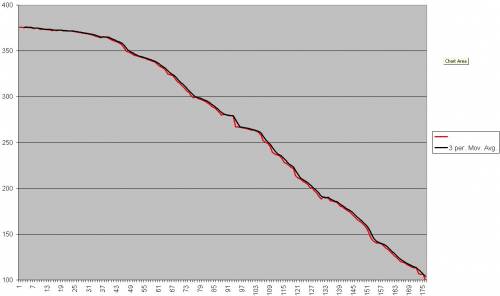
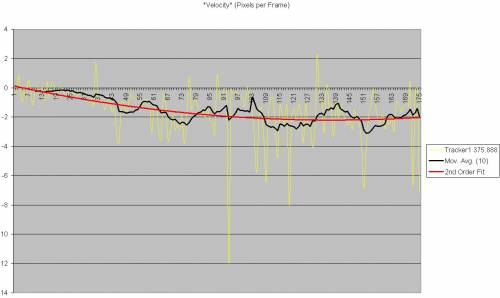
A collapse front down the west face of WTC1 remained visible and measurable down to the lower floors. The movement shows a relatively constant velocity after quickly leveling off after collapse initiation. The velocity is approximately 25m/s, or about 8 floors per second being destroyed.


Initial data for linear ejecta traversal from West face of WTC 1 (Femr2, 2009):

995880143.jpg


http://femr2.ucoz.com/photo/linear_2/6-0-217
http://femr2.ucoz.com/photo/6-0-217-3 (1280x720px/74.6Kb)

Source video in H264 format (1280x720x25fps):
http://femr2.ucoz.com/ffdemhd_264.avi

Crop of West Face Ejecta:

760729846.gif


139901890.gif


http://www.youtube.com/watch?v=BMeTGfCZWMI
http://www.youtube.com/watch?v=2F5Tw2ITMF8

Position4:
730189522.jpg

http://femr2.ucoz.com/photo/6-0-219-3 (1234x731px/67.0Kb)

Velocity:
185125992.jpg

http://femr2.ucoz.com/photo/6-0-220-3 (1224x730px/87.3Kb)


What are the characteristic features of the progressor (steady state) portions of the curves? (Measured along the OOSsw crush front)


  • Tendency toward terminal velocity
  • A steady state acceleration of zero


What are the characteristic features of the initiator (initial movement to steady state) portions of the curves? (Measured along 2 points: roofline and crush front)


  • Crush front seems to start on floor 95
  • Quick take off velocity
  • Short transitory phase (reaches steady state velocity and acceleration rapidly)
 
Some defining characteristics of the unique ROOSD progressions in WTC1 and 2 to supplement the graphs above:


The OOS progressions were confined by guide rails: Perimeter caging, combined with the outermost core columns, provide a perfectly vertical and very strong confinement of the OOS crush front.


The strength of the guide rails created a concentrated energy funnel: The crushing energy was concentrated on and funnelled toward the 208x208 ft floor space below. The unique perimeter architecture assured that crushing energy was funnelled inward to maximize the destructive power of the crush front.


Steady state progression rates were characterized by a near constant 8 floors per second crush rate with a steady state acceleration of zero.


The qualities of strong confinement, terminal velocity, and zero steady state acceleration means that these OOS steady state progressions are highly regulated, very controllable, and very predictable processes.
 
Last edited:
....
Steady state progression rates were characterized by a near constant 8 floors per second crush rate with a steady state acceleration of zero.


The qualities of strong confinement, terminal velocity, and zero steady state acceleration means that these OOS steady state progressions are highly regulated, very controllable, and very predictable processes.
... are highly regulated, ...
By the FCC? Did you make this up, or is in a structural engineering textbook?

Who regulates it? lol, please stop SPAMMING this BS. Please. Skin me alive, boil me in water, but please stop SPAMMING BS.
 
Last edited:
I believe that M_T is using the term in the following definition;
reg·u·late
ˈregyəˌlāt/Submit
verb
control or maintain the rate or speed of (a machine or process) so that it operates properly.
"a hormone that regulates metabolism and organ function"
synonyms: control, adjust, manage
"the flow of the river has been regulated"


Its not particularly surprising. Floors collapse, at this point the perimeter column system is fairly intact at that level. Obviously the perimeter can only fail post floor failure(s). So what role does the perimeter frame take in the continuing collapse? We see the ejecta coming out window openings, occasionally several floors below major ejection level. Its not a stretch to see that the amount being ejected was modified by the lag between floor failure and perimeter peel off. More material remained inside the tube, thus more mass impacting further floors, thus greater dynamic forces on lower floors.
Now femr's data shows a steady rate of floor collapse. Two things determine (regulate) that rate, the mass if, and velocity of, the falling debris.
What this illustrates then is that the collapse action reached a steady dynamic force on lower floors. Had the perimeter failed quicker allowing more ejecta there would be a point at which collapse may halt.

So what could this mean in future construction techniques? If it could be possible to funnel more debris toward the perimeter, or if some perimeter columns could be designed to punch out in such a collapse and allow more ejecta, it might be possible to halt progression.

Just a thought.
 
Last edited:
Exactly, or in connection with velocity regulation.

A velocity regulated system will resist changes to velocity. Try to speed it up and it will resist. Try to slow it down and it will likewise resist.

/////////////////////////////////////////


If one does steps 1, 2 and 3 correctly, one can now approach literature modelling the motion of collapsing buildings or WTC1 and 2 in particular from a highly informed and critical perspective.

If so, one is ready for step 4.


Step 4: EXAMINE THE VARIETY OF PHYSICS-BASED MATHEMATICAL APPROACHES TO THE COLLAPSES OF WTC1 AND 2, AND OF 1-DIMENSIONAL STACKED SYSTEMS COLLAPSING IN GENERAL


Here are a few different ways to set up the basic physics to the collapse propagation of a stacked system of masses in 1 dimension:


Models of Inelastic Accretion (OneWhiteEye, 2010)

Study of a Simple 1 Dimensional Stacked System (OneWhiteEye, 2009-10)


WTC Asynchronous Impact Crush-Down Model
(Femr2, 2009)


Approaching the complex physics of a rubble-driven collapse:

The philosophy and attributes of a rubble-driven collapse (OneWhiteEye, 2010)


A table of peer-reviewed literature on the WTC collapses has been prepared by Eastman and Cole and is available at this link.


The table includes:

All 4 Bazant papers BZ, BV, BL and BLGB, linked and reviewed here
Frank Greening, Energy Transfer in the WTC Collapse, linked and reviewed here
Keith Seffen, Progressive Collapse of the World Trade Centre: a Simple Analysis, linked and reviewed here
Gordon Ross: Momentum Transfer Analysis of the Collapse of the Upper Storeys of WTC 1 linked here


but the table also includes Cherepanov, Eagar, Musso, and Usmani.

The table also includes the latest Bazant paper called:

Why the Observed Motion History of World Trade Center Towers Is Smooth

The paper is linked here.


The last entry in the table dates 2012. It is a paper called:

Equation of Motion Governing the Dynamics of Vertically Collapsing Buildings

by Celso P. Pesce, M.ASCE, Leonardo Casetta, and Flávia M. dos Santos


The paper is linked here.
 
Last edited:
Exactly, or in connection with velocity regulation.

A velocity regulated system will resist changes to velocity. Try to speed it up and it will resist. Try to slow it down and it will likewise resist.


Does anyone (everyone) else get the idea he's way over his head and is just trying to convince people he knows what he's talking about?

:rolleyes:
 
Does anyone (everyone) else get the idea he's way over his head and is just trying to convince people he knows what he's talking about?

:rolleyes:

On that point,yes. His contention requires a negative feedback system be in place.
Try to speed things up? How? Opposing that effort would be, what?

Falling through a hypothetical floor with a solid exterior would funnel more material back into the building thus increasing dynamic forces thus decreasing time to fail a floor, thus resulting in an increase in velocity of falling mass thus increasing dynamic force....... Unless increasing velocity of falling mass also increases amount of mass ejection, its hard to see how this would see a regulation back to a terminal velocity.

OTOH we do see evidence of non-symmetry in floor failure, the laughingly characterized 'squibs'. Local increase in mass or velocity would cause increased velocity of floor failures in that area but have little effect on the majority of floor area collapses.
 
mass *ejected* was likely contents not slabs.... forced out with / by the air pressurized and moving at up to 200+ mph... like bellows!
 
Does anyone (everyone) else get the idea he's way over his head and is just trying to convince people he knows what he's talking about?

:rolleyes:

He has ROOSED to the ground and is now digging furiously.
 
On that point,yes. His contention requires a negative feedback system be in place.
Try to speed things up? How? Opposing that effort would be, what?

Falling through a hypothetical floor with a solid exterior would funnel more material back into the building thus increasing dynamic forces thus decreasing time to fail a floor, thus resulting in an increase in velocity of falling mass thus increasing dynamic force....... Unless increasing velocity of falling mass also increases amount of mass ejection, its hard to see how this would see a regulation back to a terminal velocity.

Are you saying the measurements do not indicate steady state terminal velocity?

Are you saying that you do not see how it could have happened naturally?


It is probably best and easiest to start with a basic understanding of the forces involved in the simplest of motion involving terminal velocity. WIki terminal velocity.

Note the nature of the frictional force F= -cv

Proportional to and opposed to the velocity vector.

Now, consider other types of frictional forces proportional to v^2

//////////////////

This is what both Bazant and Benson were doing back in 2007, 8.


BV eq 12:

bv_eq12.png


This is the same equation that was misrepresented from the first page of the thread. What is on the right hand side of the equation?

Frictional force


What does the single variable z(t) represent?

The location of the crush front.


Bazant states in BV:

"Eqs. (12) and (17) show that Fc(z) can be evaluated from
precise monitoring of motion history z(t) and y(t), provided
that m(z) and lamda(z) are known. A millisecond accuracy for
z(t) or y(t) would be required. Such information can, in theory,
be extracted from a high-speed camera record of the collapse.
Approximate information could be extracted from a
regular video of collapse, but only for the first few seconds
of collapse because later all of the moving part of the WTC
towers became shrouded in a cloud of dust and smoke (the visible
lower edge of the cloud of dust and debris expelled from
the tower was surely not the collapse front but was moving
ahead of it, by some unknown distance)."


He tells you how to derive the frictional force Fc given the motion history of the crush front z(t). He also writes that the information that Femr2 extracted from the visual record can't be extracted from the visual record.

He writes that the crush fronts cannot be identified using the visual record.
 
On measuring the motion history of a collapse front, this is what Bazant concludes in BV:


Quote:

4. The mode and duration of collapse of WTC towers are con-
sistent with the present model, but not much could be learned
because, after the first few seconds, the motion became ob-
structed from view by a shroud of dust and smoke.

5. The present idealized model allows simple inverse analysis
which can yield the crushing energy per story and other
properties of the structure from a precisely recorded history
of motion during collapse. From the crushing energy, one can
infer the collapse mode, e.g., single-story or multistory buck
ling of columns.

6. It is proposed to monitor the precise time history of displace-
ments in building demolitions—for example, by radio telem-
etry from sacrificial accelerometers, or high-speed optical
camera—and to engineer different modes of collapse to be
monitored. This should provide invaluable information on
the energy absorption capability of various structural sys-
tems, needed for assessing the effects of explosions, impacts,
earthquake, and terrorist acts.


In 2009 and 2010 Femr2, among others, was able to provide the very types of measurements that Bazant refers to as "invaluable information" in 2007.

Due to the 'shroud of dust and smoke', Bazant considered it impossible to either measure the collapse front or identify the collapse mode of WTC1 and 2 from the information he had available at the time.
 
Last edited:
I am rewriting a description of step 4 from a few posts ago. I am including all links to all mentioned papers

////////////////////////////////////////////


Step 4: EXAMINE THE VARIETY OF PHYSICS-BASED MATHEMATICAL APPROACHES TO THE COLLAPSES OF WTC1 AND 2, AND OF 1-DIMEMSIONAL STACKED SYSTEMS COLLAPSING


1-DIMEMSIONAL STACKED SYSTEM MECHANICS

Here are a few different ways to set up the basic physics to the collapse propagation of a stacked system of masses in 1 dimension:


Models of Inelastic Accretion (OneWhiteEye, 2010)

Study of a Simple 1 Dimensional Stacked System (OneWhiteEye, 2009-10)


WTC Asynchronous Impact Crush-Down Model
(Femr2, 2009)


Approaching the physics of a rubble-driven collapse:

The philosophy and attributes of a rubble-driven collapse


PHYSICS-BASED MATHEMATICAL APPROACHES TO THE COLLAPSES OF WTC1 AND 2

A table of peer-reviewed literature on the WTC collapses has been prepared by Eastman and Cole and is available at this link.


The table includes:

4 Bazant papers BZ(2002), BV(2007), BL(2008) and BLGB(2008), linked and reviewed here

latest Bazant paper called: Why the Observed Motion History of World Trade Center Towers Is Smooth (2011), linked here.

Frank Greening, Energy Transfer in the WTC Collapse (2006), linked and reviewed here

Keith Seffen, Progressive Collapse of the World Trade Centre: a Simple Analysis (2008), linked and reviewed here

Gordon Ross: Momentum Transfer Analysis of the Collapse of the Upper Storeys of WTC 1 linked here

Cherepanov, Mechanics of the WTC collapse (2006), available through this link

Thomas W. Eagar and Christopher Musso, Why Did the World Trade Center Collapse? Science, Engineering, and Speculation, JEM feature: Special Report (2002), linked here

Usmani, Chung, Torero, HOW DID THE WTC TOWERS COLLAPSE: A NEW THEORY, Linked and reviewed here.


The last entry in the table dates 2012. It is a paper called:

Equation of Motion Governing the Dynamics of Vertically Collapsing Buildings

by Celso P. Pesce, M.ASCE, Leonardo Casetta, and Flávia M. dos Santos. The paper is linked here.
 
Last edited:
The OOS progressions were confined by guide rails: Perimeter caging, combined with the outermost core columns, provide a perfectly vertical and very strong confinement of the OOS crush front.


The strength of the guide rails created a concentrated energy funnel: The crushing energy was concentrated on and funnelled toward the 208x208 ft floor space below. The unique perimeter architecture assured that crushing energy was funnelled inward to maximize the destructive power of the crush front.


The solution is clear: omit all vertical walls and columns, especially exterior and interior ones. This will make progressive collapse impossible.

Where aesthetics demands vertical walls and columns for decorative reasons, make them break-away under stress, to limit their ability to concentrate and funnel energy from falling floors from above.

Finally, if we go on to omit all horizontal floors, there will be no floor debris to sustain progressive collapse. Perfectly safe construction achieved!

ETA: Recommended best practices are shown here.
 
Last edited:
MT I am not saying it did not reach a steady state velocity.
Factors favouring increasing velocity
Gravity
Factors opposing acelleration
Friction of debris on tube
Rubblization increasing mean distance between debris objects
Decreasing size of earliest debris objects introduced into the system.

The later couple would spread the dynamic forces of falling debris over time.

This is not unlike terminal velocity of an object falling through a fluid. Its simply balancing forces, there's not really any negative feedback loop.
 
Last edited:
Factors favouring increasing velocity
Gravity
Factors opposing acelleration
Friction of debris on tube
Rubblization increasing mean distance between debris objects
Decreasing size of earliest debris objects introduced into the system.

The later couple would spread the dynamic forces of falling debris over time.

This is not unlike terminal velocity of an object falling through a fluid. Its simply balancing forces, there's not really any negative feedback loop.

True on all points.


Thinking in this way it is not difficult to see BV eq 12 for the simple tool that it really is.

bv_eq12.png


Exactly like he writes, if someone gives him the motion history z(t), he can find the frictional force using this equation as a tool.

Input: motion history

Output: frictional force


The mysterious 'Bazant model' in BV, BL, and BLGB is nothing more than a 2 point object tracking device (roofline and crush front) to be used on real buildings with characteristics that lie within his 4 basic assumptions.

Given the anticipated frictional force he can anticipate the actual motion of a crush front or roofline (input: frictional force, output: actual crush front and roofline motion).

or

Given the motion history z(t) the actual frictional force can be derived ((input: motion history, output: frictional force).

////////////////////////////////////////////


In a wonderful demonstration of how memes can be born, grow, multiply, and destroy any possibility of critical thinking, please review the popular interpretation of a mysterious creature called the 'Bazant model' which is accepted and propagated at JREF:

Newtons Bit
R Mackey
Dave Rogers and Myriad


These posts don't make much sense if examined for technical accuracy, but they make perfect sense if they are viewed as propagating memes.
 
Last edited:
Some defining characteristics of the unique ROOSD progressions in WTC1 and 2 to supplement the graphs above:


The OOS progressions were confined by guide rails: Perimeter caging, combined with the outermost core columns, provide a perfectly vertical and very strong confinement of the OOS crush front.


The strength of the guide rails created a concentrated energy funnel: The crushing energy was concentrated on and funnelled toward the 208x208 ft floor space below. The unique perimeter architecture assured that crushing energy was funnelled inward to maximize the destructive power of the crush front.


Steady state progression rates were characterized by a near constant 8 floors per second crush rate with a steady state acceleration of zero.


The qualities of strong confinement, terminal velocity, and zero steady state acceleration means that these OOS steady state progressions are highly regulated, very controllable, and very predictable processes.


One more point.

The unique architecture of WTC1 and 2 created a physical condition I will call a ROOSD basket. A ROOSD basket is essentially a containment vessel consisting of the flooring not yet destroyed and the 4 perimeter walls that act like caging.

It is not possible to correctly characterize the nature of the WTC1 and 2 crush fronts without understanding basic structural properties of this ROOSD basket.

It is the dynamic and unique shape and nature of the 'ROOSD basket' containment vessel which steered and trapped the progressing crush fronts that explains so much of what is witnessed in the visual record.
 
Last edited:
MT I am not saying it did not reach a steady state velocity.
Factors favouring increasing velocity
Gravity
Factors opposing acelleration
Friction of debris on tube
Rubblization increasing mean distance between debris objects
Decreasing size of earliest debris objects introduced into the system.

The later couple would spread the dynamic forces of falling debris over time.

This is not unlike terminal velocity of an object falling through a fluid. Its simply balancing forces, there's not really any negative feedback loop.

The collapse front was not uniform like pancakes dropping... it was a flow of rubble... some rubble ahead and some behind.. No? The resistance of the floor slabs to destruction was relatively constant... each 4 1/2" slab was the same.. each mech floor was the same. In terms of the scale of the forces, the number of floors destroyed and the separation of the floors and the random nature of the rubble-ized floor material, the number of floors destroyed...the notion of a precise rate of collapse progression is a fool's errand. A *local* rate can be determined perhaps by measuring the progression of the material ejected racing down the corner which was forced out as one slab was destroyed and the descending flow forced the air out along with pulverized contents from between the slabs. I don't think there is enough video from all sides synchronized to determine the precise rate. But apparently measurements at that one corner over many floors appears to show no acelleration and be about 65 mph. Ask femr2 he measured it. Can one assume that this rate has a universal application to rubbleized descending collapsing slab parts in the entire foot print? Maybe...
 
The solution is clear: omit all vertical walls and columns, especially exterior and interior ones. This will make progressive collapse impossible.

Where aesthetics demands vertical walls and columns for decorative reasons, make them break-away under stress, to limit their ability to concentrate and funnel energy from falling floors from above.

Finally, if we go on to omit all horizontal floors, there will be no floor debris to sustain progressive collapse. Perfectly safe construction achieved!

ETA: Recommended best practices are shown here.

Only someone who was planning an inside job would use columns, walls or floors. These things are clearly demolition devices in hiding! :boxedin:
 
Status
Not open for further replies.

Back
Top Bottom