Merged On why cold fusion is denied by nuclear theorists

wlad

New Blood
Joined
May 10, 2021
Messages
21
Several threads have been merged into one discussing "cold fusion". Please keep such discussion to this thread, and please bear rule 6 in mind both in terms of multiple threads on the same subject and the over-use of varying font sizes.
Posted By: Agatha


Review by B. Arne,
Sr. Optical Engineer at Lockheed Martin,
on a publication of mine
in Linkedin

If I understand your broken English correctly,
you 'defended' your PhD 'thesis' to yourself
and having text books as your 'mentors'.

The lord would not 'create' the universe without
a particle playing some role (if I understand that correctly).

Furthermore you of course have the intuition everyone else 'lacks'.
Naturally all the reviewers that reject your manuscripts are clueless.

Has it ever ocurred to you that maybe you are the one that is clueless??


My reply:

Probably you are right, Arne.

Just because maybe I am the one that is clueless,
this is the reason why I found
the wrong math procedure used in nuclear physics,
in the paper published by Physical Review Letter:

Guglinski, W.
Wrong math procedure used in nuclear physics for the calculation of magnetic moments of excited Z= N even–even nuclei
Physics Essays. (2019)


An error not perceived by
the two Reviewers,
neither by the Editor-in-Chief of PRL,
three experts in nuclear physics that,
like you,
are not clueless like me.

An error also not perceived by
the three nuclear physicists,
authors of the paper.

Also,
an error not found even by
Dr. Maria Borge, Editor-in-Chief
of the European Physical Journal A,
and head of the department of
Spectroscopy at the Institute for the Structure of Matter,
and former ISOLDE-CERN leader.

It's seems that to be expert in nuclear physics
is not enough to discover errors in the nuclear theory.
For the discovery of the errors in nuclear physics,
there is need a person clueless,
like me.
 
Last edited by a moderator:
wow, nice crank journal you publish in.
Robataille & Crothers seem to have a paper in each volume :-)
 
wow, tusenfem
go to the crank journal, and come back to tell us that there is not any error in the procedure of paper published by Physical Review Letters

The Editor-in-Chiefof the European Physical Journal A, Prof. Maria Borge, did not succeed to show that there is not any error in the procedure used by the authors of the paper published by PRL.

Who knows... you are able to show it??
 
I almost hate to ask the OP this question, "What exactly is wrong? Where is the error?"

I will not ask what all the poor deluded nuclear physicists have been up to since this discovery in 2019. Have they all given up their life profession and taken to driving garbage truck? :confused:
 
Introdutory part of the book
Subtle is the Math
St Honoré Editions - 2021
​

According to my new nuclear model – which will be available for readers in another book entitled “New Foundations of Nuclear Physics” – some excited nuclei, whose number Z of protons and number N of neutrons are both pairs – have null magnetic moments, despite they have non zero nuclear spin. This is impossible, according to the current nuclear physics. But the magnetic moments, of many of those excited nuclei, are not quoted in nuclear tables. So, I had a good reason to suppose that they are not quoted because they have null magnetic moments, which therefore cannot be detected by experiments.

So, I wrote a paper, entitled “Proposal of an experiment able to eliminate the controversy: are right, or wrong the foundations of the Standard Nuclear Theory?”, and submitted it to European Physical Journal A, in 15-Oct-2018.

The Editor-in-Chief, Prof Maria Borge, rejected the paper with the following Report:


Subject:

European Physical Journal A - Decision on Manuscript ID EPJA-104798

Body: 19-Oct-2018

Dear Professor Guglinski:

Thank you for submitting your paper mentioned above to EPJ A "Hadrons and Nuclei". The content of the article is not correct. It try to generalise the absent of data of magnetic moments for the 2+ states of conjugated nuclei to invalidate theory. Some of the cases you mentioned has been measured and there are good agreement with shell model calculations. I recommend you to read, for instance, PRL114 (2015)062501 and even the old compilation of NJ Stone, Atomic Data and Nuclear Data Table 90 (2005) 75 where some magnetic moments for 2+ states are already given.

Therefore, I cannot accept your contribution for publication in EPJ A.

Sincerely yours

Professor Maria Borge

Editor in Chief

European Physical Journal A


I read that paper published in 2015 by Physical Review Letters, whose autors are Kusoglu, Giorgev, and Stuchbery, and I discovered an error in the procedure of calculation, because:

1- Kusoglu, Giorgev, and Stuchbery, have considered that excited 12Mg24 has spherical shape. And for their calculations, they used a nuclear table, published by S. Raman in 2001.

2- But in 2012 the journal Nature published a paper, regarding an experiment which detected that nuclei with pair numbers Z of protons and N of neutrons have not spherical shape. This experimental finding of 2012 had demonstrated to be correct the prediction in the page 137, of my book Quantum Ring Theory, that atomic nuclei with Z pair, being Z=N, acctually have ellipsoidal shapes.

3- Therefore, the authors of the paper published by PRL had wrongly used the Raman’s table, which after 2012 no longer can be applied for nuclei with Z=N, both them pairs, as they wrongly did when applied it to the excited 12Mg24.

So, I wrote a new paper, entitled “Mandatory check for Misunderstandings on Measurements for Magnetic Moments of Excited Even-even Atomic Nuclei”, in which is showed that Physical Review Letters had published in 2015 a paper where a wrong math procedure is applied, and I submitted it to European Physical Journal A.

The paper was rejected by the Editor-in-chief Maria Borge, with the following Report:

Subject:

European Physical Journal A - Decision on Manuscript ID EPJA-104814

Body: 01-Feb-2019

Dear Professor Guglinski:

Thank you for submitting your paper mentioned above to EPJ A "Hadrons and Nuclei".

However, the subject of this paper is outside the aims and scopes of EPJ A.

Therefore, I cannot accept it for publication in EPJ A.

Sincerely yours

Professor Maria Borge

Editor in Chief

European Physical Journal A


Along the years, during which I have tried to prove to the physicists that some fundamentals are missing in the foundations of physics, I have discovered that Editors - of the most raputable peer review journals – betray the scientific method, when new experiments deny the current theories. But the Report by Prof. Maria Borge inaugurated a new era for my comprehension about the publication of articles in journals of physics: the Editors also betray the mathematics, if she denies the current theories. They accept the math only when she seems to prove their current theories. In resume, beyond to betray the scientific method and the math, the Editors of the most reputable journals of physics also betray the peer review procedure of papers evaluation.

The paper was published by Physics Essays in July 2019 – with the title “Wrong math procedure used in nuclear physics for the calculation of magnetic moments of excited Z=N even-even nuclei” – after being rejected by several journals, as Analls of Physics, Nuclear Physics A and B published by APS, and many other, and the Editors always used the same argument used by Prof. Maria Borge.

Ironically, after the rejection of EPJ A, I have submitted the paper to the Physical Review Letters, whose Editor approaved the publication of a paper developed from a wrong math procedure. But he rejected to publish the paper, with the same sort of argument used by Prof. Maria Borge, that the paper was outside the aims and scopes of PRL. Therefore, paradoxically…

· … to publish a paper – whose math was developed through a wrong math procedure – is perfectly inside the aims and scopes of PRL…

· … but to publish a paper – where is shown that a wrong math was used in that paper published by PRL – is totally outside the scope of the journal.

 
Gord,
regarding your question:

"
I will not ask what all the poor deluded nuclear physicists have been up to since this discovery in 2019. Have they all given up their life profession and taken to driving garbage truck?​
"

nuclear physicists are looking for a truck to transport nuclear physics to a dump.

But since 2019, when I discovered the error published in Physical Review Letters, they still haven't found a truck big enough to transport such a large amount of garbage to the garbage dump.
 
I almost hate to ask the OP this question, "What exactly is wrong? Where is the error?"

I will not ask what all the poor deluded nuclear physicists have been up to since this discovery in 2019. Have they all given up their life profession and taken to driving garbage truck? :confused:
Guglinski the cretinous crank, and his sycophants, don't do mathematics. :rolleyes:
 
Guglinski the cretinous crank, who found a mathematical error in an article on nuclear physics published by Physical Review Letters, that several nuclear physicists (three article authors, two article reviewers, the PRL Editor, European Physical Journal A Editor-in-Chief, Prof. Maria Borge) were unable to detect.

Hmmmm... but after all, who are the cretinous crank??


catsmate,
I suggest you to become an Editor of a journal of nuclear physics.
You have the talent
 
In pursuit of the fundamentals of physics
also in the
Introdutory part of the book
Subtle is the Math
St Honoré Editions - 2021
​


I have started to reflect on the fundamentals of physics in1990. By the end of 1993 I started to put my ideas in the form of papers, and to submit them to journals. The first paper was published in 2000 by the Journal of New Energy. The second paper was published in Infinite Energy, in 2002. The Editor Eugene Mallove found very interesting some of my ideas, and that encouraged me to continue in my effort to prove them. In 2006 the Bäuu Institute Press published my book Quantum Ring Theory, where several new fundamentals for physics are proposed.

When I started to analyse the current nuclear models in 1993, I felt very strange that the direction of spins of protons and neutrons are distributed along several directions, as shown in the figure ahead. My intuition was telling that a nucleus could not have a well defined magnetic moment with that sort of distribution of spins, because (as the protons are submitted to very strong Coulomb repulsions and very strong attractions through the strong nuclear force), the protons should rotate chaotically, each sliding in relation to the neighboring protons, so that the direction of each proton vector should be rotating chaotically too, and the nucleus could not have a definite magnetic moment.


The only available way to prevent the chaotic changing of the direction of the spins, by considering the foundations of nuclear physics, in order to put them according it’s seen in the figure, would be by considering that the mathematics is able to produce a force, keeping each of the spins of protons and neutrons in those directions shown in the figure. This sort of conjecture, by considering that the math is able to produce forces, was already proposed by Heisenberg through his concept of isospin, by considering that the math is able to avoid two neutrons to form a dineutron, because as two neutrons have no charge, but are strongly attracted through the strong force, they had to fuse, forming a dineutron. Obviously that sort of philosophy, inherent to nuclear physics, seemed to me very strange, because instead the phenomena should be caused by physical mechanisms, as the action of a force, they were caused by an abstraction: the math. And the math, of course, is not able to produce forces. A famous phrases that defines Quantum Mechanics was coined by Heisenberg, who said: “What we observe is not nature itself, but nature exposed to our method of questioning”. Yes, and as the method of their questioning is through the mathematics, the most reasonable is to conclude that quantum theorists did not interpret correctly the math, because of course nature cannot identify itself with that sort of questioning, because she is not able to compel the math to produce forces.


So, my intuition told me that there was need to have a central 2He4 inside the atomic nuclei, which would be able, by some yet unknown physical mechanism, to align all the directions of the spin vectors toward a same direction. As consequence, all atomic nuclei would had to have a Z-axis, and all the vector spins had to be parallel to that axis. The existence of this Z-axis is proposed in the section “Critique to the models of nuclear physics”, at the page 123 of the book Quantum Ring Theory, published in 2006, where in the page 133 is written:

"The distribution about the z-axis is a nuclear property up to now unknown in Nuclear Physics"​


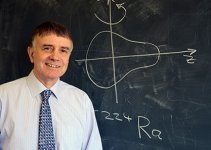
In 2013 the journal Nature published a paper about an experiment, which detected that Ra224 is pear-shaped: “Studies of pear-shaped nuclei using accelerated radioactive beams, Nature, 497, 199–204”. That experiment forced the nuclear theorists to conclude that atomic nuclei have a Z-axis, around which protons and neutrons have different distributions. According to the current Nuclear Physics, the nucleus Rα224 cannot be pear shaped, because from its foundations all the even-even nuclei must have either a spherical shape (when Z = N) or an ellipsoidal shape (when N > Z). But according to the discovery of 2013, while Radium 224 is pear-shaped, Radon 220 does not assume the fixed shape of a pear but rather vibrates about this shape, and such finding is in contradiction with what is expected from the foundations that rule the behavior of the nuclear models. Beyond the discovery to be very important for the understanding on the structure of the nucleus, the nuclear theorists think that such puzzle can be also related to questions regarding the fundamental interactions responsible for the working of the structure of the universe. And Dr. Timothy Chupp, a University of Michigan professor of physics, has explained how the theorists are dealing with the puzzle. He thinks that pear shape is special, suggesting that neutrons and protons inside the nucleus take different positions along an internal axis. In another words, the pear shape of Ra224 implies that atomic nuclei have a special Z-axis, around which protons and neutrons have a preferential distribution, whose existence is impossible, according to current nuclear models.

In the figure ahead, Prof. Peter Butler, one of the physicists who worked in the experiment, is speaking about the Z-axis.​
 

Attachments

  • Fig- 1 A - Copia.jpg
    Fig- 1 A - Copia.jpg
    33.9 KB · Views: 4
2022, The Next Revolution in Physics

I'm putting the finishing touches on my new book THE NEW NUCLEAR PHYSICS. In two weeks I will be submitting the book to publishers, to find one that is interested in publishing it.

On one of the book's introductory opening pages is this humble prophecy, about the fate of theoretical physics:


2022,

The Next Revolution in Physics

The value of the proton radius from the scattering proton-muon
will be announced in the end of 2022,
and it will set off the new revolution in theoretical physics.
In June 16 2021 was announced the status of the Project Muse

Current plan and schedule

- We will start production data in September - December 2021

- Further plan includes 6 months of data taking in 2022 and 3 months in 2023

It's in the page 20 of this link:
indico.jlab.org/event/446/contributions/8650/attachments/7123/9806/Wan_Lin_HUGS_Presentation.pdf


In the page 023.5 of “MUSE: The MUon Scattering Experiment”, by E. Cline1, J. Bernauer1,2, E. J. Downie3 and R. Gilman4, available in
scipost.org/SciPostPhysProc.5.023/pdf​
the prediction of the disclosure of the measured value of the proton radius is presented, as follows:

----------------------------------------------------------
“A test of the full MUSE system in December 2019 led to several planned
upgrades to make the system more robust. Due to the ongoing international
public health crisis and its resulting impact on international travel, we were
only able to partially complete the upgrades during 2020. We plan to
complete the upgrades and start MUSE production data taking in 2021.
With 12 months of data taking and analysis to be performed, we anticipate
publication of first results in 2023/24. MUSE will be the first experiment to
measure elastic muon-proton scattering in an appropriate kinematic region,
with a precision sufficient to address the proton radius puzzle.
The corresponding results for the simultaneously-measured electron
scattering, will put a strong constraint on potential systematic uncertainties,
and may help settle the discrepancies between the Mainz and PRad results.
MUSE will be the only experiment that can directly measure with its own data
the difference between electron and muon extractions of the radius, making
it highly compelling.”
----------------------------------------------------------​


A value measured by Project MUSE,
below 0.80 fm,
will require new foundations for physics,
implying a profound revolution​


But the community of physicists is convinced that the value of the radius of the proton, measured by the proton-muon scattering, will be between 0.875 and 0.83 fm. And that this result will not be the trigger for a new revolution in physics. So where does the author of this book get his certainty that the results of Project MUSE will spark a new revolution in physics?

In the author's article, "Calculation of a proton radius to be measured in the Project MUSE", published by the journal Physics Essays in 2018, calculations are presented that predict that the radius measured by the proton-muon scattering will be between 0.616 fm and 0.722 fm. But it is not these calculations by the author, in the article published in 2018 by Physics Essays, that provide the author with the certainty that the proton radius, measured by the proton-muon scattering, will be below 0.80 fm.

The author's certainty that the radius measured by the proton-muon scattering will be below 0.80 fm comes from two sources:

1- Calculations of the proton radius within the structures of 1H2, 1H3, and 2He3, from the mass defect of these three nuclei, in a procedure that does not exist in current physics, in which the mass defect is a phantasmagoric phenomenon, since in the current physics there is not any physical mechanism from which the mass defect occurs. In current physics, the mass defect is only calculated, by using the Einstein’s equation E= mc², but the physicists do not know from which physical mechanism the mass defect comes from. The author discovered that the mass defect connects the shrinkage of the proton radius (within atomic nuclei) to the mass defect, to the magnetic moment, and to the isotopic mass, and proved it by calculations, exposed in the book Subtle is the Math, published in October 2021.

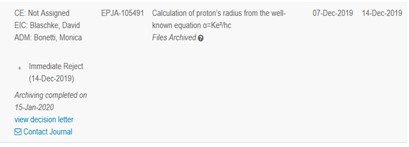
2- Experiment carried out at the Paul Scherrer Institute, published by Nature in 2021, which measured the radius of helium-4, obtaining the value 1,67824 fm. On page 487 of the book Subtle is the Math, a calculation is presented showing that, for helium-4 to have this radius, the radius of the proton within the structure of helium-4 must be equal to 0.69515 fm. This value is close to the radius of the proton within the structures of the nuclei 1H2, 1H3, and 2He3, whose values are respectively 0.6644 fm, 0.7388 fm and 0.64154 fm, calculated on pages 184, 187, and 190 of the book. The article in which these calculations are presented was rejected by the nuclear physics journal European Physical Journal A, on December 14, 2019, as shown on page 177 of the book, showing the dashboard bellow.


When the results of Project MUSE are released, physicists will realize that the foundations of physics will have to change. And they will understand that they will have to take the author's findings seriously, and that they will be useful in deciding which fundamental laws adopted in current theories should be rejected, and which new fundamental laws should be adopted.​
 

Attachments

  • 2022, new physics revolution a.jpg
    2022, new physics revolution a.jpg
    8.5 KB · Views: 7
Last edited by a moderator:
Awfully huge amount of "intuition" being employed here. It's one hallmark of cracked-pottedness. The author "feels" that something is wrong and their nuttiness is right instead. Obviously very convincing!

I remain flabbergasted that all the world's nuclear scientists of the last 100-odd years, with their years of training and experience in top-flight mathematics as well as nuclear physics, have managed for so long over miss these completely obvious flaws in the mathematics. It must surely be a conspiracy!!!
:crazy:


Indeed. As we have all come to know by now... only conspiracy theorists and the self-trained crackpots have the "speshul nollidge" and know the "twoof"
 
There is likely a serious clue to all this in the center-justified text formatting of the op. The “corrected” math is no doubt hidden in this text for the initiated to glean.
 

ISF - Join now!

Every member here is approved by hand. No bots, no spam, just people who care about evidence and honest debate.

Membership is free!

Create your free account

Back
Top Bottom