dogjones
Graduate Poster

- Joined
- Oct 3, 2005
- Messages
- 1,303
retarded chimps that made stone tools
interesting

Ah, but given enough time, retarded chimps could also write Hamlet. Making stone tools is far less arduous.

retarded chimps that made stone tools
interesting
retarded chimps that made stone tools
interesting


The idea that DNA contains information is only an analogy. A useful analogy, to be sure (I use it myself, sometimes), but like all analogies, it does not completely tell the full story.

How does that make DNA special from just about anything else?One could, in principle, extract the DNA from one of your cells, read it into a computer, synthesize a new strand with the same coding, and inject it back into the cell--and in the end, the cell would operate exactly as before.
How does that make DNA special from just about anything else?
You wouldn't normally think of...say... a cleaning sponge as information. One could, in principal, extract the holes in a sponge, read it into a computer, synthesize a new sponge with the same holes, and inject it back into a sponge maker--and in the end, the sponge would operate exactly as before.
And, I just used cleaning sponges as my example, because I happened to be looking at one as I wrote this.

A friend of mine is slowly descending into religiosity. He is a smart chappie but cannot handle the implications of "materialism", "naturalism", etc - namely, that objective moral truths cannot exist within this worldview. Fine, I have a good time debating him philosophically over a few glasses of indifferent Malbec.
Unfortunately though, he is now straying into the realm of attempting to debunk evolution. Not, of course, 'micro' evolution, but 'macro'. His main thing appears to be "evolution cannot explain augmentation of DNA by external information/stimuli alone". I'm not sure even he knows what this means. I guess I would take it to mean that:
1. Evolution successfully describes changes in already existing DNA ("microevolution").
2. But some species have more DNA than others, and possibly this should be the definition of "species".
3. There is no evidence for how this 'creation' of new DNA ("macroevolution") comes about by purely naturalistic processes.
4. Therefore it is reasonable to 'doubt' macroevolution.
Oh yeah, and also the fossil record is incomplete and provides no evidence of said macroevolution.
Um. Help!?
Because if you rearrange the holes in a sponge, you still end up with a sponge. The holes carry information, sure, but it's useless--random and irrelevant.
But if you rearrange the base pairs on a strand of DNA, you get something fundamentally different. DNA that codes for humans or bacteria is made of the same stuff, just in a different order.
You could of course use your sponge to carry information, perhaps by arranging the holes to spell out a poem. But now you have a very different thing--the interesting part (the poem) has nothing to do with it being a sponge. The sponge is just a substrate for the information.
- Dr. Trintignant

(Unless a certain hole structure led to a tangibly more absorbent sponge, thereby causing the manufacturer to investigate, determine this was the case and then make all of their sponges exactly the same...

For human purposes, yes. But, the natural world of physics and such does not make such automatic distinctions.Because if you rearrange the holes in a sponge, you still end up with a sponge. The holes carry information, sure, but it's useless--random and irrelevant.
What if the more efficient hole structure wasn't calculated by humans, but instead by computer, using an evolutionary selection algorithm... Nervermind, the IDers would probably latch on to that one, as well, claiming "the computer program was designed with that specific purpose!"Unless a certain hole structure led to a tangibly more absorbent sponge, thereby causing the manufacturer to investigate, determine this was the case and then make all of their sponges exactly the same... but IDers would probably latch on to this... the manufacturer is GOD!


Well, one (macro) is simply the result of lots of the other (micro), according to theory.I still fail to see why we have to accept both.
Science is not infallible. That much is true.I understand that at times we can prove that a lineage is the way science suggests but at the same time I don't think it is infallible.
Because it's the most informative, useful, and productive theory for explaining what we do find. Individual, specific ideas may be shown to be wrong. But, nothing has contradicted the general theory, yet. (Not even the findings that disproves those more specific ideas.)I've seen what I consider leaps in theories that later turn out to be wrong. So why should be accept any theory about this?
Someone explain this to me because I'm tired of being treated like an idiot for what seems like common sense to me.

I am a person who says I accept microevolution but have doubts about macroevolution. I still fail to see why we have to accept both. I understand that at times we can prove that a lineage is the way science suggests but at the same time I don't think it is infallible.
I've seen what I consider leaps in theories that later turn out to be wrong. So why should be accept any theory about this?
You could say that about anything. In a sense, you'd be right to say it about anything. Why say it about evolution in particular?I've seen what I consider leaps in theories that later turn out to be wrong. So why should be accept any theory about this?

Marduk said:A friend of mine is slowly descending into religiosity. He is a smart chappie but cannot handle the implications of "materialism", "naturalism", etc - namely, that objective moral truths cannot exist within this worldview. Fine, I have a good time debating him philosophically over a few glasses of indifferent Malbec.
Unfortunately though, he is now straying into the realm of attempting to debunk evolution. Not, of course, 'micro' evolution, but 'macro'. His main thing appears to be "evolution cannot explain augmentation of DNA by external information/stimuli alone". I'm not sure even he knows what this means. I guess I would take it to mean that:
1. Evolution successfully describes changes in already existing DNA ("microevolution").
2. But some species have more DNA than others, and possibly this should be the definition of "species".
3. There is no evidence for how this 'creation' of new DNA ("macroevolution") comes about by purely naturalistic processes.
4. Therefore it is reasonable to 'doubt' macroevolution.
Oh yeah, and also the fossil record is incomplete and provides no evidence of said macroevolution.
Um. Help!?
try showing him this and asking him to explain it
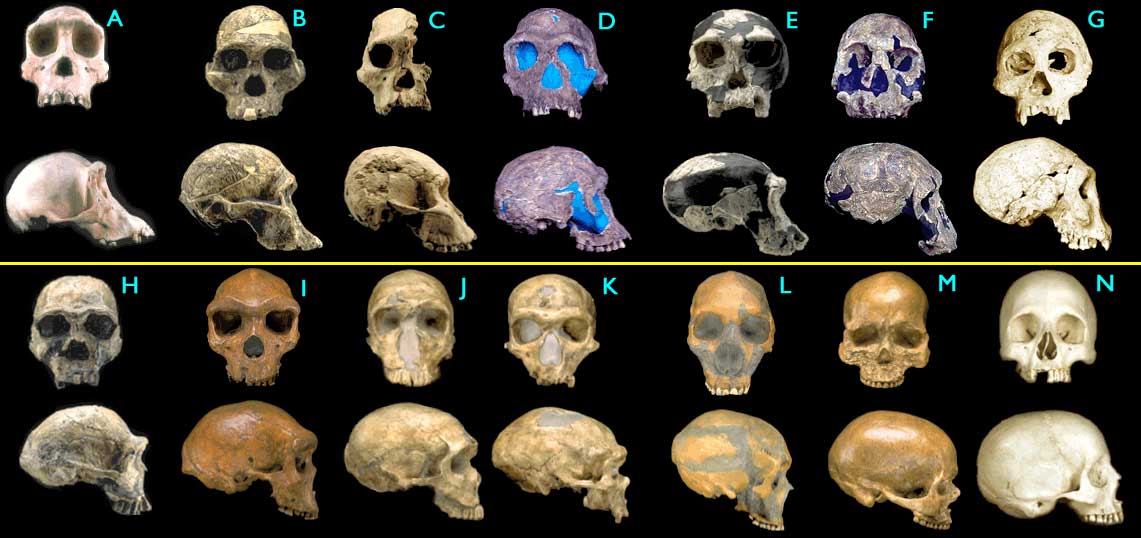
was it Gods practice attempts ?(A) Pan troglodytes, chimpanzee, modern
(B) Australopithecus africanus, STS 5, 2.6 My
(C) Australopithecus africanus, STS 71, 2.5 My
(D) Homo habilis, KNM-ER 1813, 1.9 My
(E) Homo habilis, OH24, 1.8 My
(F) Homo rudolfensis, KNM-ER 1470, 1.8 My
(G) Homo erectus, Dmanisi cranium D2700, 1.75 My
(H) Homo ergaster (early H. erectus), KNM-ER 3733, 1.75 My
(I) Homo heidelbergensis, “Rhodesia man,” 300,000 – 125,000 y
(J) Homo sapiens neanderthalensis, La Ferrassie 1, 70,000 y
(K) Homo sapiens neanderthalensis, La Chappelle-aux-Saints, 60,000 y
(L) Homo sapiens neanderthalensis, Le Moustier, 45,000 y
(M) Homo sapiens sapiens, Cro-Magnon I, 30,000 y
(N) Homo sapiens sapiens, modern
if so how come these werent mentioned in the babble
if hes using the outdated "missing link" belief, then perhaps you should also explain to him what a "transitional fossil" is
http://en.wikipedia.org/wiki/Transitional_fossil
Transitional fossils (popularly termed missing links) are the fossilized remains of intermediary forms of life that illustrate an evolutionary transition. They can be identified by their retention of certain primitive (plesiomorphic) traits in comparison with their more derived relatives, as they are defined in the study of cladistics. Numerous examples exist, including those of primates and early humans.
According to modern evolutionary theory, all populations of organisms are in transition. Therefore, a "transitional form" is a human construct of a selected form that vividly represents a particular evolutionary stage, as recognized in hindsight. Contemporary "transitional" forms may be called "living fossils", but on a cladogram representing the historical divergences of life-forms, a "transitional fossil" will represent an organism near the point where individual lineages (clades) diverge.

